


2026/02/05 - 2026/02/05
41位(同エリア933件中)

旅熊 Kokazさん
- 旅熊 KokazさんTOP
- 旅行記1927冊
- クチコミ854件
- Q&A回答101件
- 1,710,862アクセス
- フォロワー752人
MOMAT コレクション〔国立東京近代美術館 所蔵作品展〕(2025.11.5-2026.2.8)
2025年11月5日-2026年2月8日の所蔵作品展のみどころ
当館コレクション展の特徴をご紹介します。まずはその規模。1952年の開館以来の活動を通じて収集してきたおよそ14,000点の所蔵作品から、会期ごとに約200点を展示する国内最大級のコレクション展です。そして、それぞれ小さなテーマが立てられた全12室のつながりによって、19世紀末から今日に至る日本の近現代美術の流れをたどることができる国内随一の展示です。
今期のみどころ紹介です。長らく国外への貸出が続いていた奈良美智《Harmless Kitty》(1994年)が、約2年ぶりにMOMATコレクションに帰ってきました。4階ハイライト・コーナーでご覧いただけます。3階9室では写真家の細江英公の初期代表作「薔薇刑」を展示します。2024年に逝去された細江の追悼と、被写体となった小説家三島由紀夫の生誕100年記念(2025年)を兼ねての紹介です。
今期も、新収蔵作品が多く展示されています(作品横に貼られた「新収蔵作品」マークが目印です)。長く館を代表してきた顔ぶれにフレッシュな新星と、盛りだくさんのMOMATコレクションをお楽しみください。
https://www.momat.go.jp/exhibitions/r7-2
- 旅行の満足度
- 5.0
-

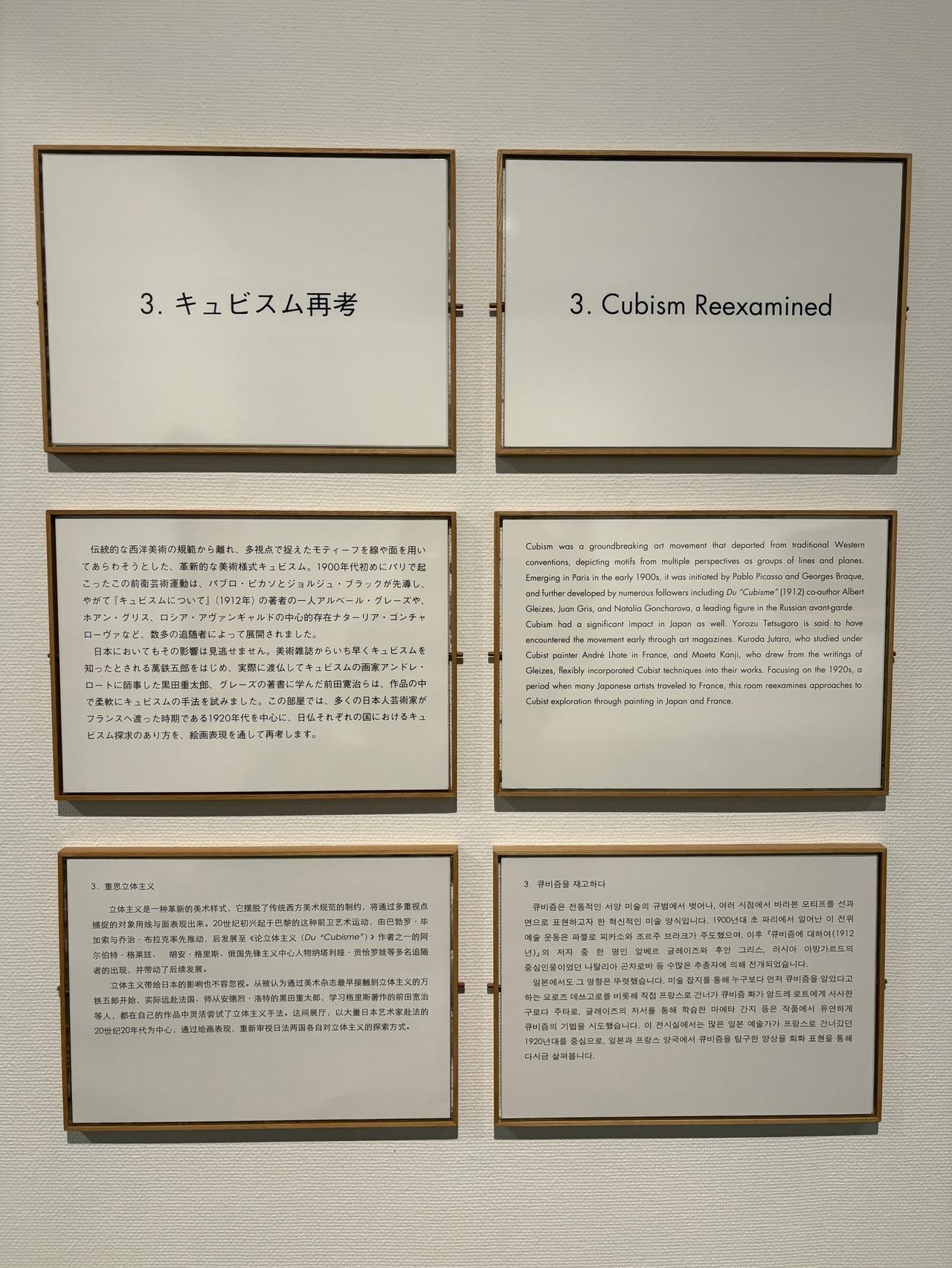
3. キュビスム再考
伝統的な西洋美術の規範から離れ、多視点で捉えたモティーフを線や面を用いてあらわそうとした、革新的な美術様式キュビスム。1900年代初めにパリで起こったこの前衛芸術運動は、パブロ・ビカンとジョルジュ・ブラックが先導し、やがて「キュビスムについて」(1912年)の著者の一人アルベール・グレーズや、ホアン・グリス、ロシア・アヴァンギャルドの中心的存在ナターリア・ゴンチャローヴァなど、数多の追随者によって展開されました。
日本においてもその影響は見逃せません。美術雑誌からいち早くキュビスムを知ったとされる萬鉄五郎をはじめ、実際に渡仏してキュビスムの画家アンドレ・ロートに事した黒田重太郎、グレーズの著書に学んだ前田寛治らは、作品の中で柔軟にキュビスムの手法を試みました。この部屋では、多くの日本人芸術家がフランスへ渡った時期である1920年代を中心に、日仏それぞれの国におけるキュビスム探求のあり方を、絵画表現を通して再考します。
3. Cubism Reexamined
Cubism was a groundbreaking art movement that departed from traditional Western conventions, depicting motifs from multiple perspectives as groups of lines and planes. Emerging in Paris in the early 1900s, it was initiated by Pablo Picasso and Georges Braque and further developed by numerous followers including Du "Cubisme" (1912) co-author Albert Gleizes, Juan Gris, and Natalia Goncharova, a leading figure in the Russian avant-garde.
Cubism had a significant impact in Japan as well. Yorozu Tetsugoro is said to have encountered the movement early through art magazines. Kuroda Jutaro, who studied under Cubist painter André Lhote in France, and Maeta Kanji, who drew from the writings of Gleizes, flexibly incorporated Cubist techniques into their works. Focusing on the 1920s, a period when many Japanese artists traveled to France, this room reexamines approaches to Cubist exploration through painting in Japan and France. -
盛田良子コレクション
Morita Yoshiko Collection
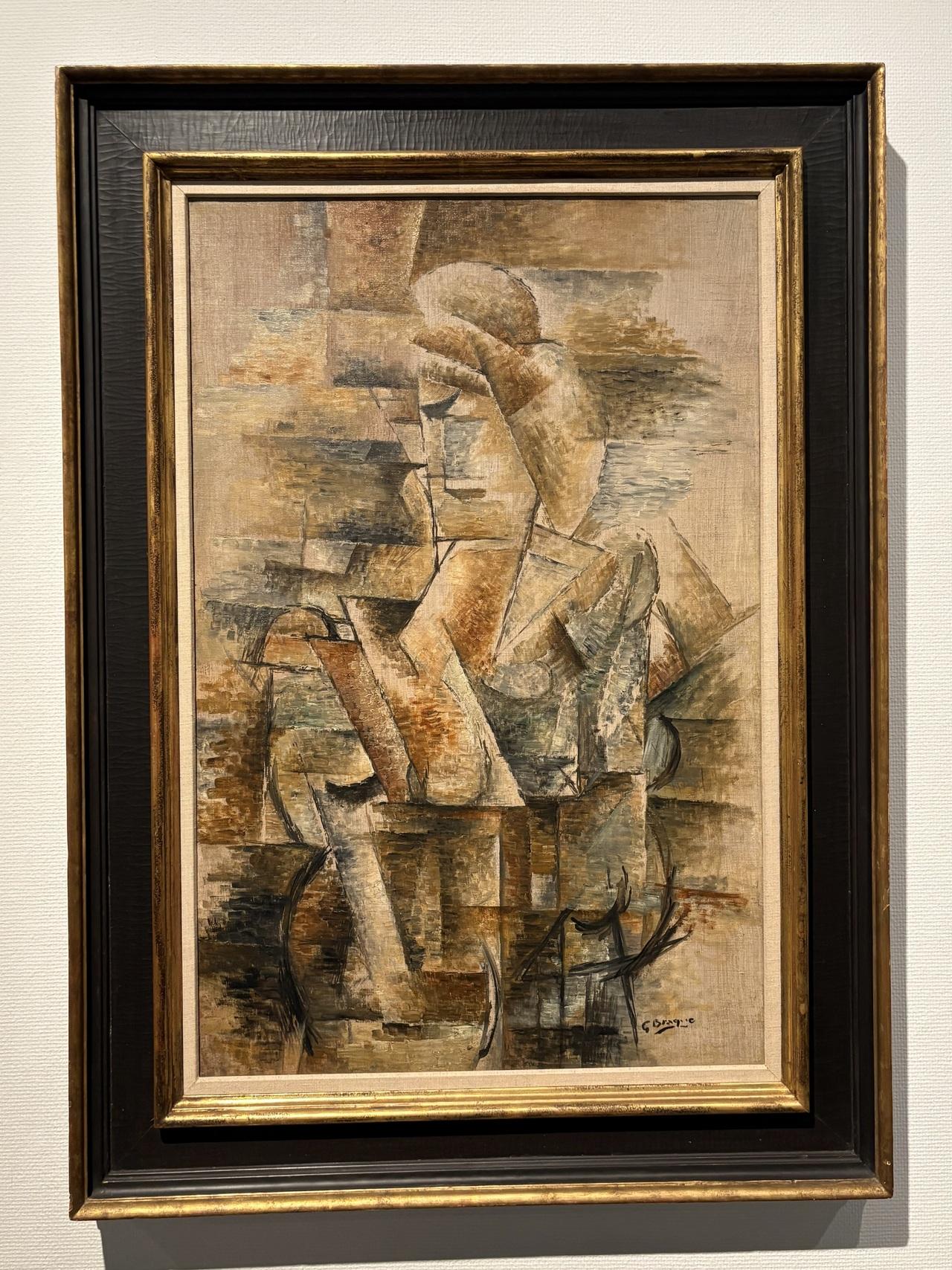
ジョルジュ・ブラック
Georges Braque
1882-1963
女のトルソ
Female Torso
1910-1911 明治43-44年
油彩・キャンバス oil on canvas
購入
Purchased
ブラックはピカソとともに、20世紀でもっとも重要な美術動向の一つ、「キュビスム」を創始しました。キュビスムは、二次元の絵画平面上に三次元の奥行きを表すヨーロッパ絵画の遠近法や明暗表現を、根本から問い直しました。この作品は、ブラックのキュビスム期の作品の中でももっとも充実したものの一つです。いくつもの開かれた面に分解された女性の上半身は、さまざまな角度から見た像をつなぎ合わせたように絶えず揺らいで見えます。
Along with Picasso, Braque originated Cubism, one of the most important trends in 20th century art. Cubism fundamentally reexamined the use of perspective and shading in European painting as ways of expressing three-dimensional depth in the two-dimensional plane of the painting. This work is one of the most substantial from Braque's Cubist period. The torso of the woman, divided up into several open surfaces, appears to be endlessly fluctuating as if images from a variety of angles have been pieced together. -
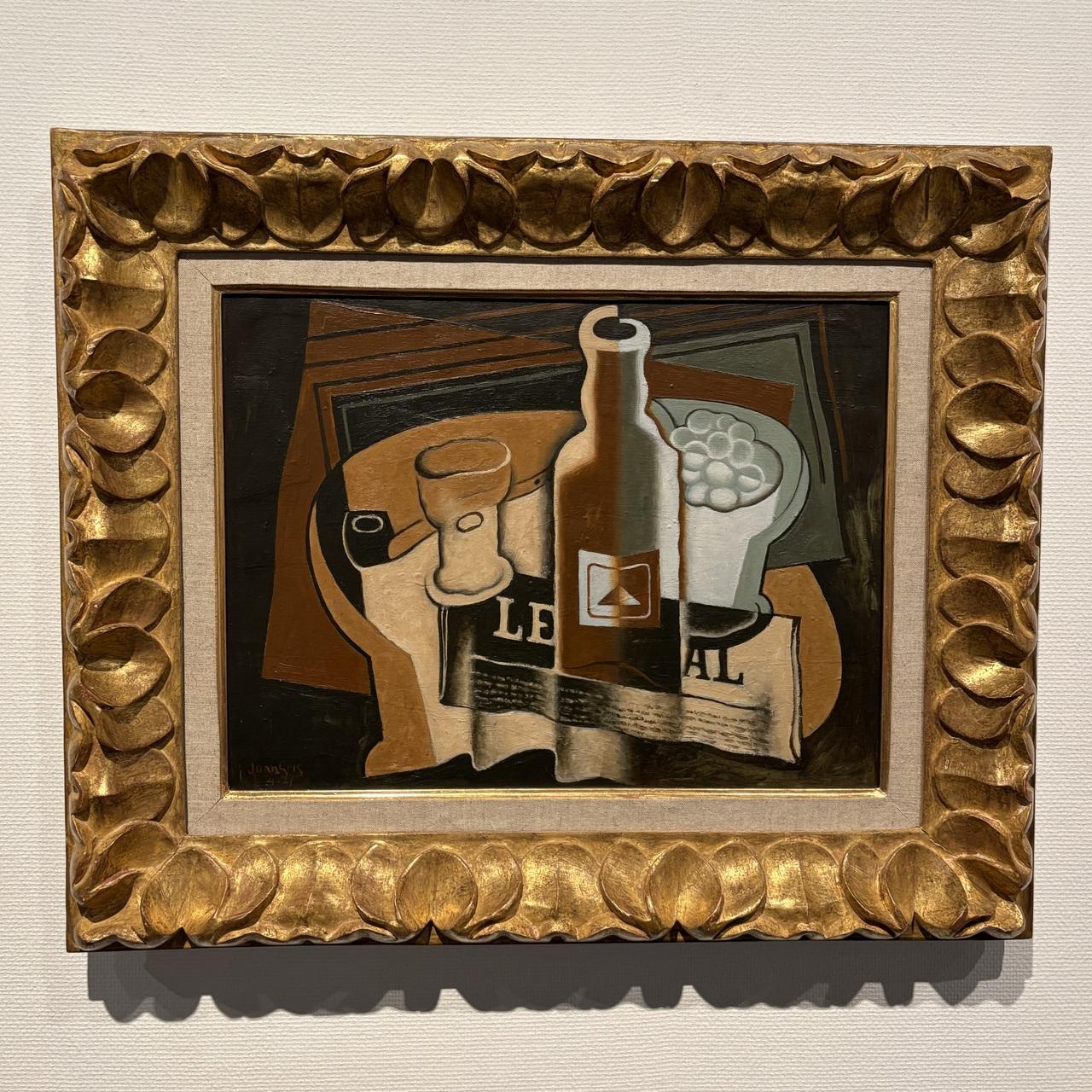
ホアン・グリス
Juan Gris
1887-1927
円卓
The Gueridon
1921
大正10年
油彩・キャンバス
oil on canvas
購入
Purchased -
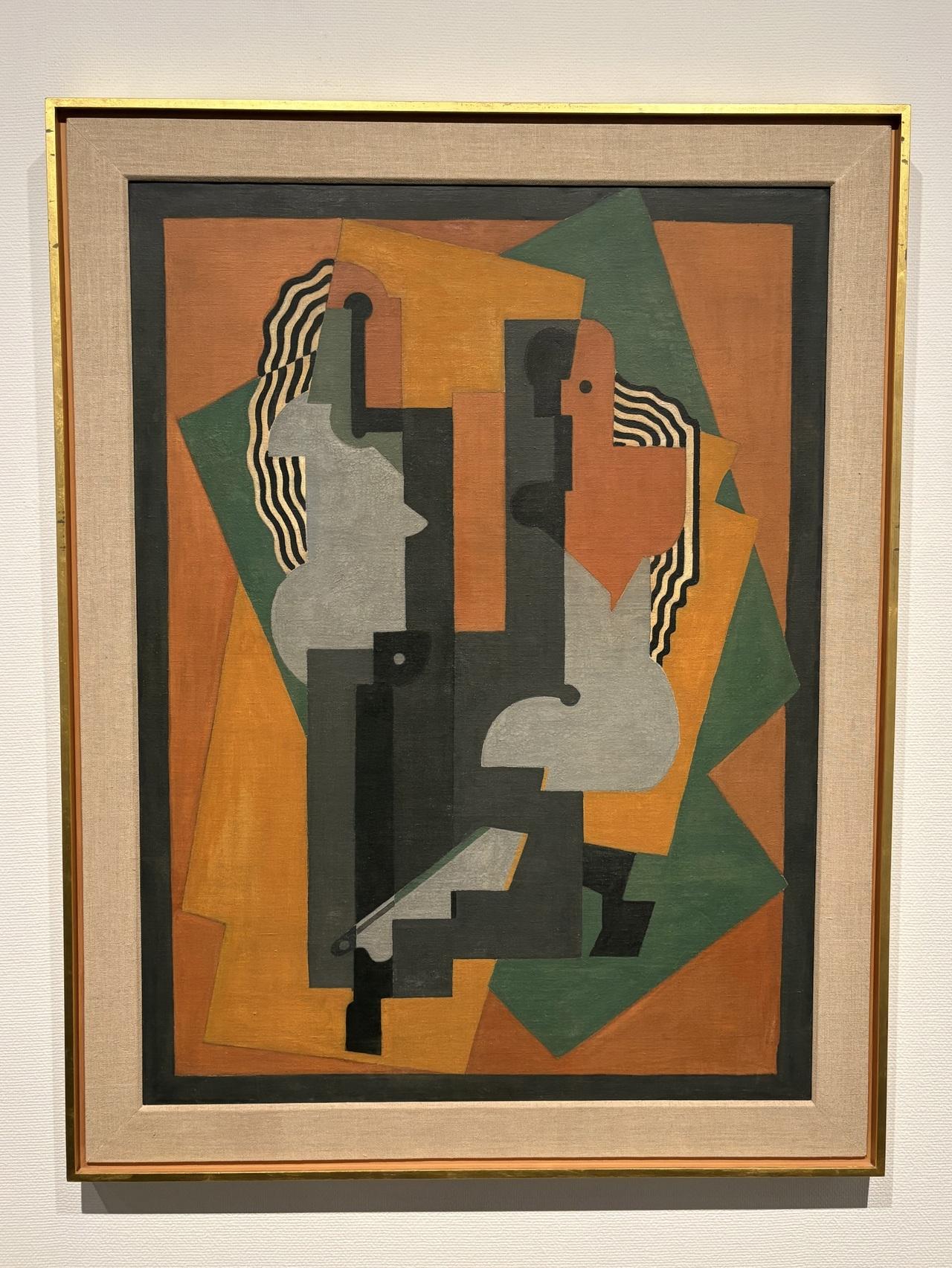
アルベール・グレーズ
Albert Gleizes
1881-1953
二人の裸婦の構成
Composition with Two Female Nudes
1921 大正10年
油彩・キャンバス oil on canvas
購入
Purchased -
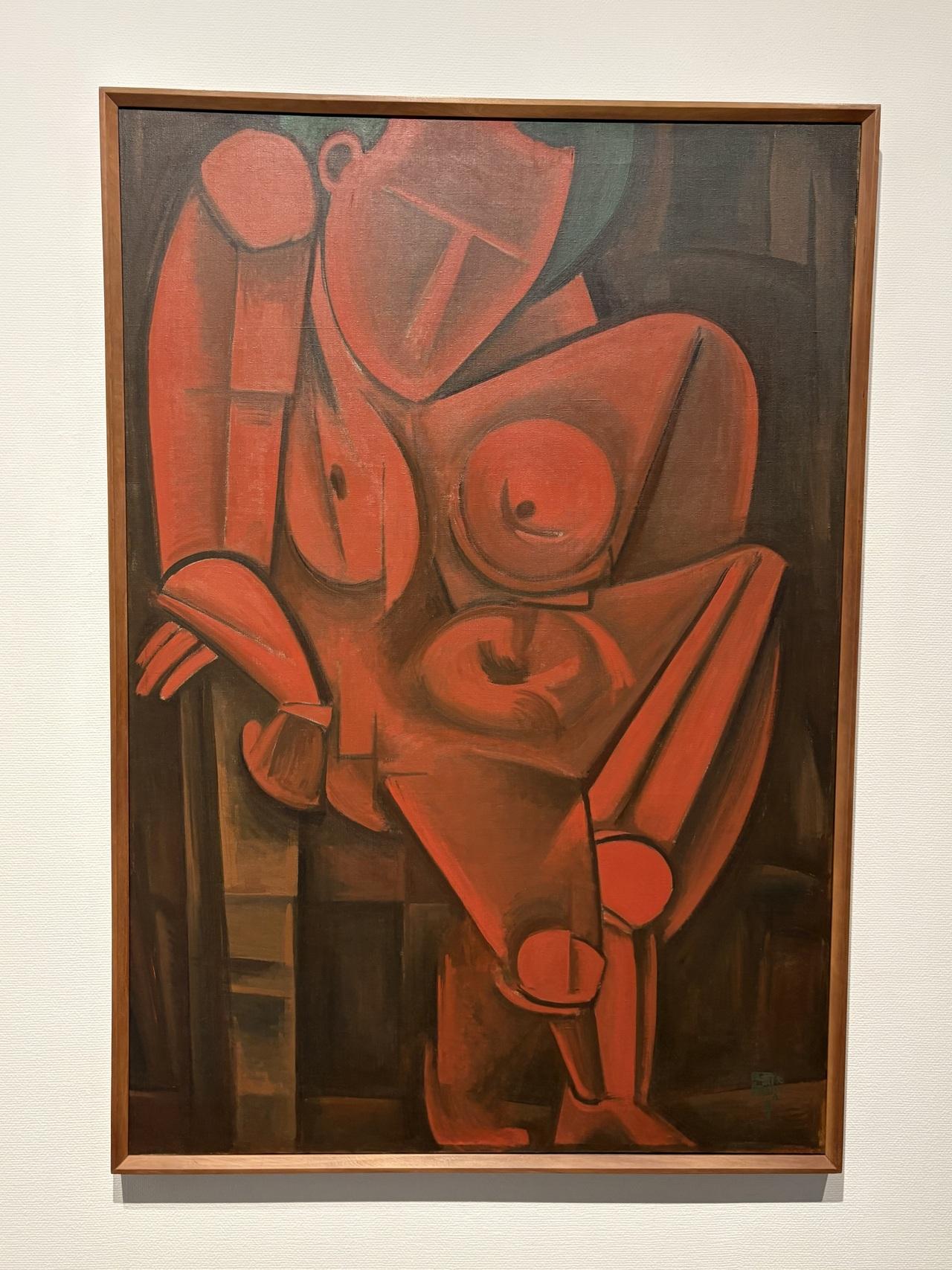
萬鉄五郎
YOROZU, Tetsugoro
1885-1927
もたれて立つ人
Leaning Woman
1917
大正6年
油彩・キャンバス oil on canvas
八木正治氏寄贈
Gif of Yagi Mascharu
直線と円でできたロボットのような人体(ちなみに女性)です。パブロ・ピカソとジョルジュ・ブラックが創始した「キュビスム」と呼ばれる動向の影響を日本でいち早く示した、記念すべき作例とされます。
では、どうやってこんなに人間離れした身体ができたのでしょう。女性のおへそを見て下さい。画面のちょうど中心にあるのがわかります。この一点を動かさず、あとは絵画の四角い枠で上下左右から身体をぎゅっと押しつぶします。すると、がくんと垂れた大きな頭、蛇腹状に折れて重なった肩や腰、脚のかたちができるというわけです。
ちなみにこの人物、一体何に「もたれて」立っているのでしょう。答えは・・・・・四角い画面の左側の枠なのです。
This human form (which happens to be female) has the appearance of a robot composed of straight lines and circles. The work is a noteworthy example of one of the first Japanese paintings to display the influence of the "Cubist" movement, originated by Pablo Picasso and Georges Braque.
How was this superhuman body created? Look at the woman's navel. You will notice that it is in the exact center of the picture. Without altering this point, Yorozu scrunched the woman's body into the square picture frame from all sides. This led to the large, sharply drooping head, pleated shoulders and back, and the shape of the legs.
And what exactly is the figure "leaning" against? Answer: The left side of the square picture frame. -
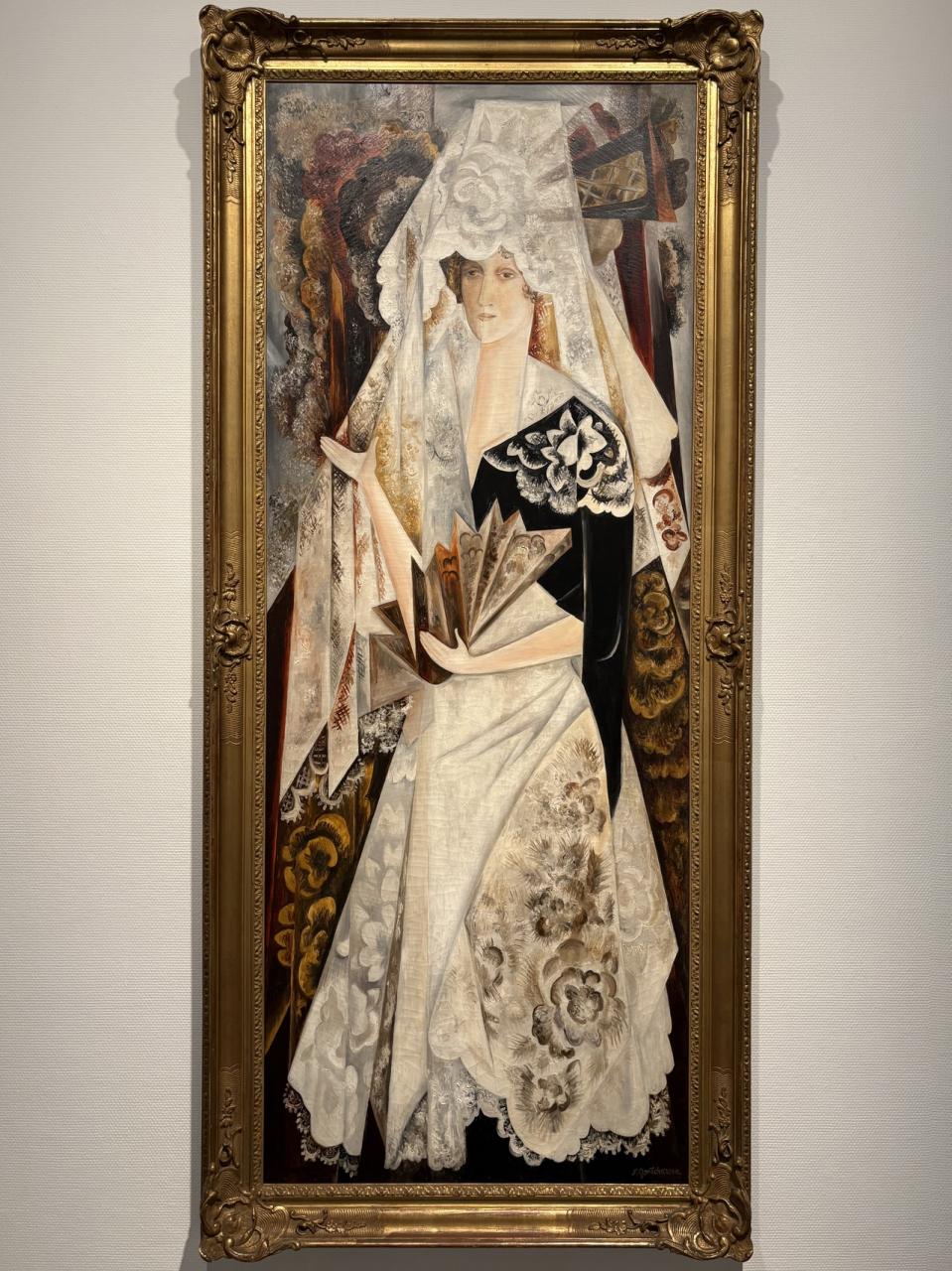
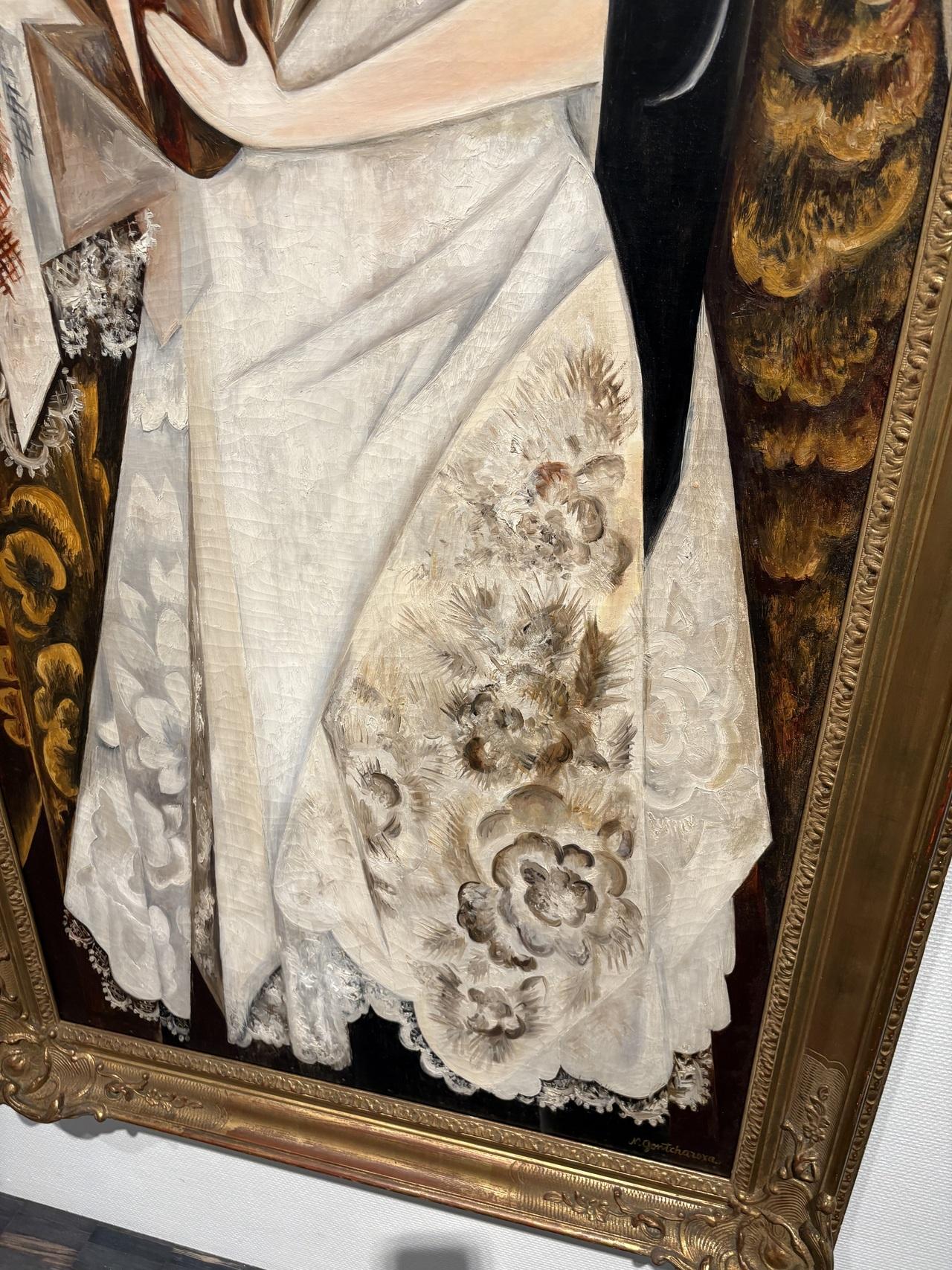
ナターリア・ゴンチャローヴァ
Natalia Gontcharova
1881-1962
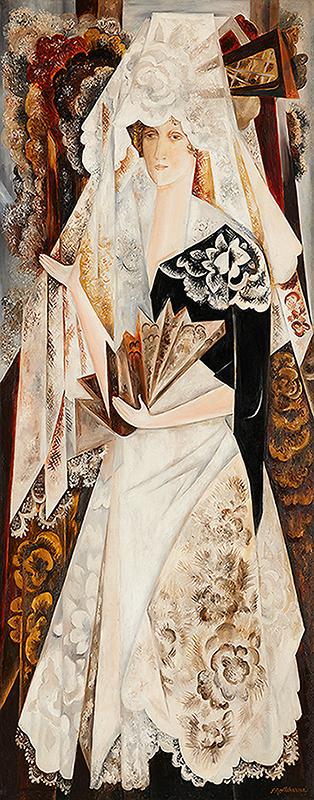
スペイン女
Spanish Woman
c.1916-20 大正5-9年頃
油彩・キャンバス oil on canvas
購入
Purchased
ロシア出身のアーティスト、ゴンチャローヴァは、セルゲイ・ディアギレフの「バレエ・リュス」のための舞台美術を手がけたことでも知られます。ロシアで活動した初期には「光線主義(レイヨニスム)」、「立体未来主義(クボ・フトゥリズム)」と呼ばれる前衛運動に関わります。1919(大正8)年に拠点をパリに移し、38年にフランスに帰化、62年にパリで亡くなりました。
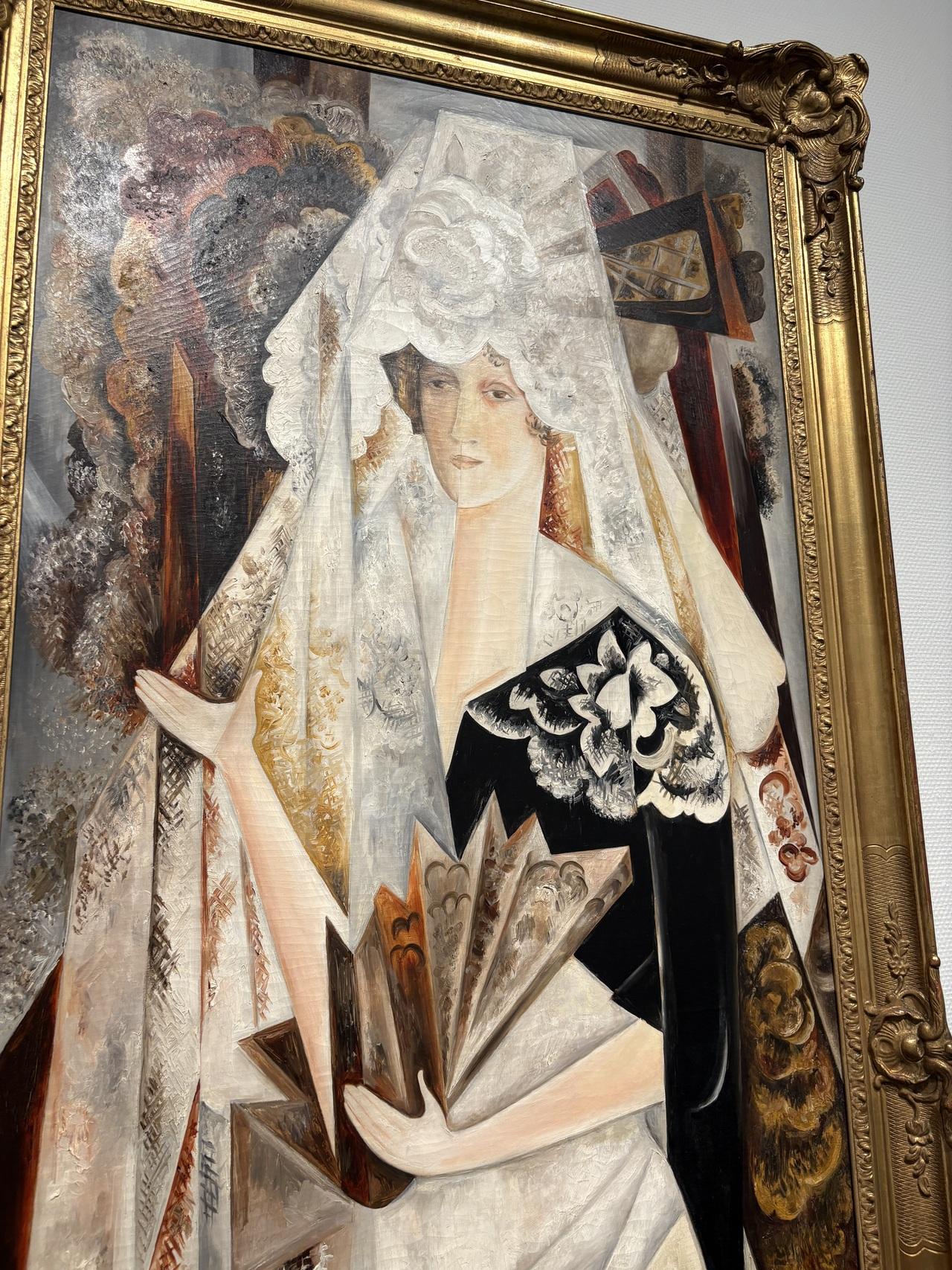
1916年、ゴンチャローヴァはディアギレフらとスペインを訪れます。ディアギレフはスペインをテーマにした舞台を計画し、その衣装などをゴンチャローヴァが担当します。結局、舞台は実現しませんでしたが、この経験から本作が生まれました。女性の身体は縦に引き伸ばされてモニュメンタルな雰囲気をたたえ、また幾何学的で平面的な処理をほどこされた白いレースのスカーフ(マンティラ)や手にした扇の表現には、キュビスムからの影響がうかがえます。
The Russian-born artist Natalia Gotcharova is known for the stage sets she made for Sergei Diaghilev's Ballets Russes. While still in Russia, she also spearheaded avant-garde movements like Rayonism and Cubo-Futurism. In 1919, Gotcharova moved to Paris, became a French citizen in 1938, and died in Paris in 1962.
In 1916, Gotcharova traveled with Diaghilev and his company to Spain. Diaghilev had planned several ballets based on a Spanish theme and Gontcharova was in charge of the costumes and sets. The production was ultimately never realized, but the experience did inspire Gotcharova to make this painting. In addition to the monumental atmosphere, in which the woman's body is vertically elongated, the expression of her white, lace head-scarf (mantilla), with its flat and geometrical aspect, and the fan in her hand suggest the influence of Cubism. -
-
-
-
黒田重太郎
KURODA, Jutaro
1887-1970
港の女
Women of the Harbour
1922 大正11年
油彩・キャンバス oil on canvas
作者寄贈
Gift of the artist
まず画面の縦と横をそれぞれ二等分してみましょう。そうすると、ちょうど左上の長方形が、港を望む窓となるよう舞台設定が決められていることがわかります。次に、等分してできたそれぞれの長方形に、対角線を引いてみます。すると、ちょうどその対角線に沿うように、人物たちの腕などの角度が決められていることがわかるでしょう。このように、この作品は周到に構図が計算されています。パリでアンドレ・ロートに学んだ黒田は、ロートの「幾何学は最上の語学であり、精神に依って生かされた物質の徹底的な表現である」という教えを日本に紹介しました。
First, mentally divide the picture in half vertically and horizontally. This reveals a setting arranged so the rectangle occupying the top left quadrant is a window overlooking the harbor. Next, draw imagined diagonal lines through each rectangle formed by the division of the painting into quadrants. You will find that the angles of people's arms are aligned along these diagonals. It is evident that this composition was carefully calculated. Kuroda, who studied with André Lhote in Paris, introduced Japan to Lhote's teaching that "Geometry is the highest form of language, and the ultimate expression of matter brought to life by the spirit." -
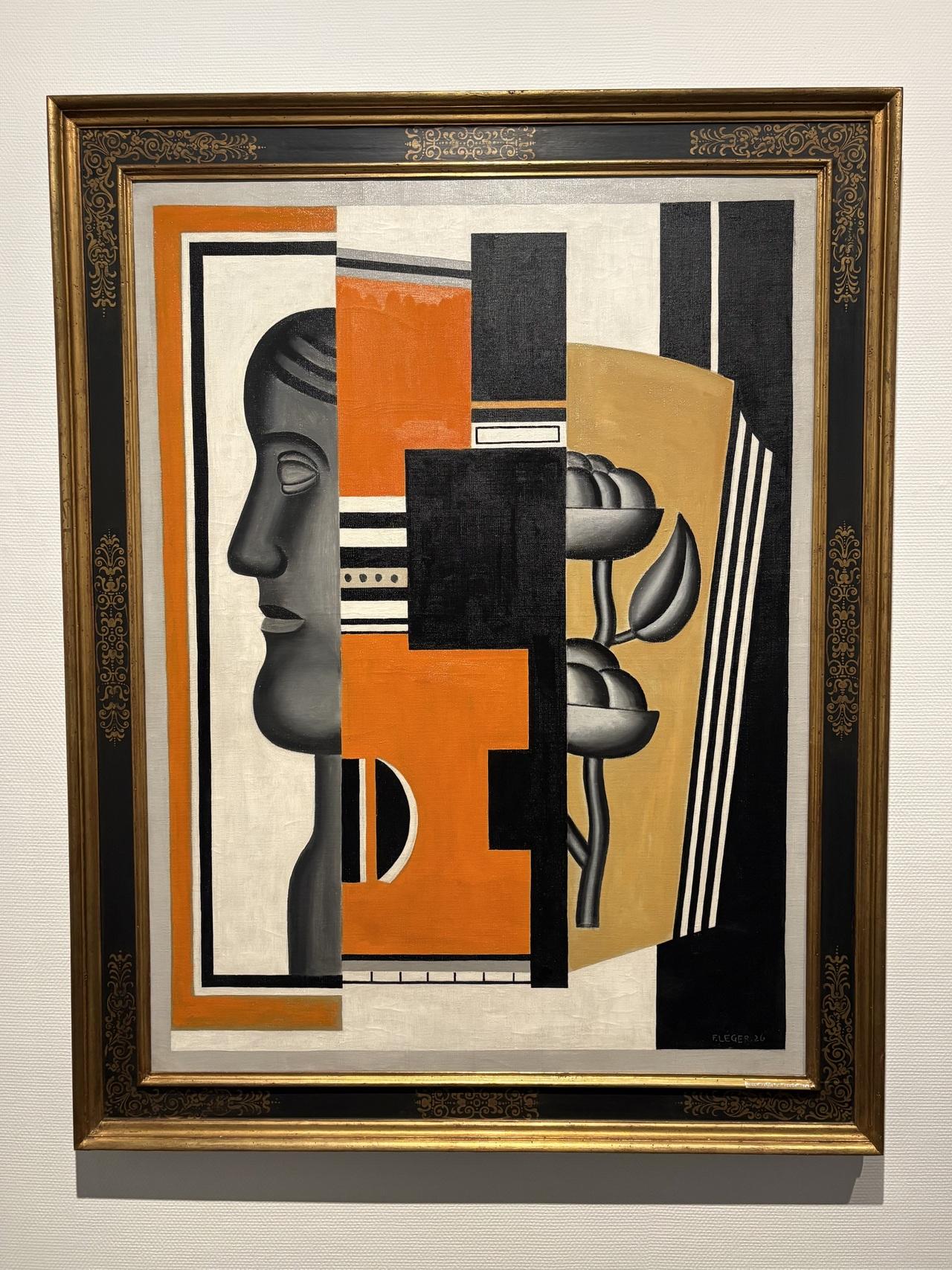
フェルナン・レジェ
Fernand Léger
1881-1955
女と花
Woman and Flower
1926 大正15年
油彩・キャンバス oil on canvas
購入
Purchased
20世紀初頭、日常生活の中に姿を現し始めたさまざまな機械のかたちや質感に、レジェは新たな時代の美を見出しました。
この画面では、女性や花はまるで工業製品のようにピカピカで、中央の機械の部品のような形と混じり合っています。しかも明るい色彩と、「チューブ」と呼ばれるレジェ特有のふくらみを持つかたちの表現とが、生物・無生物の別なく、すべてにちょっとふてぶてしいような生命感を与えています。
ピカソ、ブラックと共に「キュビスム」の画家として知られるレジェですが、機械と人間や自然とが共存する明るい世界の捉え方は、レジェ特有のものです。
At the outset of the 20th century, Léger developed beautiful art for the new era based on the shapes and textures of various machines that were starting to become part of everyday life.
The woman and flower, with the shiny quality of an industrial product, are combined with mechanical parts in the center of this picture. Moreover, the bright colors and unique swollen shapes commonly referred to as "tubes," are imbued with a slightly brazen sense of vitality, regardless of whether they are animate or inanimate objects.
Known along with Picasso and Braque as a Cubist painter, Léger's view of a bright world in which machines, people, and nature exist side-by-side was uniquely his own. -
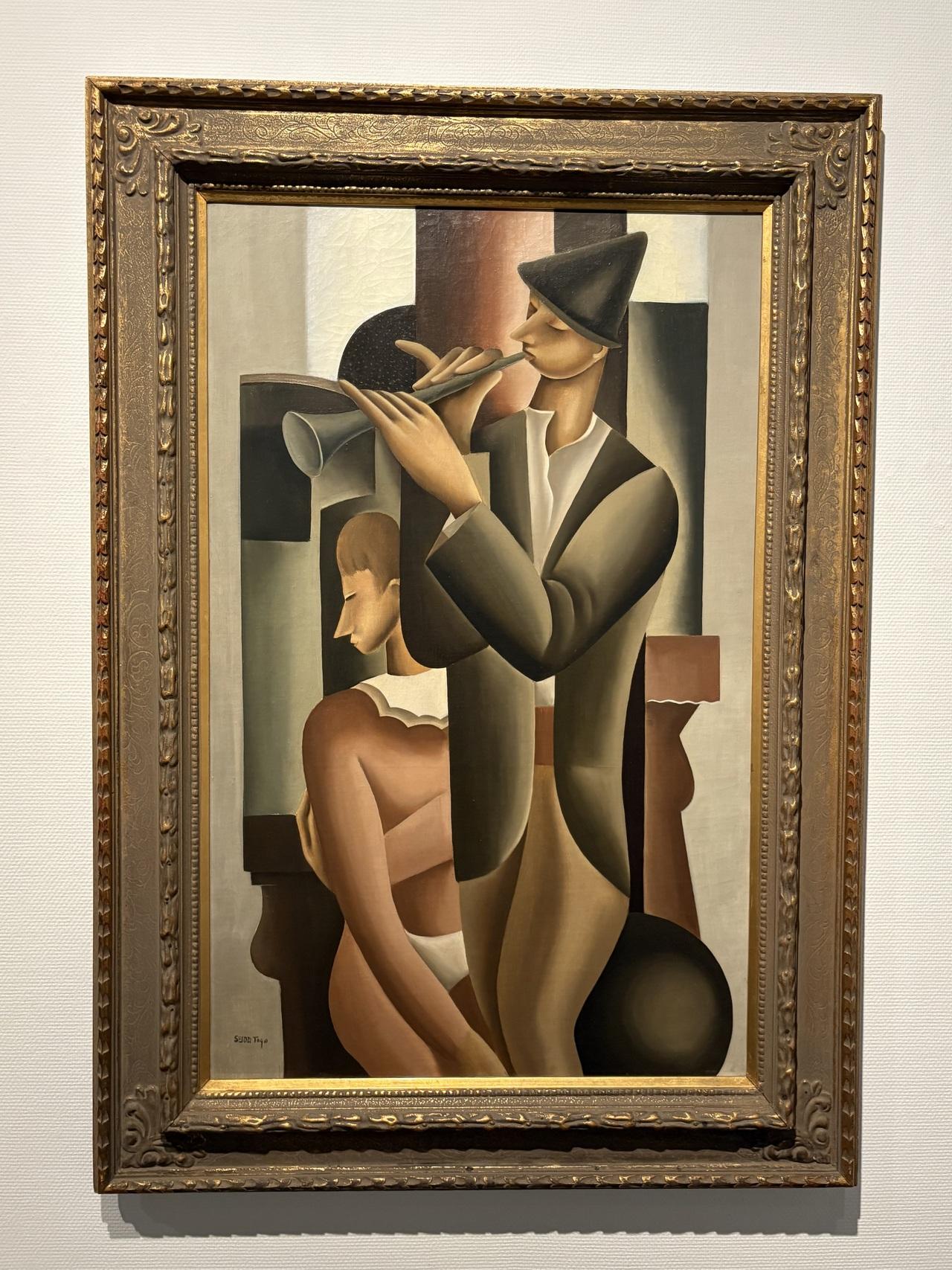
東郷青児
TOGO, Seiji
1897-1978
サルタンバンク
Street Performers
1926大正15年
油彩・キャンバス oil on canvas
購入
Purchased
東郷青児は、1914年頃にドイツ留学から帰国した作曲家の山田耕筰と出会い、最新の前衛的な美術思潮に触れます。1921年には自らも渡仏。本作は、画家自身が「この絵はピカンに引かれ、ピカソから逃れようと、日夜苦しんでいた頃の絵である」と述べているように、ピカンの影響をとどめつつ、自らの表現を模索していた滞欧期の作品です。サルタンバンクとは大道芸人、旅芸人のことで、三角帽子をかぶって笛を吹く楽士などの人体は、変形され単純化されています。しかし、落ち着いた色調、滑らかな輪郭、丸味を帯びた形態、静謐な画面など、後年の優美で掃情的な東郷の美人画に通じる要素も見て取れます。
Around 1914, Togo Seiji met the composer Yamada Kosaku, who had returned from studying in Germany, and was exposed to the latest developments in avant-garde art. In 1921, Togo himself went to France. This is a work from his time in Europe, when he was seeking his own expression while retaining the influence of Picasso, and in the artist's own words, "The painting was made at a time when I was drawn to Picasso and struggled day and night to escape from him." The Japanese title is Saltimbanques, which refers to itinerant street performers. The human figures, including a musician wearing a triangular hat and playing a flute, are deformed and simplified. However, the subdued tones, smooth contours, rounded forms, and serene composition also show elements of Togo's later, more graceful and lyrical paintings of beautiful women. -
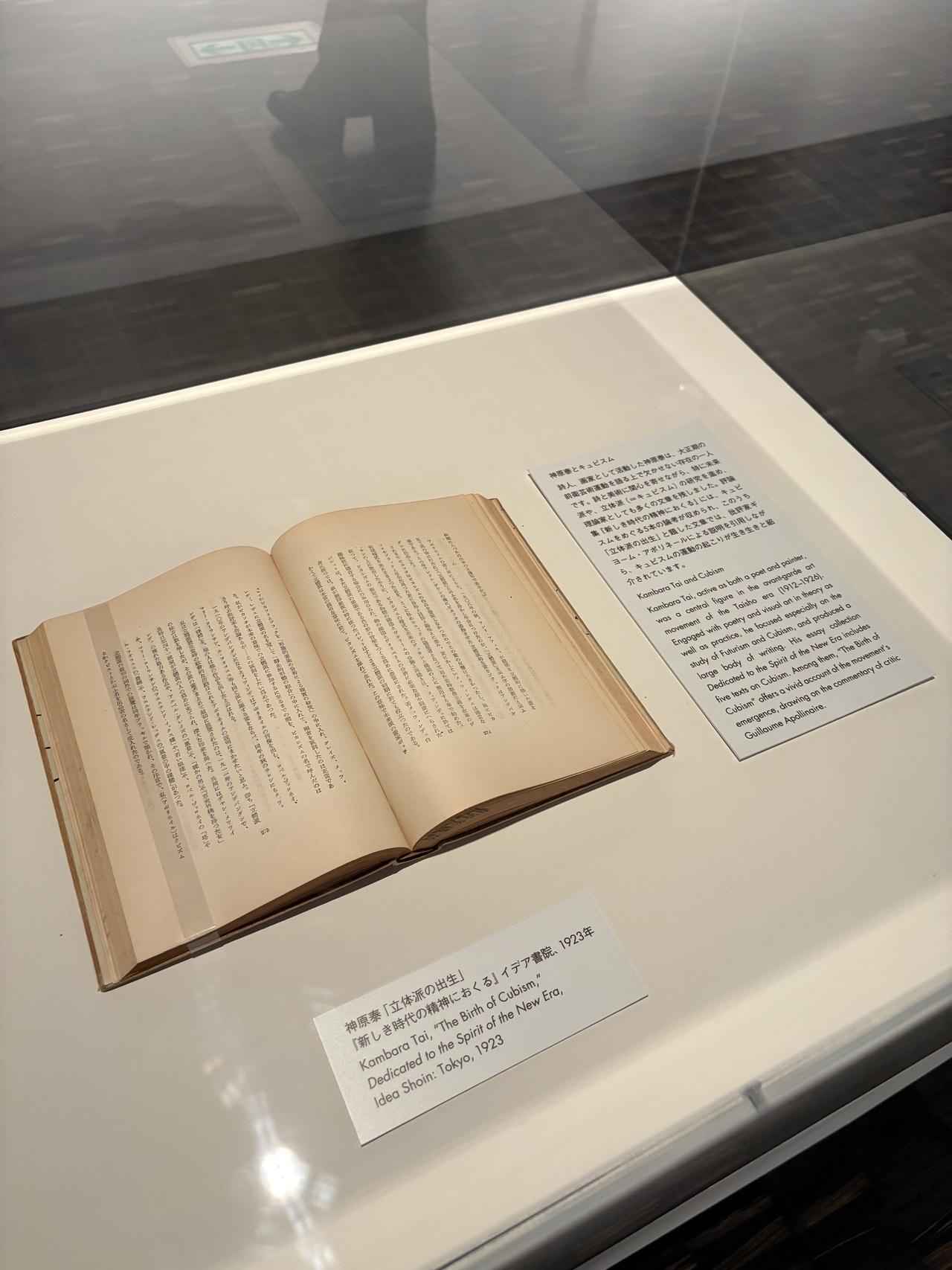
神原泰「立体派の出生」
「新しき時代の精神におくる」イデア書院、1923年
Kambara Tai, "The Birth of Cubism"
Dedicated to the Spirit of the New Era,Idea Shoin: Tokyo, 1923 -
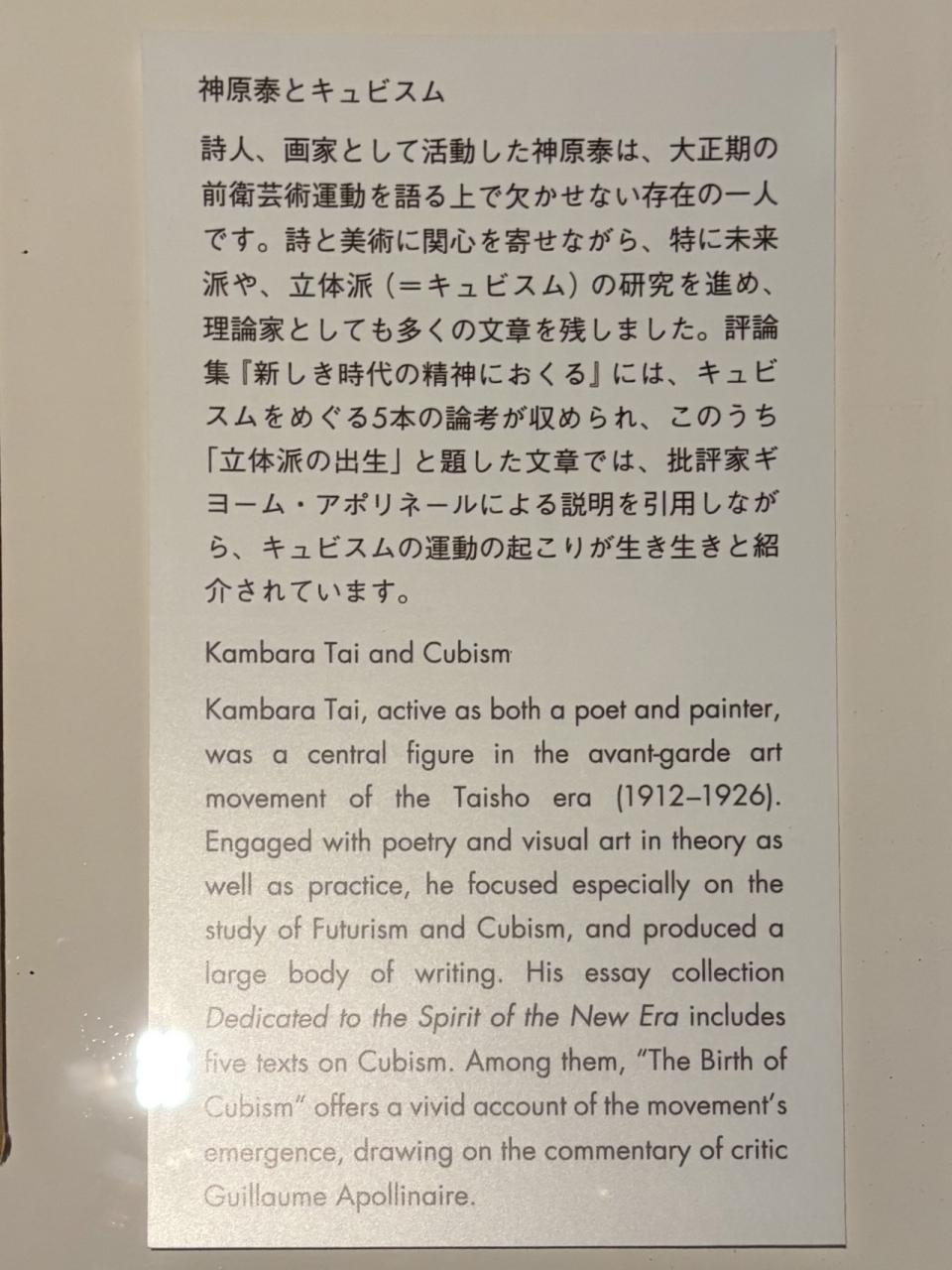
神原泰とキュビスム
詩人、画家として活動した神原泰は、大正期の前衛芸術運動を語る上でかせない存在の一人です。詩と美術に関心を寄せながら、特に未来派や、立体派(=キュビスム)の研究を進め、理論家としても多くの文章を残しました。評論集「新しき時代の精神におくる」には、キュビスムをめぐる5本の論考が収められ、このうち「立体派の出生」と題した文章では、批評家ギヨーム・アポリネールによる説明を引用しながら、キュビスムの運動の起こりが生き生きと紹介されています。
Kambara Tai and Cubism
Kambara Tai, active as both a poet and painter, was a central figure in the avant-garde art movement of the Taisho era (1912-1926). Engaged with poetry and visual art in theory as well as practice, he focused especially on the study of Futurism and Cubism, and produced a large body of writing. His essay collection Dedicated to the Spirit of the New Era includes five texts on Cubism. Among them, "The Birth of Cubism" offers a vivid account of the movement's emergence, drawing on the commentary of critic Guillaume Apollinaire. -
(続く・・・)

この旅行記のタグ


利用規約に違反している投稿は、報告する事ができます。
-
前の旅行記

"MOMAT〔国立東京近代美術館〕コレクション展 ~2026.2.8" その2.新か、旧か? "和田三造《南...
2026/02/05~
神田・神保町
-
次の旅行記

"MOMAT〔国立東京近代美術館〕コレクション展 ~2026.2.8" その4.『濹東綺譚』。"木村荘八 、...
2026/02/05~
神田・神保町
-

"MOMAT〔国立東京近代美術館〕コレクション展 ~2026.2.8" その1.ハイライト。"奈良美智《Ha...
2026/02/05~
神田・神保町
-

"MOMAT〔国立東京近代美術館〕コレクション展 ~2026.2.8" その2.新か、旧か? "和田三造《南...
2026/02/05~
神田・神保町
-

"MOMAT〔国立東京近代美術館〕コレクション展~2026.2.8" その3.キュビスム再考 "ナターリア・...
2026/02/05~
神田・神保町
-

"MOMAT〔国立東京近代美術館〕コレクション展 ~2026.2.8" その4.『濹東綺譚』。"木村荘八 、...
2026/02/05~
神田・神保町
-

"MOMAT コレクション展 ~2026.2.8" その5.1930年代の絵画:現実の彼方へ、幻影の手前で。...
2026/02/05~
神田・神保町
-

MOMAT〔国立東京近代美術館〕コレクション展 ~2026.2.8: その6.戦時の女性たち。"『主婦之友』...
2026/02/05~
神田・神保町
-

MOMAT〔国立東京近代美術館〕コレクション展 ~2026.2.8: その7.アクション前夜。"朝倉摂 《黒...
2026/02/05~
神田・神保町
-

MOMAT コレクション展 ~2026.2.8:8.「・・・アクション!」&「・・・カット!」。"ルーチョ・...
2026/02/05~
神田・神保町
-

MOMAT〔国立東京近代美術館〕コレクション展 ~2026.2.8:その9."細江英公「薔薇刑」"
2026/02/05~
神田・神保町
-

MOMAT ~2026.2.8:その10.1950~60年代:有機的な彫刻/川端龍子と青龍社。"ジェルメーヌ...
2026/02/05~
神田・神保町
-

MOMAT〔国立東京近代美術館〕コレクション展 ~2026.2.8:その11.記憶と想起。"河原温《1966...
2026/02/05~
神田・神保町
-

MOMAT コレクション展 ~2026.2.8:12.入れ替わる世界、ひらかれる感覚。"冨井大裕《board...
2026/02/05~
神田・神保町
-

国立東京近代美術館 "コレクションによる小企画 没後30年 榎倉康二(~2026.2.8)"《 干渉(STO...
2026/02/05~
神田・神保町
旅行記グループをもっと見る
コメントを投稿する前に
十分に確認の上、ご投稿ください。 コメントの内容は攻撃的ではなく、相手の気持ちに寄り添ったものになっていますか?
サイト共通ガイドライン(利用上のお願い)報道機関・マスメディアの方へ 画像提供などに関するお問い合わせは、専用のお問い合わせフォームからお願いいたします。






フォートラベル公式LINE@

おすすめの旅行記や旬な旅行情報、お得なキャンペーン情報をお届けします!
QRコードが読み取れない場合はID「@4travel」で検索してください。
\その他の公式SNSはこちら/




旅行記グループ MOMAT コレクション〔国立東京近代美術館 所蔵作品展〕(2025.11.5-2026.2.8)
0
15