


2026/05/04 - 2026/05/09
116位(同エリア935件中)

旅熊 Kokazさん
- 旅熊 KokazさんTOP
- 旅行記1932冊
- クチコミ857件
- Q&A回答101件
- 1,713,994アクセス
- フォロワー755人
MOMAT コレクション展 ~2026.5.10
④能楽と歌舞伎
日付はダミーで、5月9日(土)訪問
『MOMATコレクションにようこそ!
当館コレクション展の特徴をご紹介します。まずはその規模。1952年の開館以来の活動を通じて収集してきたおよそ14,000点の所蔵作品から、会期ごとに約200点を展示する国内最大級のコレクション展です。そして、それぞれ小さなテーマが立てられた全12室のつながりによって、19世紀末から今日に至る日本の近現代美術の流れをたどることができる国内随一の展示です。
今期の見所紹介です。4階2室は、当館と金沢の国立工芸館とのコラボレーション企画。鈴木長吉《十二の鷹》(重要文化財)や、新収蔵の金森宗七《花鳥文様象耳付大花瓶》など名品が目白押しです。
また毎年恒例の「美術館の春まつり」にちなみ、川合玉堂《行く春》、跡見玉枝《桜花図巻》など人気作品を惜しげもなくお見せします(3月3日―4月12日)。「春まつり」後(4月14日―5月10日)も豪華です。1階で開催の「下村観山展」(3月17日から)にちなみ、横山大観、菱田春草など観山をとりまく芸術家による素晴らしい作品群を集めました。
今期も盛りだくさんのMOMATコレクション、どうぞお楽しみください。』とのこと・・・
https://www.momat.go.jp/exhibitions/r7-3
- 旅行の満足度
- 5.0
-

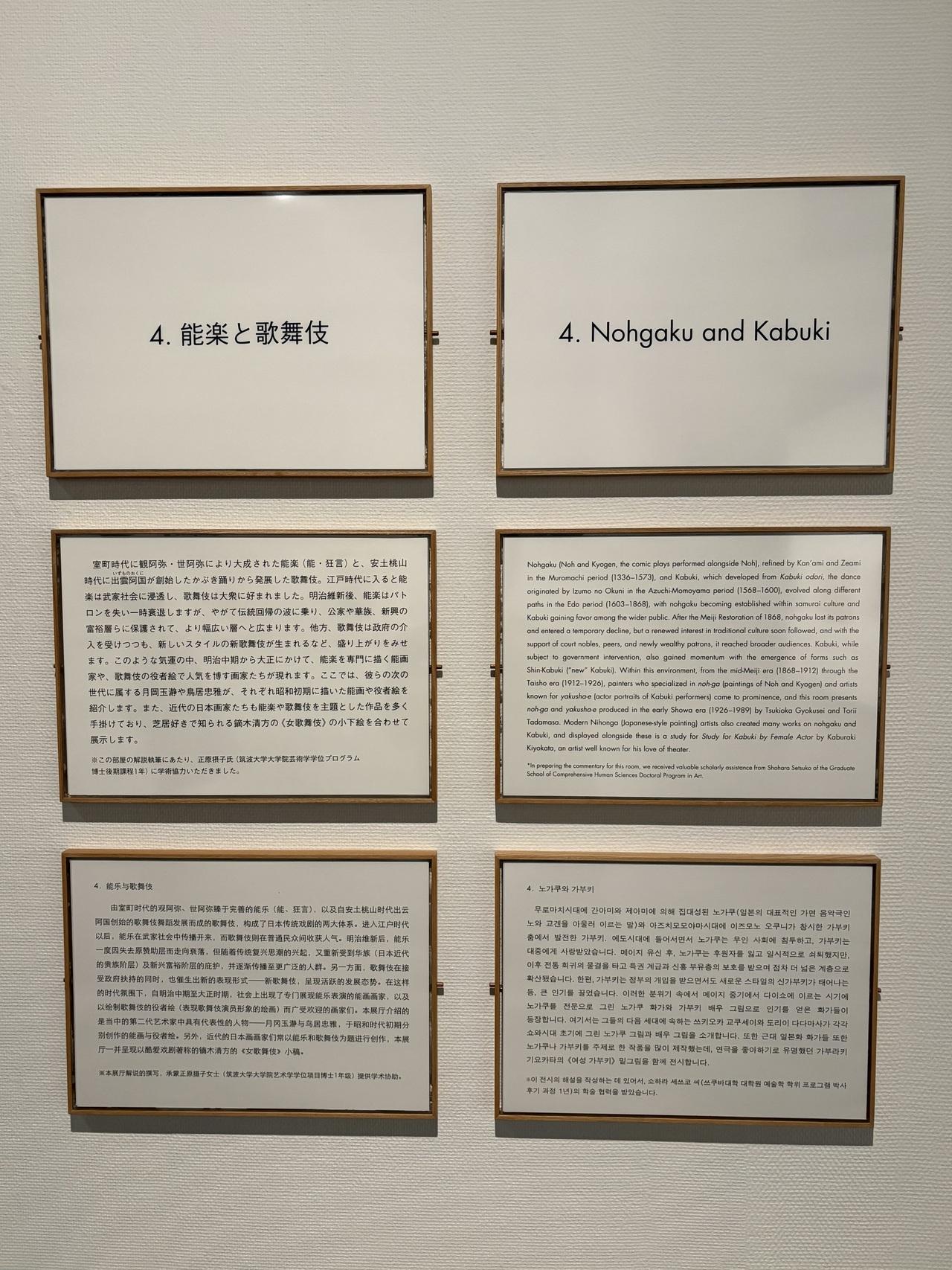
4. 能楽と歌舞伎
室町時代に観阿弥・世阿弥により大成された能楽(能・狂言)と、安土桃山時代に出雲阿国が創始したかぶき踊りから発展した歌舞伎。江戸時代に入ると能楽は武家社会に浸透し、歌舞伎は大衆に好まれました。明治維新後、能楽はパトロンを失い一時衰退しますが、やがて伝統回帰の波に乗り、公家や華族、新興の富裕層らに保護されて、より幅広い層へと広まります。他方、歌舞伎は政府の介入を受けつつも、新しいスタイルの新歌舞伎が生まれるなど、盛り上がりをみせます。
このような気運の中、明治中期から大正にかけて、能楽を専門に描く能画家や、歌舞伎の役者絵で人気を博す画家たちが現れます。ここでは、彼らの次の世代に属する月岡玉瀞や鳥居忠雅が、それぞれ昭和初期に描いた能画や役者絵を紹介します。また、近代の日本画家たちも能楽や歌舞伎を主題とした作品を多く手掛けており、芝居好きで知られる鏑木清方の《女歌舞伎》の小下絵を合わせて展示します。
4. Nohgaku and Kabuki
Nohgaku (Noh and Kyogen, the comic plays performed alongside Noh), refined by Kan'ami and Zeami in the Muromachi period (1336-1573), and Kabuki, which developed from Kabuki odori, the dance originated by Izumo no Okuni in the Azuchi-Momoyama period (1568-1600), evolved along different paths in the Edo period (1603-1868), with nohgaku becoming established within samurai culture and Kabuki gaining favor among the wider public. After the Meiji Restoration of 1868, nohgaku lost its patrons and entered a temporary decline, but a renewed interest in traditional culture soon followed, and with the support of court nobles, peers, and newly wealthy patrons, it reached broader audiences. Kabuki, while subject to government intervention, also gained momentum with the emergence of forms such as Shin-Kabuki ("new" Kabuki).
Within this environment, from the mid-Meiji era (1868-1912) through the Taisho era (1912-1926), painters who specialized in noh-ga (paintings of Noh and Kyogen) and artists known for yakushare lactor portraits of Kabuki performers) came to prominence, and this room presents noh-ga and yakusha-e produced in the early Showa era (1926-1989) by Tsukioka Gyokusei and Torii Tadamasa. Modern Nihonga (Japanese-style painting) artists also created many works on nohgaku and Kabuki, and displayed alongside these is a study for Study for Kabuki by Female Actor by Kaburaki Kiyokata, an artist well known for his love of theater. -
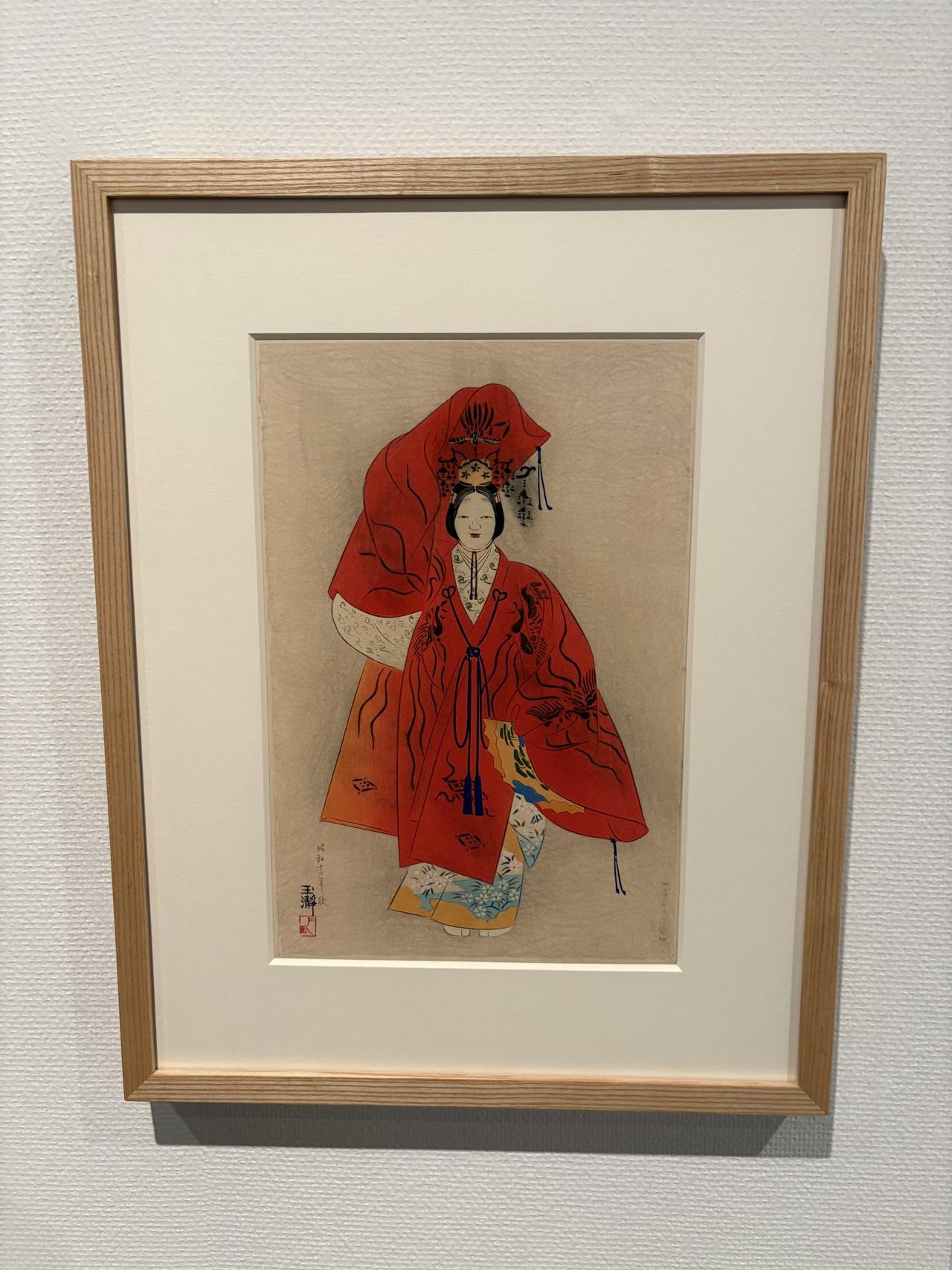
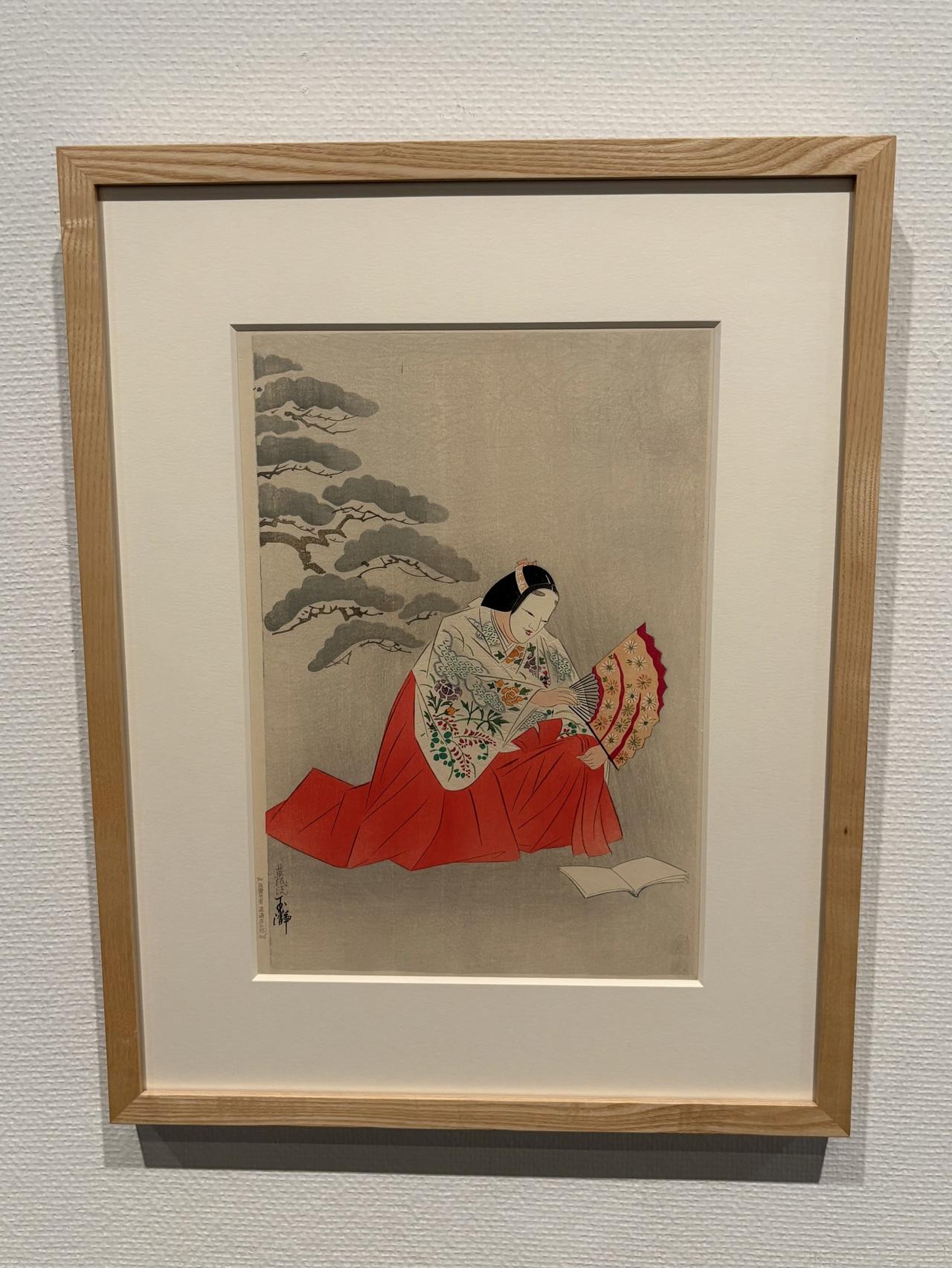
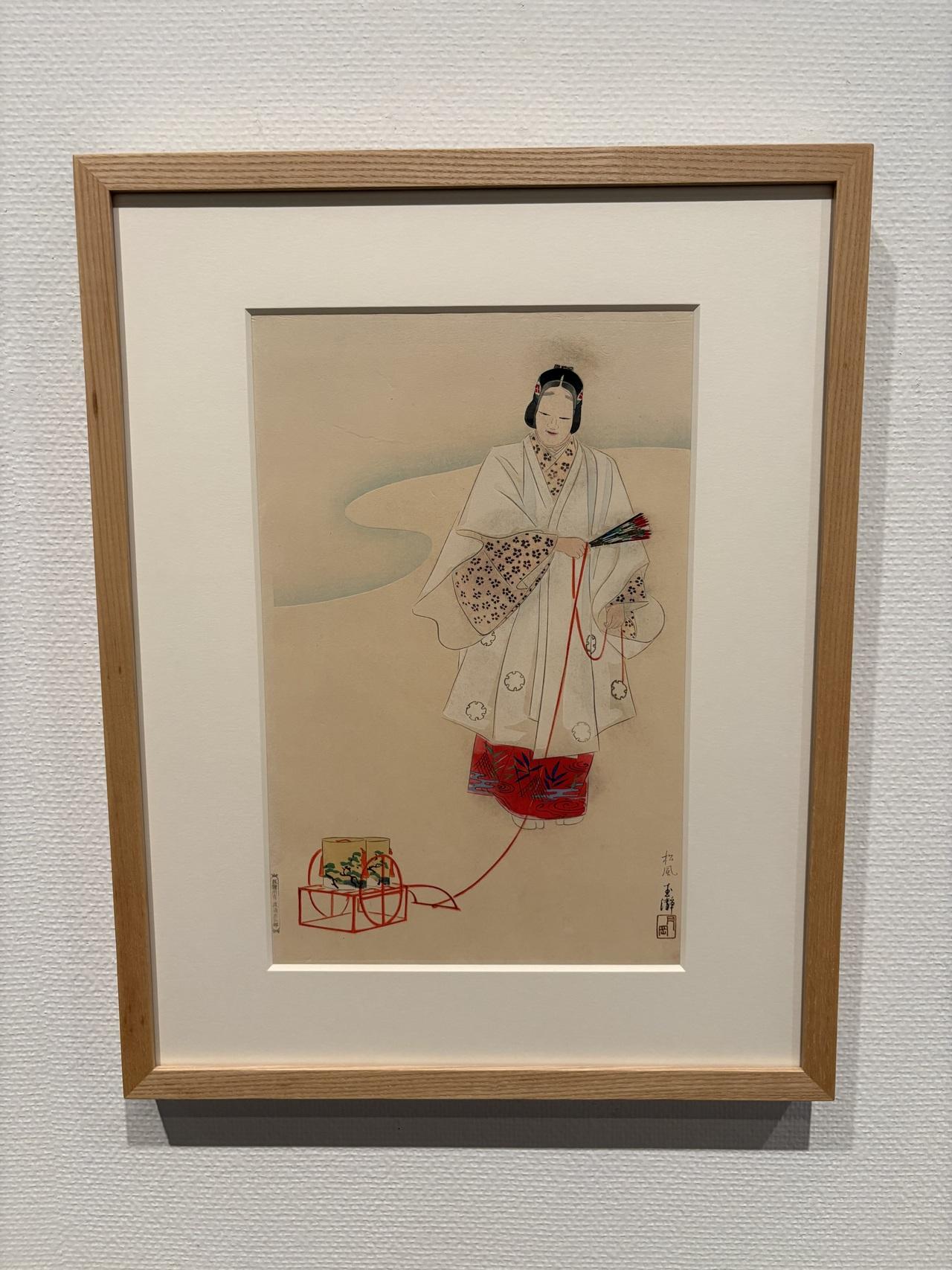
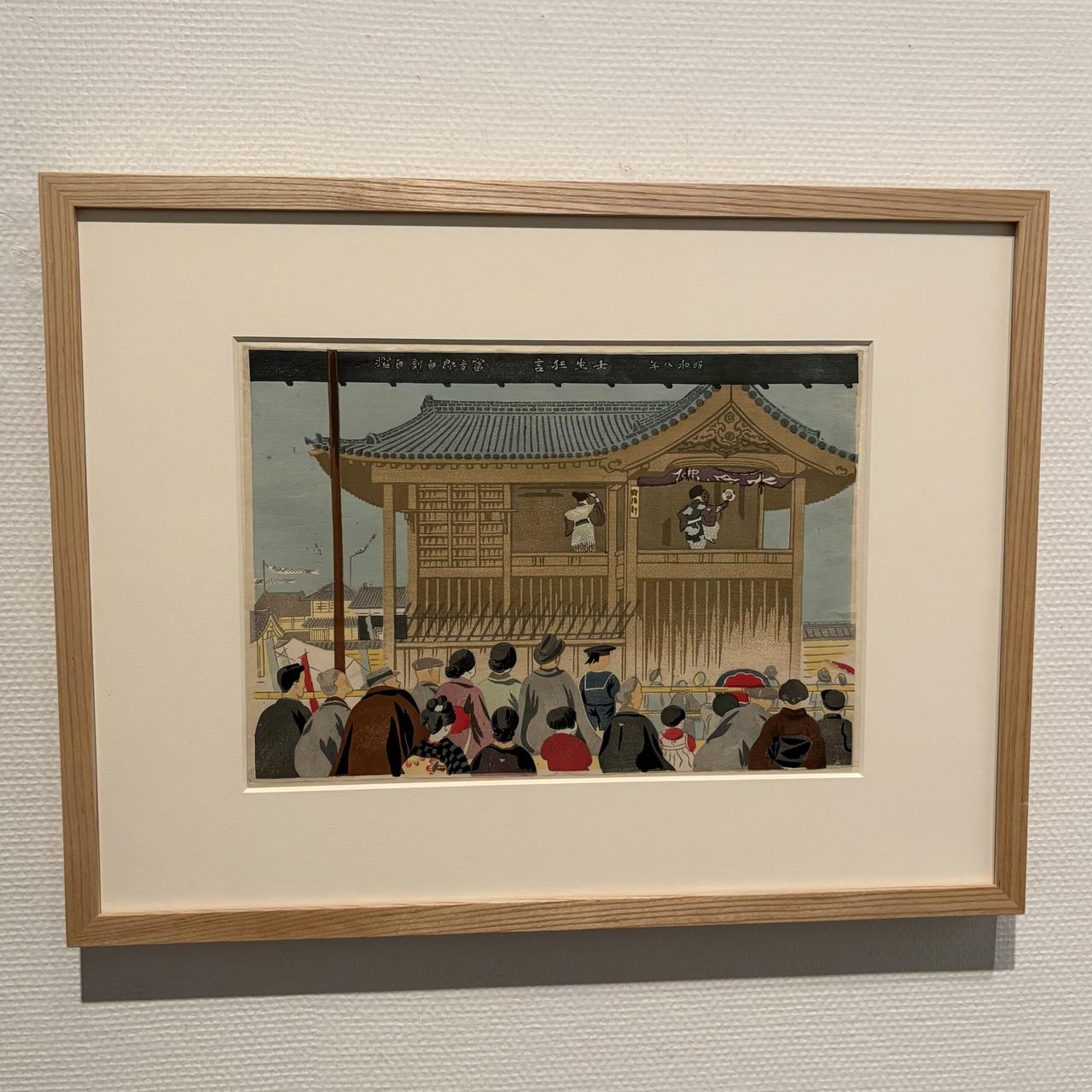
月岡玉瀞
TUKIOKA, Gyokusei
1908-1994
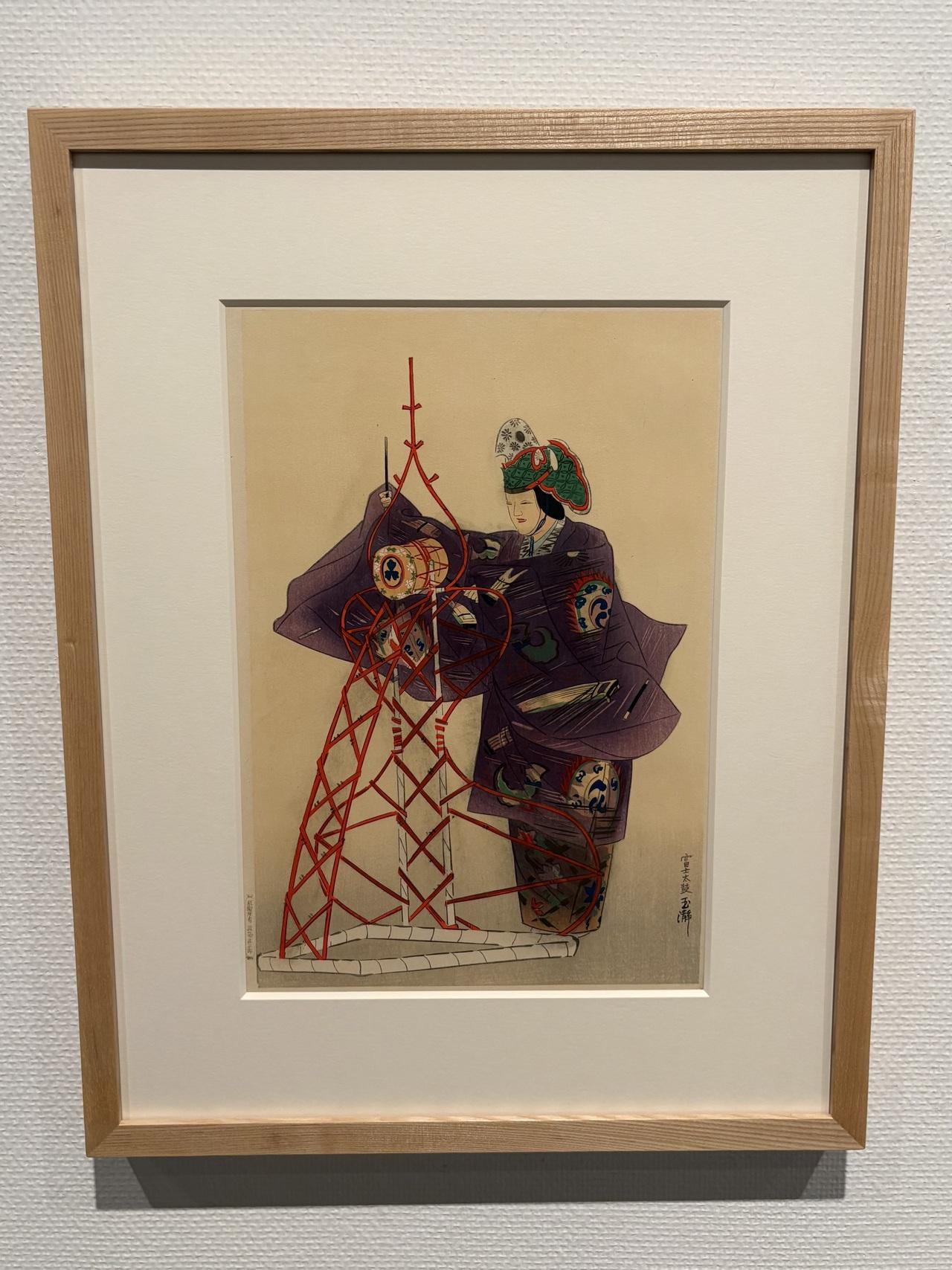
羽衣
Hagoromo
1937
昭和12年
木版(多色)
color woodcut
熱懸さと氏寄贈
Gift of Fujikake Sato
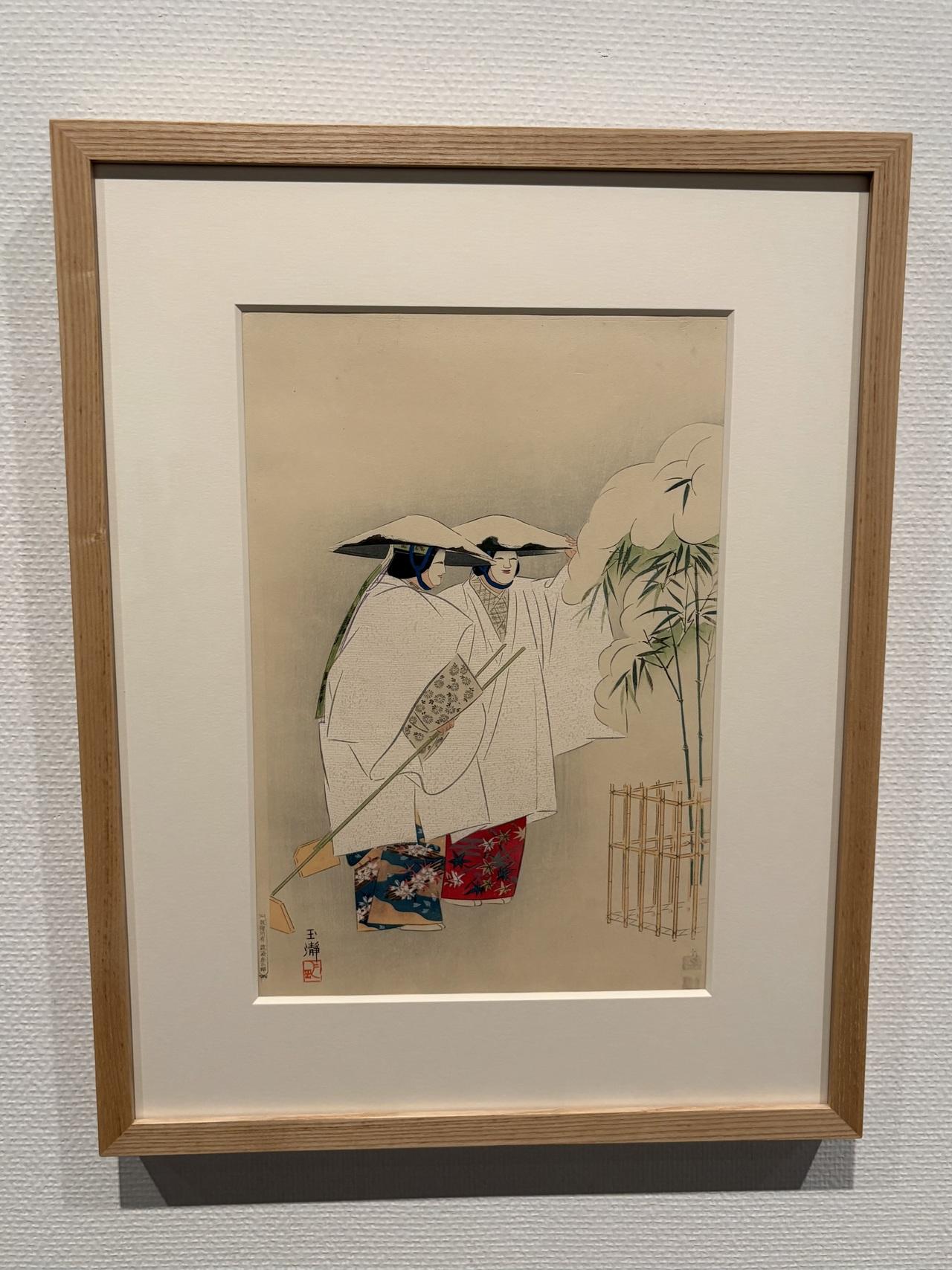
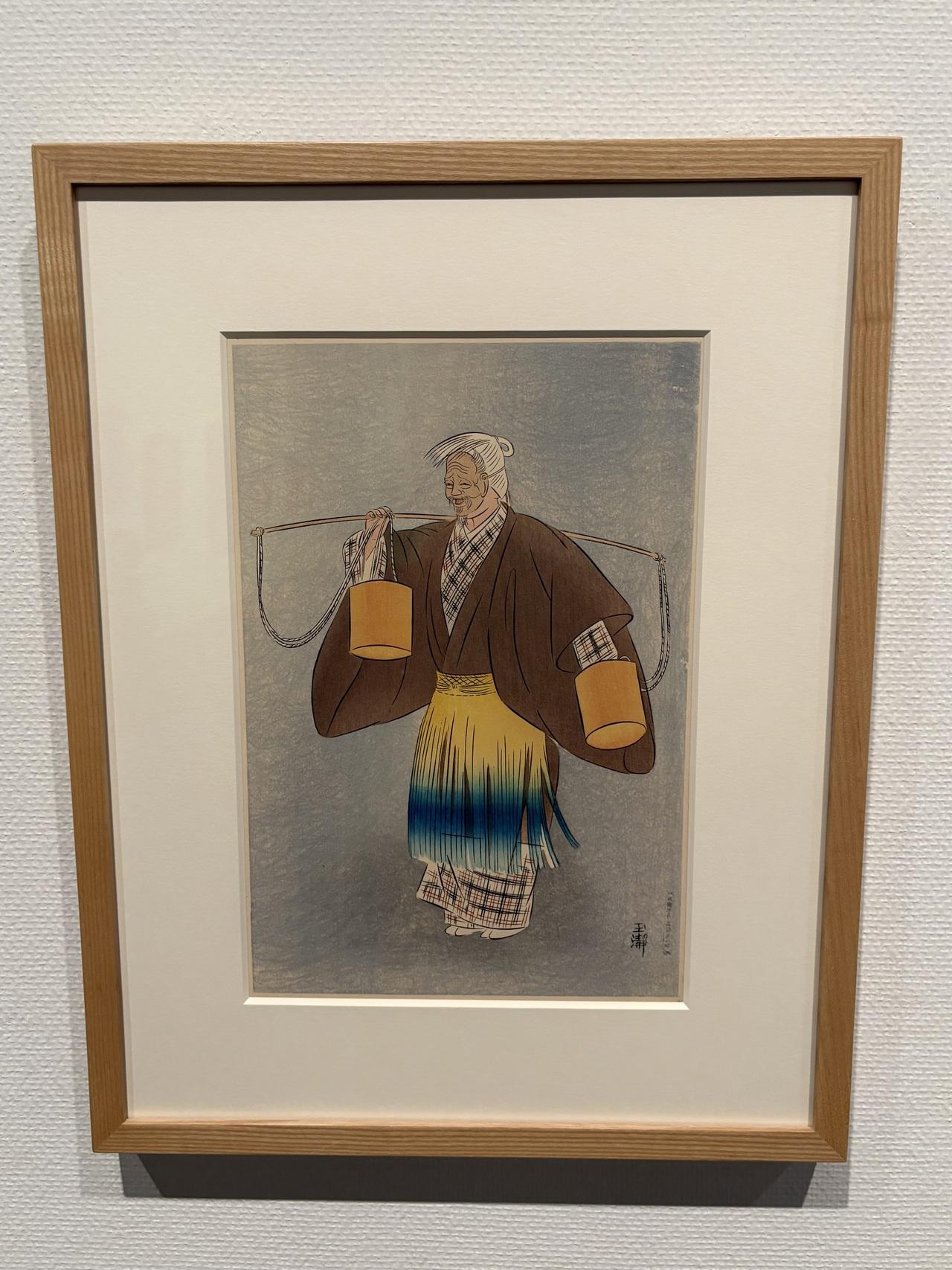
月玉瀞は、浮世絵師の月芳年(1839-1892)を祖父に、能画家の月岡耕漁(1869-1927)を文にもちます。幼少期から絵を習い、女子美術学校で日本画を学んだのち松岡映丘(1881-1938)に師事し、同窓生が結成した青補社展に出品を重ねました。玉着は父と同様、能を主題にした日本画や木版画を専門に手がけています。当館が所蔵するのは、1937(昭和12)年に版元の渡邊庄三郎のもとから発行された20点組の能画のうちの7点で、いずれもシテ(主役)を描いたものです。
「羽衣」では、三保の松原にて、漁師・白龍が持ち帰ろうとする羽衣を返してもらおうと、舞を見せる天女の姿が描かれています。羽衣を着た天女は、月宮の様子を現わす舞いなどを見せたのち、彼方の富士山へ舞い上がり、霞にまぎれて消えていきました。
Tsukioka Gyokusei's grandfather was the ukiyoe artist Tsukioka Yoshitoshi, and her father was the noh-ga painter Tsukioka Kogyo. She studied painting from childhood, went on to study Nihonga (Japanese-style painting) at Joshibi University of Art and Design, and later trained under Matsuoka Eikyu. She frequently showed her work in exhibitions of the Seishisha group formed by her fellow students. Like her father, Gyokusei worked primarily in Nihonga and woodcut prints with Noh as their subject. The museum's collection includes seven works from a set of twenty noh-ga prints published in 1937 by Watanabe Shozaburo, all of which portray a Noh play's principal character.
In Hagoromo (The Feather Mantle), a celestial maiden performs a dance to persuade the fisherman Hakuryo to return the feather mantle he attempted to take from the pine grove of Miho no Matsubara. Once wearing the mantle, she performs dances representing a moon palace and other scenes, then ascends toward Mount Fuji in the distance and disappears into the mist. -
-
-
-
-
-
-
-
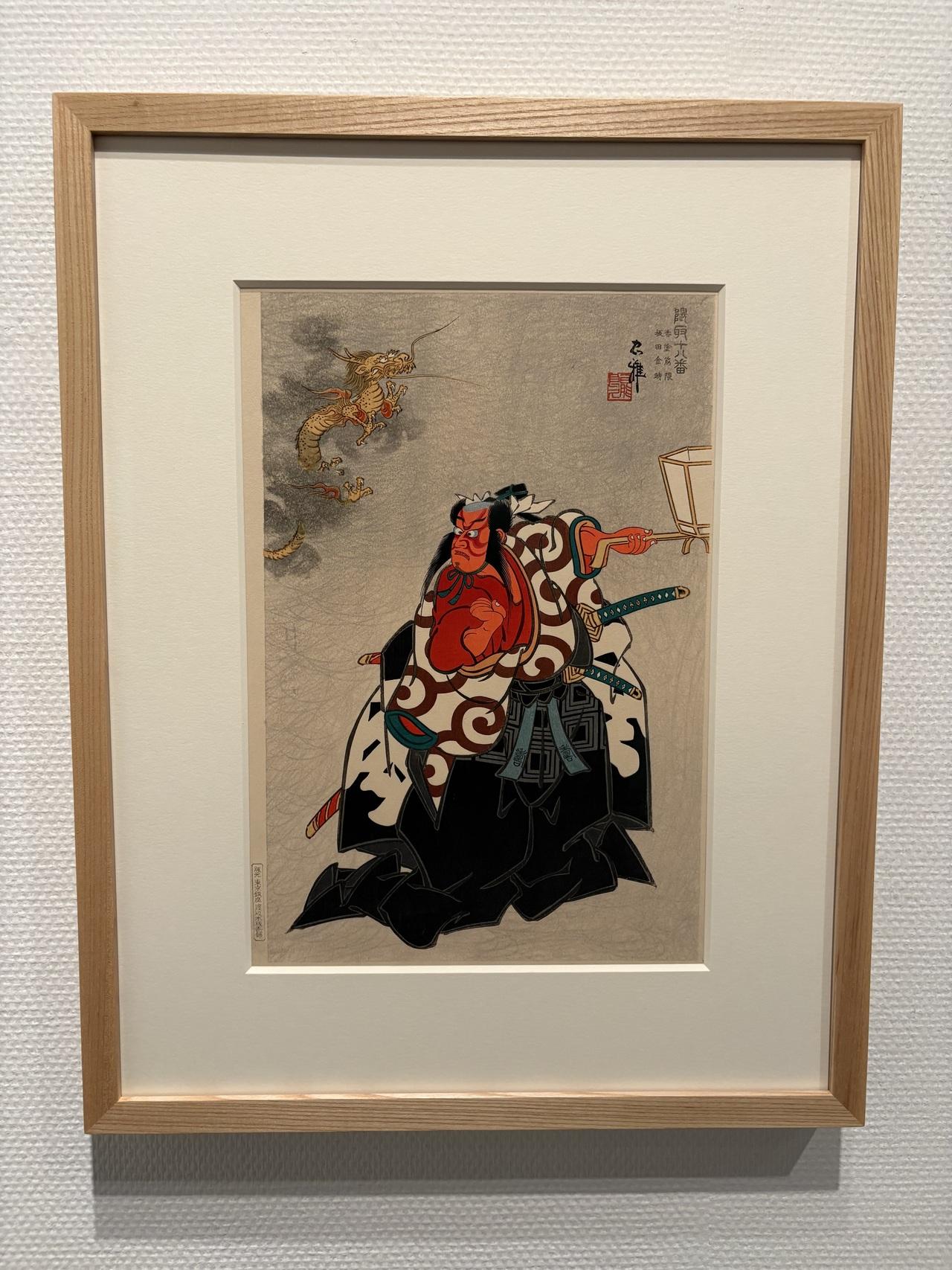
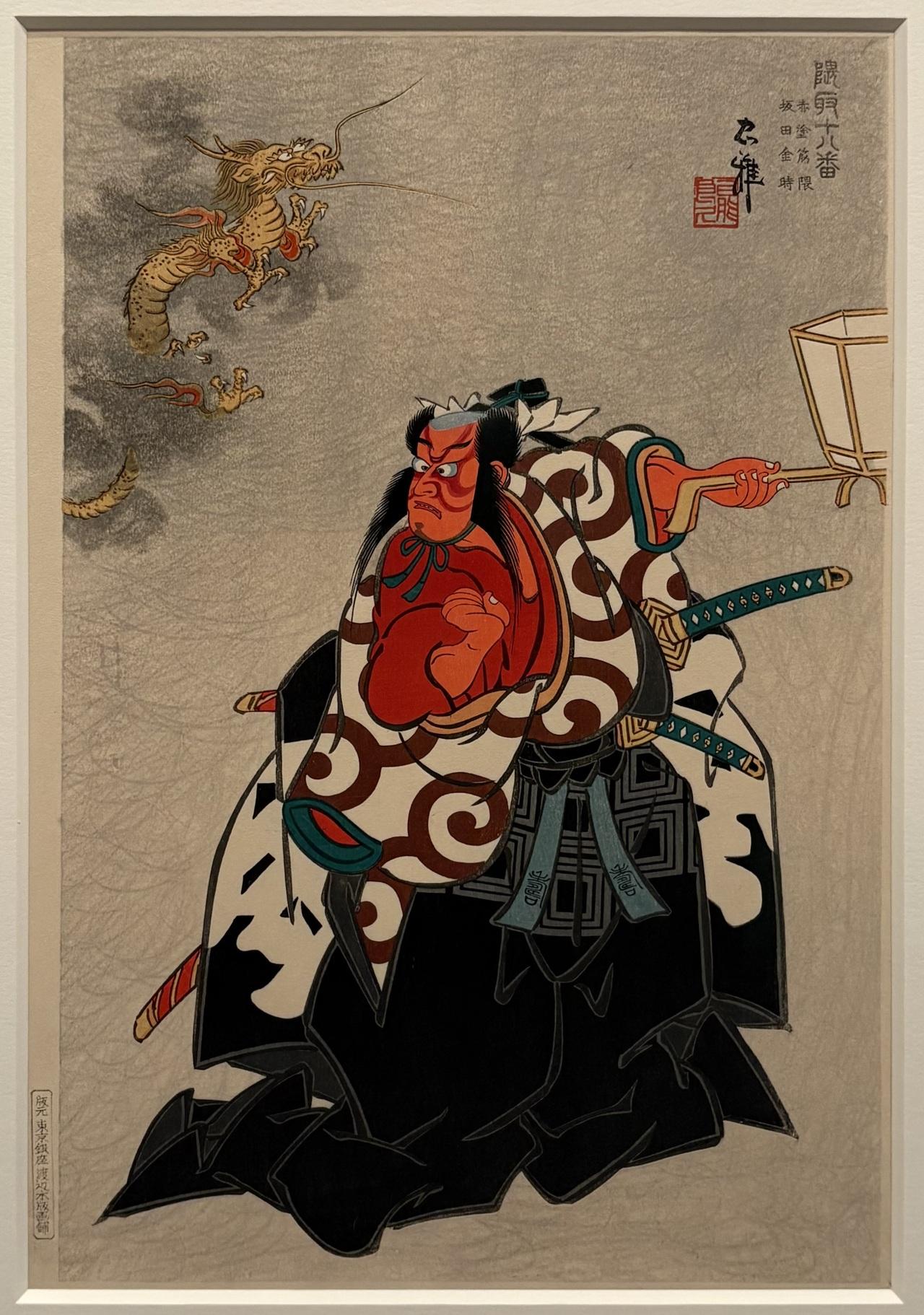
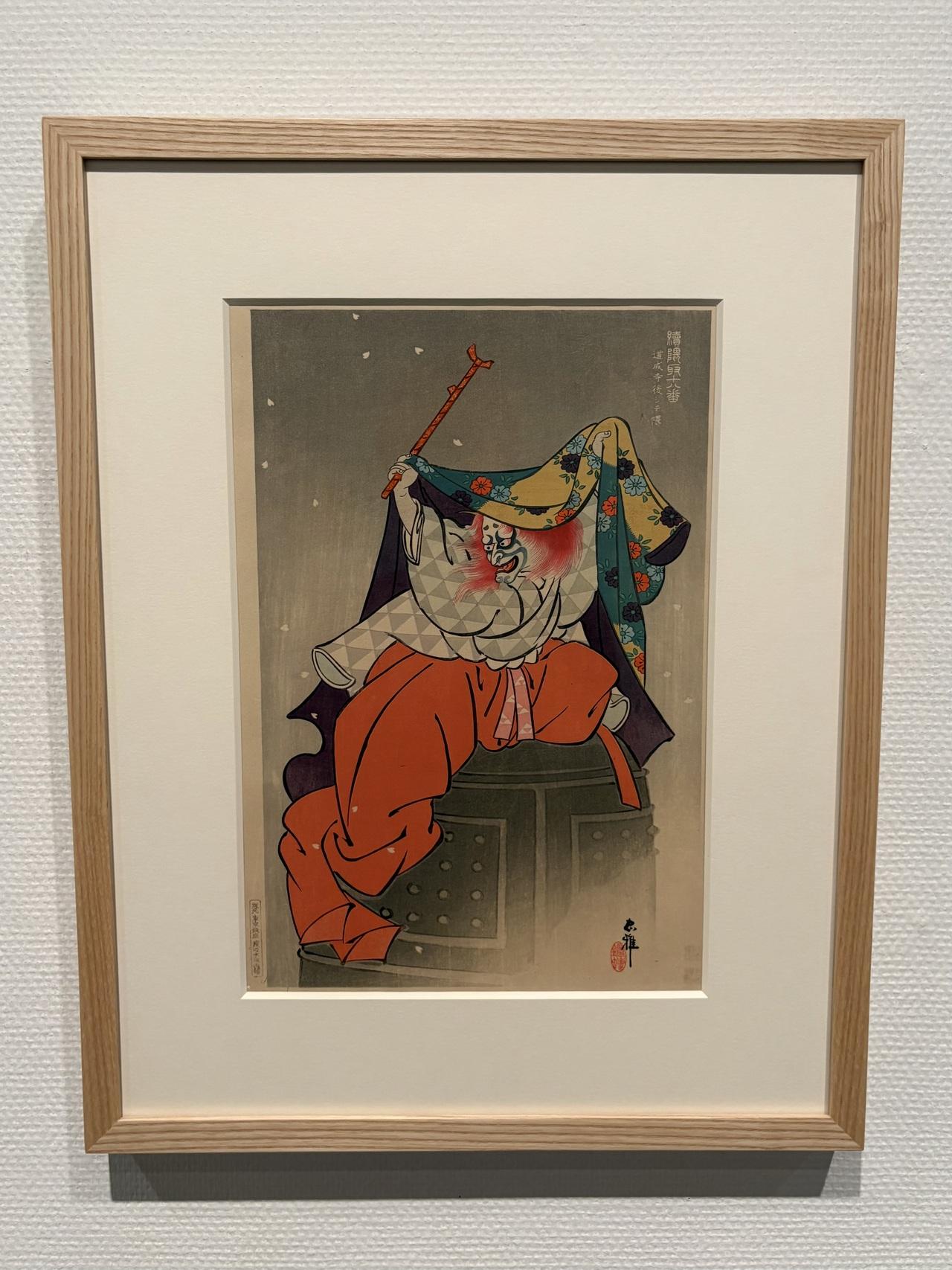
鳥居忠雅
TORII, Tadamasa
1904-1970
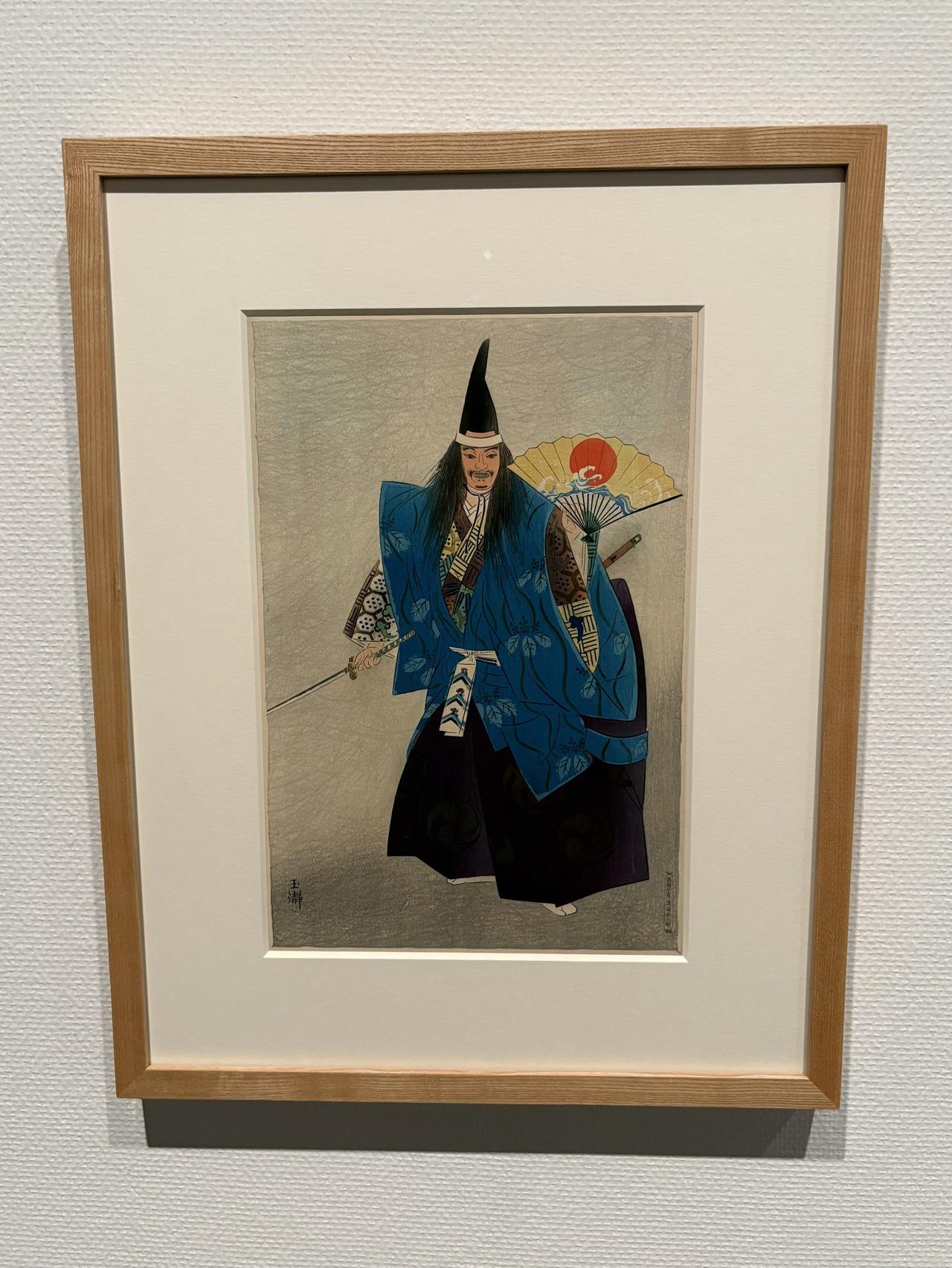
「隈取十八番」より赤塗筋隈 坂田金時
Sujiguma on Red Base for Sakatano Kintoki from Famous Kabuki Makeups
1941 昭和16年
木版(多色) color woodcut
藤懸さと氏寄贈
Gift of Fujikake Sato
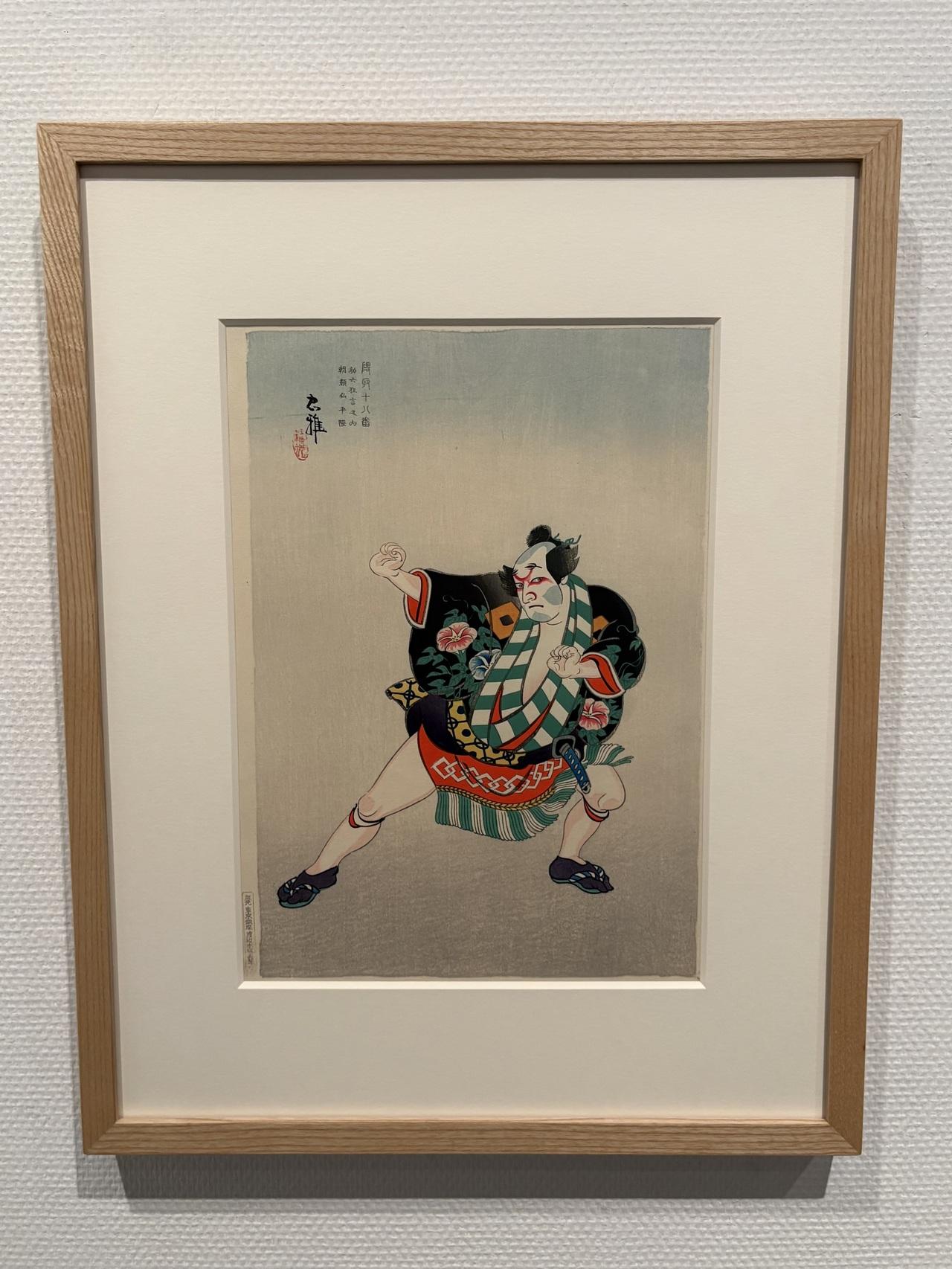
東京本郷の薬局に生まれた忠雅は、浮世絵師である鳥居清忠に師事して鳥居派の芝居絵を学び、やがて歌舞伎座や国立劇場、街闘座の絵看板や番付を手がけました。渡邊木版美術画舗より出版された1941(昭和16)年の「隈取十八番」と、1943(昭和18)年の「続隈取十八番」は、忠雅の代表作。
隈取とは、顔の血管や筋肉を誇張するための歌舞伎の化粧法で、初代市川園十郎が、宙時の息子である英雄田役の初舞台で、紅と墨を用いて化粧したことが始まりと言われています。
Born into a family that ran a pharmacy in Hongo, Tokyo, Tadamasa studied under the ukiyoe artist Torii Kiyotada, learning the Torii school's theatrical print traditions. He later produced e-kanban (illustrated billboards placed in front of theaters showing scenes from current performances) and banzuke (printed promotional materials for Kabuki) for the Kabukiza Theatre, the National Theatre, and the Misonoza Theatre. Famous Kabuki Makeups (1941) and More Famous Kabuki Makeups (1943), published by Watanabe Shozaburo, are his best-known works.
Kumadori is a Kabuki makeup style used to exaggerate the blood vessels and muscles of the face, and is said to have originated when Ichikawa Danjuro I used red and black makeup for his debut performance as the hero Sakata no Kinpira, the son of Sakata no Kintoki. -
-
-
-
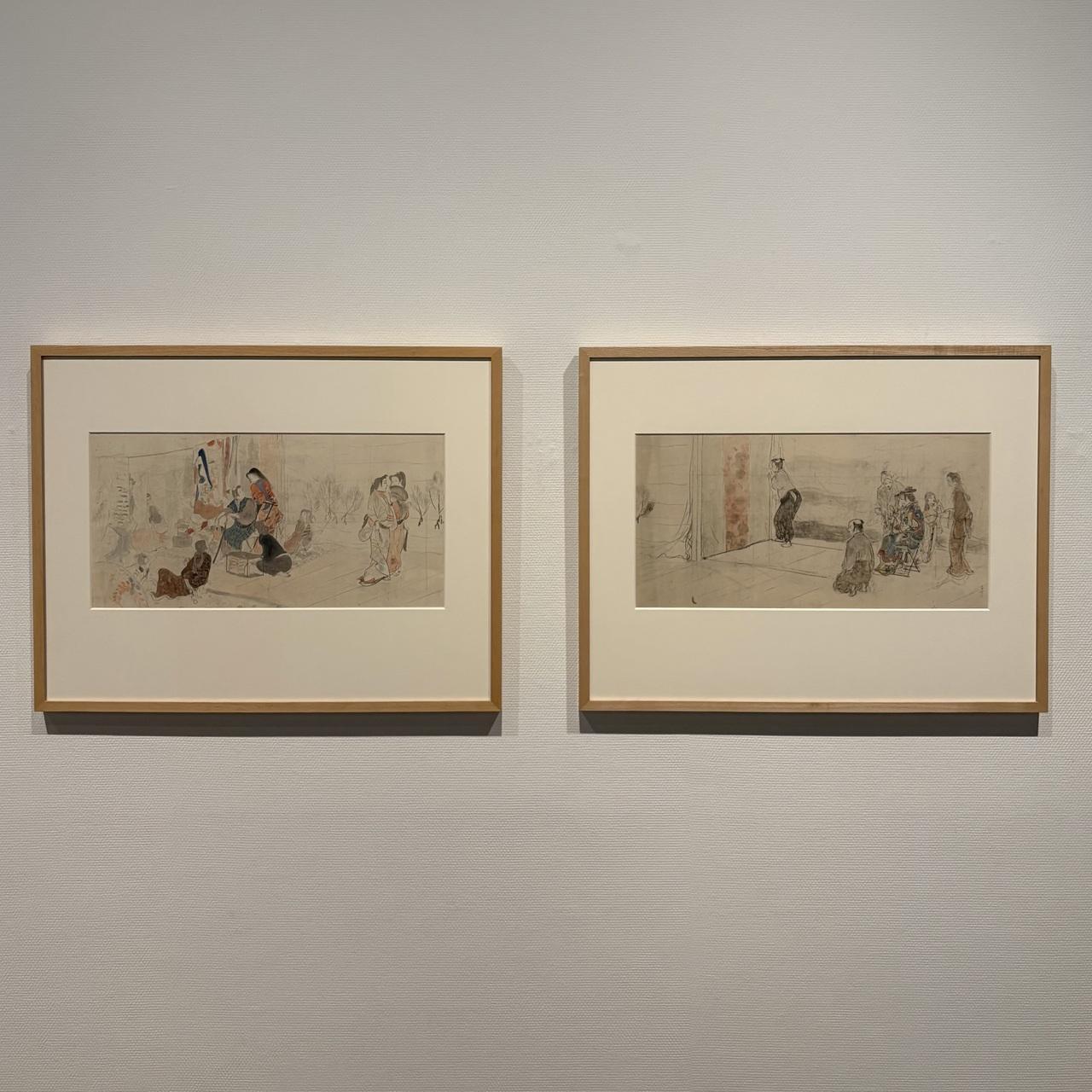
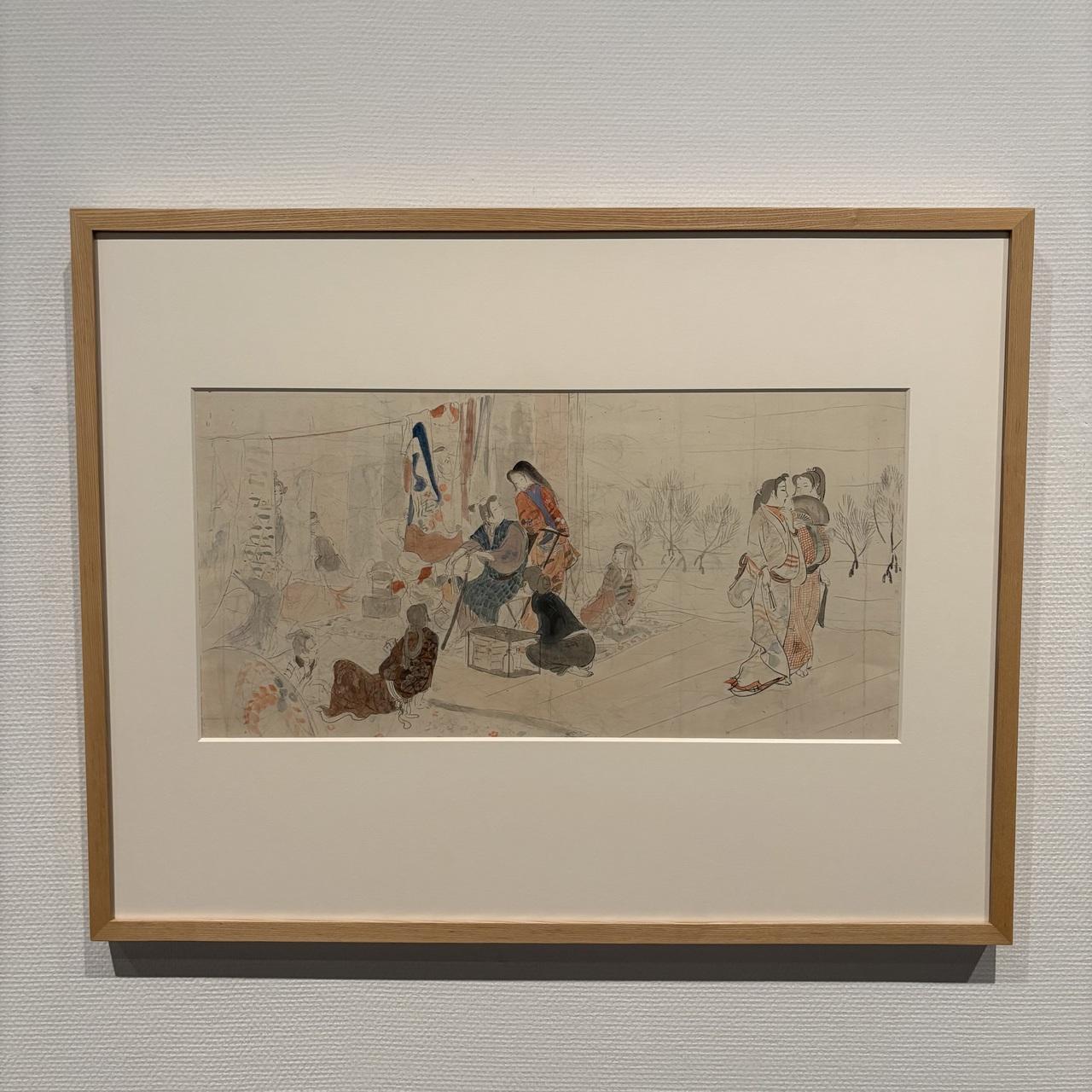
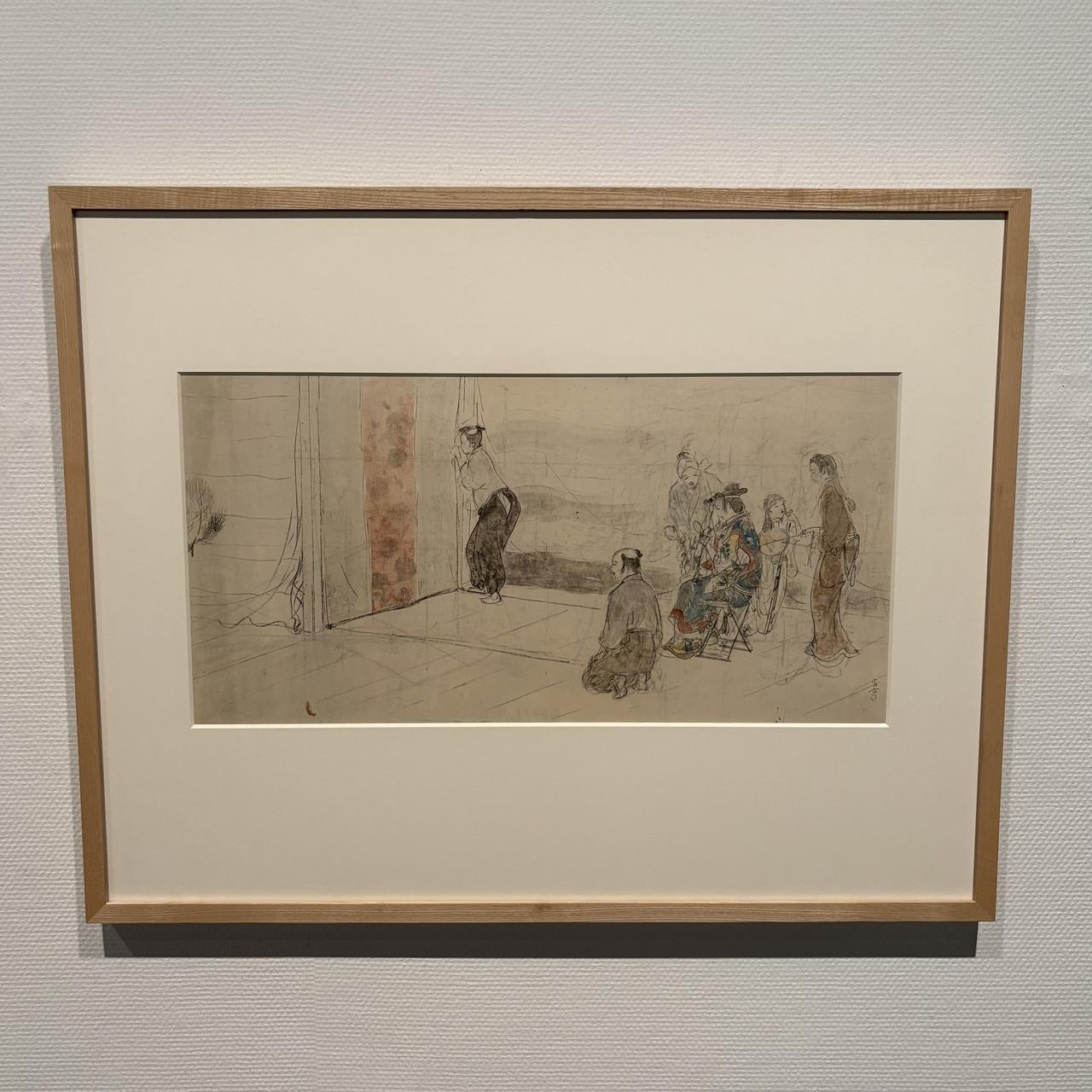
鏑木清方
KABURAKI, Kiyokata
1878-1972
《女歌舞伎》のための小下絵
Study for Kabuki by Female Actor
1910 明治43年
墨、彩色、岩絵具、鉛筆・紙
sumi, color, Japanese pigment and pencil on paper
購入
Purchased
挿絵画家から日本画家への転身を図ろうとしていた清方が、六曲一双の屏風という大画面に初めて挑んだ作品《女歌舞伎》のための小下絵です。本画は1910(明治43)年の第4回文展に出品されて三等賞主席となり、帝国劇場の食堂に飾られていましたが、関東大震災で焼失しました。慶長年間に起こった女歌舞伎を主題とし、右には、舞台袖で出番を待つ出間国らの姿が、左には、楽屋で化粧をしたり、うんすんカルタ(室町時代にポルトガルの船員から伝わったトランプを、日本でカルタに作り変えた遊び)に興じたりする役者たちの姿が描かれています。
This is a study for Kabuki by Female Actor, the work in which Kaburaki, aiming to transition from illustration to Nihonga (Japanese-style painting), first undertook the challenge of painting on the large scale of a pair of six-panel folding screens. The completed painting was submitted to the fourth Bunten in 1910, received the highest honors among the third-place awards, and was displayed in the dining room of the Imperial Theatre, but it was later destroyed in the Great Kanto Earthquake of 1923. The subject is Kabuki by female actors, which emerged around 1600. The right screen portrays Izumo no Okuni, the legendary founder of Kabuki, and others waiting in the wings for their cue, while the left screen shows actors in the dressing room applying makeup and playing unsun karuta, a card game that developed in Japan from the playing cards introduced by Portuguese sailors in the Muromachi period(1336-1573). -
-


利用規約に違反している投稿は、報告する事ができます。
-
前の旅行記

MOMAT コレクション展 ~2026.5.10 ③花ひらく大正。"藤島武二《匂い》"
2026/05/03~
神田・神保町
-
次の旅行記

MOMAT コレクション展 ~2026.5.10 ⑤戦間期のコントルポアン。"浅原清隆 《多感な地上》"
2026/05/05~
神田・神保町
-

MOMAT コレクション展 ~2026.5.10 ③花ひらく大正。"藤島武二《匂い》"
2026/05/03~
神田・神保町
-

MOMAT コレクション展 ~2026.5.10 ④能楽と歌舞伎。"鳥居忠雅《「隅取十八番より」赤塗筋隈 ...
2026/05/04~
神田・神保町
-

MOMAT コレクション展 ~2026.5.10 ⑤戦間期のコントルポアン。"浅原清隆 《多感な地上》"
2026/05/05~
神田・神保町
-

MOMAT コレクション展 ~2026.5.10 ⑤~⑥ ソル・ルウィット| ウォール・ドローイング#769...
2026/05/05~
神田・神保町
-

MOMAT コレクション展 ~2026.5.10 ⑥1941-1945|戦争/美術。"国吉康雄 《誰かが私の...
2026/05/06~
神田・神保町
-
![MOMAT コレクション展 ~2026.5.10 ⑦今井壽恵と岡上淑子。"今井壽惠 《「オフェリアその後」より[1]》"](https://cdn.4travel.jp/img/thumbnails/imk/travelogue_album/12/06/97/240x180_12069709.jpg?updated_at=1788062966)
MOMAT コレクション展 ~2026.5.10 ⑦今井壽恵と岡上淑子。"今井壽惠 《「オフェリアその後」よ...
2026/05/07~
神田・神保町
-

MOMAT コレクション展 ~2026.5.10 ⑧ツヤツヤピカピカ。"上田薫 《スプーンに水あめ》"
2026/05/08~
神田・神保町
-

MOMAT コレクション展 ~2026.5.10 ⑨ "植田正治 砂丘劇場 《パパとママと子供たち》"
2026/05/09~
神田・神保町
-

MOMAT コレクション展 ~2026.5.10 ⑪描くことと見えるものの間一 1990年代以降の絵画表現【...
2026/05/10~
神田・神保町
-

MOMAT コレクション展 ~2026.5.10 ⑪描くことと見えるものの間一1990年代以降の絵画表現【2...
2026/05/11~
神田・神保町
旅行記グループをもっと見る
コメントを投稿する前に
十分に確認の上、ご投稿ください。 コメントの内容は攻撃的ではなく、相手の気持ちに寄り添ったものになっていますか?
サイト共通ガイドライン(利用上のお願い)報道機関・マスメディアの方へ 画像提供などに関するお問い合わせは、専用のお問い合わせフォームからお願いいたします。






フォートラベル公式LINE@

おすすめの旅行記や旬な旅行情報、お得なキャンペーン情報をお届けします!
QRコードが読み取れない場合はID「@4travel」で検索してください。
\その他の公式SNSはこちら/





旅行記グループ MOMAT コレクション〔国立東京近代美術館 所蔵作品展〕(2026.3.3-5.10)
0
16