


2026/05/06 - 2026/05/09
147位(同エリア935件中)

旅熊 Kokazさん
- 旅熊 KokazさんTOP
- 旅行記1932冊
- クチコミ857件
- Q&A回答101件
- 1,714,081アクセス
- フォロワー755人
MOMAT コレクション展 ~2026.5.10 ⑥1941-1945|戦争/美術
-

6.1941-1945|戦争/美術
1937(昭和12)年に日中戦争が始まり、翌38年に国家総動員法が施行されると、国民は戦争への協力を迫られていきます。美術家もまた例外でなく、多くの画家が戦地に派遣されて戦争記録画を制作します。また自由で前衛的な表現への弾圧も行われ、展覧会の禁止や美術団体の解散といった事態に至ります。
この部屋に並ぶ作品は、戦況が厳しさを増していく1941(昭和16)年(真珠湾攻撃)から45年(第二次世界大戦終結)の間に制作されたものです。戦争と美術の直接的な関係を分かりやすく伝えているように見えるのは戦争記録画です。また、それまでのスタイルを揺るぎなく継続させ、戦争の影響がほぼないかに見える作品、戦争への違和を間接的に示しているように見える作品もあります。この時代の表現を戦争か美術か、あるいは戦争協力戦争反対かという二者択一の図式で整理するのはおそらく適当ではありません。どの作品にも戦争と美術とが含まれており、鑑賞において、その二つの要素を同時に見なければいけないという困難がここにはあります。
6. Art / War: 1941-1945
The Sino-Japanese War began in 1937. The National Mobilization Law was enacted the following year, forcing Japanese citizens to cooperate with the war effort. Artists were no exception. Many were sent to the front and made pictures documenting the war. There was also a crackdown on free and avant-garde expression, leading exhibitions to be banned and art groups dissolved.
The works assembled in this room were created between 1941 (the year of the attack on Pearl Harbor) and 1945 (the end of World War Il), a period in which war conditions were becoming increasingly severe. The war-record paintings express a direct link between war and art in an easily understandable manner. Other works, which remained firmly grounded in a given style, seem to have largely escaped the influence of the war. Still other works seem to indirectly convey a sense of discomfort regarding the war. It would be inappropriate to divide works of the era into those that represent art and those that represent the war, or those that express support or opposition to the conflict. All of them contain aspects of war and art and the fact that we are confronted with both of these elements is what makes them so difficult to look at. -
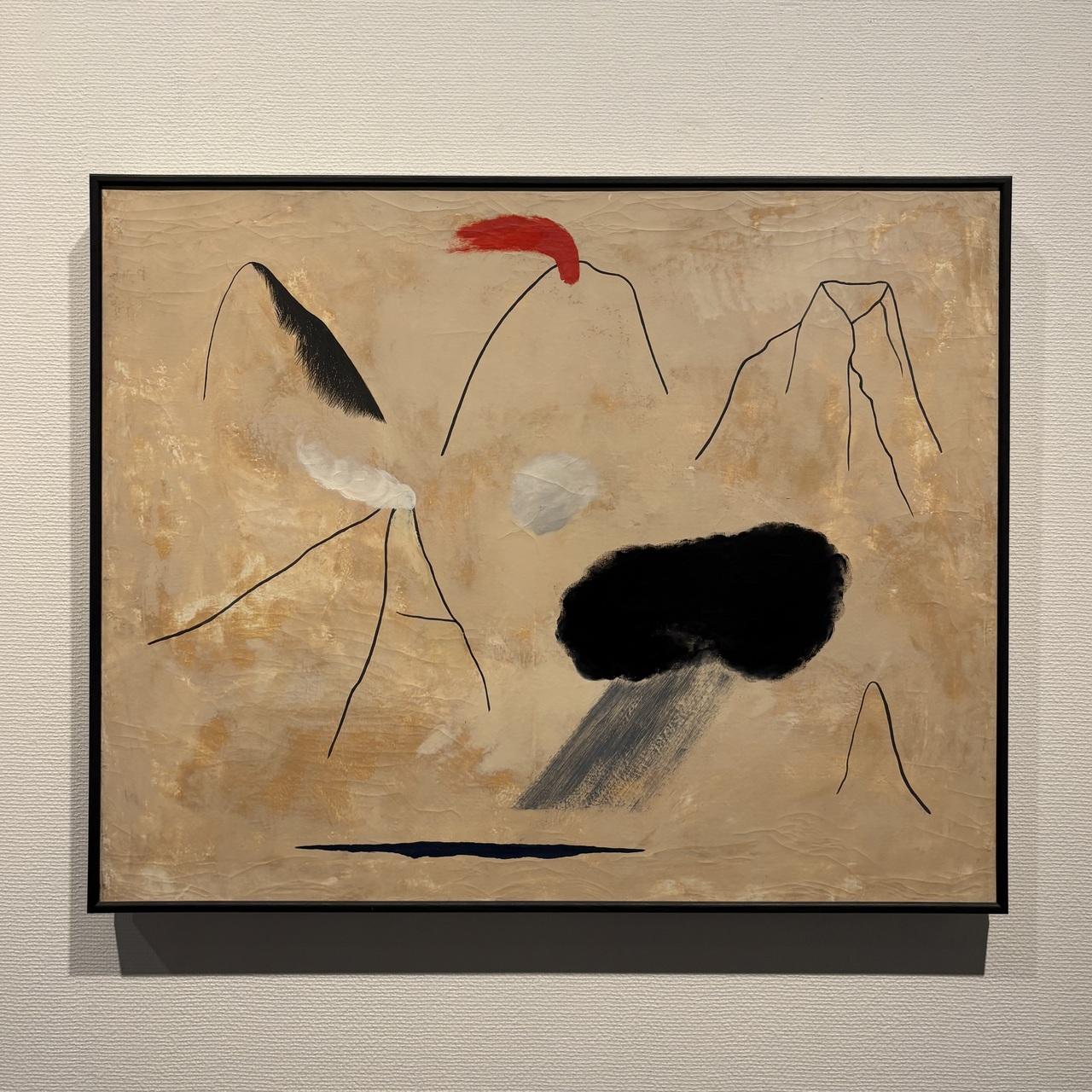
吉原治良
YOSHIHARA, Jiro
1905-1972
火山
Volcanoes
火山
1943
昭和18年
油彩・キャンバス oil on canvas
購入
Purchased
「赤い炎を吹く山」らしきかたち、「白い煙が立ち上る山」らしきかたち、「黒い雨雲」らしきかたち、「白い綿」らしきかたち、「黒い影」らしきかたちなどが、ベージュの地に浮かんでいます。1930年代に幾何学的な抽象絵画を発表して注目された吉原治良が、時局柄、抽象芸術への風当たりが強くなるなかで制作した作品です。つつがなく連続した空間を直接的に(あるいは分かりやすく)描くのでなく、記号や文字のようにばらばらの要素が寄せ集められた画面からは、間接的に(あるいは曖味に)「不穏な感じ」が立ち上がってきます。
This work includes forms that resemble mountains belching out red flames and white smoke, black rainclouds, white cotton, and black shadows floating over a beige ground. Made by Yoshihara Jiro, who had been acclaimed for his geometrical abstractions in the 1930s, the painting dates from a time when abstract art was being subjected to harsh criticism. Rather than directly (or clearly) depicting a unified three-dimensional space that was free of problems, Yoshihara filled the canvas with disparate elements that recall symbols or letters, indirectly (or vaguely) creating an air of disquiet. -
-
国吉康雄
KUNIYOSHI, Yasuo
1889-1953
誰かが私のポスターを破った
Somebody Tore My Poster
1943昭和18年
油彩・キャンバス ail on canvas
寄託
Long term loan
壁に貼られたポスターは、国吉の友人である画家、ベン・シャーンが反ナチスを訴えるために描いたもの。国吉はこのように、一つの画面の中に別の画面を描きこむ構図(画中画)を好みました。この作品では、ポスターの中の大きな手が、今にも女性の後頭部につかみかかりそうです。タバコを持つ女性自身の右手と、手のようなかたちをした女性の不思議な帽子が、ポスターの中の手とともに女性の頭を三方から取り囲み、息苦しい雰囲気を作り出しています。こちらを振り返った女性は、いったい誰に視線を投げているのでしょうか。怒っているのでしょうか、それとも哀しいのでしょうか。戦時下に描かれた国吉の代表作です。
The poster attached to the wall is an anti-Nazi statement made by Kuniyoshi's friend, the painter Ben Shahn. Kuniyoshi was fond of incorporating a picture within a picture. In this work, the huge hand in the poster seems about to grab the back of the woman's head. Along with the hand in the poster, the woman's right hand, holding a cigarette, and the strange hand-like shape of her hat surround her on three sides, creating an oppressive atmosphere. As she looks back toward us, what is she focusing on? Is she angry or sad? This picture is representative of Kuniyoshi's work during the war. -
-
-
-
松本竣介
MATSUMOTO, Shunsuke
1912-1948
Y市の橋
Bridge in Y-City
1943
昭和18年
油彩・キャンバス
oil on canvas
文化庁管理換
Transferred from Agency for Cultural Affairs
橋の向こうには、国鉄の跨線橘と架線の鉄柱の複雑な交差が、細い線描で描かれています。深みのある色彩の川面は流れを感じさせません。橋の上と橋のたもとにいる人物はシルエットで描かれ、寂寥感をかきたてます。
題材となった「Y市の橋」とは、横浜駅近くを流れる新笛間川に架かっていた月見橋のこと。松本はこの橋を題材に、多くのスケッチや油彩画を残しました。
1945(昭和20)年5月、横浜大空襲によって当時の横浜市域の34%が焼失し、月見橋周辺も焦土と化します。戦後まもなく彼はこの橋を再訪し、その被災した様子も描きました。
Using minute lines, the artist depicts a complicated intersection between a national railway overpass and steel power poles beyond a bridge. The surface of the river, covered with a field of color, does not convey any sense of movement. The human figures on and at the foot of the bridge are shown in silhouette, exuding a sense of loneliness. The title alludes to Tsukimi Bridge, which spans the Aratama, a river that flows near Yokohama Station. Matsumoto used the bridge as the subject in many sketches and oil paintings.
In May 1945, 34 percent of the Yokohama municipal area was reduced to ashes in the Great Yokohama Air Raid. The area around Tsukimi Bridge was also razed to the ground.
Matsumoto revisited the site not long after the war and also depicted the devastation he found there. -
靉光
AI-MITSU
1907-1946
自画像
Self-Portrait
1944 昭和19年
油彩・キャンバス oil on canvas
井上長三郎氏寄贈
Gift of Inoue Chozaburo
戦争が激しさを増し、戦時体制が強化されてい<状況下の1943(昭和18)年、光、松本竣介、麻生三郎、井上長三郎といった若い画家たちは、自由な創作の場を求めて「新人画会」というグループを結成します。画材の入手も困難であったはずですが、彼らは展覧会を開催し、時局に対する抵抗の姿勢を示しました。観光は召集を受ける直前に、この胸をはり、顎を少し上げて遠くを見つめる自画像を描きます。この作品を新人画会の第三回展に出品するように友人に託して光は戦地に赴きますが、戦後間もなく上海で還らぬ人となりました。
In 1943, as the war intensified and the military regime grew more powerful, the young painters Aimitsu, Matsumoto Shunsuke, Aso Saburo, and Inoue Chozaburo formed a group called the Shinjin Gakai (Newcomers' Art Association) in order to create a place where they could work freely. Although it was probably difficult for them to obtain painting materials, they organized exhibitions of their work and expressed a defiant attitude to the state of things in the country. Just prior to being drafted,
Aimitsu made this self-portrait of himself with his chest out and his chin slightly raised as he gazes off into the distance. Aimitsu entrusted this work, first shown in the third Shinjin Gakai exhibition, to a friend before he left for the front, but he died in Shanghai not long after the war ended. -
戦争記録画について
東京国立近代美術館には、153点の戦争記録画が保管されています。これらの多くは、日中戦争から太平洋戦争にかけて、軍部の委嘱によって制作されたものです。
1937(昭和12)年、日中戦争が勃発すると、翌1938年には国家総動員法が成立し、国民すべてが戦争への協力を迫られるようになります。美術家も例外ではなく、戦地へと従軍して記録画を制作する画家たちが次第に増えていきます。1939(昭和14)年には陸軍美術協会が結成され、第1回聖戦美術展が開催されました。その後も大東亜戦争美術展(1942、43年)、国民総力決戦美術展(1943年)、戦争記録画展(1945年)など、数多くの戦争画展が開催され、多くの観客を動員しましたこれらの戦争記録画は、戦災を受けたり、戦後まもなく焼却されたりするなどして散逸したものが少なくありませんが、連合軍総司令部は主要作品153点を接収し、上野の東京都美術館に保管しました。
これらは1951(昭和26)年にアメリカ合衆国に移されましたが、その後、日米修好100年にあたる1961(昭和36)年頃から国内で徐々に返還を求める声が起こり、両国の間で折が続けられました。その結果、これらの戦争記録画はアメリカ政府から日本政府に「無期限貸与」することとし、貸与後の取扱いは事実上日本側に一任することで合意に達しました。1970(昭和45)年3月31日にワシントンDCで交換文書の調印が行われ、同年4月、引き受け先に決まった館に作品が到着しました。当館では6年をかけてこれらの作品を修復し、近代日本美術史上での歴史的事実を示すため、1977(昭和52)年以降、所蔵作品展の中で数点ずつ展示しています。
War Record Paintings
A total of 153 War Record Paintings are housed in the National Museum of Modern Art, Tokyo. Many of these works were commissioned by the military between the Second Sino-Japanese War and World War Il in the Pacific.
The Sino-Japanese War broke out in 1937. The following year, the National Mobilization Law was enacted, making it obligatory for all Japanese citizens to cooperate with the war effort. This was also true for artists, an increasing number of whom were dispatched to the front to document conditions on the battlefield. In 1939, the Military Art Association was formed and the group soon organized the 1st Holy War Art Exhibition. This marked the start of a succession of similar exhibitions, including the Greater East Asia War Art Exhibition (1942 and 1943), the Final War Art Exhibition (1943), and the War Record Painting Exhibition (1945), all of which attracted large audiences.
A significant number of War Record Paintings were lost, having been destroyed in the fighting or burned immediately after the war. The General Headquarters of the Allied Forces (GHQ) confiscated 153 of the more important works and temporarily stored them in the Tokyo Metropolitan Art Museum in Ueno before transferring them to the U.S. in 1951. In about 1961 (the 100th anniversary of friendly relations between Japan and the U.S.), calls for the repatriation of the paintings grew stronger in Japan, prompting the two countries to engage in a series of negotiations. Ultimately, the U.S. agreed to return the works to Japan on "indefinite loan" and allow the Japanese government to decide how to deal with them in the future. An official agreement was concluded in Washington, D.C. on March 31, 1970, and in April of that year, the paintings were sent to the National Museum of Modern Art, Tokyo, the designated recipient. Over the following six years, the works were restored, and beginning in 1977, they were displayed several at a time as part of the museum's collection exhibition to shed light on the reality of modern Japanese art history. -
-



利用規約に違反している投稿は、報告する事ができます。
-
前の旅行記

MOMAT コレクション展 ~2026.5.10 ⑤~⑥ ソル・ルウィット| ウォール・ドローイング#769...
2026/05/05~
神田・神保町
-
次の旅行記

MOMAT コレクション展 ~2026.5.10 ⑦今井壽恵と岡上淑子。"今井壽惠 《「オフェリアその後」よ...
2026/05/07~
神田・神保町
-

MOMAT コレクション展 ~2026.5.10 ③花ひらく大正。"藤島武二《匂い》"
2026/05/03~
神田・神保町
-

MOMAT コレクション展 ~2026.5.10 ④能楽と歌舞伎。"鳥居忠雅《「隅取十八番より」赤塗筋隈 ...
2026/05/04~
神田・神保町
-

MOMAT コレクション展 ~2026.5.10 ⑤戦間期のコントルポアン。"浅原清隆 《多感な地上》"
2026/05/05~
神田・神保町
-

MOMAT コレクション展 ~2026.5.10 ⑤~⑥ ソル・ルウィット| ウォール・ドローイング#769...
2026/05/05~
神田・神保町
-

MOMAT コレクション展 ~2026.5.10 ⑥1941-1945|戦争/美術。"国吉康雄 《誰かが私の...
2026/05/06~
神田・神保町
-

MOMAT コレクション展 ~2026.5.10 ⑦今井壽恵と岡上淑子。"今井壽惠 《「オフェリアその後」よ...
2026/05/07~
神田・神保町
-

MOMAT コレクション展 ~2026.5.10 ⑧ツヤツヤピカピカ。"上田薫 《スプーンに水あめ》"
2026/05/08~
神田・神保町
-

MOMAT コレクション展 ~2026.5.10 ⑨ "植田正治 砂丘劇場 《パパとママと子供たち》"
2026/05/09~
神田・神保町
-

MOMAT コレクション展 ~2026.5.10 ⑪描くことと見えるものの間一 1990年代以降の絵画表現【...
2026/05/10~
神田・神保町
-

MOMAT コレクション展 ~2026.5.10 ⑪描くことと見えるものの間一1990年代以降の絵画表現【2...
2026/05/11~
神田・神保町
旅行記グループをもっと見る
コメントを投稿する前に
十分に確認の上、ご投稿ください。 コメントの内容は攻撃的ではなく、相手の気持ちに寄り添ったものになっていますか?
サイト共通ガイドライン(利用上のお願い)報道機関・マスメディアの方へ 画像提供などに関するお問い合わせは、専用のお問い合わせフォームからお願いいたします。




フォートラベル公式LINE@
おすすめの旅行記や旬な旅行情報、お得なキャンペーン情報をお届けします!
QRコードが読み取れない場合はID「@4travel」で検索してください。
\その他の公式SNSはこちら/




旅行記グループ MOMAT コレクション〔国立東京近代美術館 所蔵作品展〕(2026.3.3-5.10)
0
12