


2020/02/01 - 2020/02/01
1613位(同エリア10483件中)

nomonomoさん
- nomonomoさんTOP
- 旅行記5551冊
- クチコミ9247件
- Q&A回答332件
- 6,907,015アクセス
- フォロワー103人


この旅行記スケジュールを元に
British Museum は焦点を絞って回らないと,疲れるだけです。今回は,古代ギリシャとアッシリアを中心にみました。
- 旅行の満足度
- 4.5
- 観光
- 4.5
- 交通手段
- 鉄道 徒歩
- 旅行の手配内容
- 個別手配
-

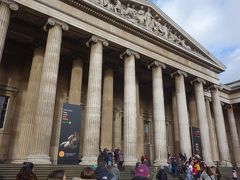
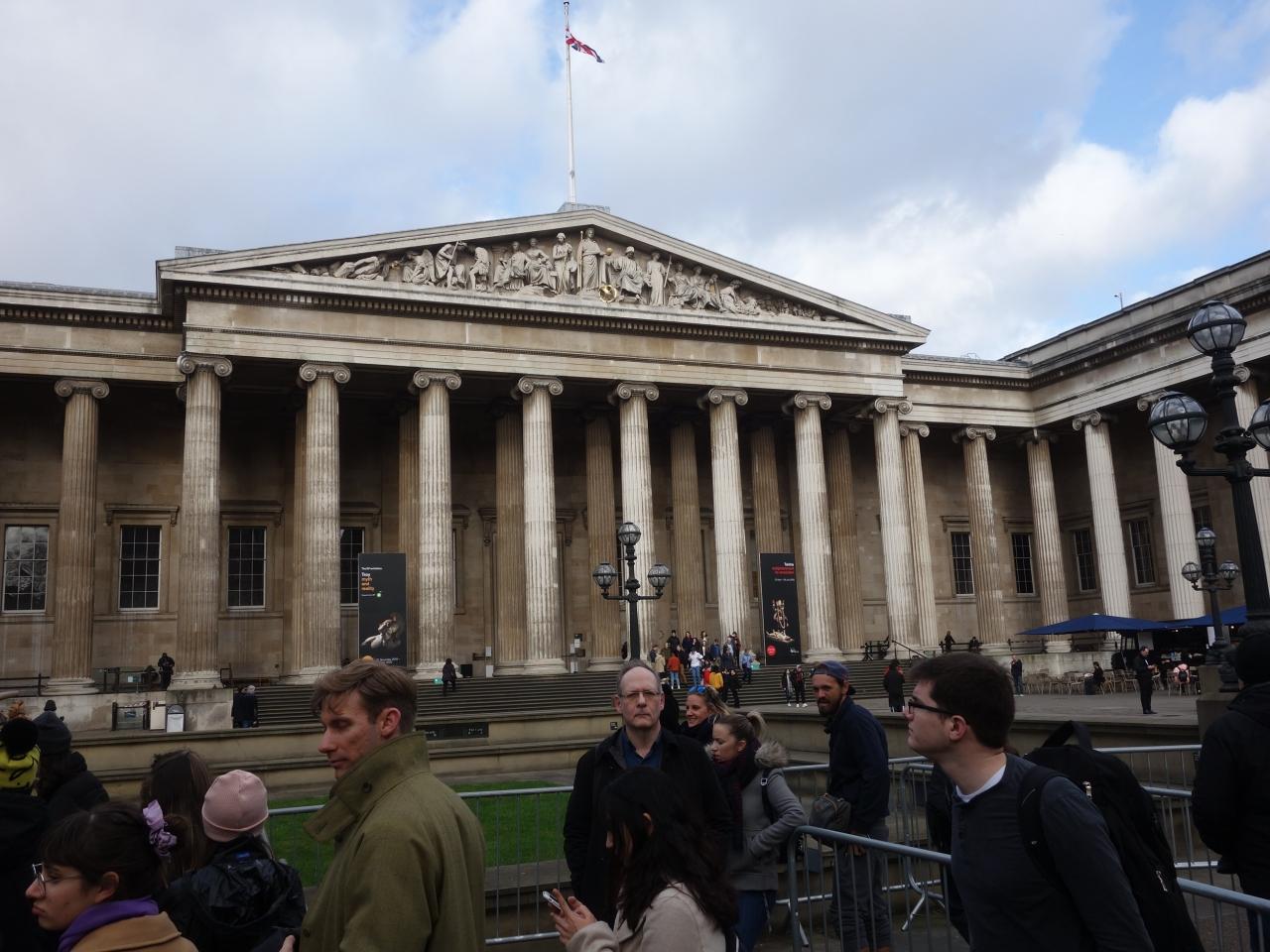
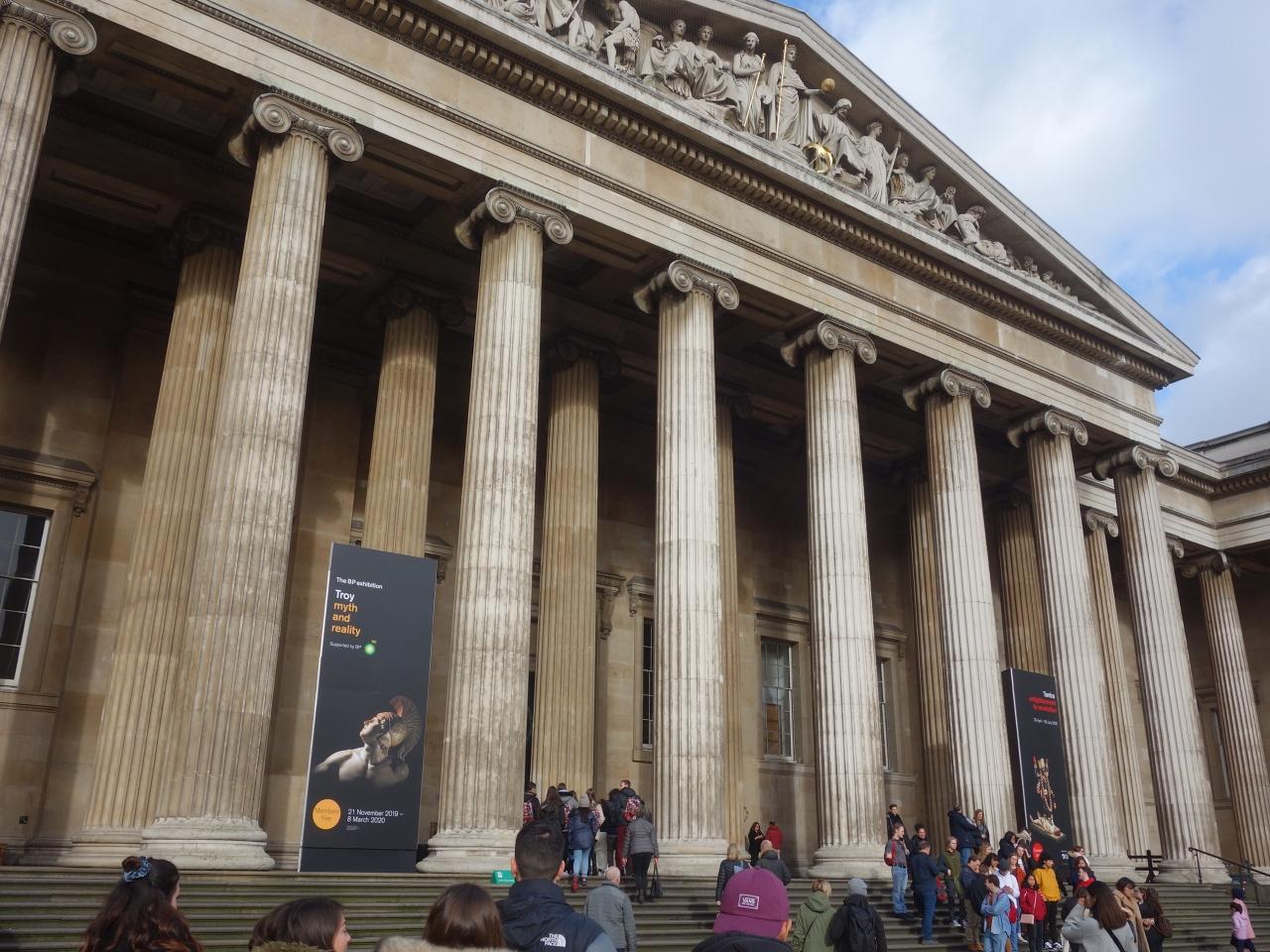
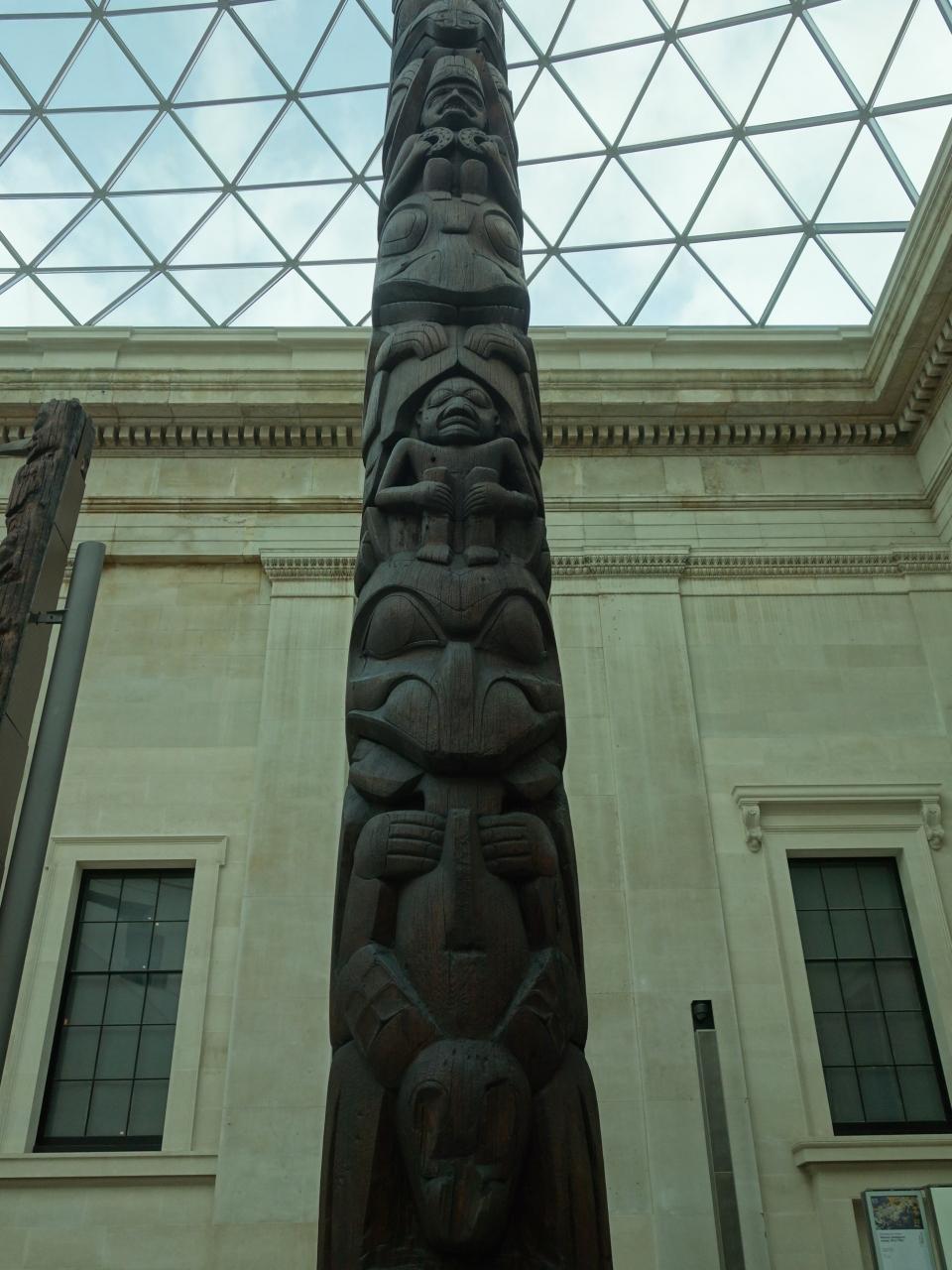
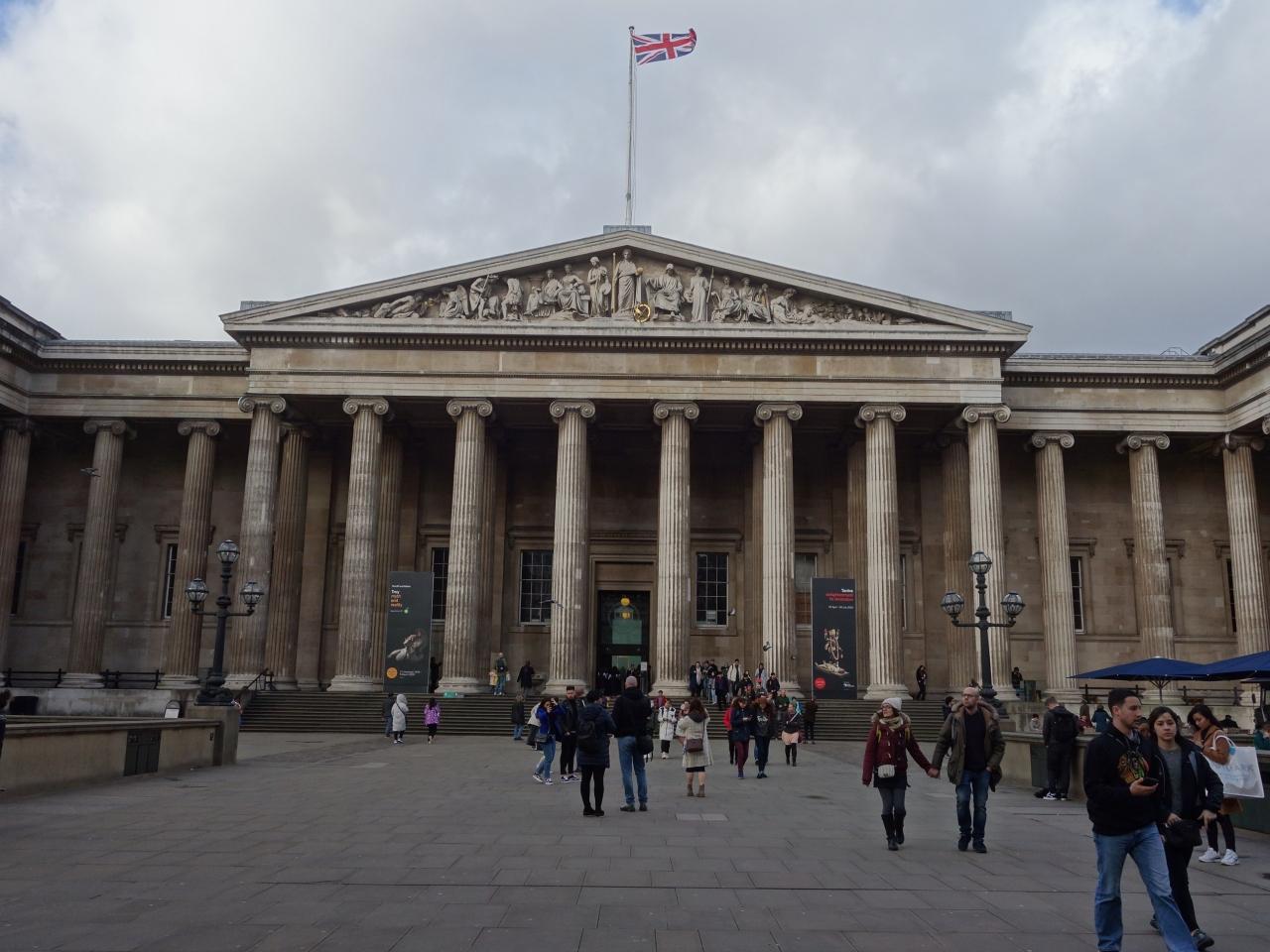
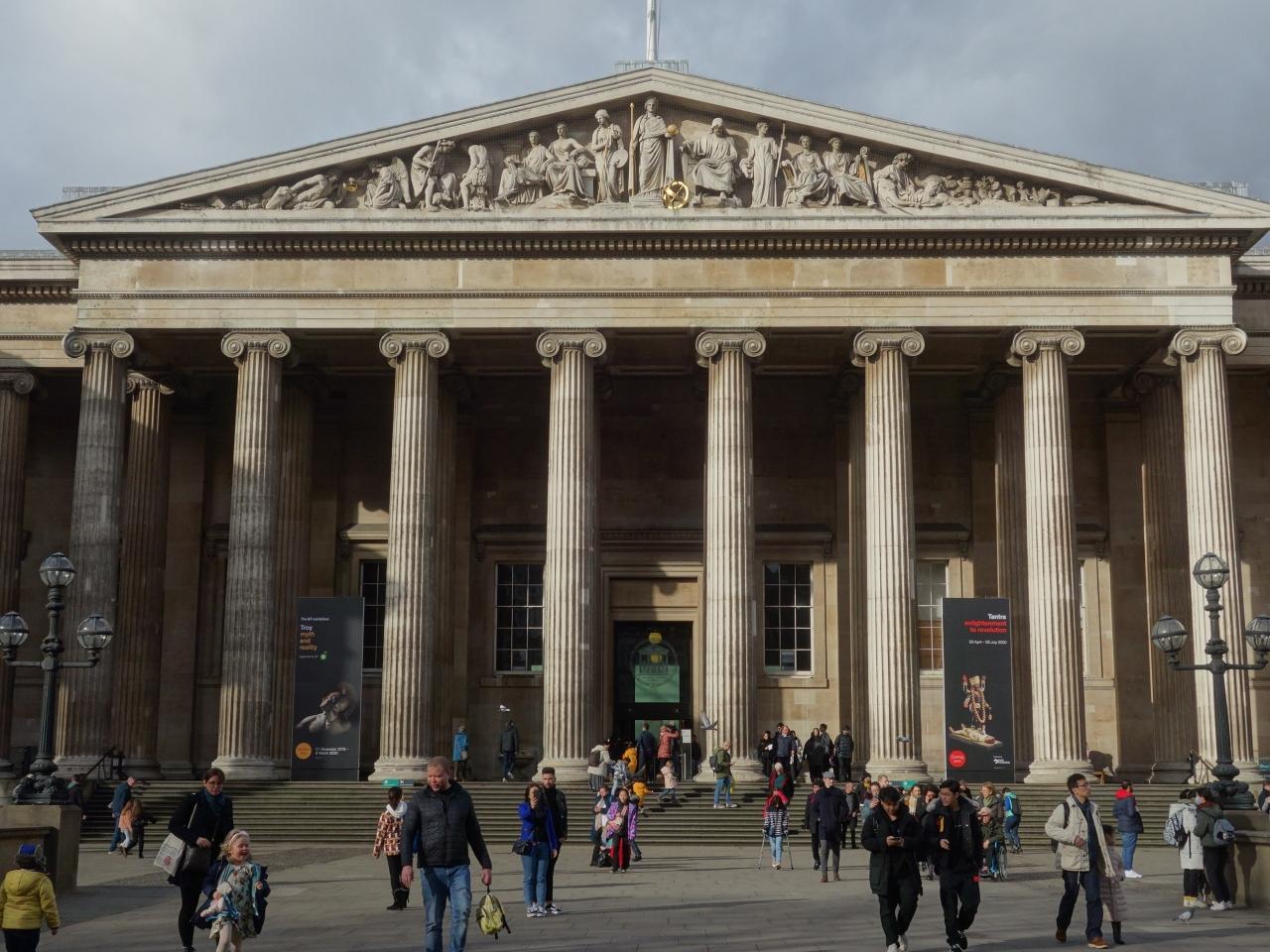
大英博物館に来ました。何回目でしょうか。
-
荷物検査があります。
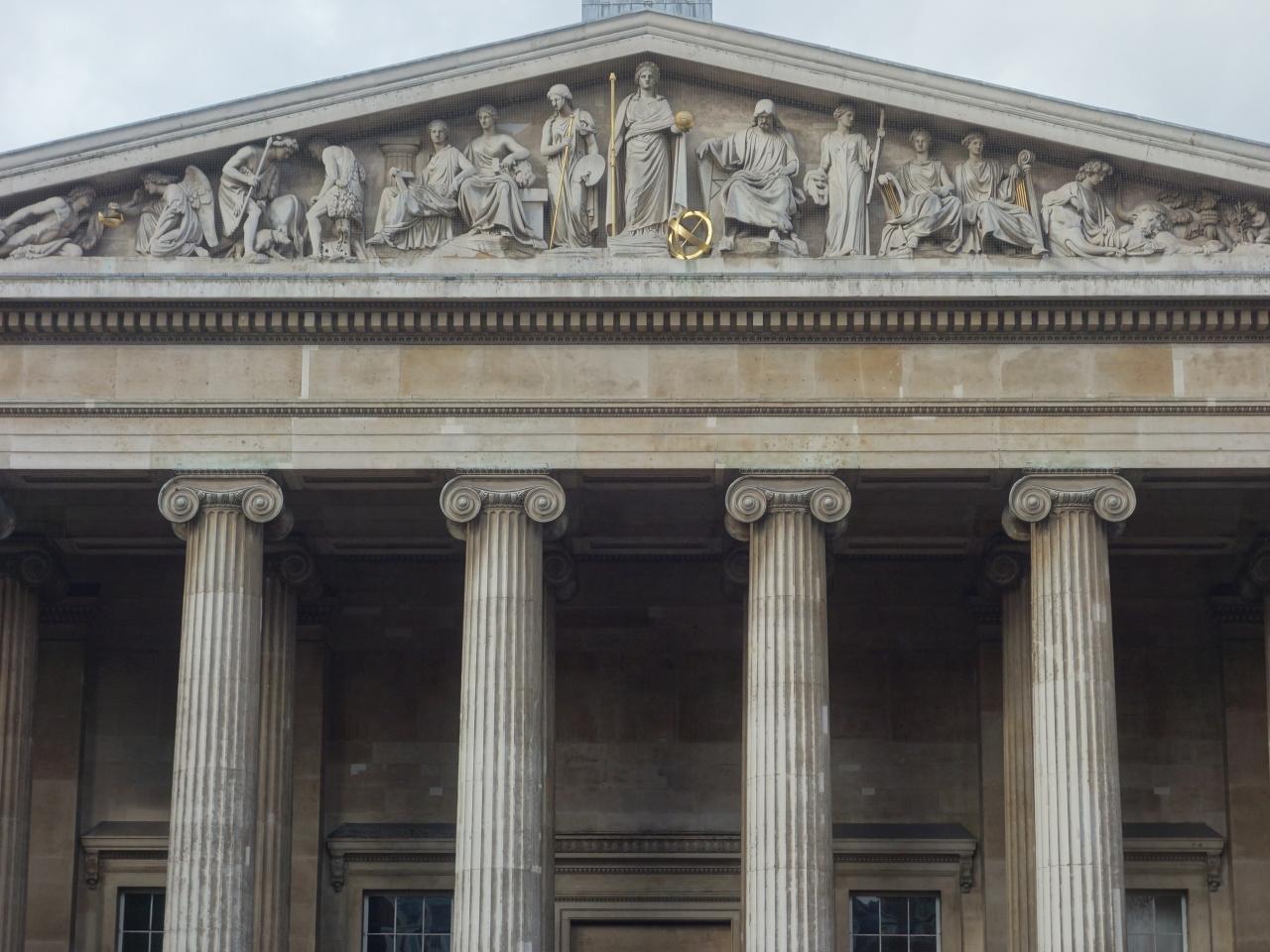
大英帝国の栄華の歴史です。批判も忘れないように。 by nomonomoさん大英博物館 博物館・美術館・ギャラリー
-
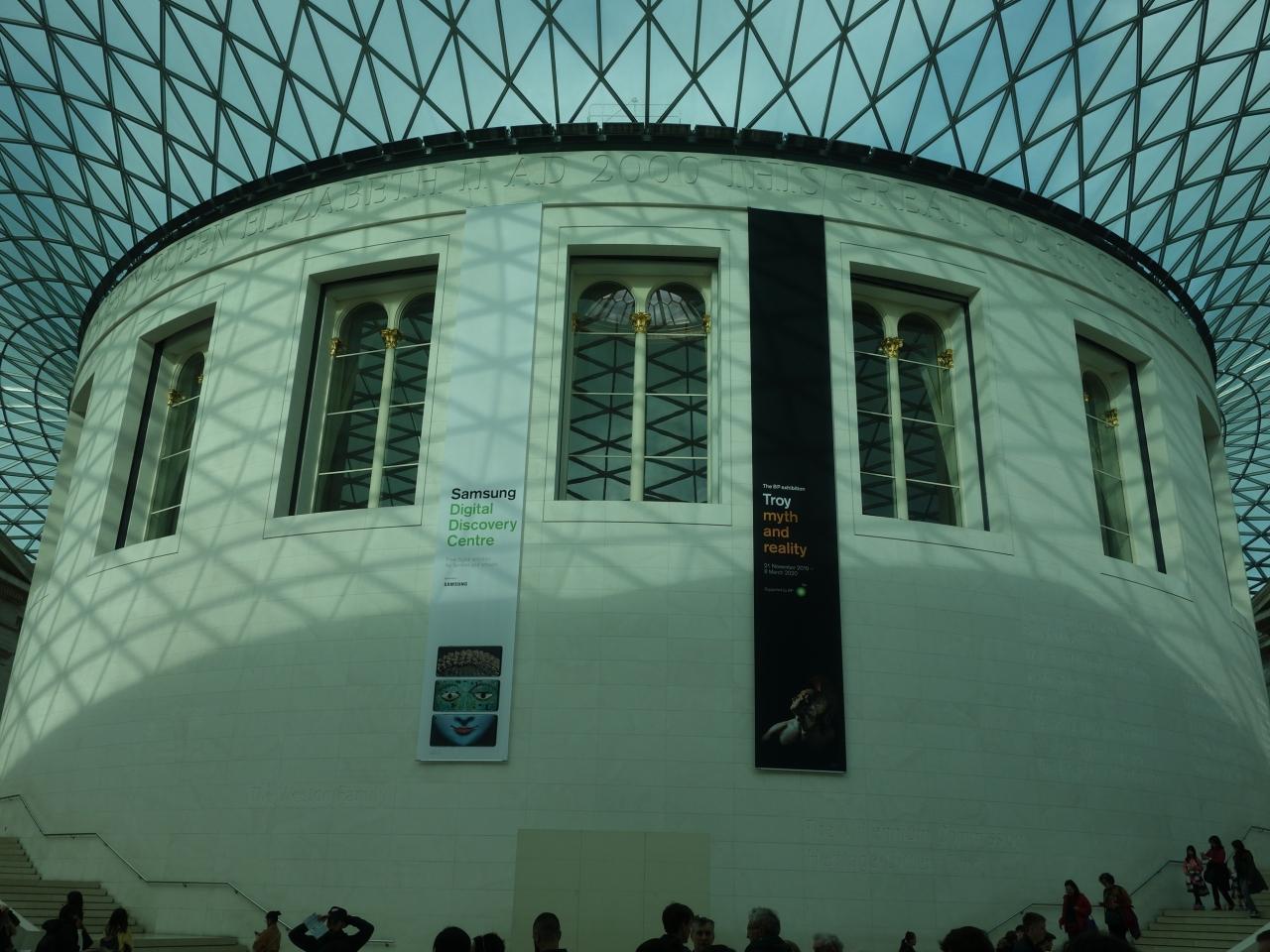
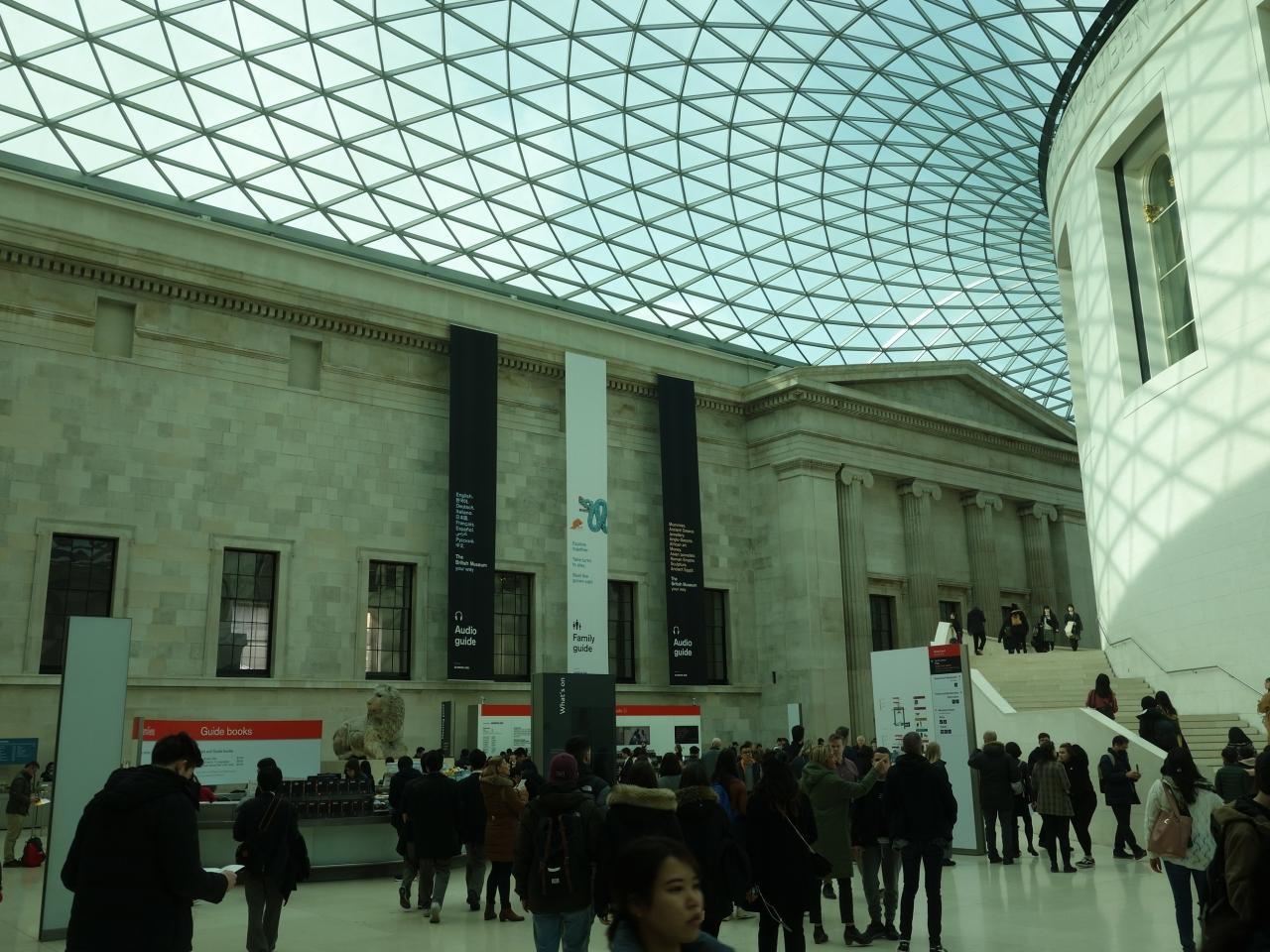
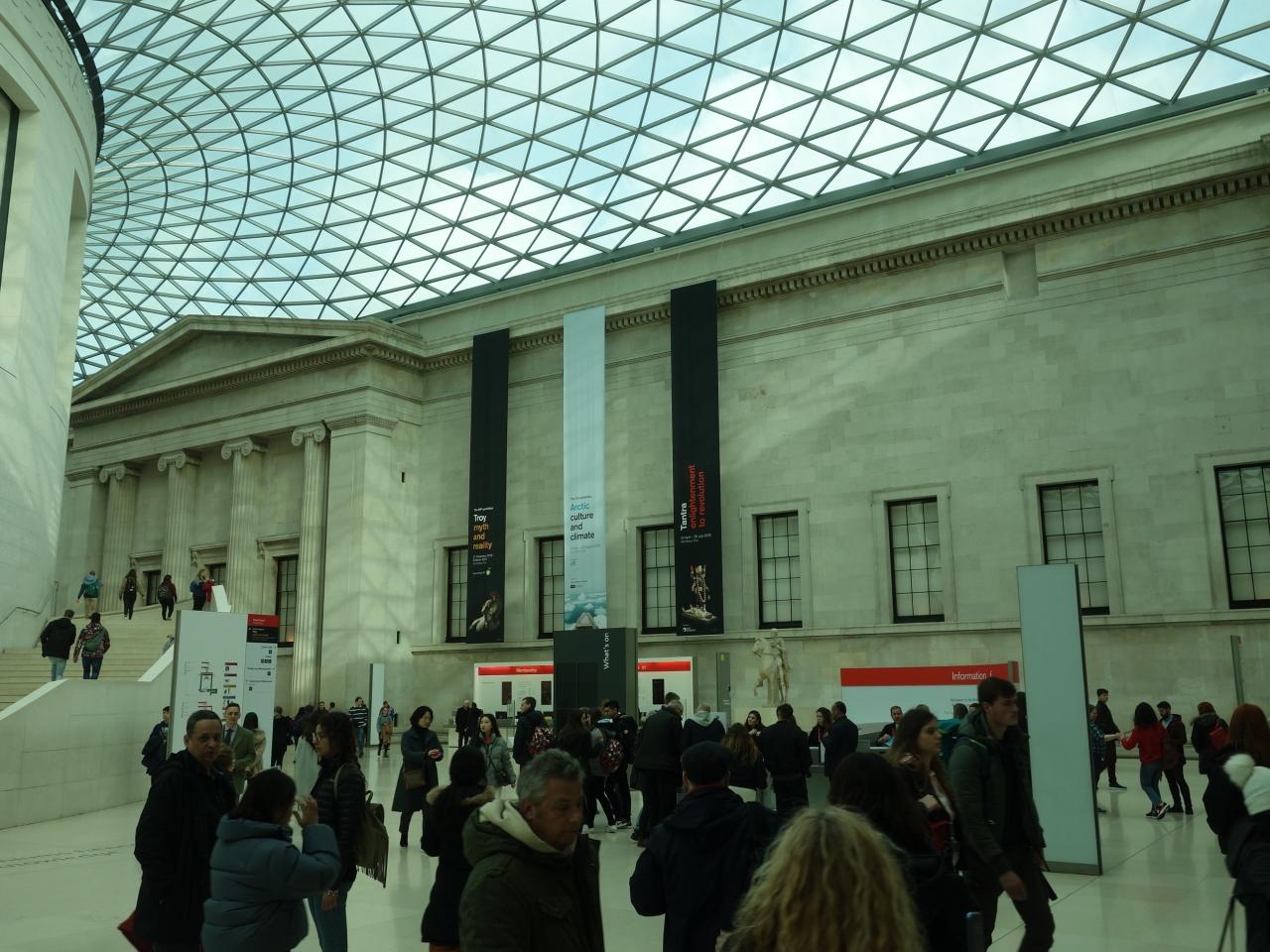
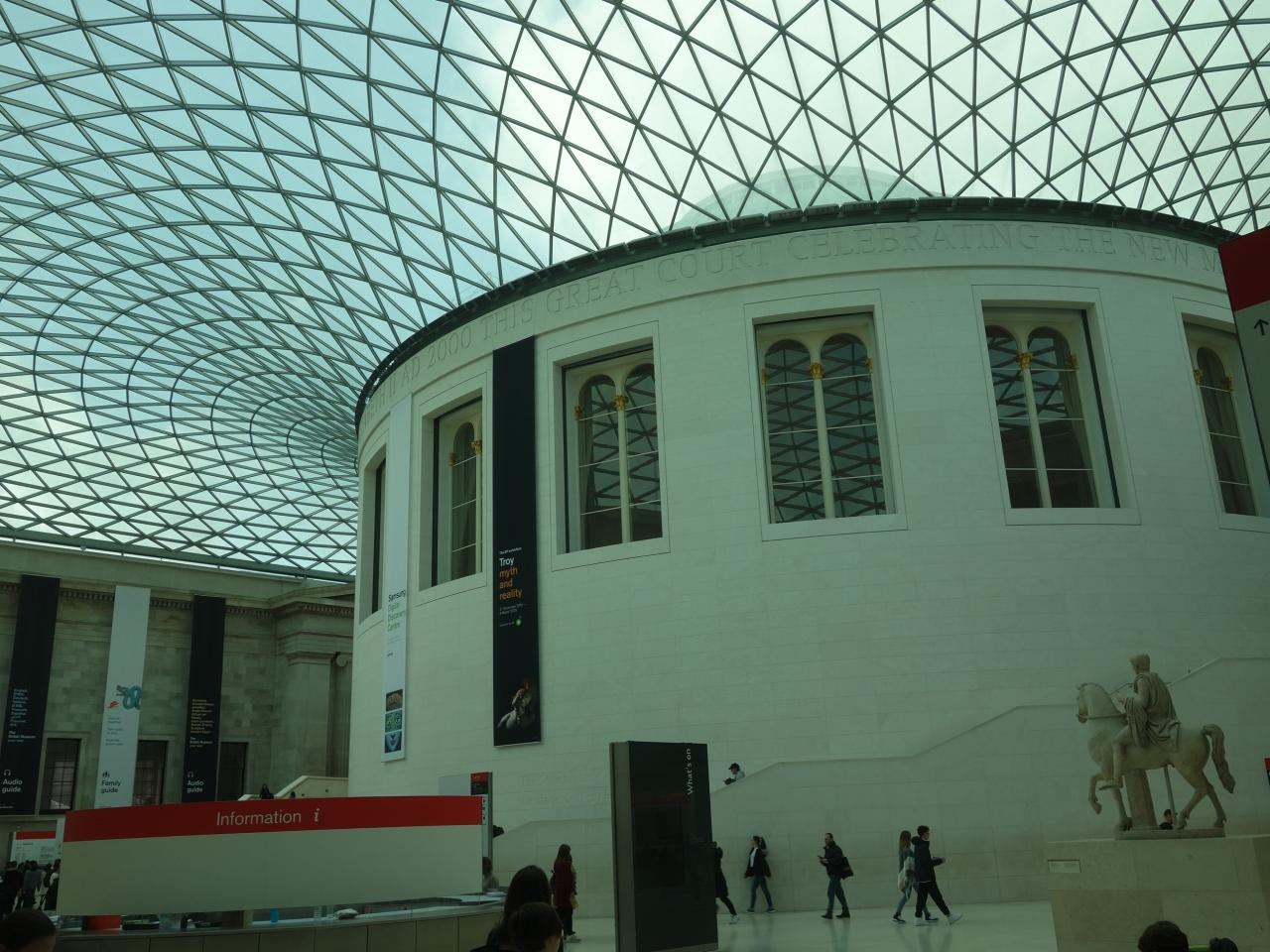
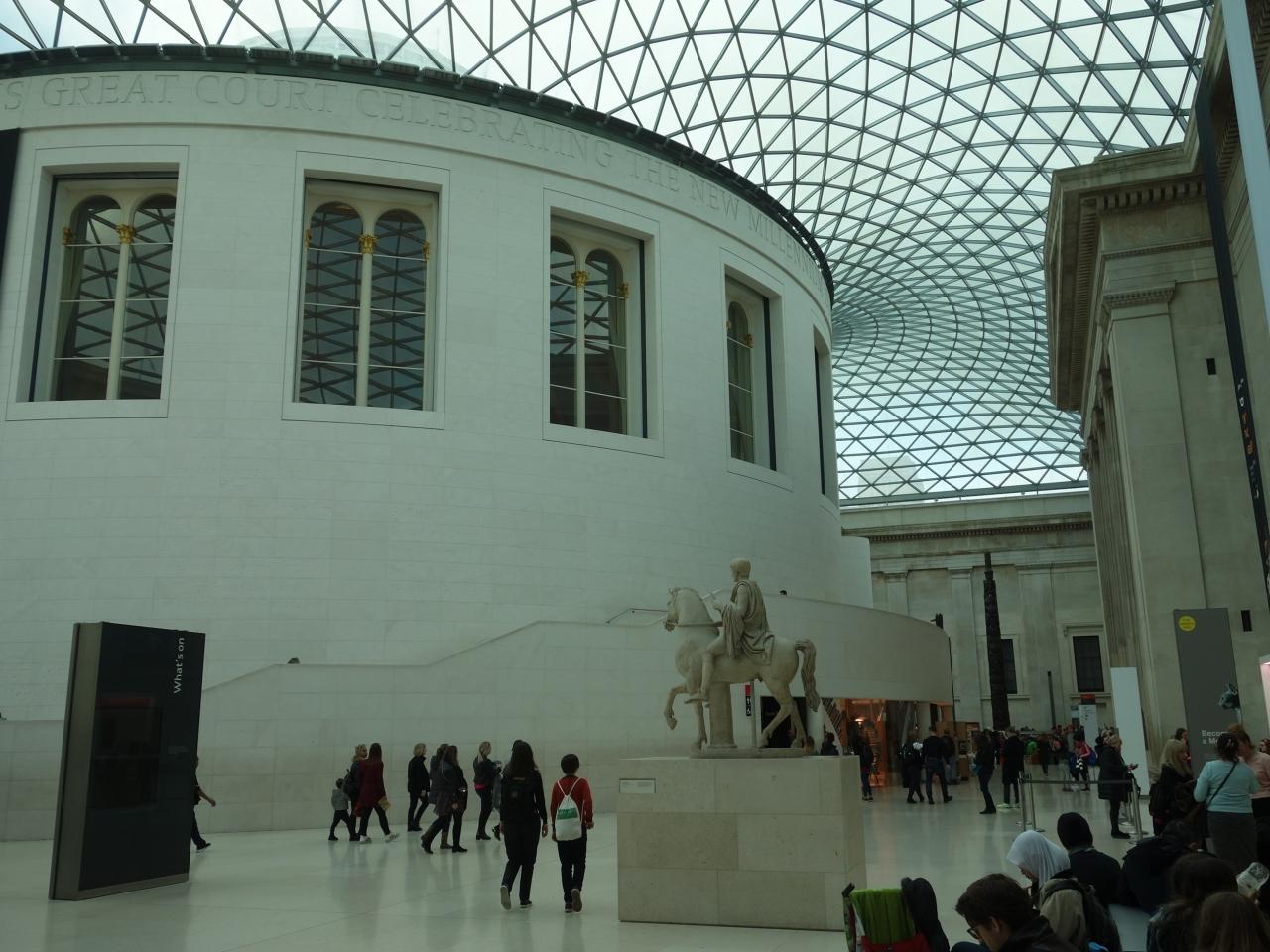
館内に入りました。
-
-
-
-
-
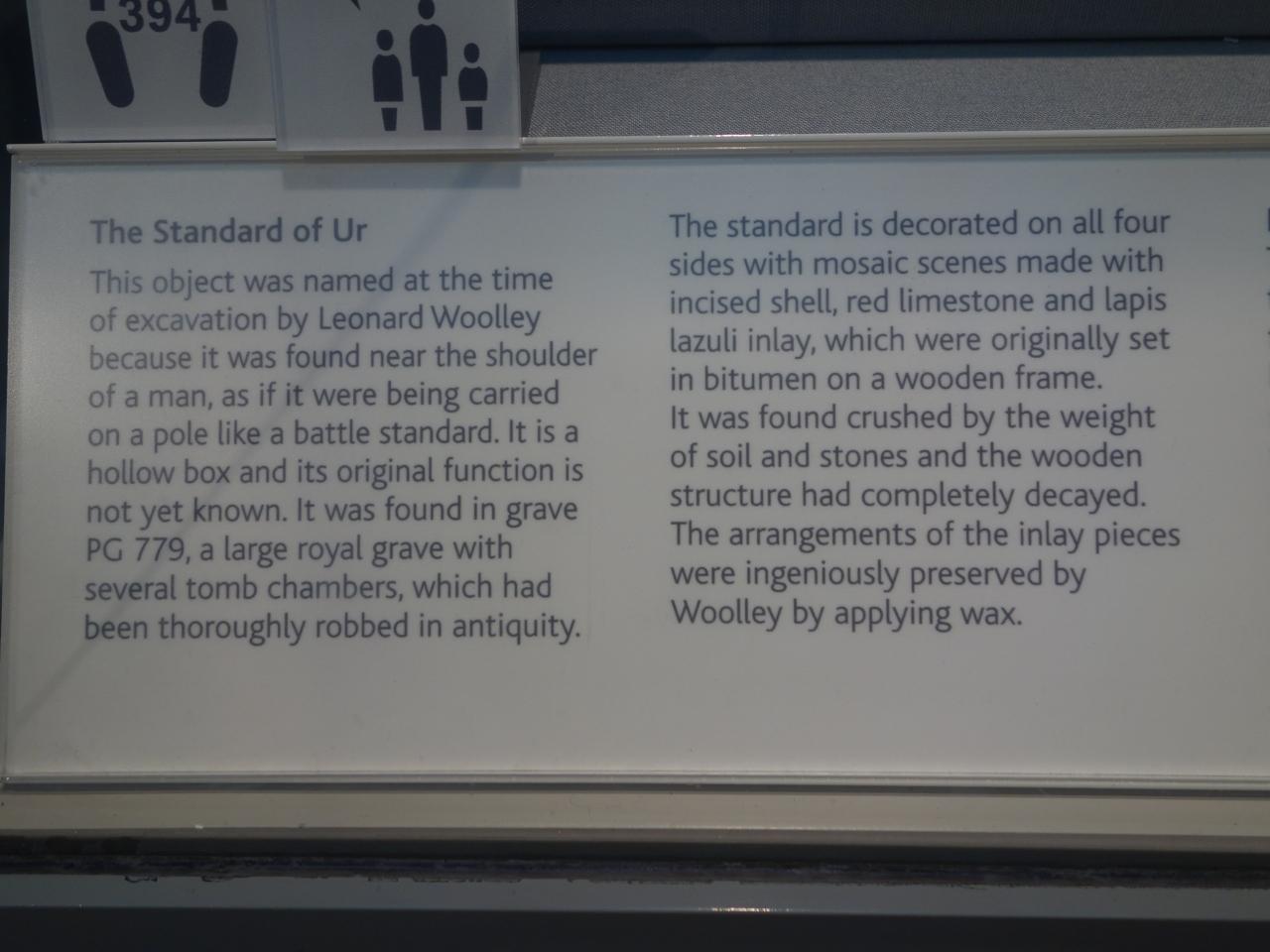
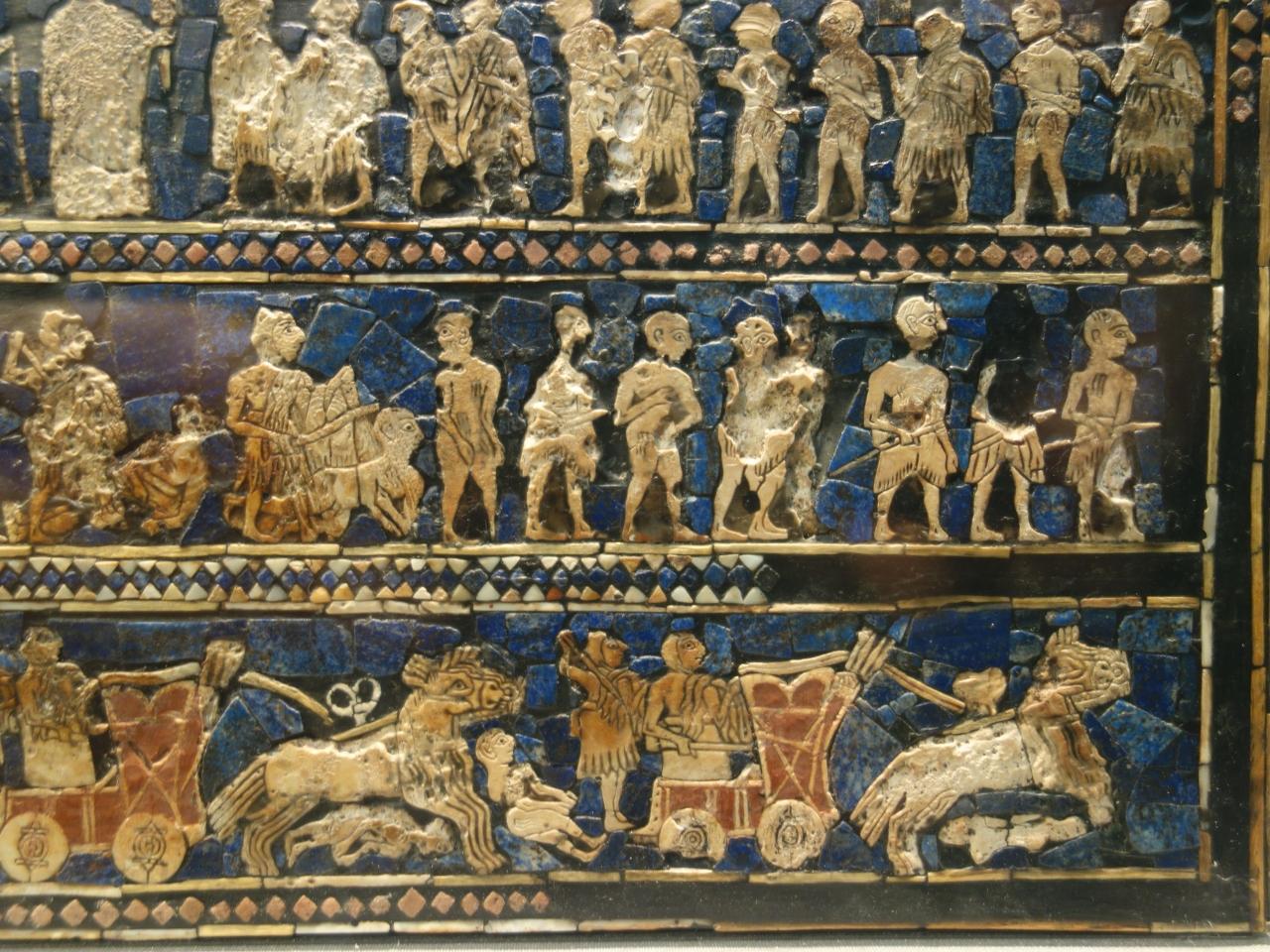
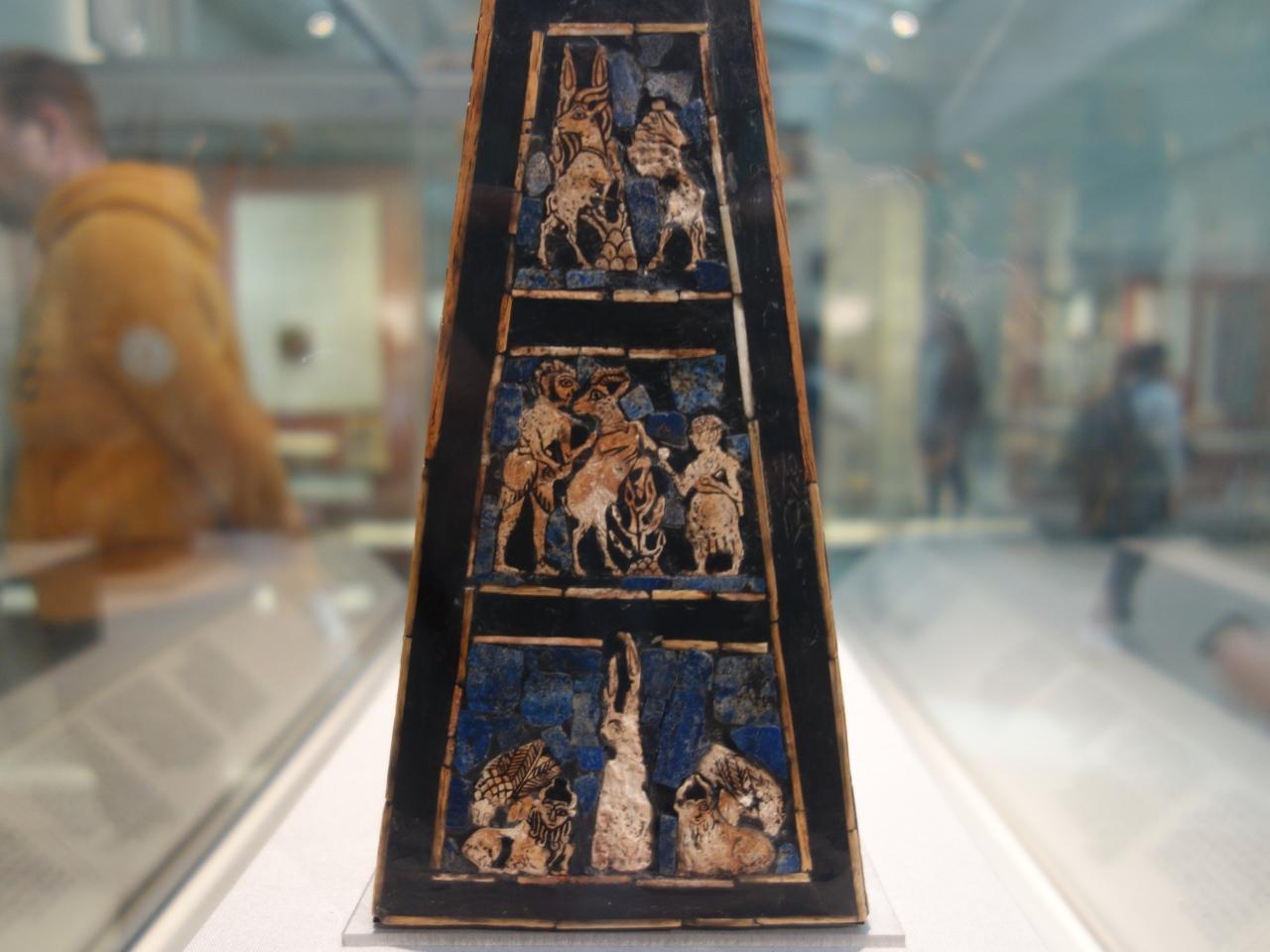
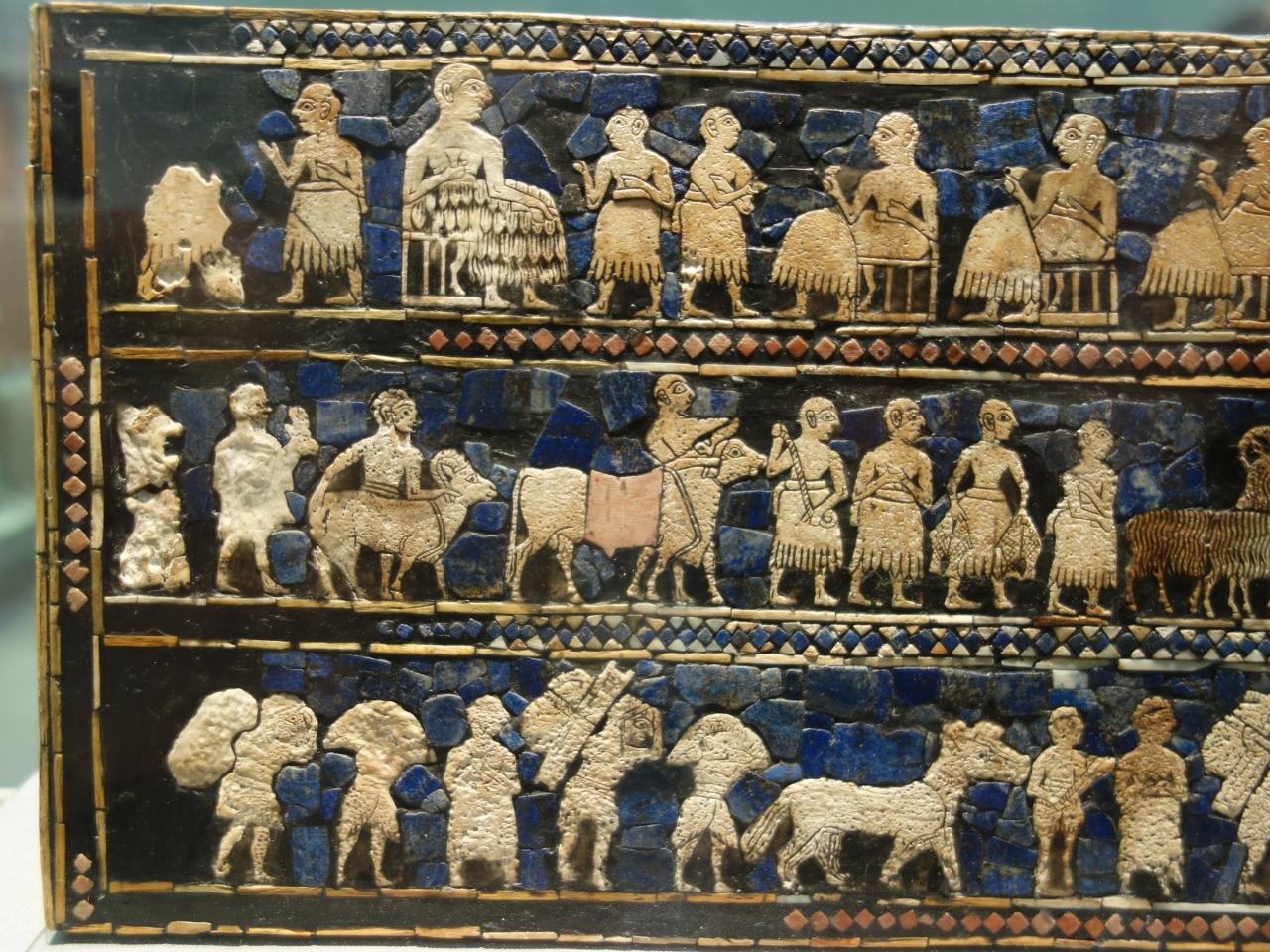
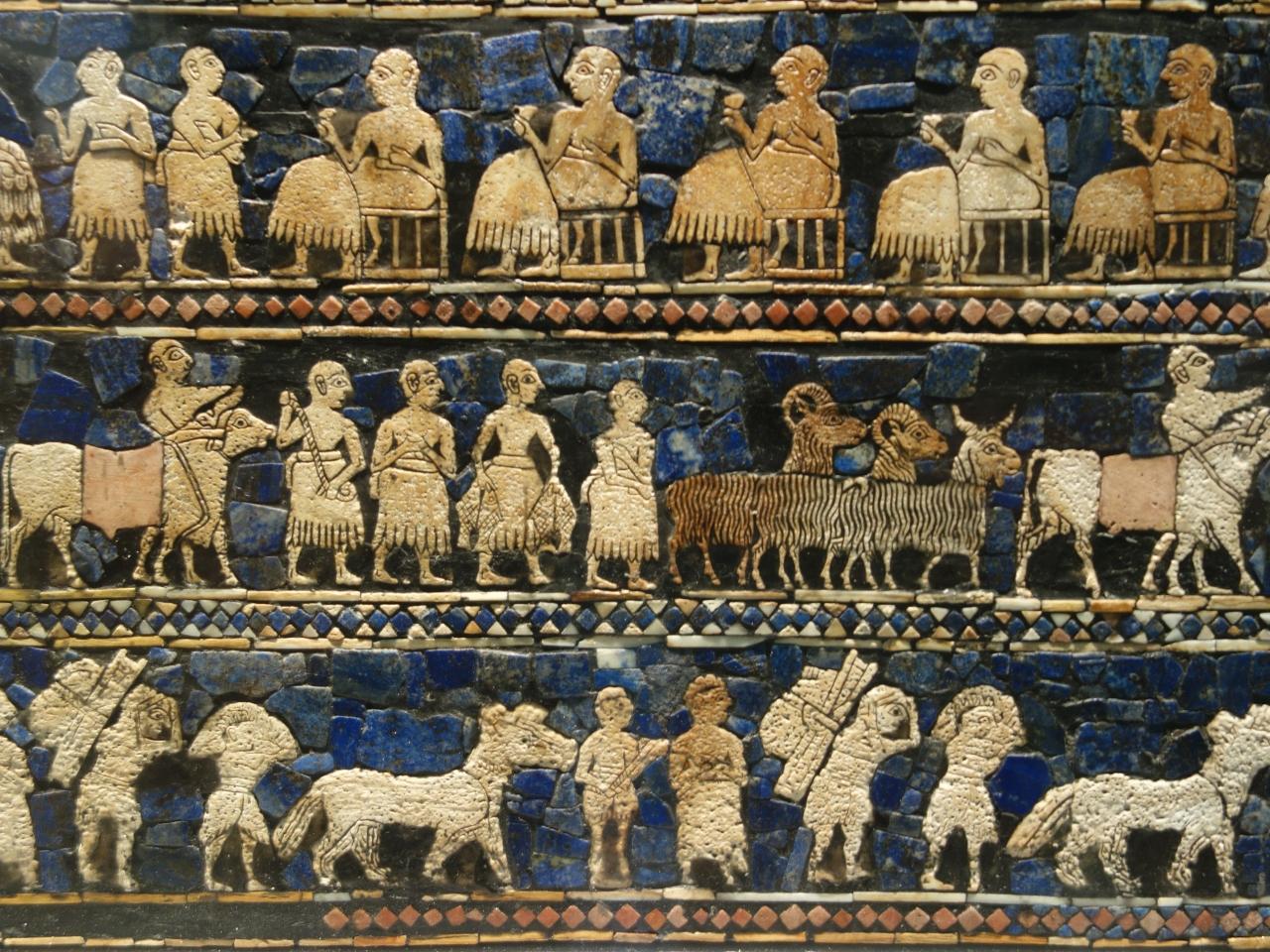
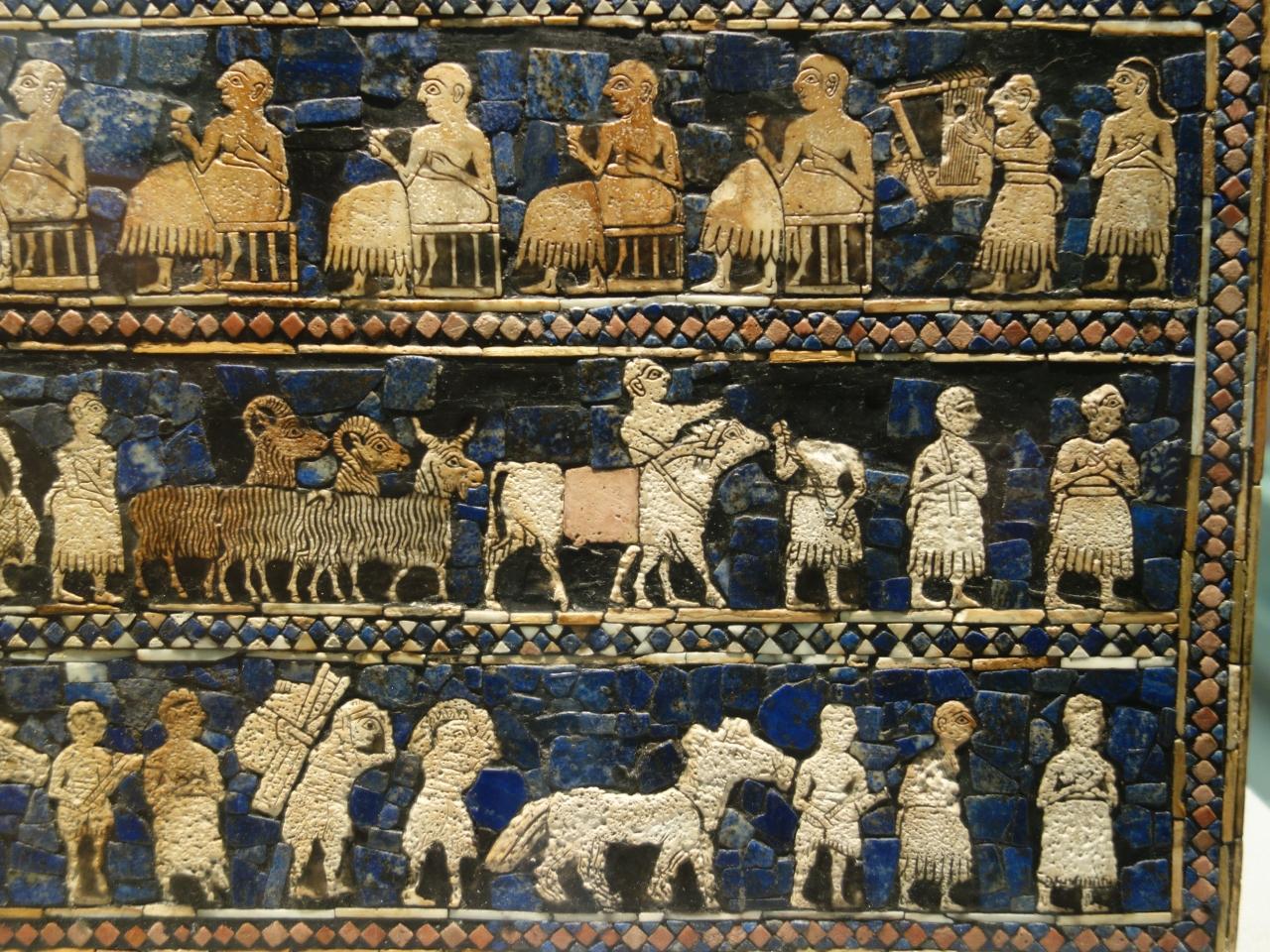
The Standard of Ur
This object was named at the time
of excavation by Leonard Woolley
because it was found near the shoulder
of a man, as if it were being carried
on a pole like a battle standard. It is a
hollow box and its original function is
not yet known. It was found in grave
PG 779, a large royal grave with
several tomb chambers, which had
been thoroughly robbed in antiquity.
The standard is decorated on all four
sides with mosaic scenes made with
incised shell, red limestone and lapis
lazuli inlay, which were originally set
in bitumen on a wooden frame.
It was found crushed by the weight
of soil and stones and the wooden
structure had completely decayed.
The arrangements of the inlay pieces
were ingeniously preserved by
Woolley by applying wax. -
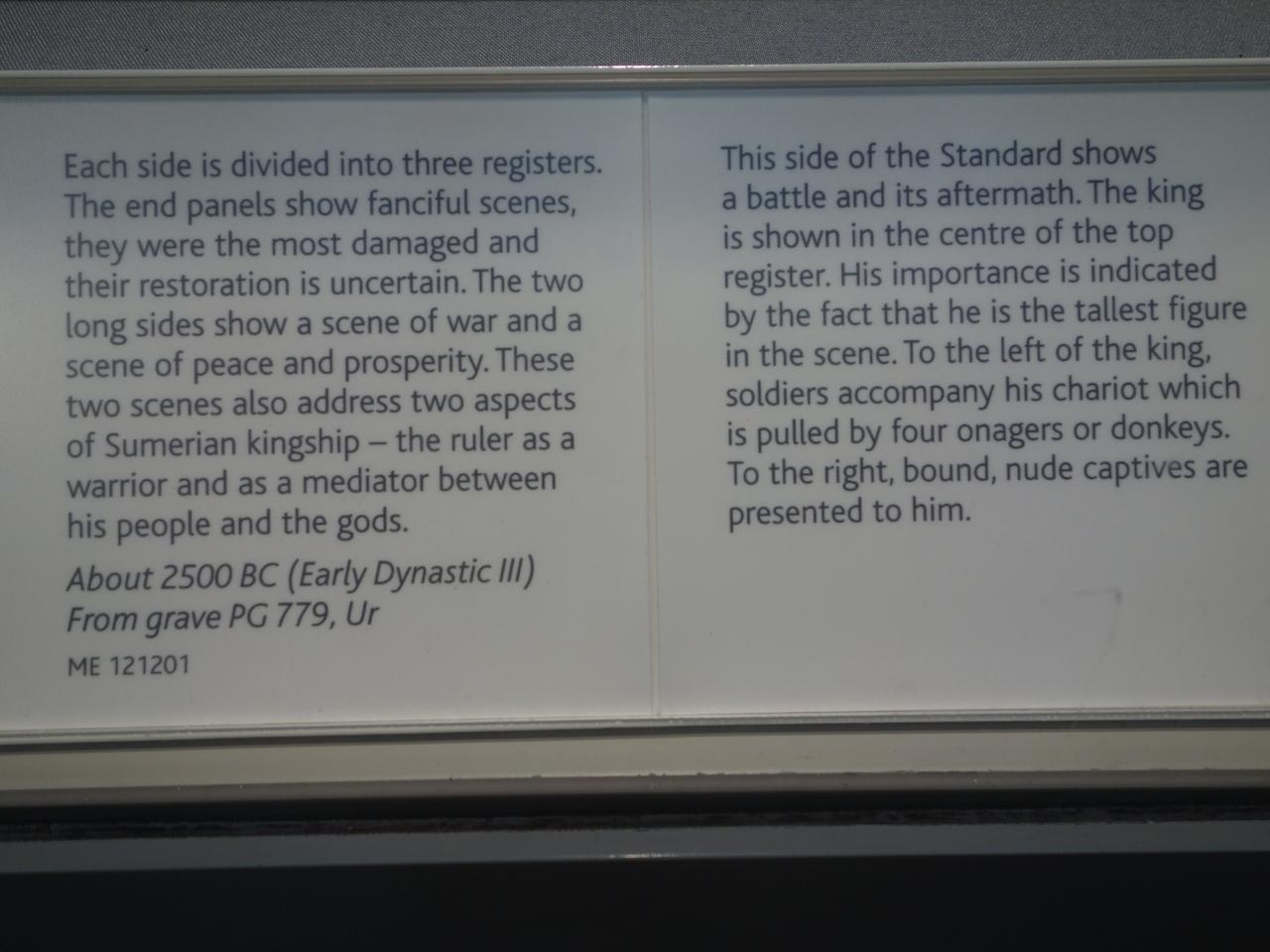
Each side is divided into three registers.
The end panels show fanciful scenes,
they were the most damaged and
their restoration is uncertain. The two
long sides show a scene of war and a
scene of peace and prosperity. These
two scenes also address two aspects
of Sumerian kingship ? the ruler as a
warrior and as a mediator between
his people and the gods.
About 2500 BC (Early Dynastic III)
From grave PG 779, Ur
ME 121201
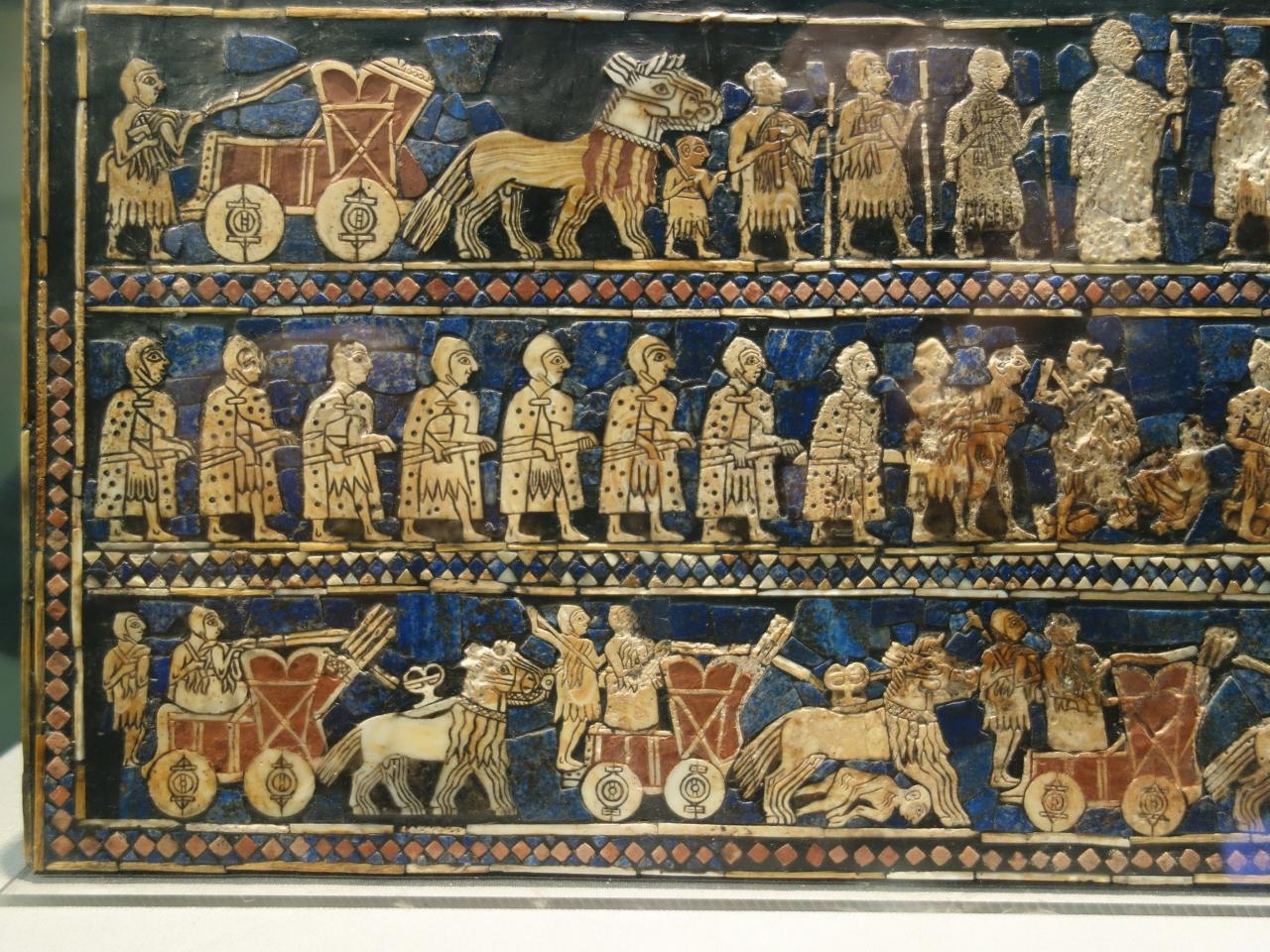
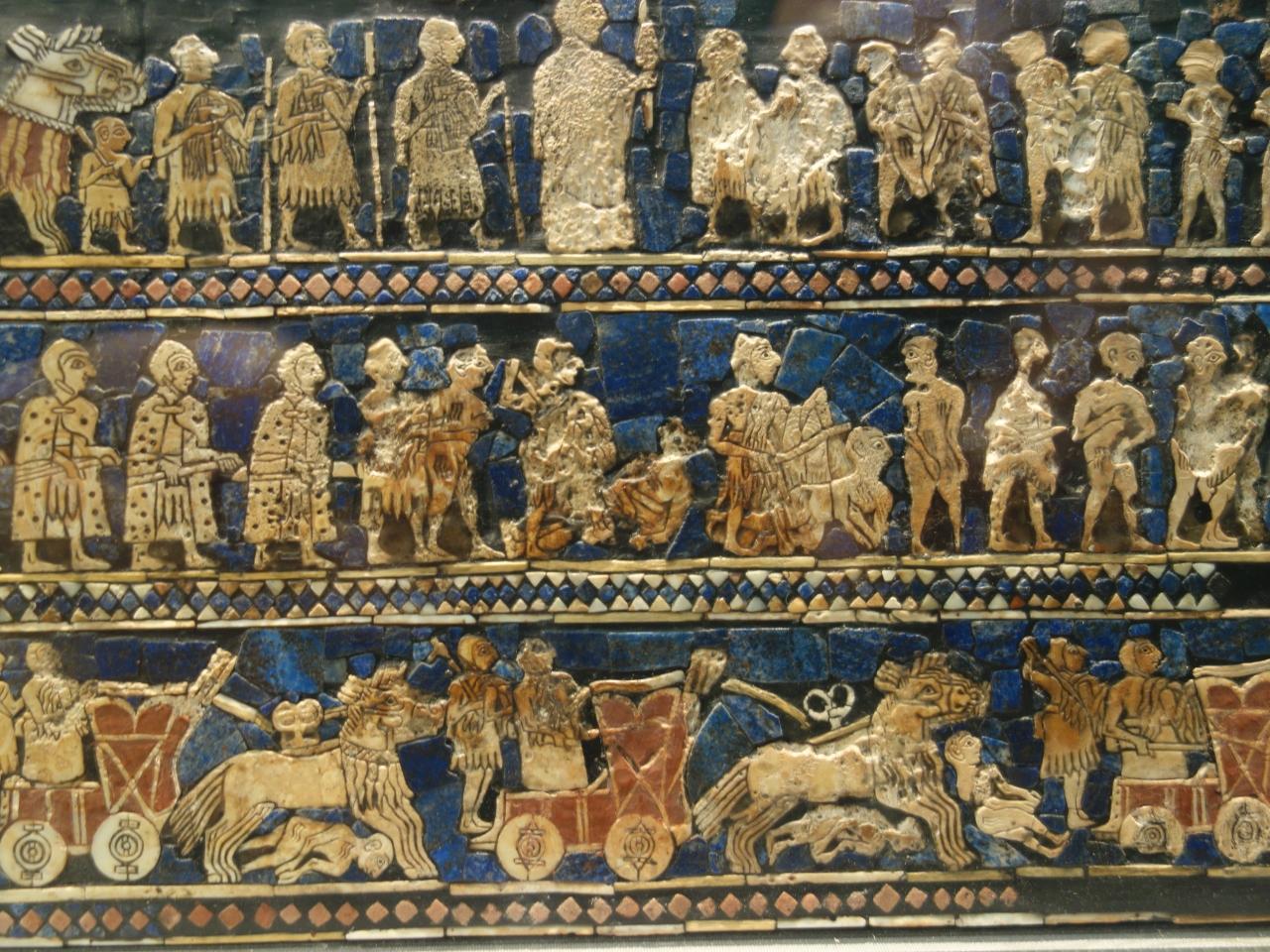
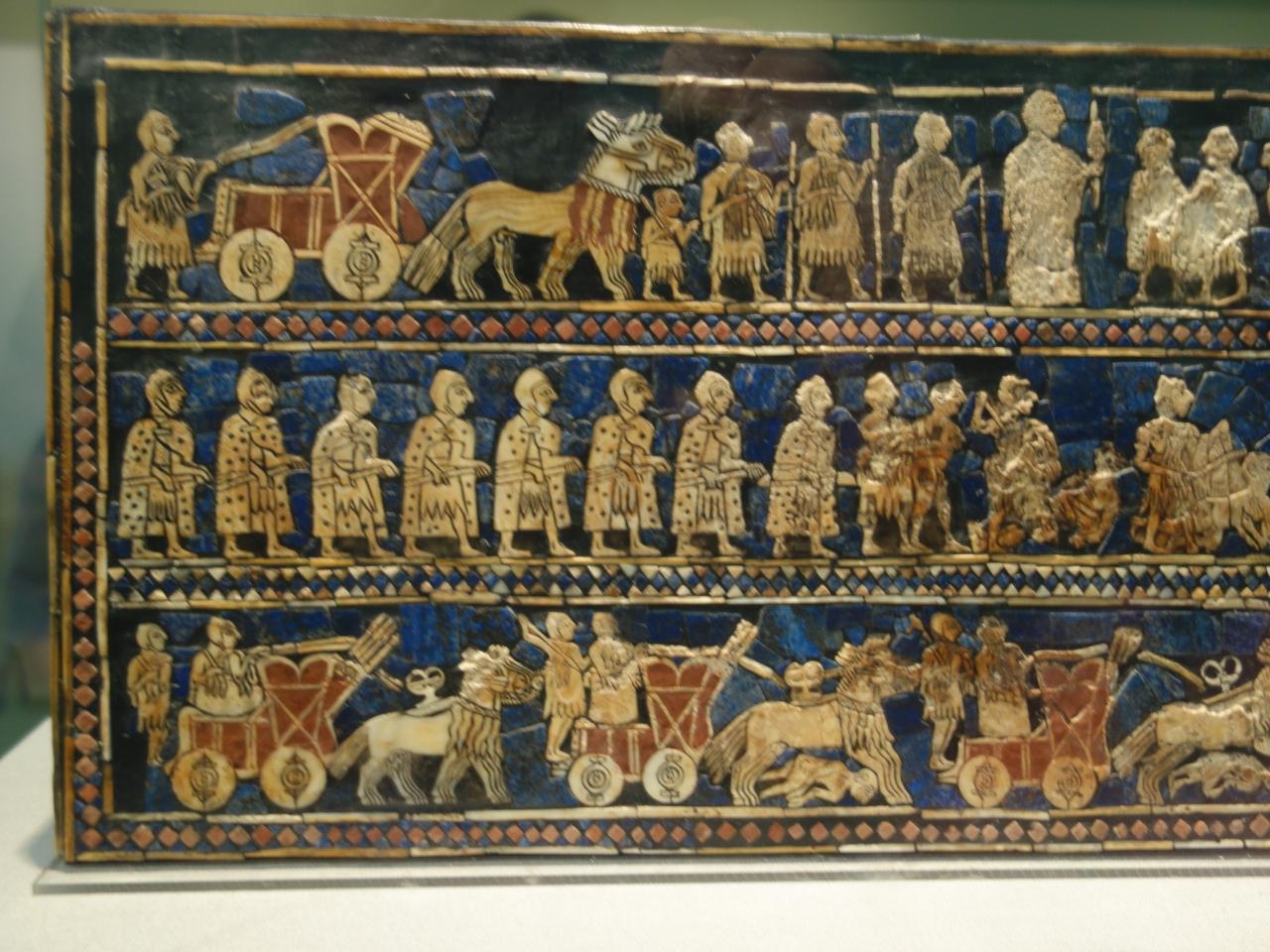
This side of the Standard shows
a battle and its aftermath. The king
is shown in the centre of the top
register. His importance is indicated
by the fact that he is the tallest figure
in the scene. To the left of the king,
soldiers accompany his chariot which
is pulled by four onagers or donkeys.
To the right, bound, nude captives are
presented to him. -
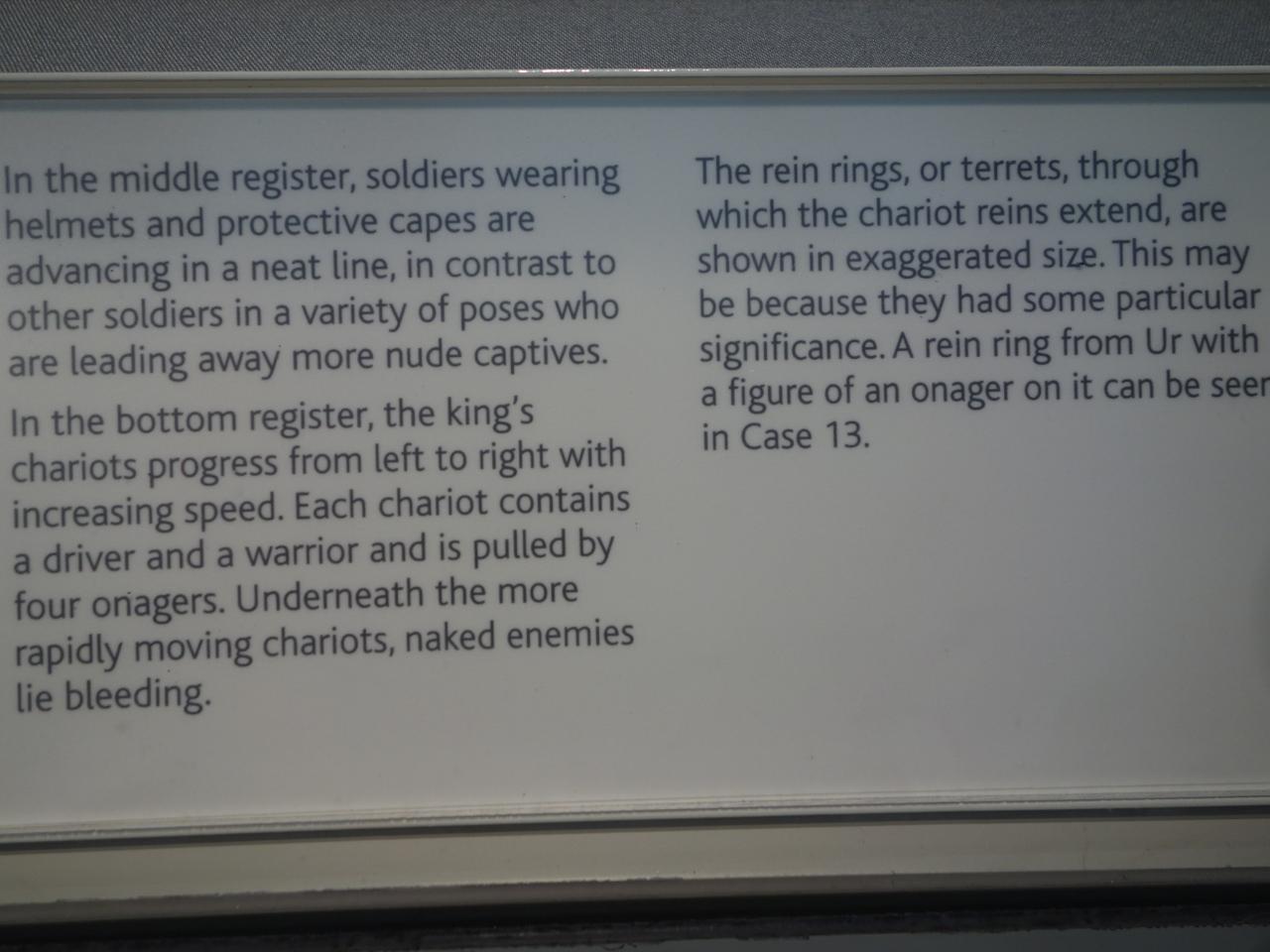
In the middle register, soldiers wearing
helmets and protective capes are
advancing in a neat line, in contrast to
other soldiers in a variety of poses who
are leading away more nude captives.
In the bottom register, the king's
chariots progress from left to right with
increasing speed. Each chariot contains
a driver and a warrior and is pulled by
four onagers. Underneath the more
rapidly moving chariots, naked enemies
lie bleeding.
The rein rings, or terrets, through
which the chariot reins extend, are
shown in exaggerated size. This may
be because they had some particular
significance. A rein ring from Ur with
a figure of an onager on it can be seen
in Case 13. -
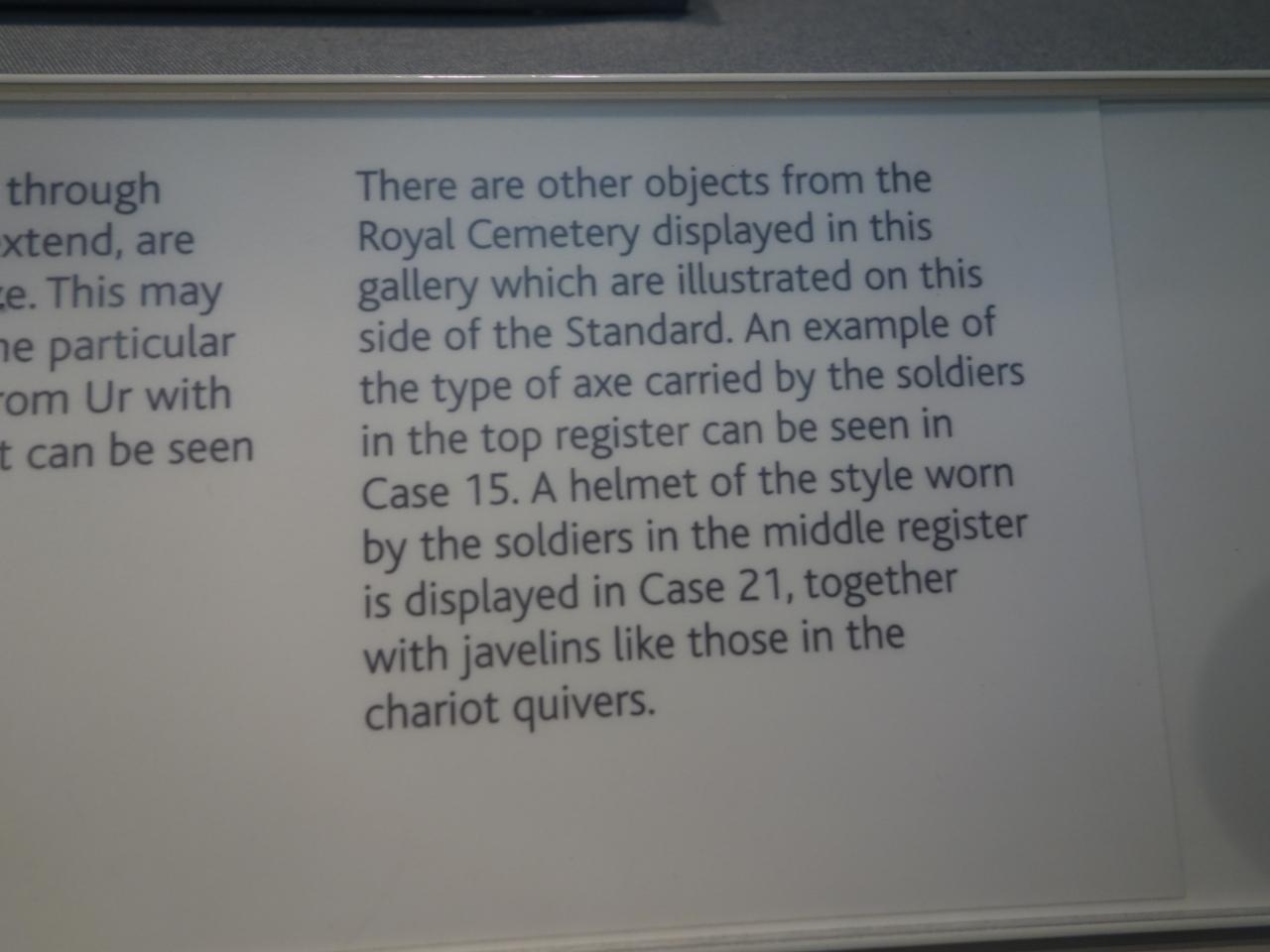
There are other objects from the
Royal Cemetery displayed in this
gallery which are illustrated on this
side of the Standard. An example of
the type of axe carried by the soldiers
in the top register can be seen in
Case 15. A helmet of the style worn
by the soldiers in the middle register
is displayed in Case 21, together
with javelins like those in the
chariot quivers. -
-
-
-
-
-
-
-
-
-
-
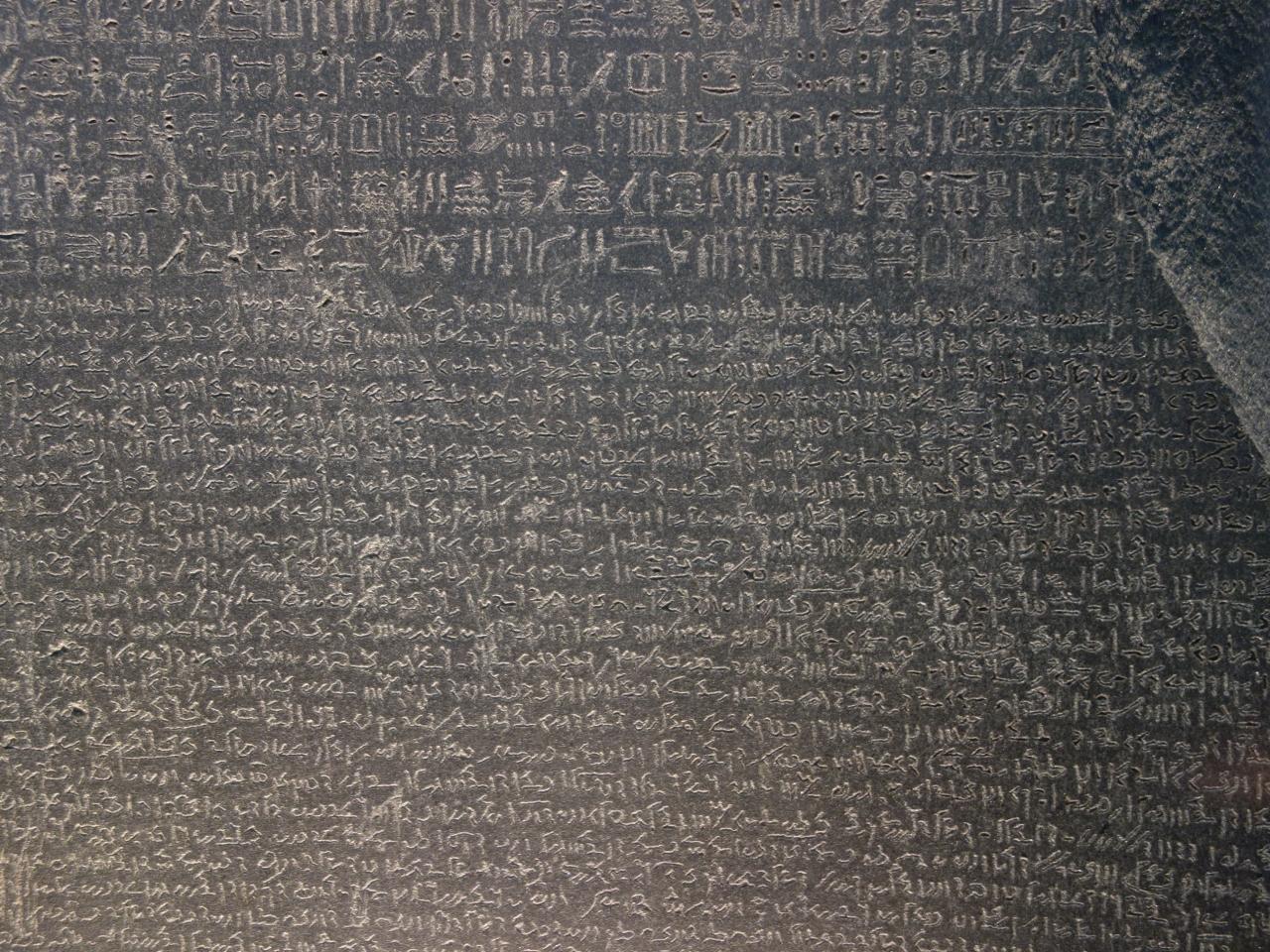
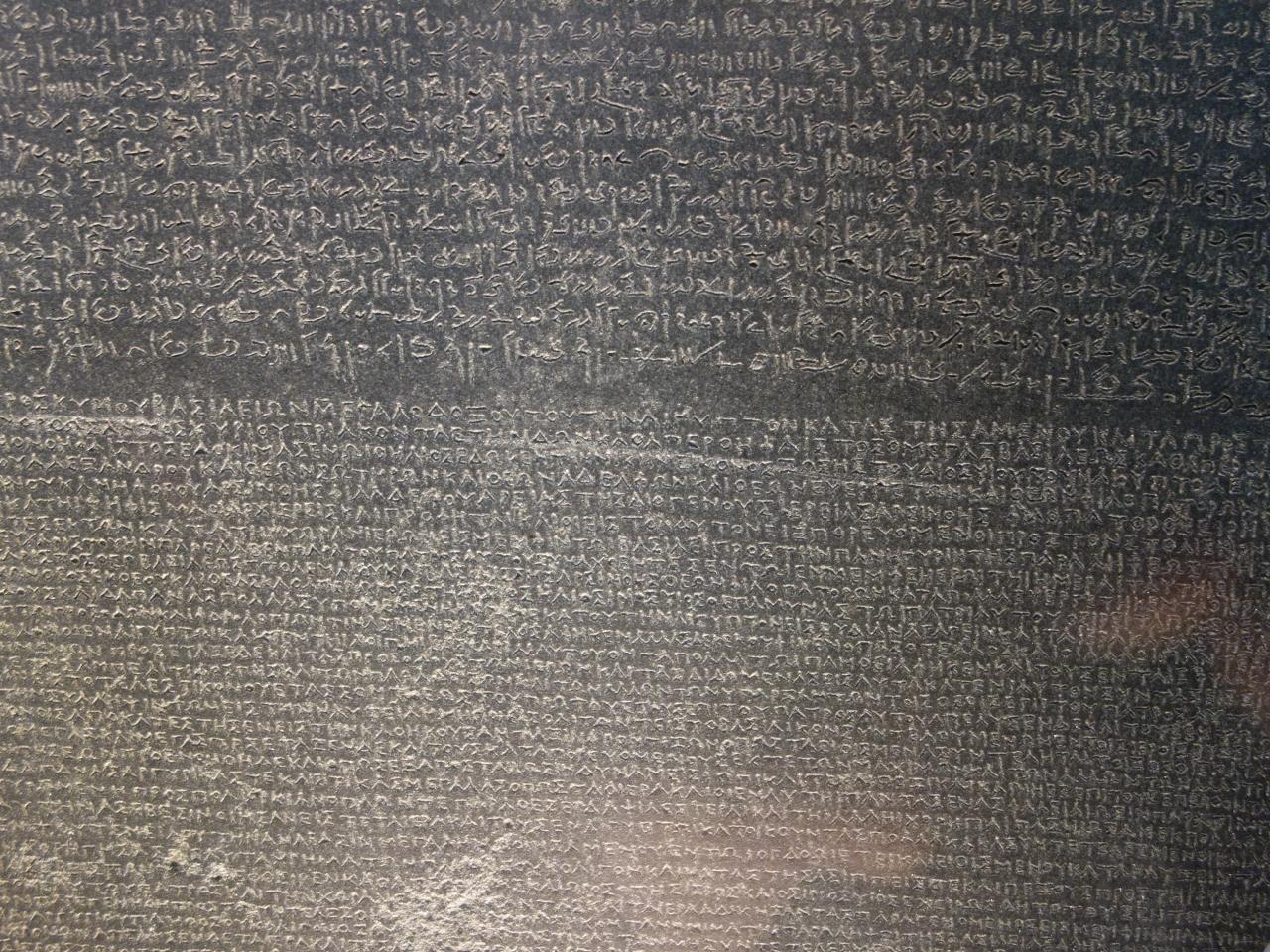
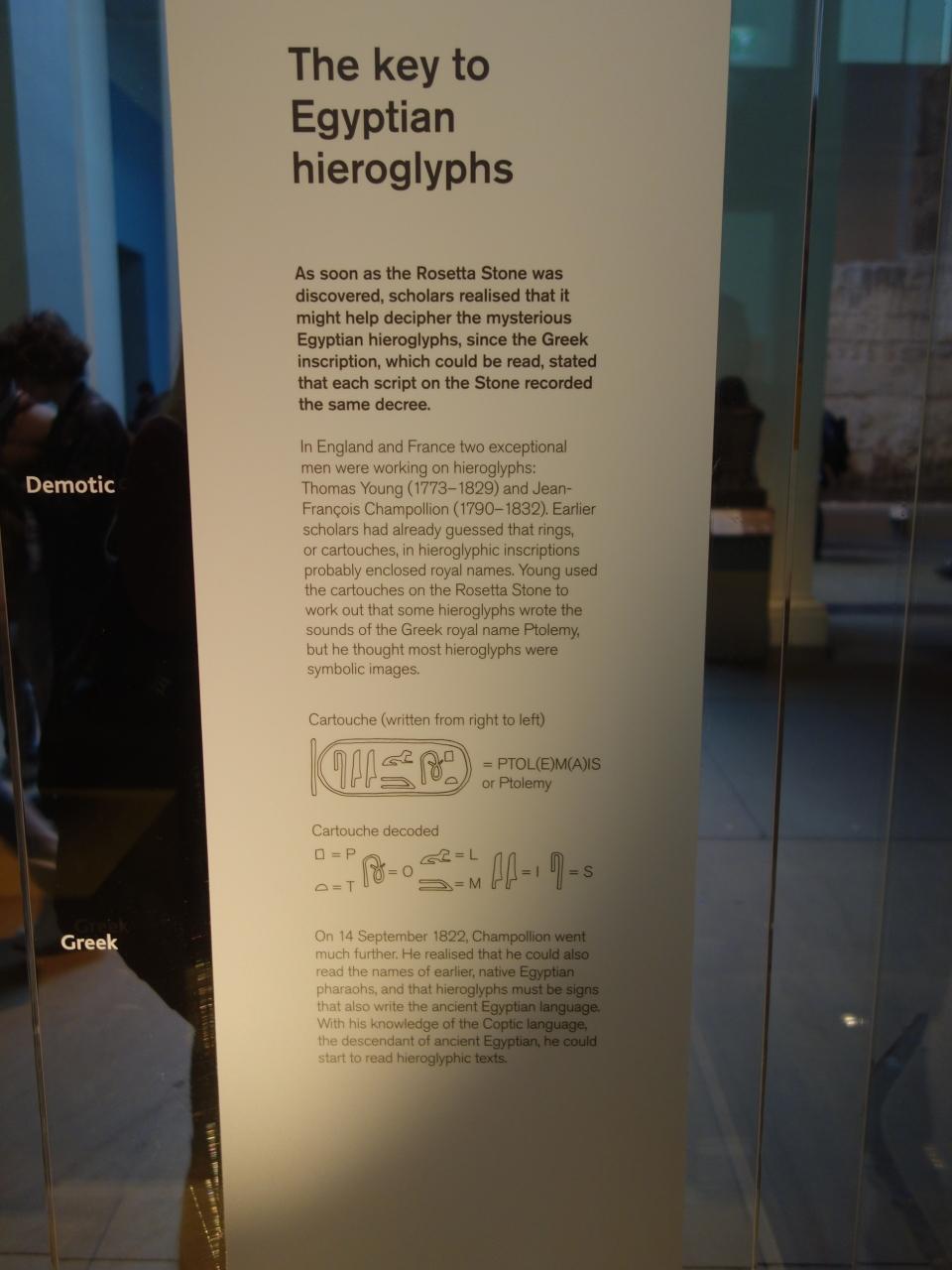
The key to
Egyptian
hieroglyphs
As soon as the Rosetta Stone was
discovered, scholars realised that it
might help decipher the mysterious
Egyptian hieroglyphs, since the Greek
inscription, which could be read, stated
that each script on the Stone recorded
the same decree.
In England and France two exceptional
men were working on hieroglyphs:
Thomas Young (1773-1829) and Jean-
Francois Champollion (1790-1832). Earlier
scholars had already guessed that rings,
or cartouches, in hieroglyphic inscriptions
probably enclosed royal names. Young used
the cartouches on the Rosetta Stone to
work out that some hieroglyphs wrote the
sounds of the Greek royal name Ptolemy,
but he thought most hieroglyphs were
symbolic images.
On 14 September 1822, Champollion went
much further. He realised that he could also
read the names of earlier, native Egyptian
pharaohs, and that hieroglyphs must be signs
that also write the ancient Egyptian language.
With his knowledge of the Coptic language,
the descendant of ancient Egyptian, he could
start to read hieroglyphic texts. -
-
-
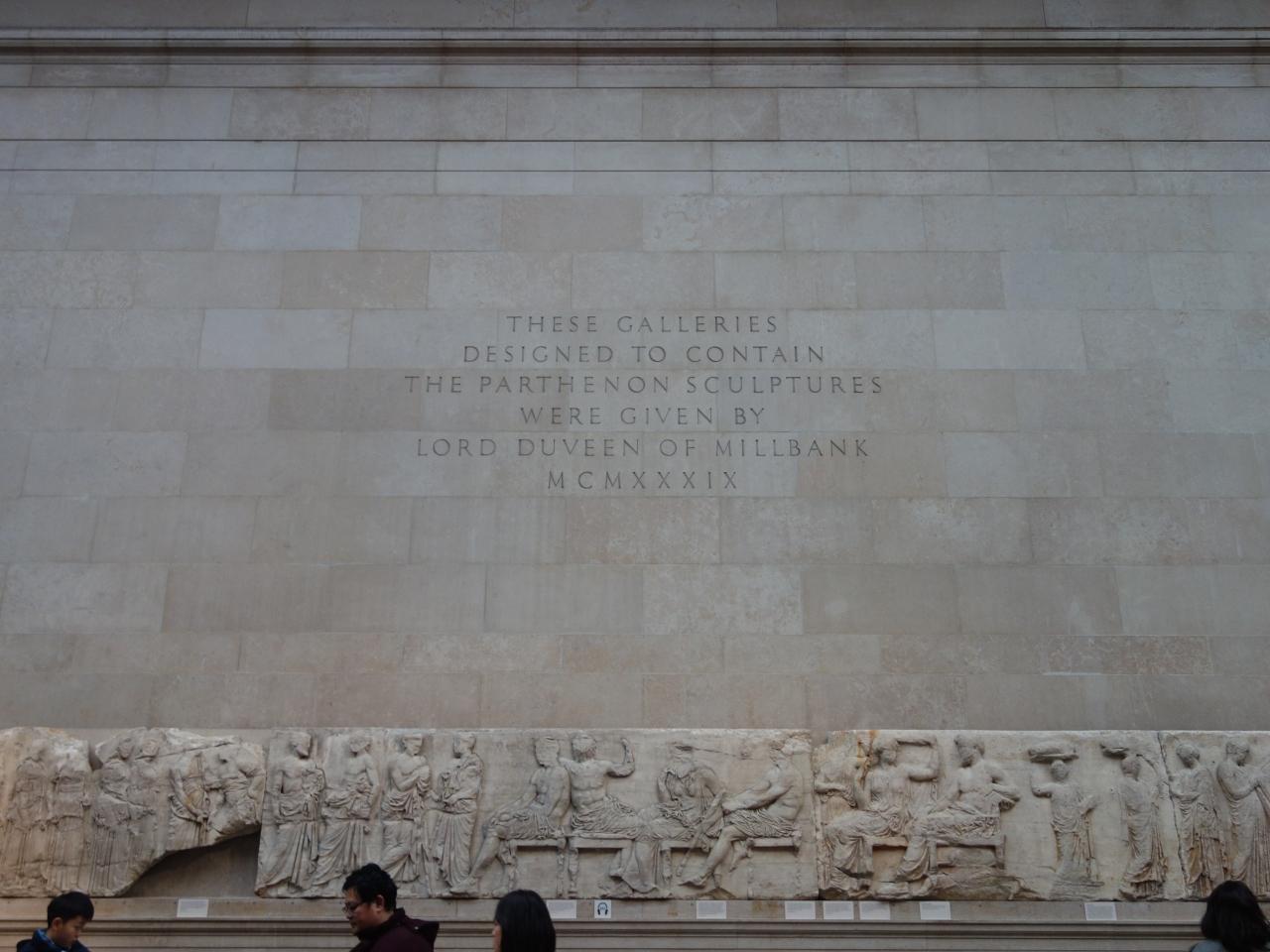
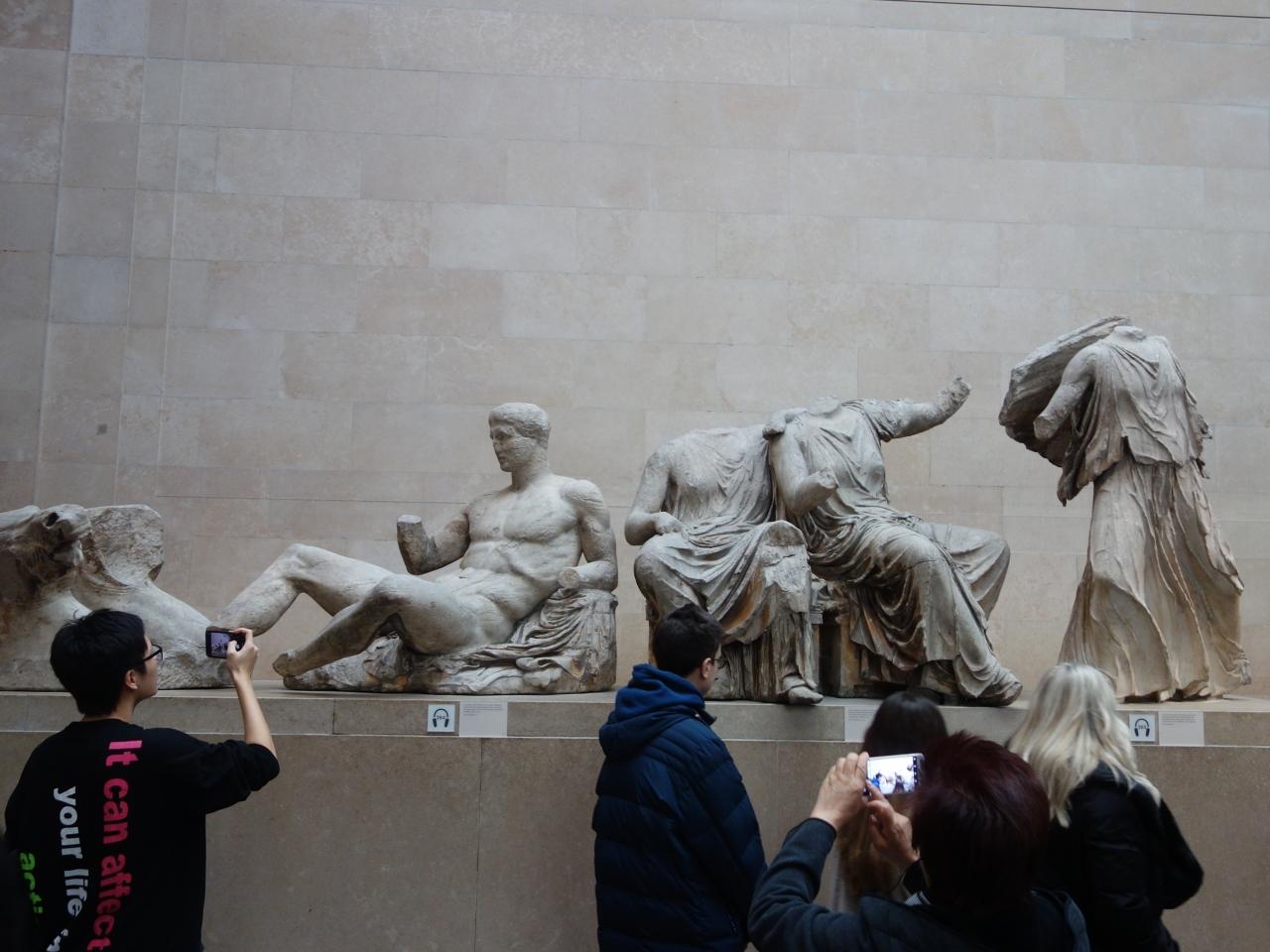
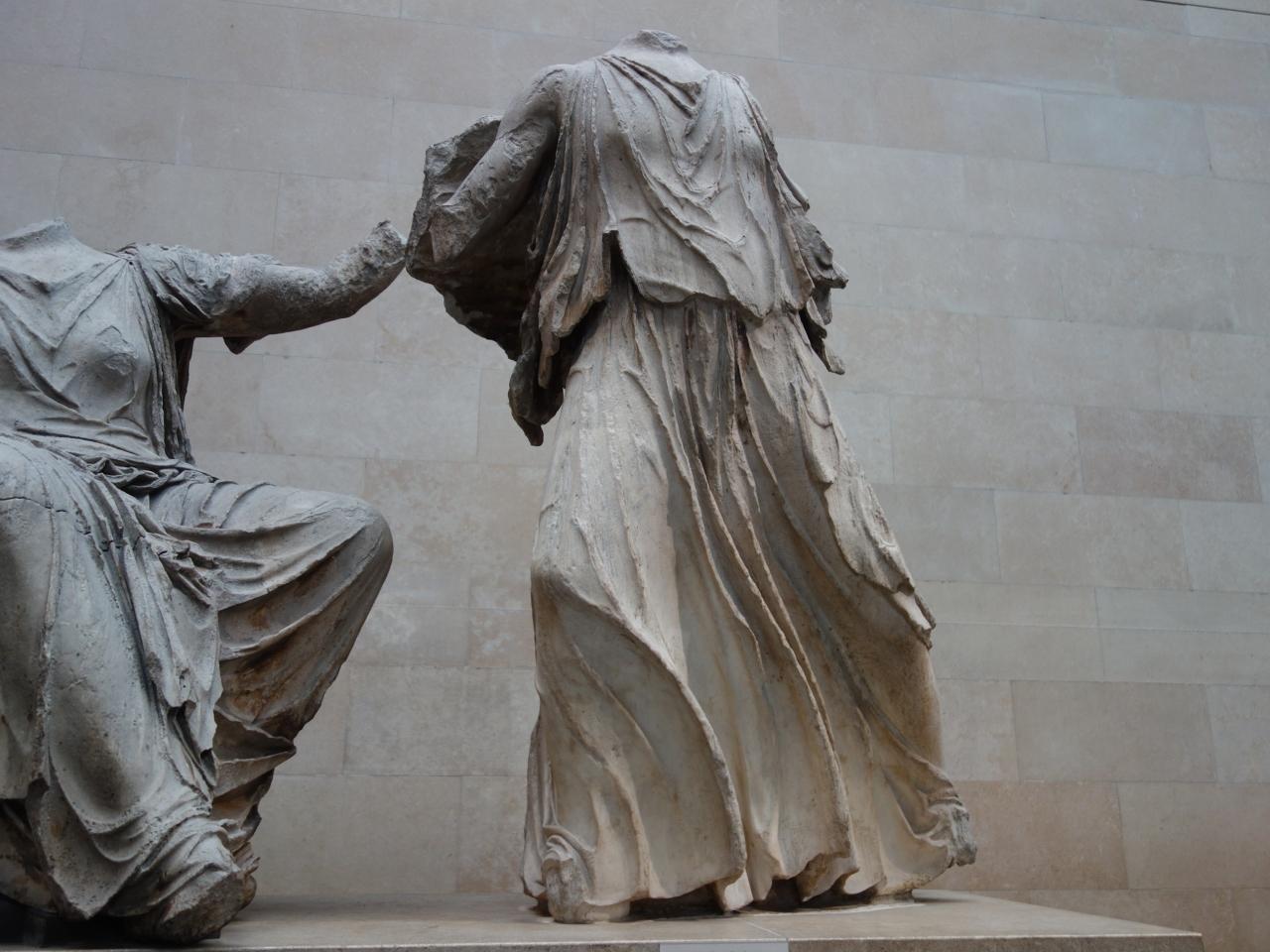
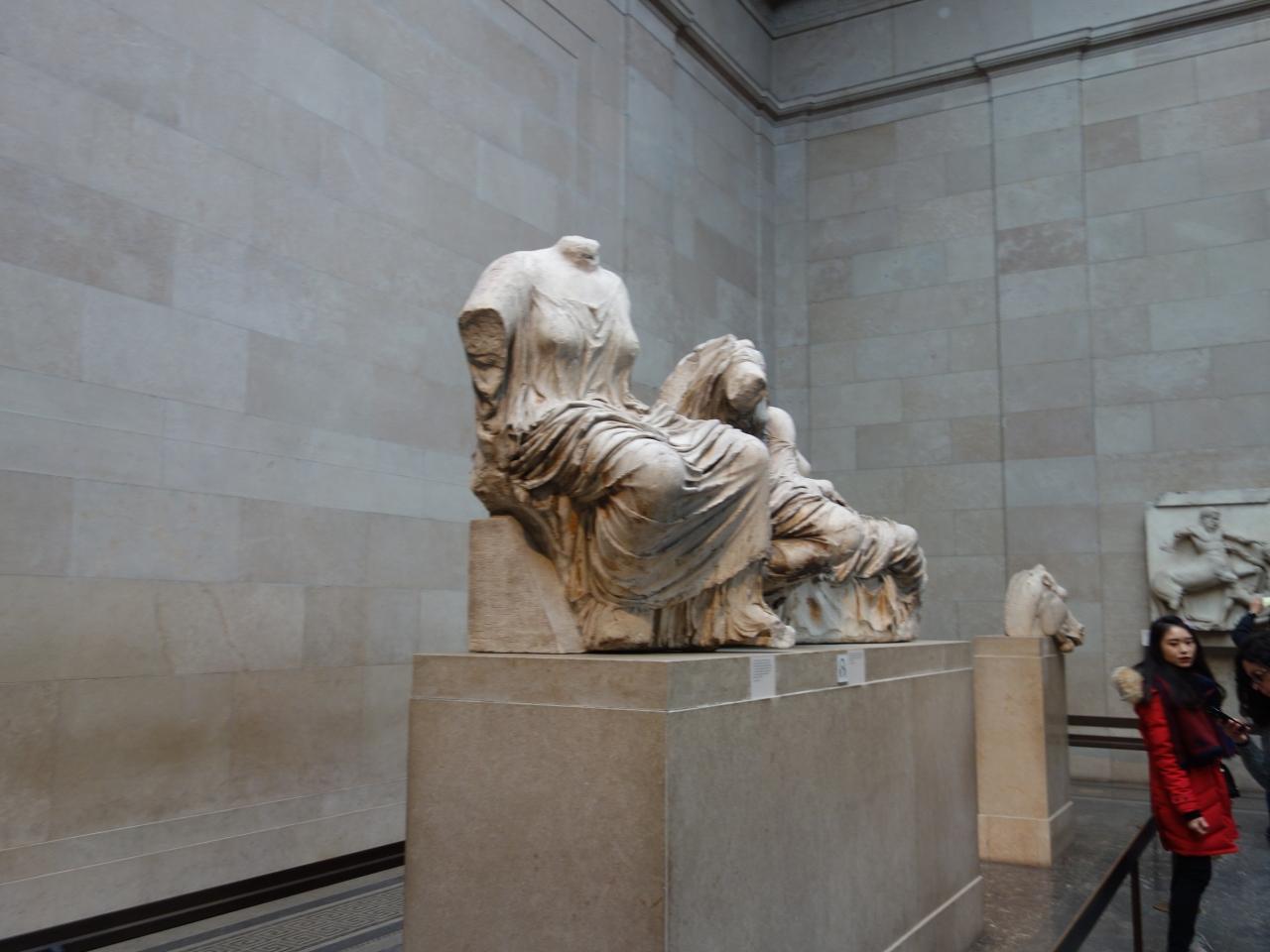
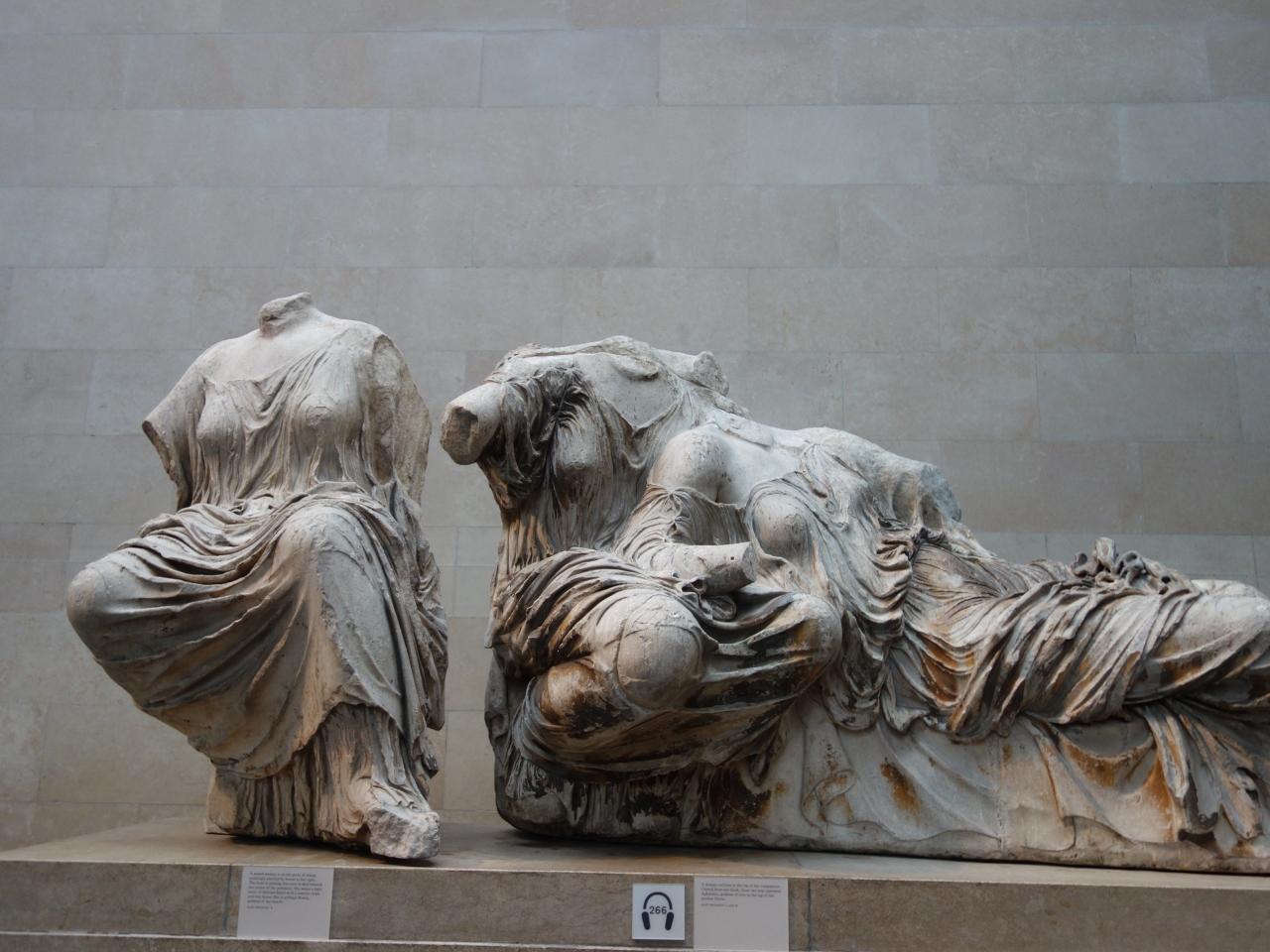
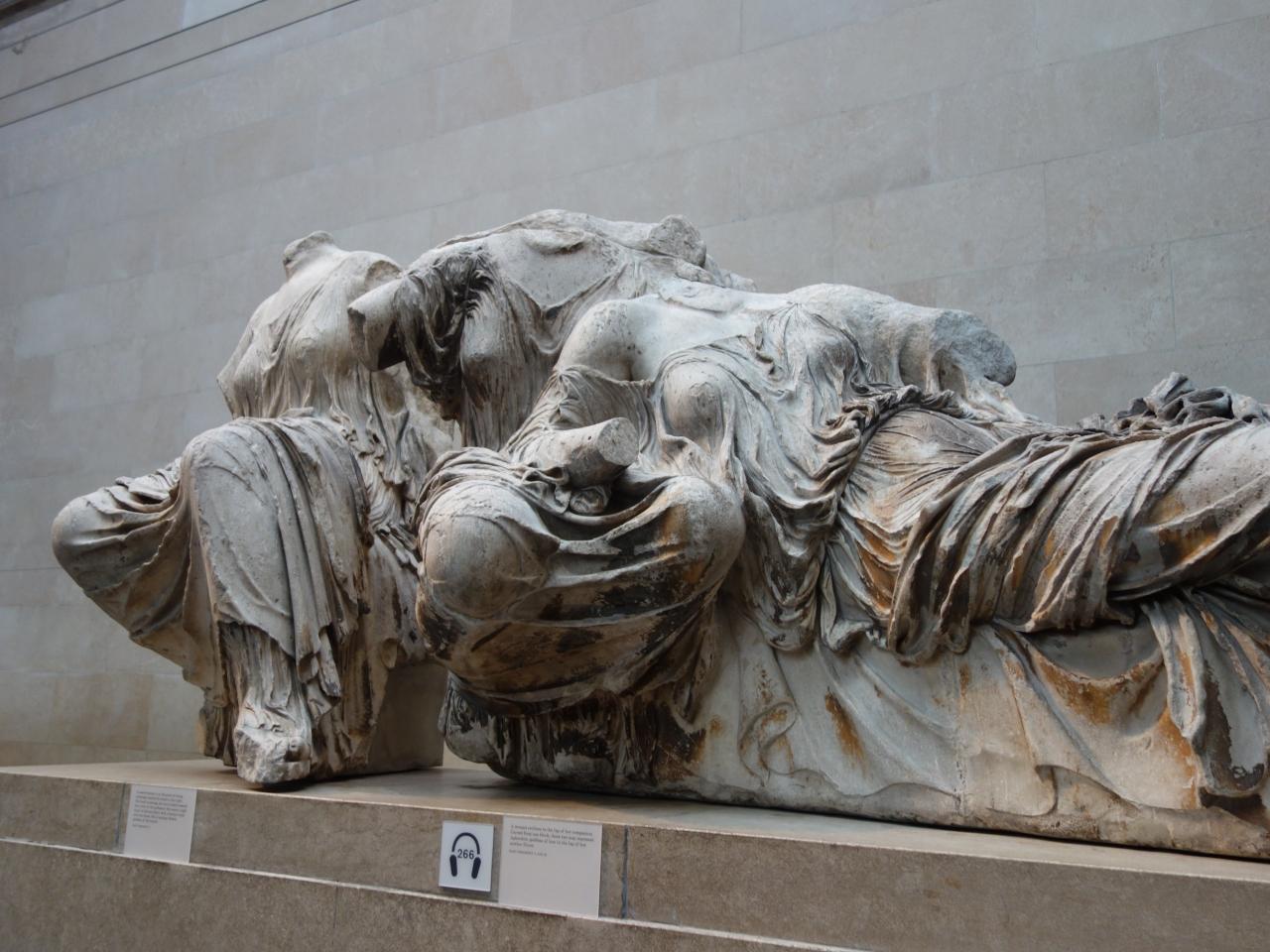
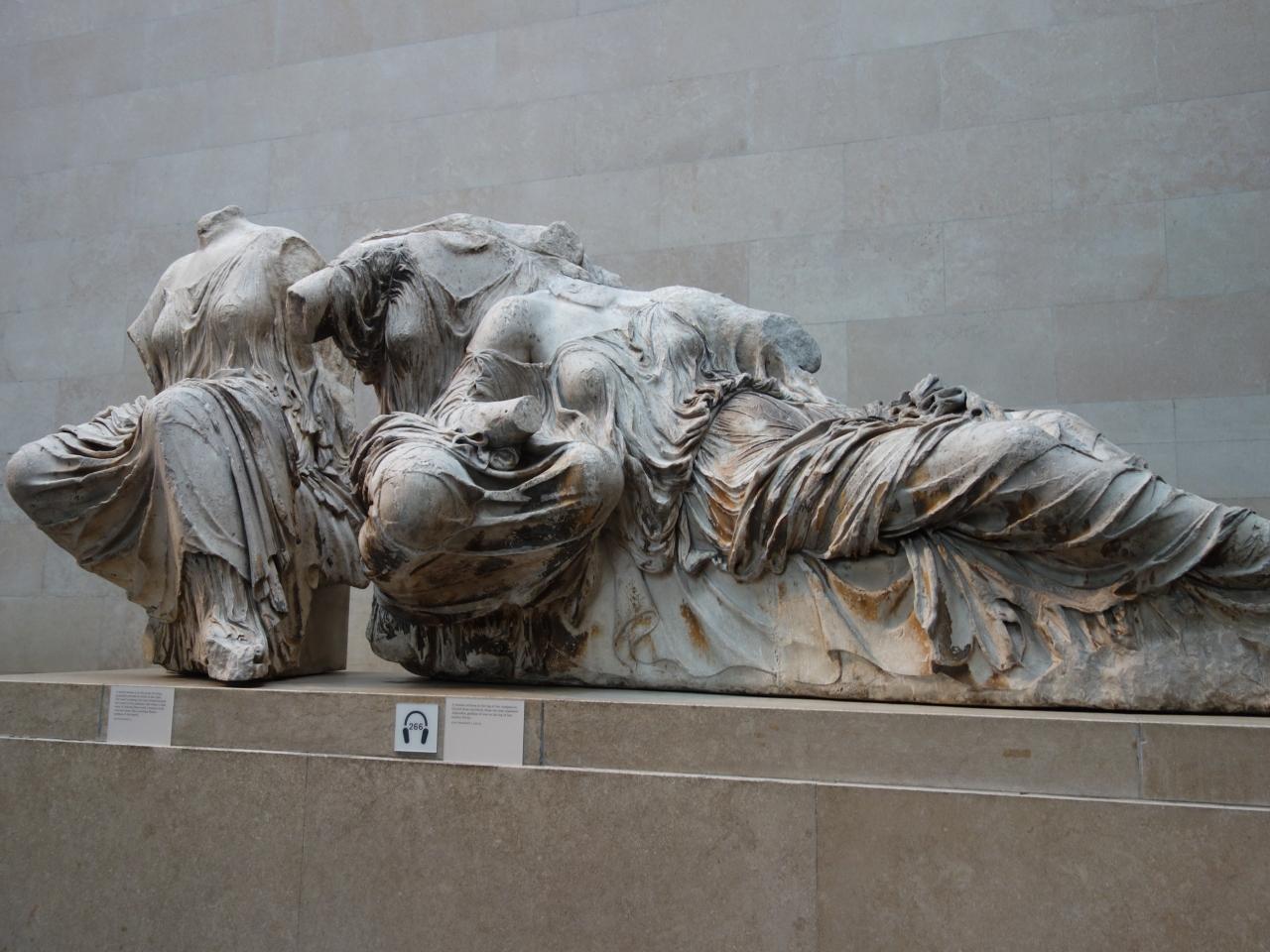
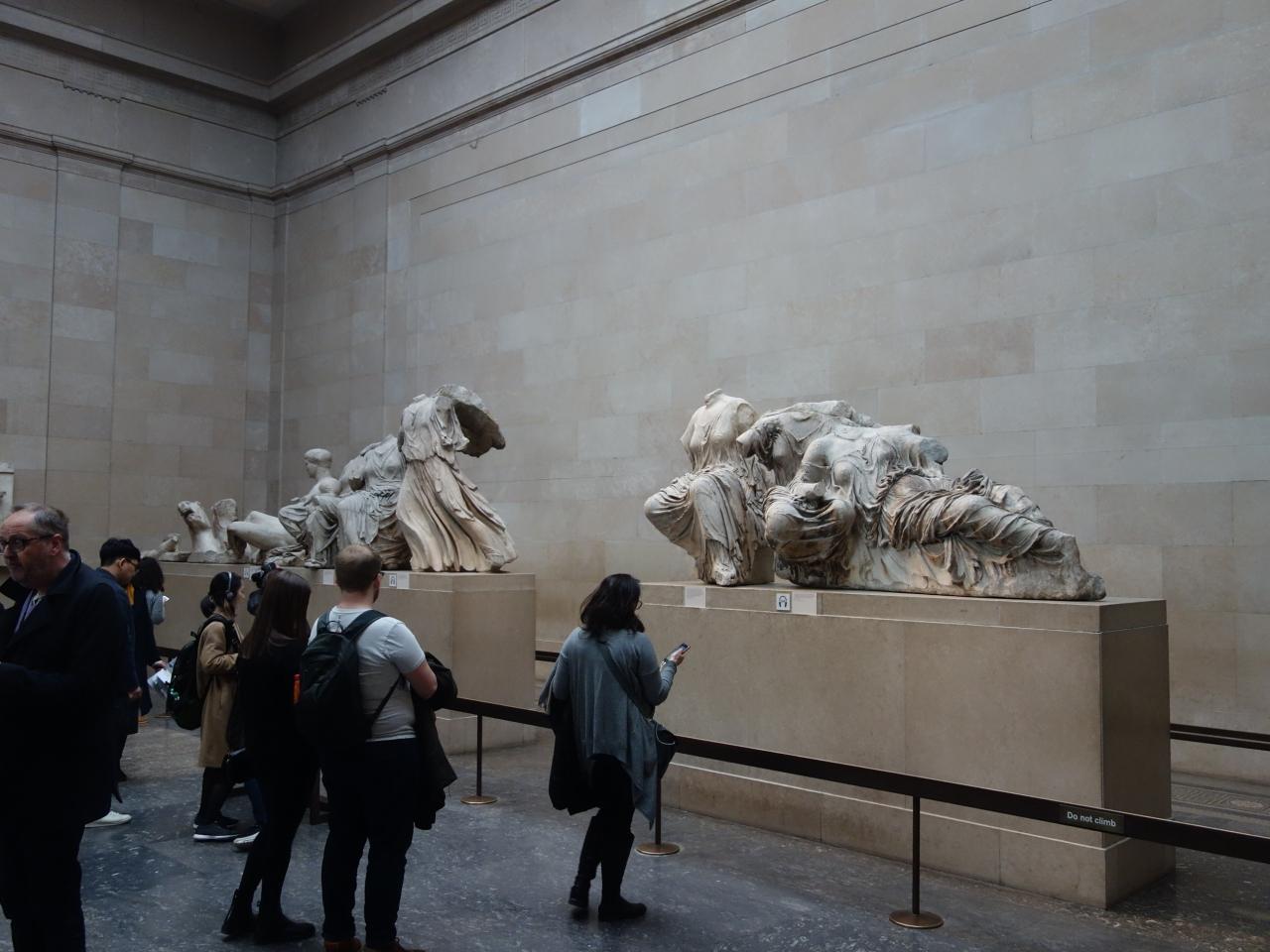
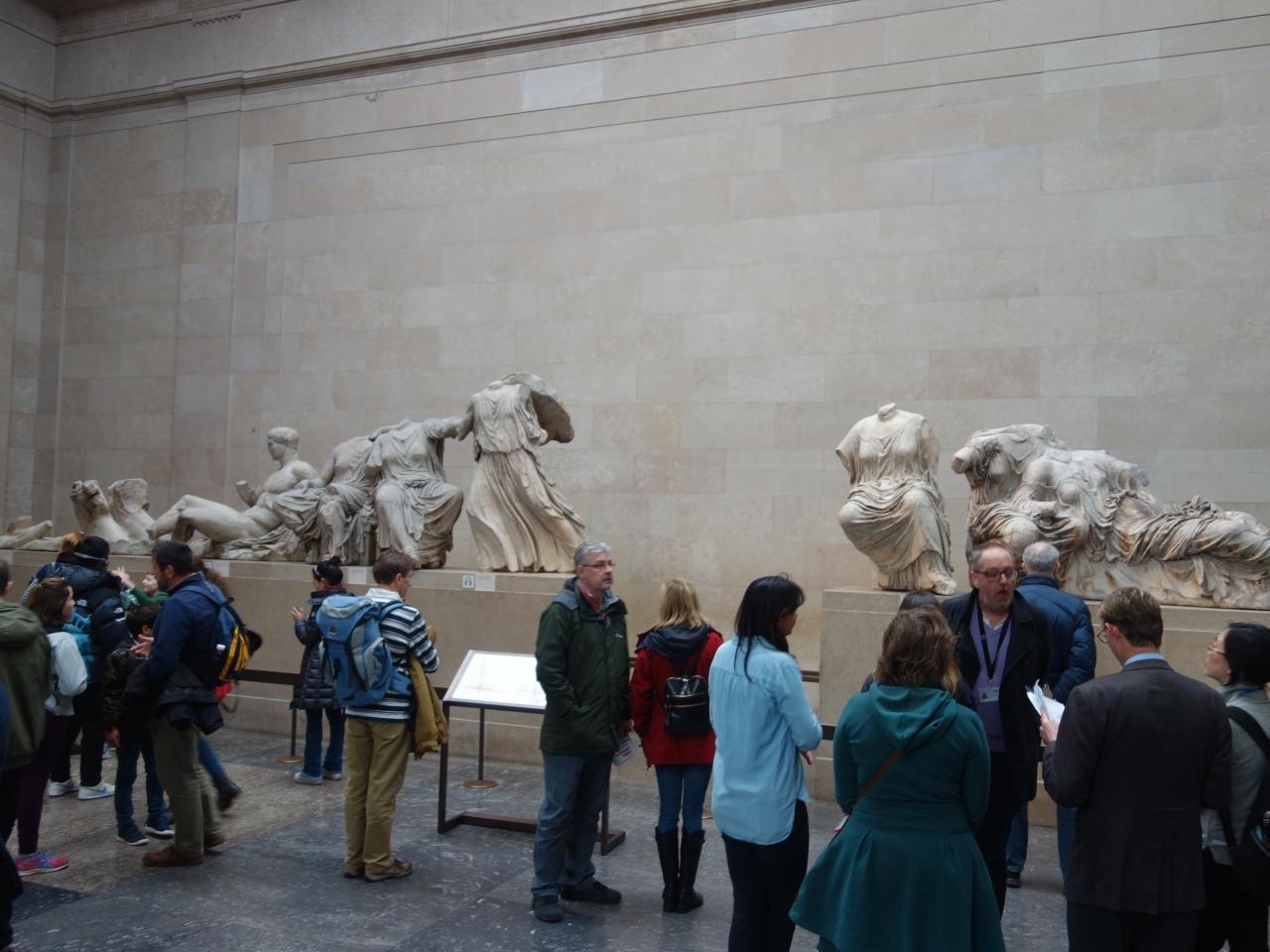
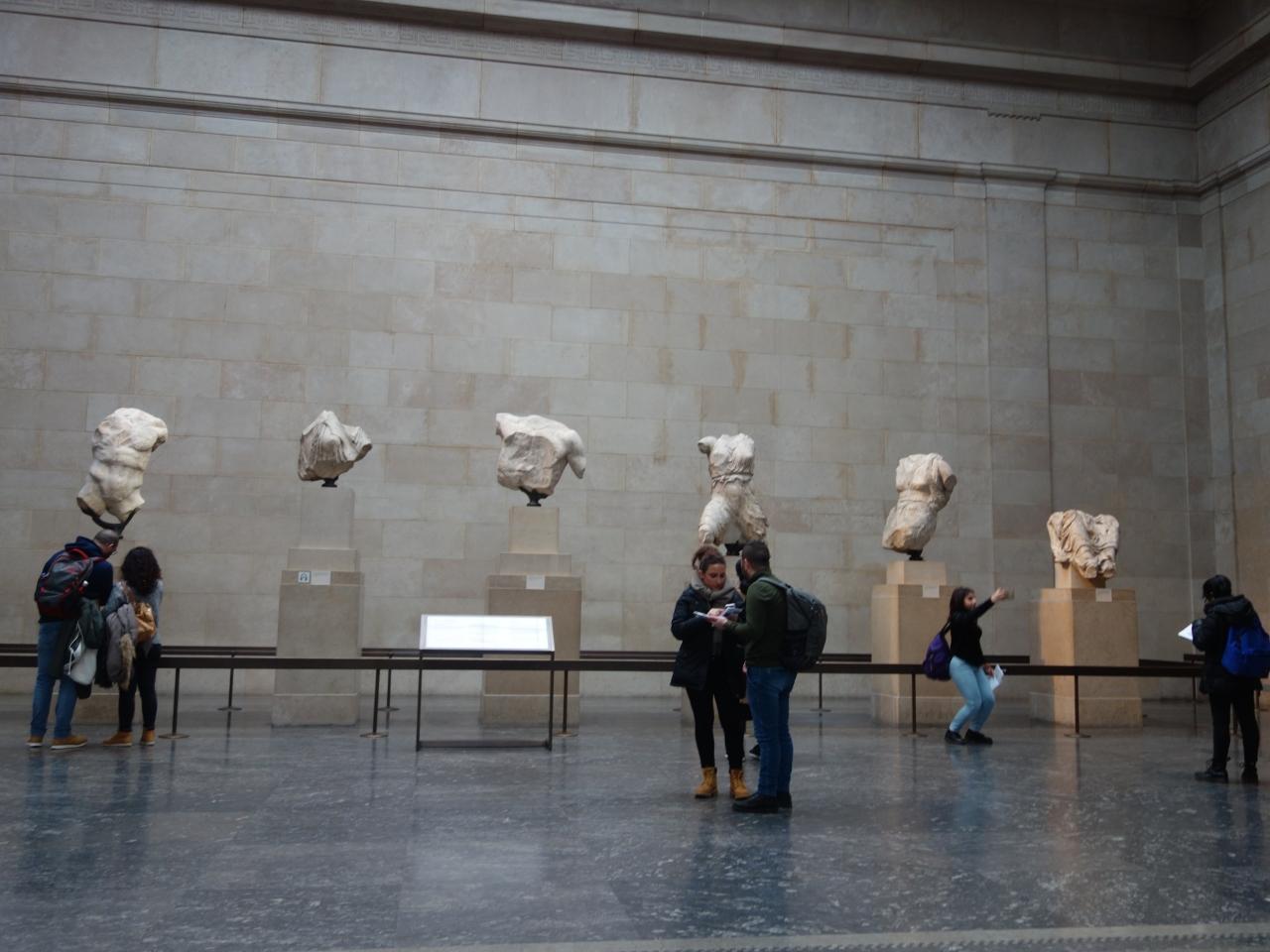
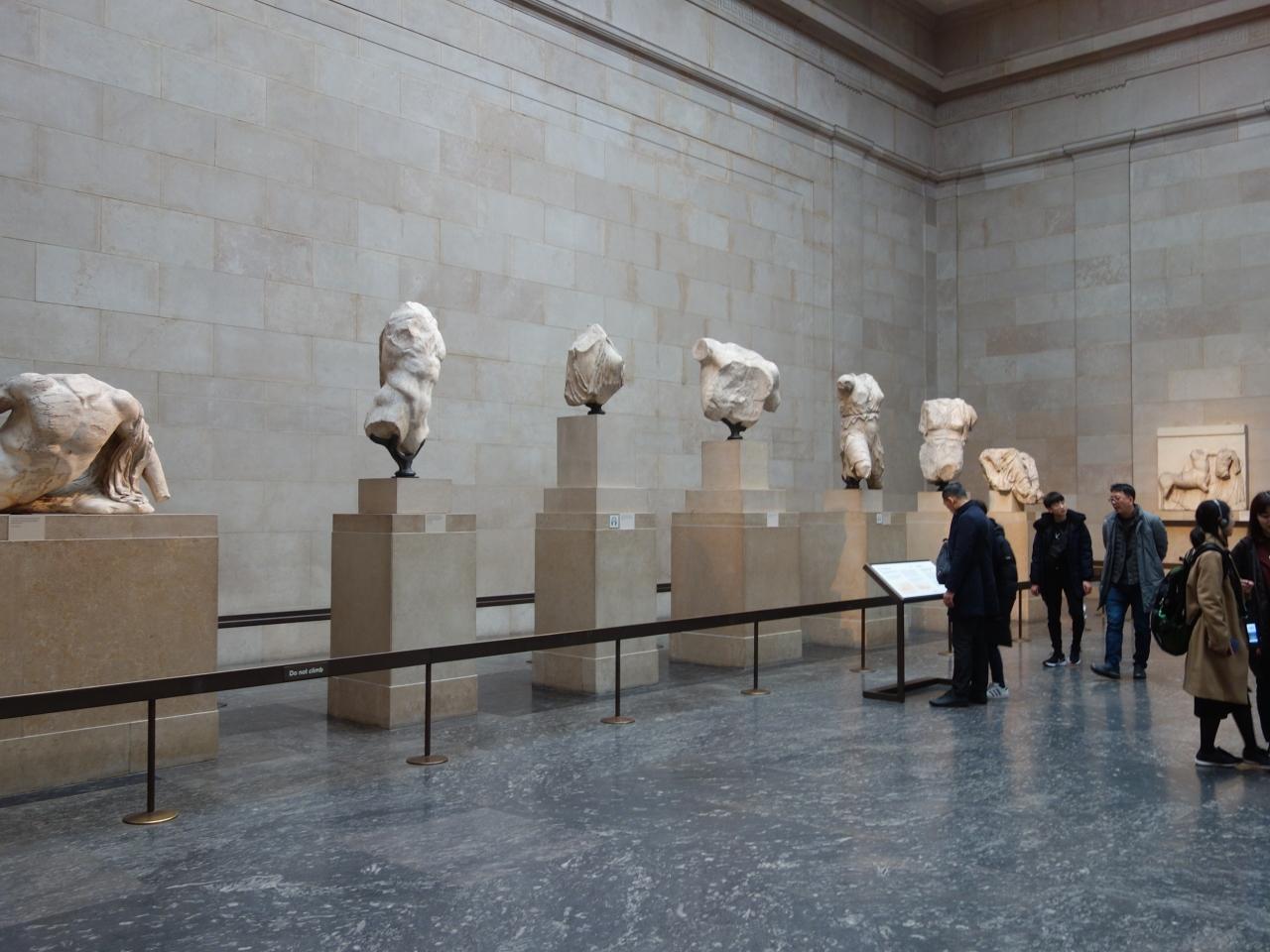
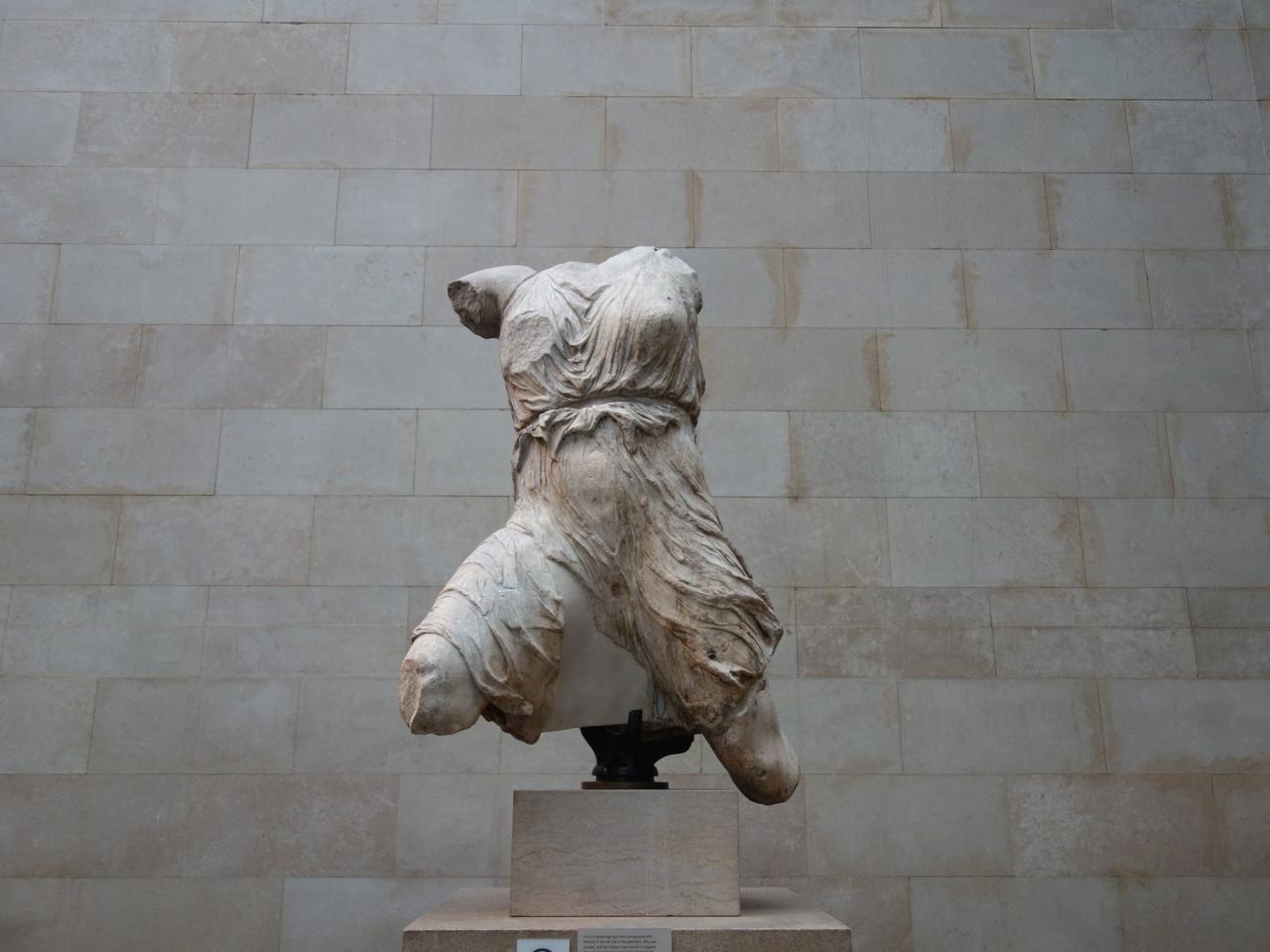
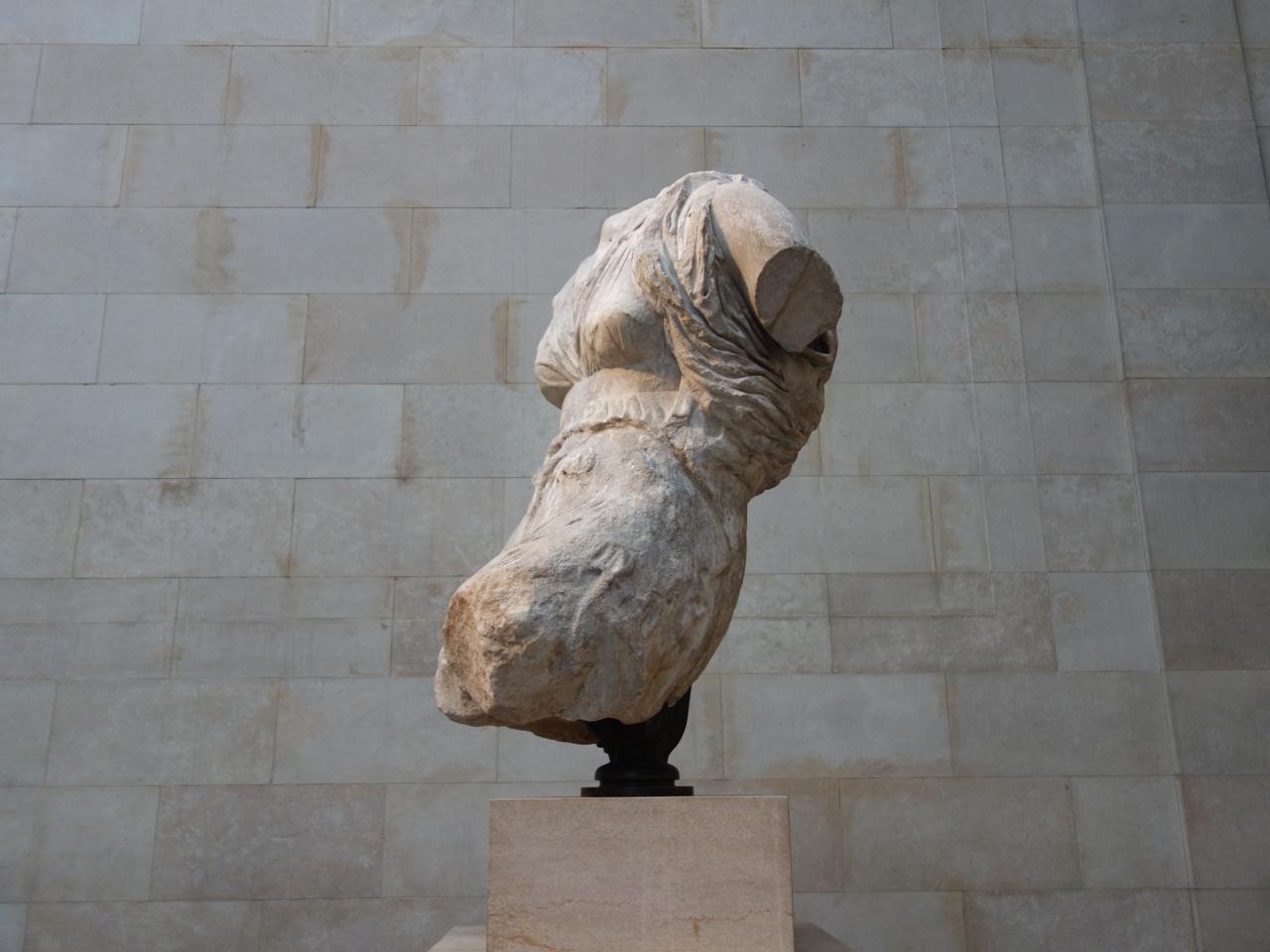
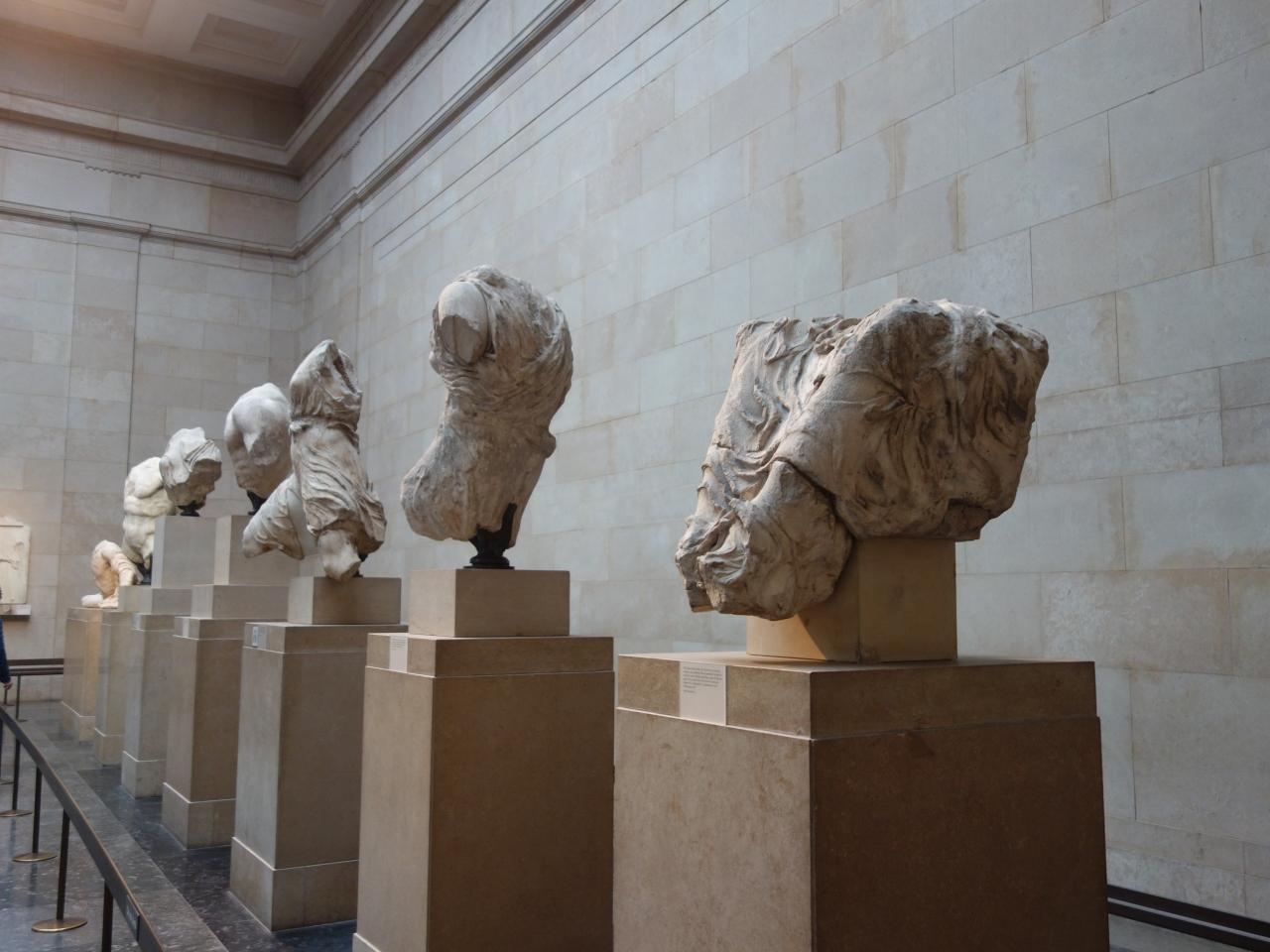
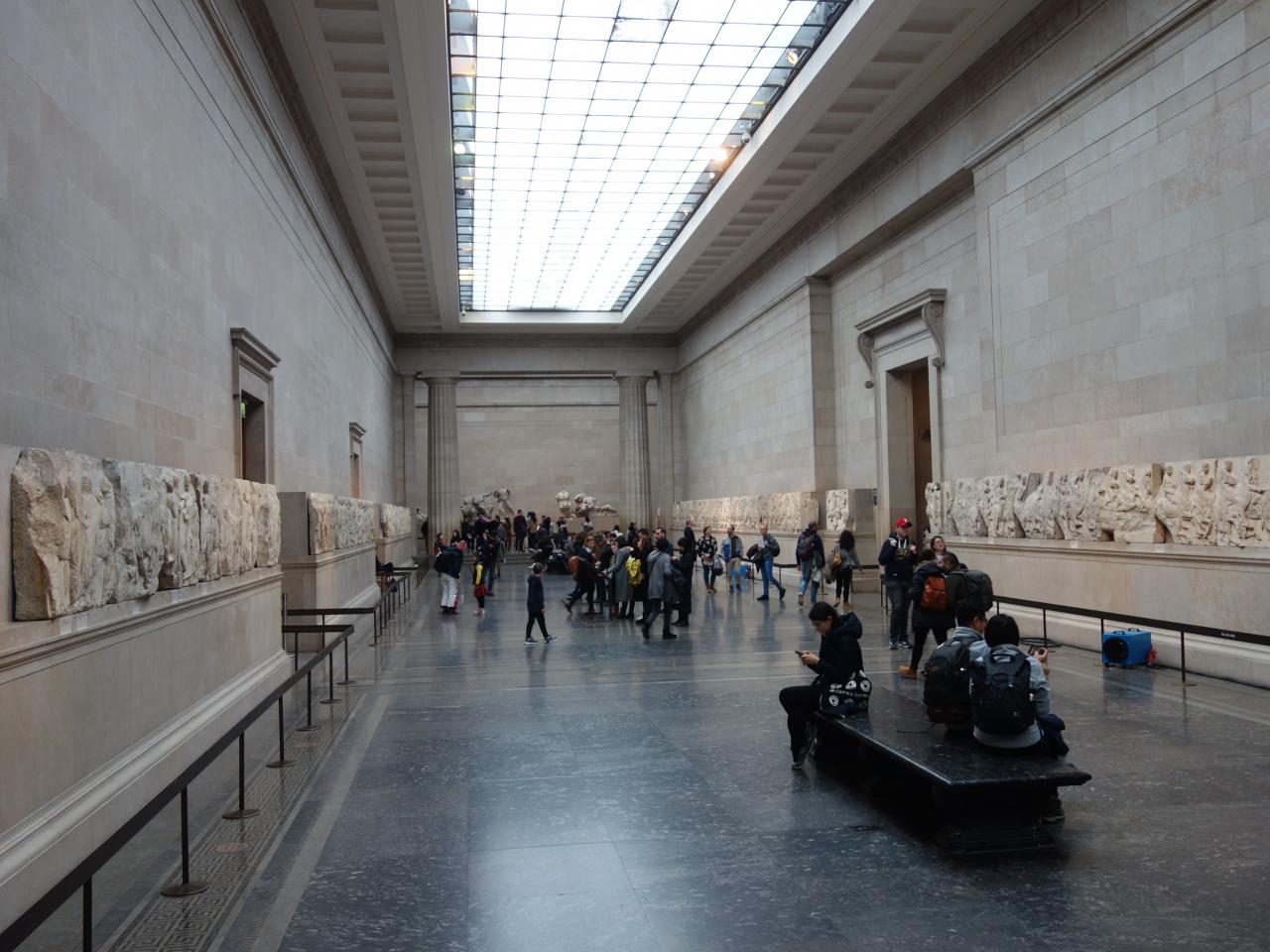
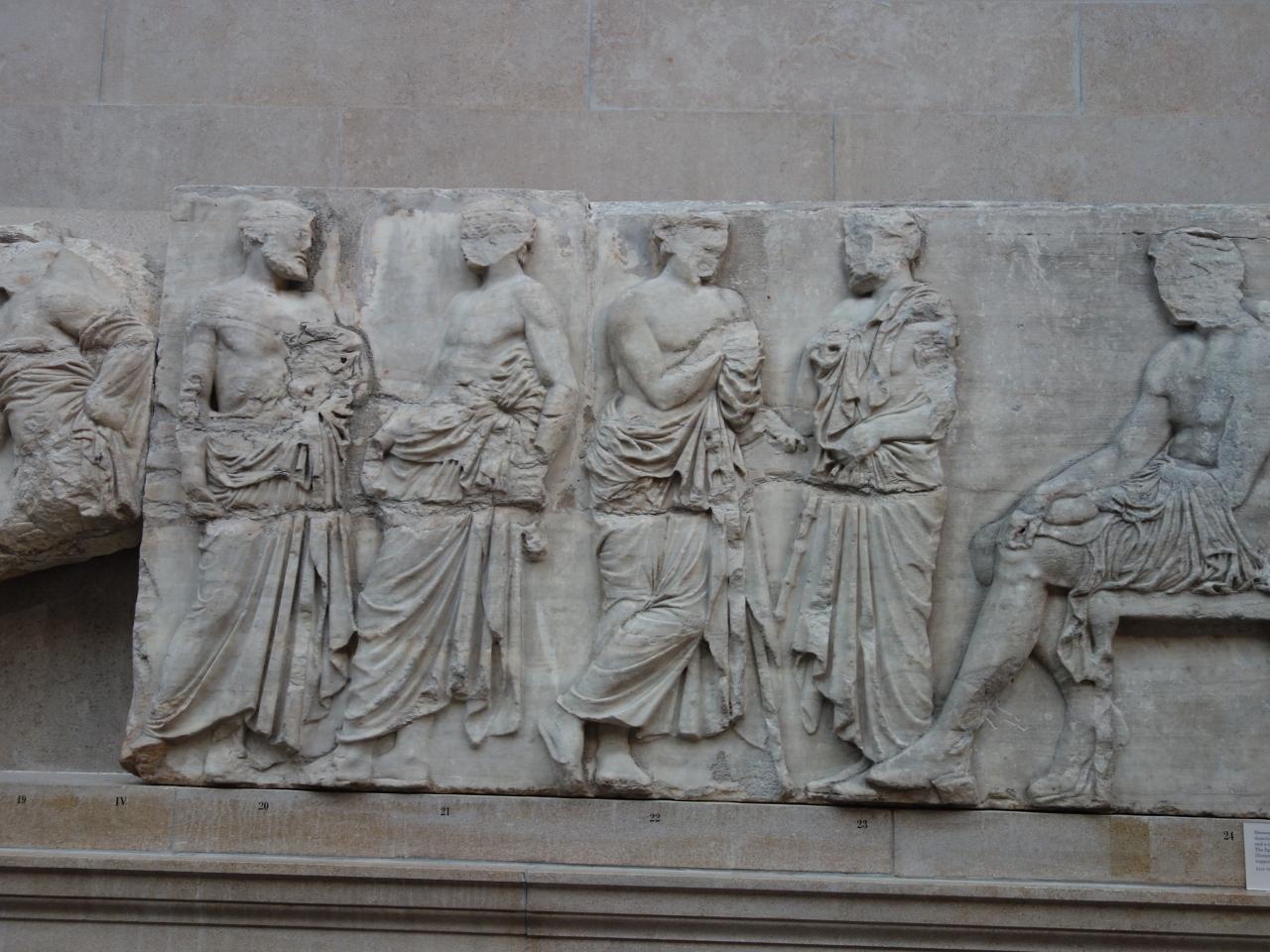
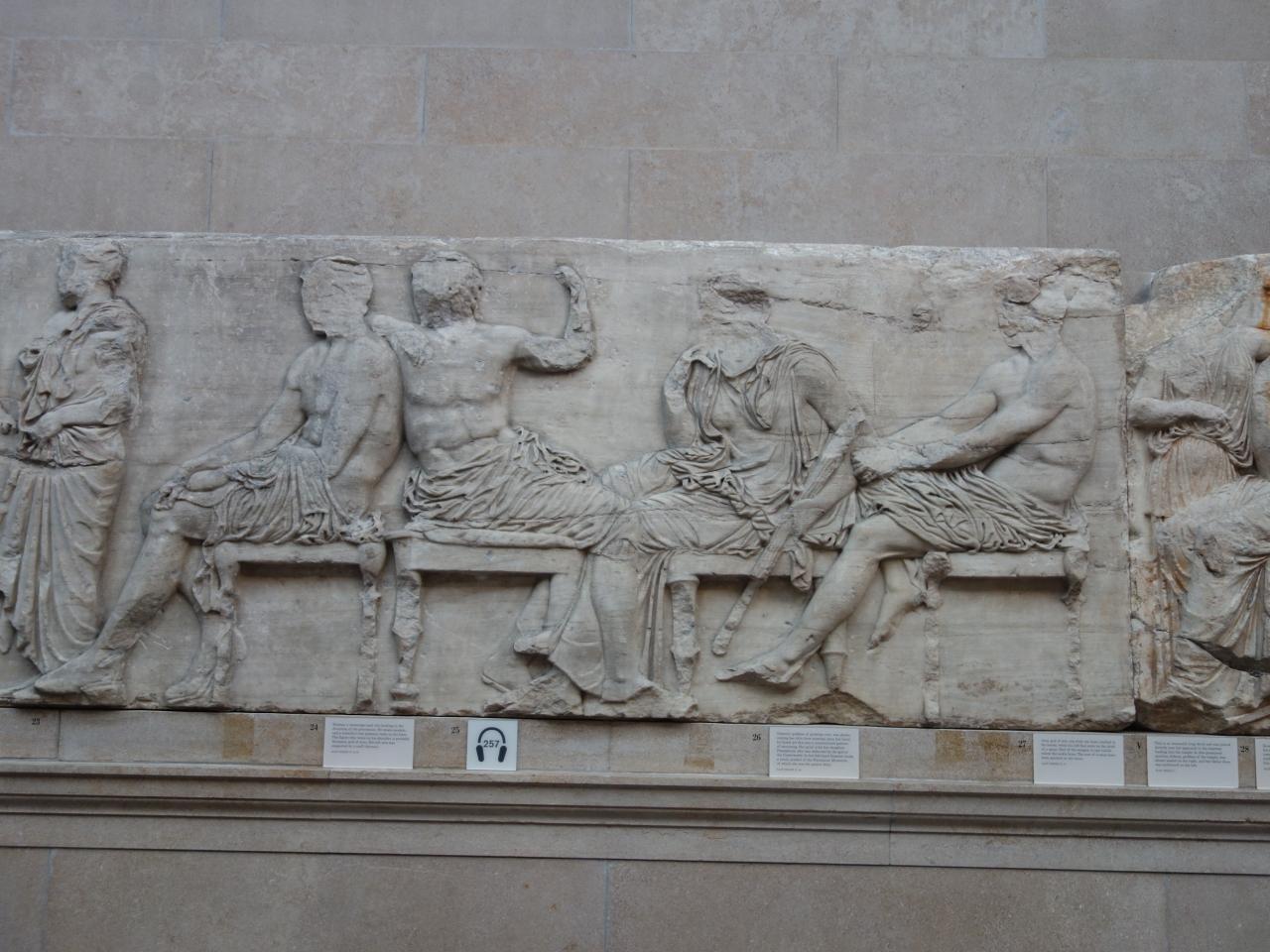
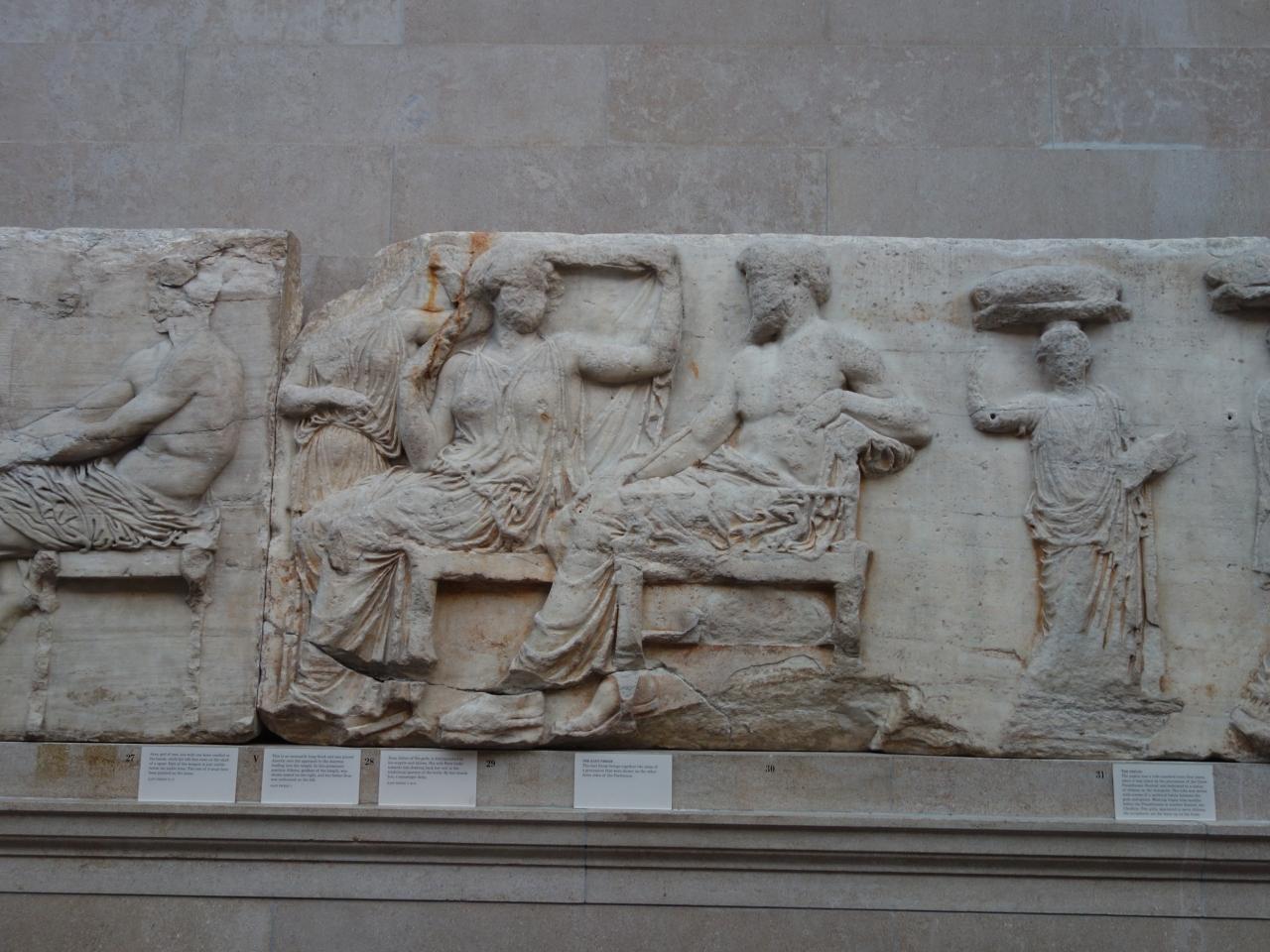
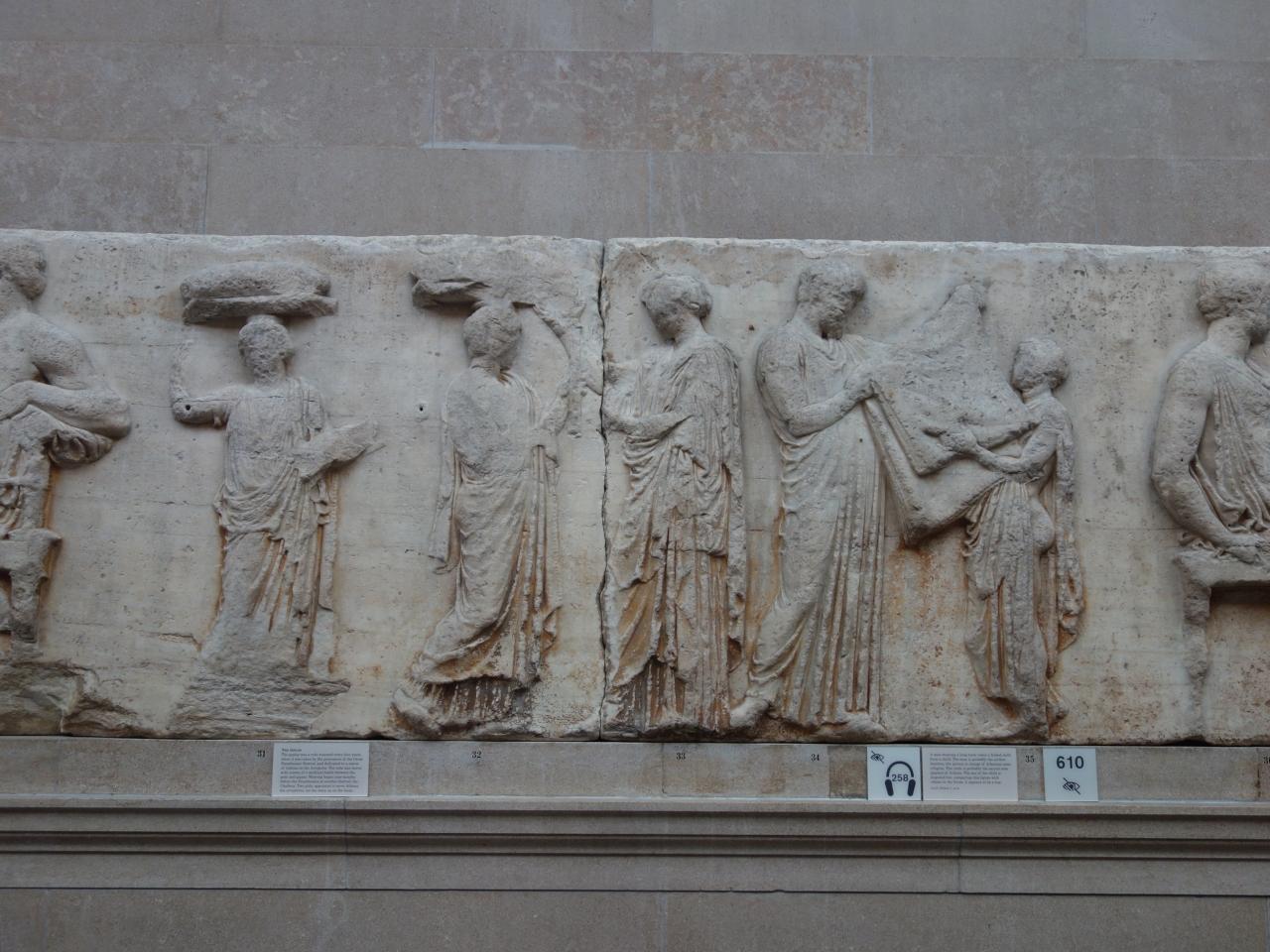
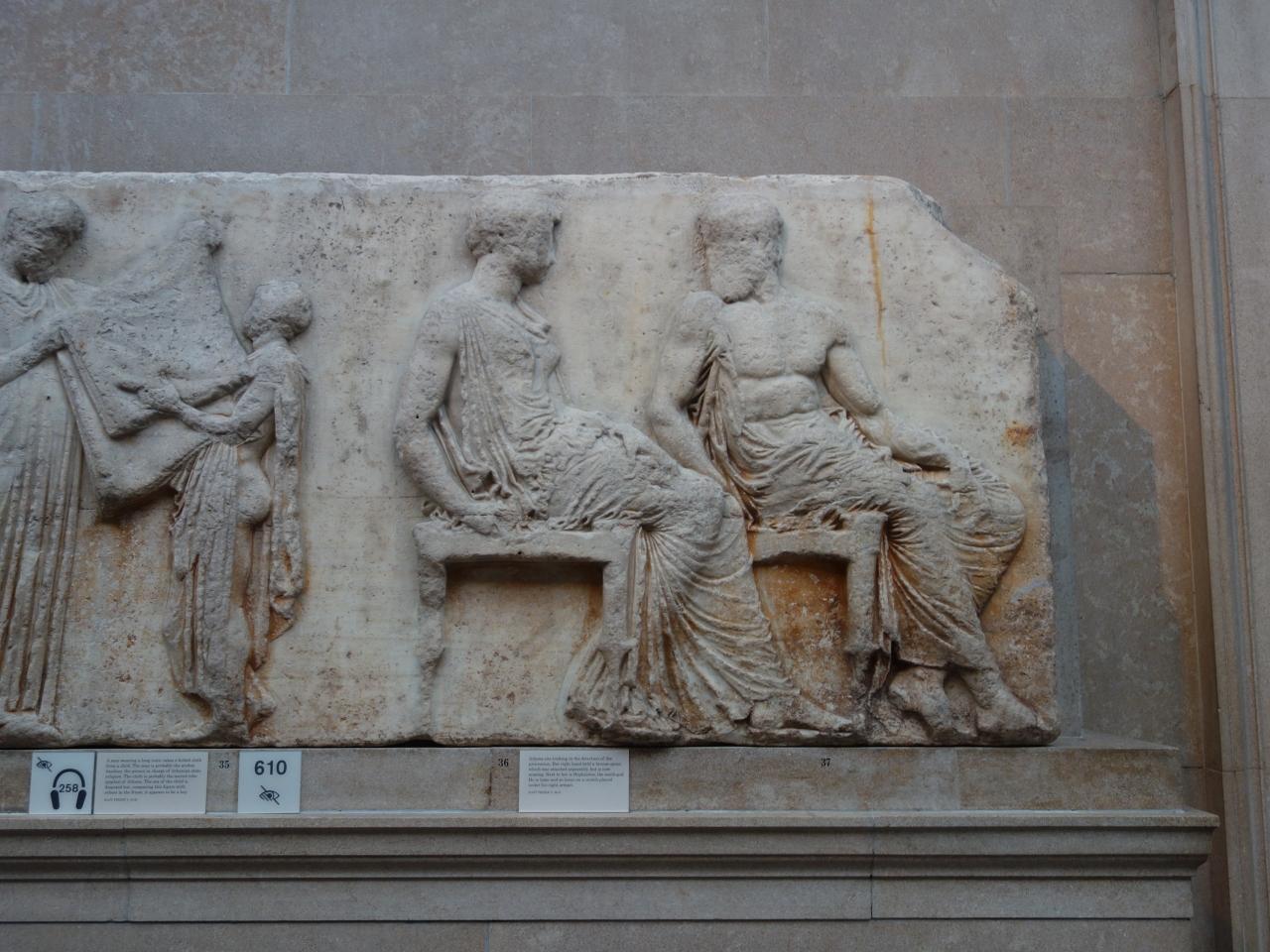
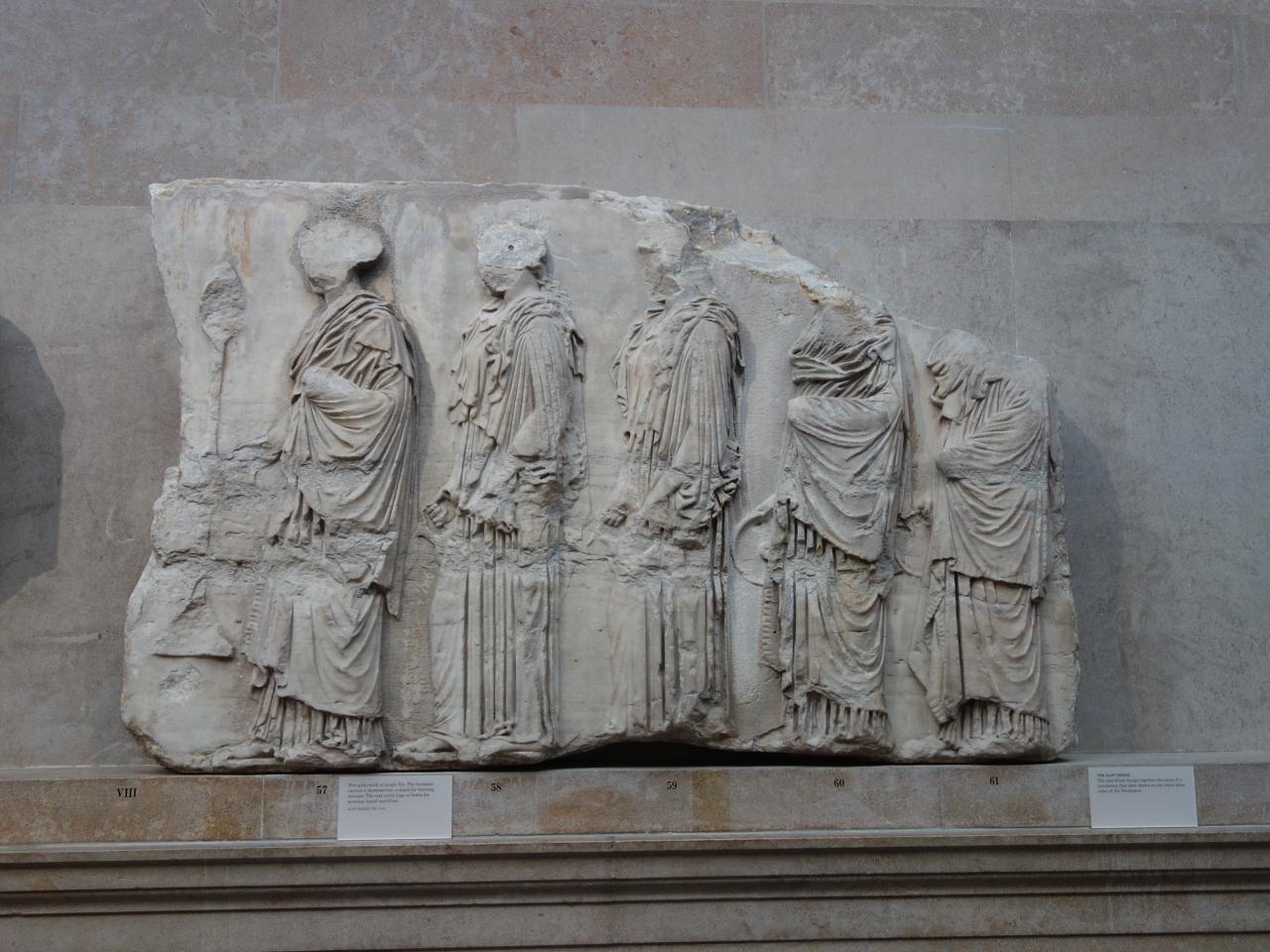
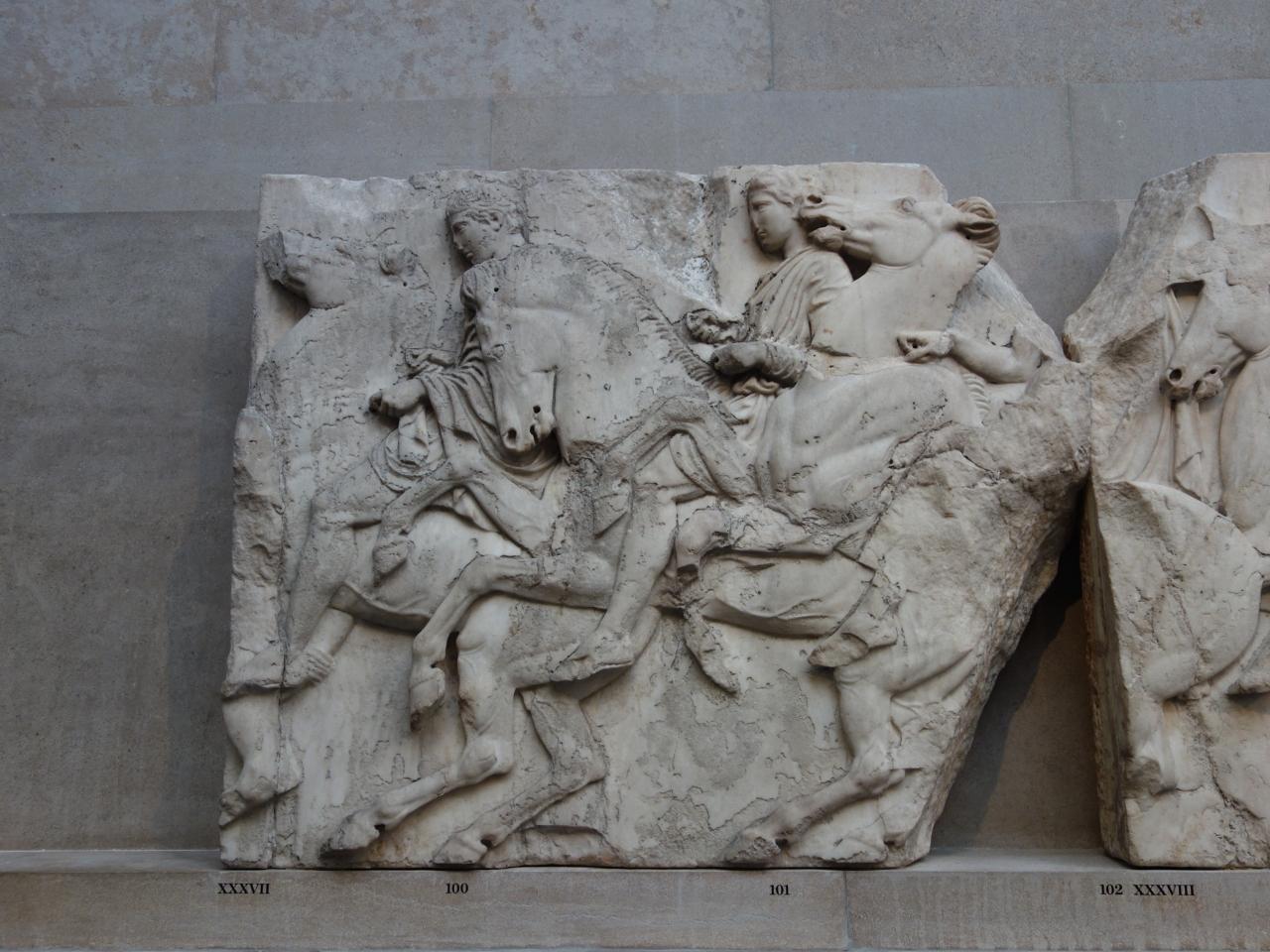
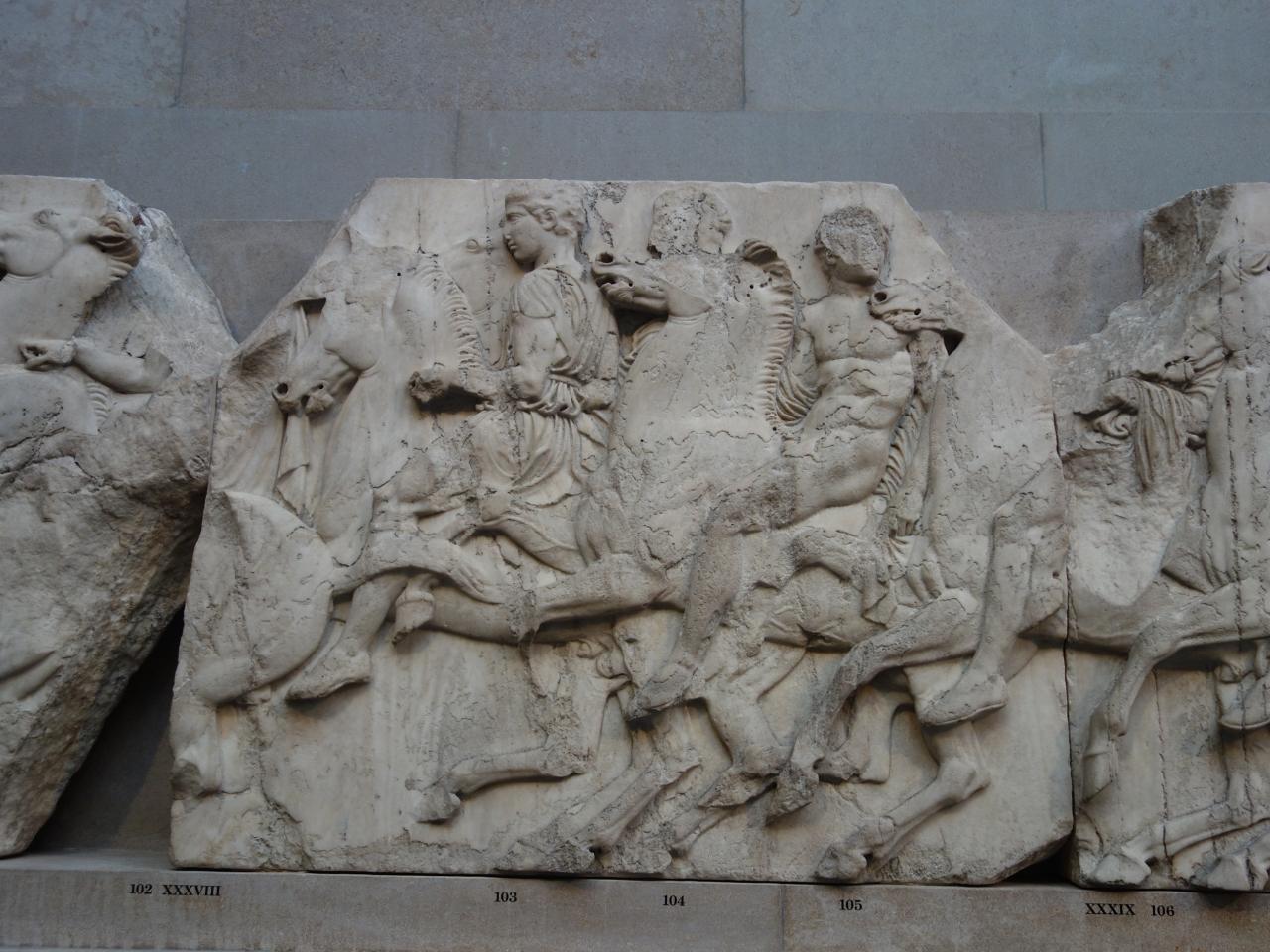
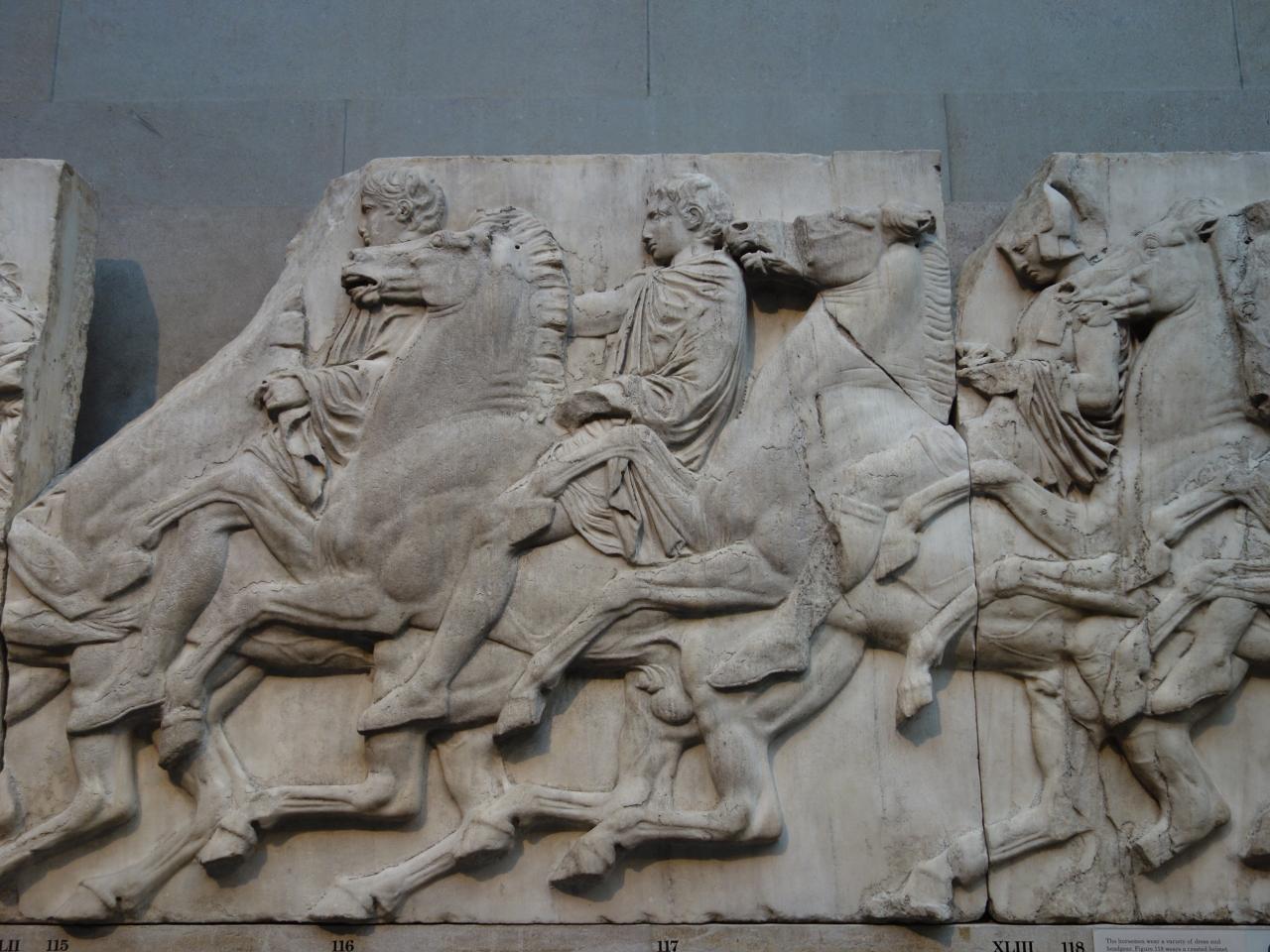
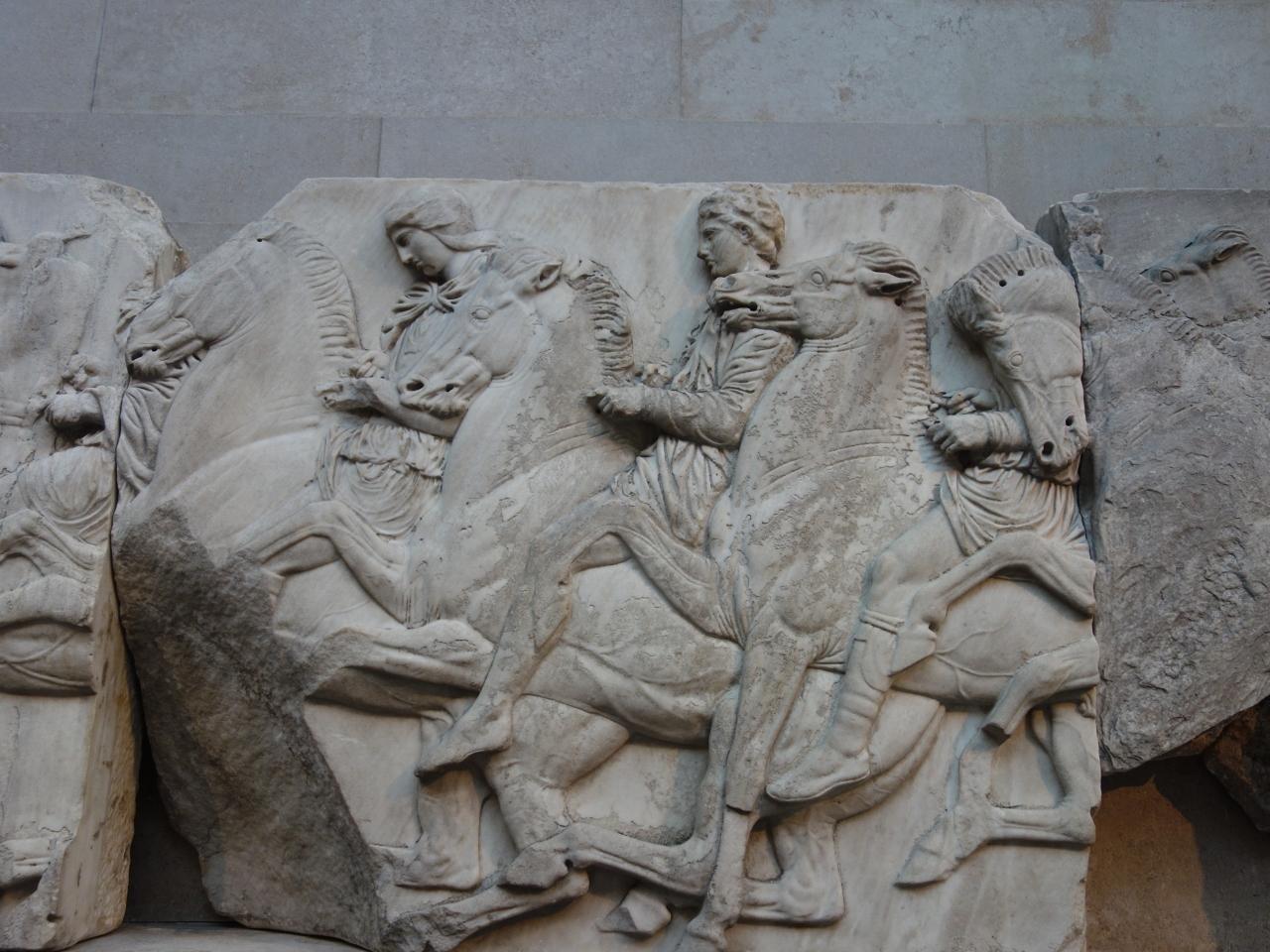
エルギン・マーブルはギリシャが返還を要求しています。
-
-
-
-
-
-
-
-
-
-
-
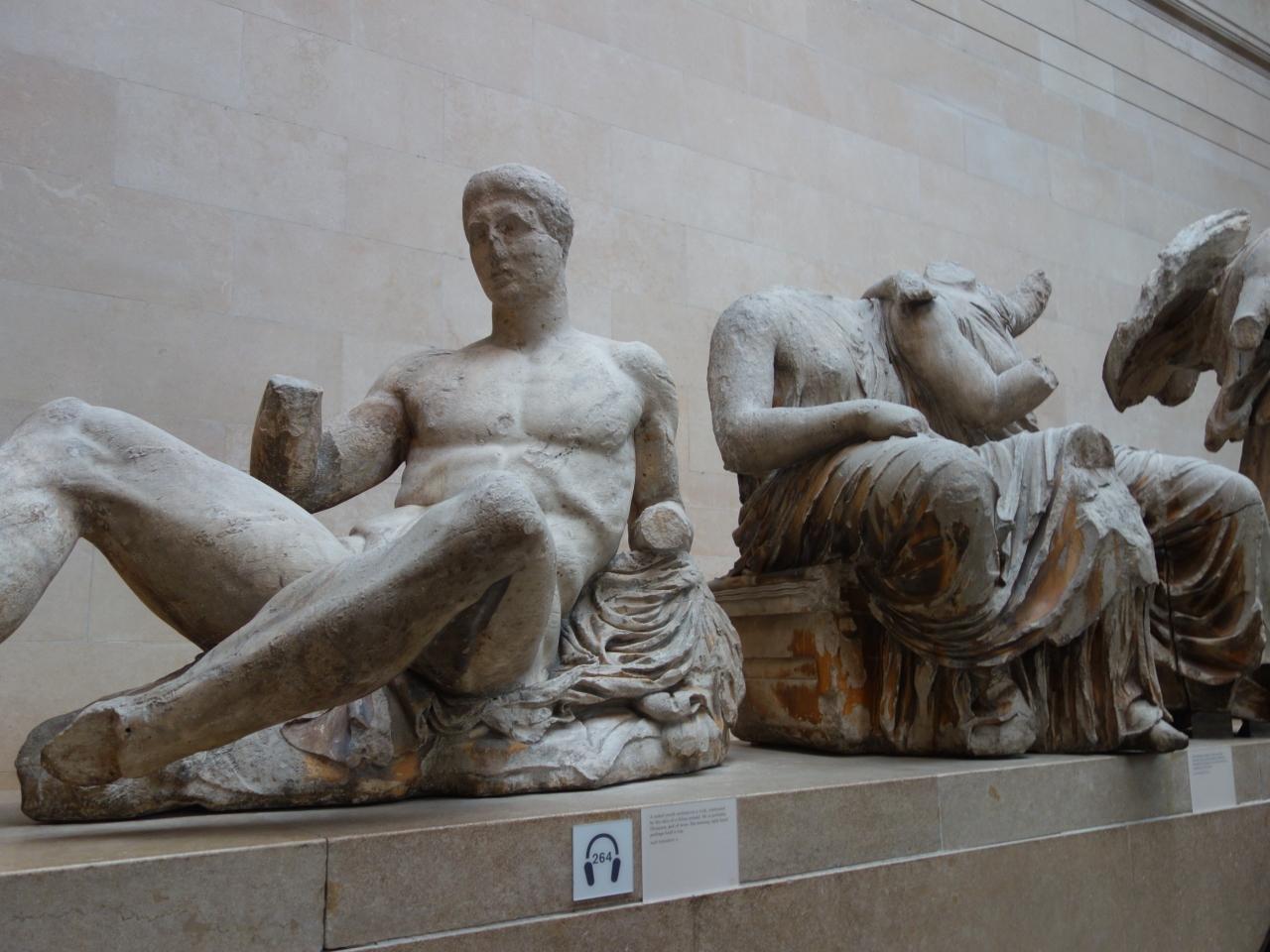
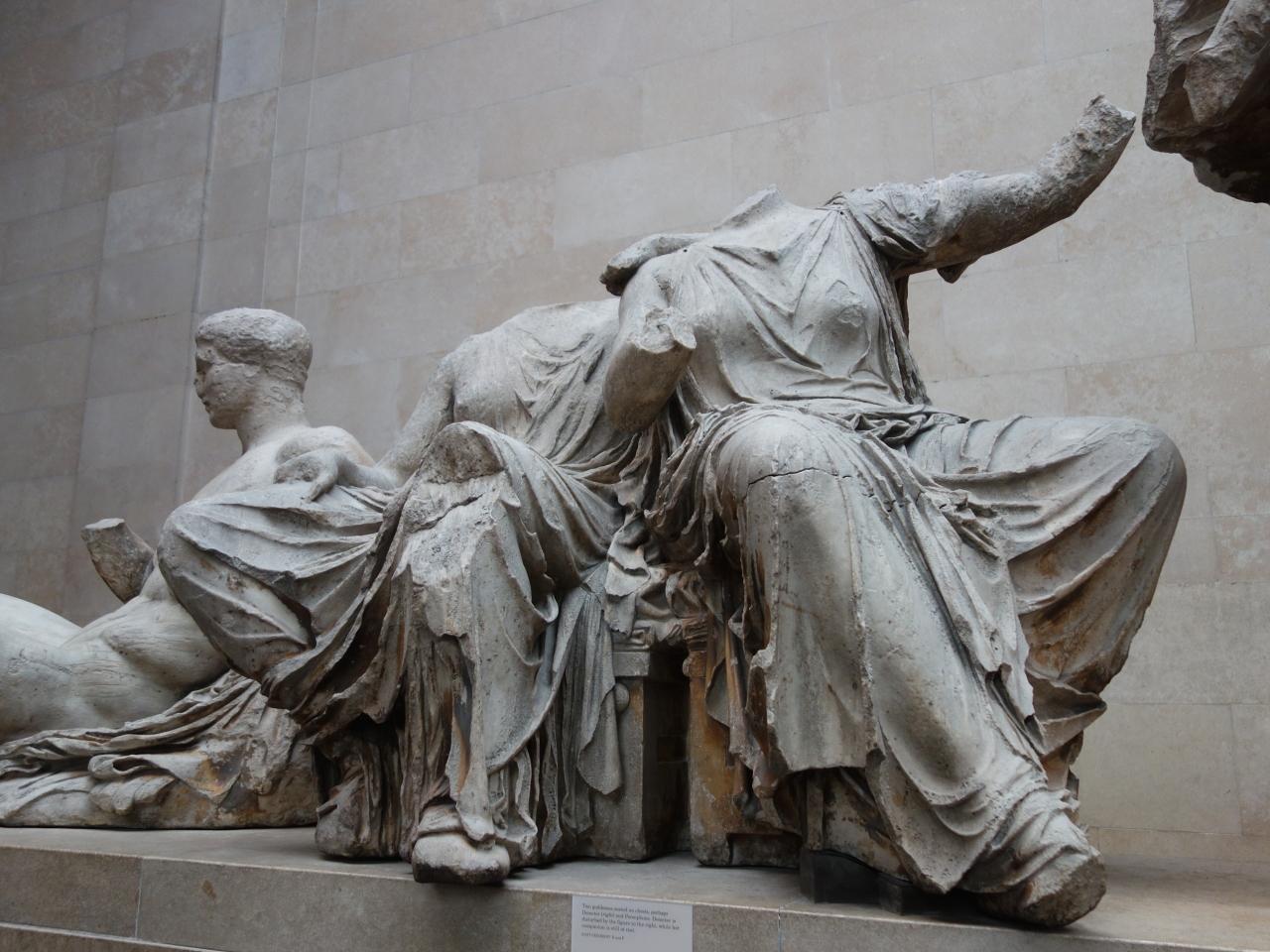
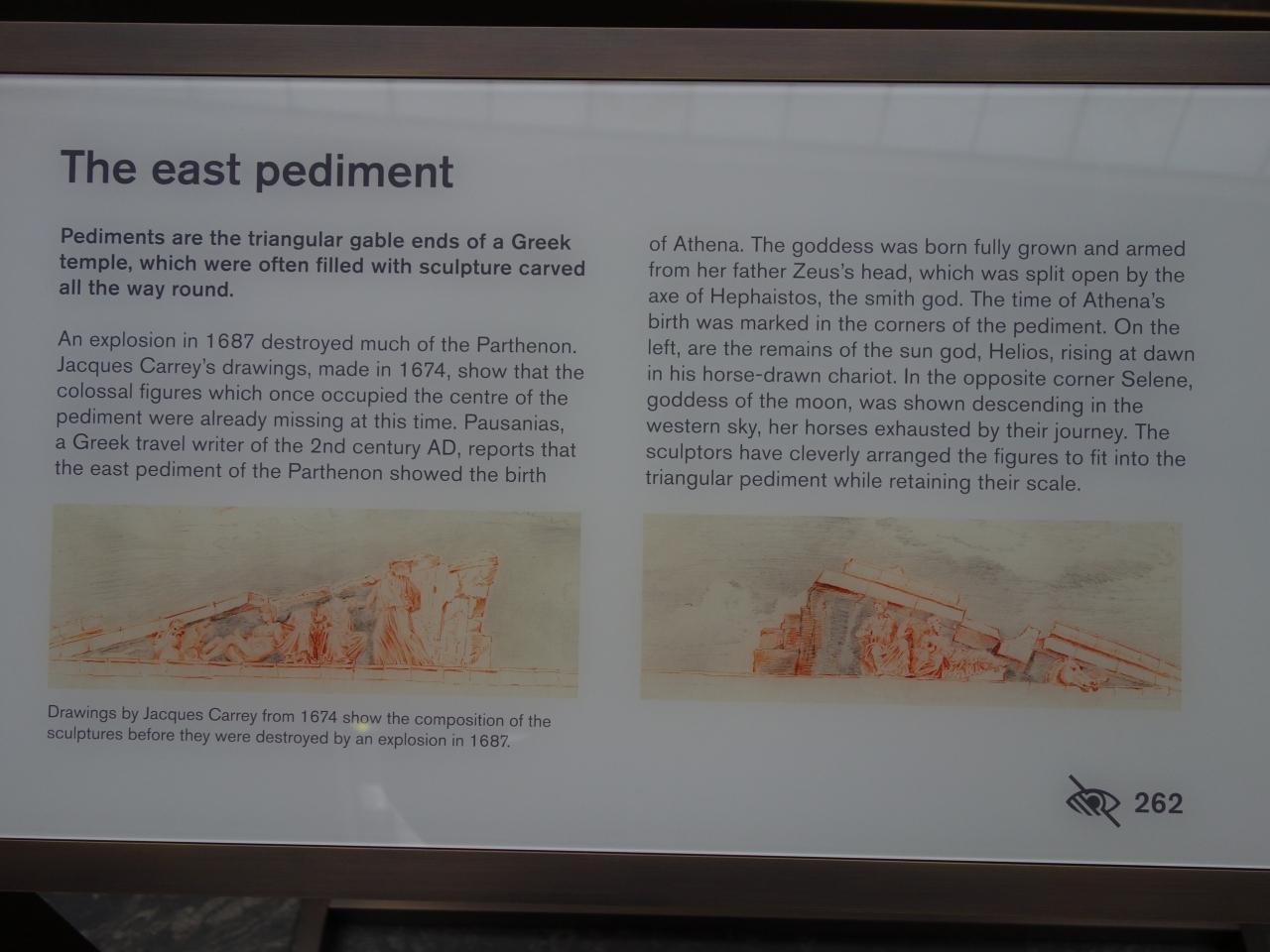
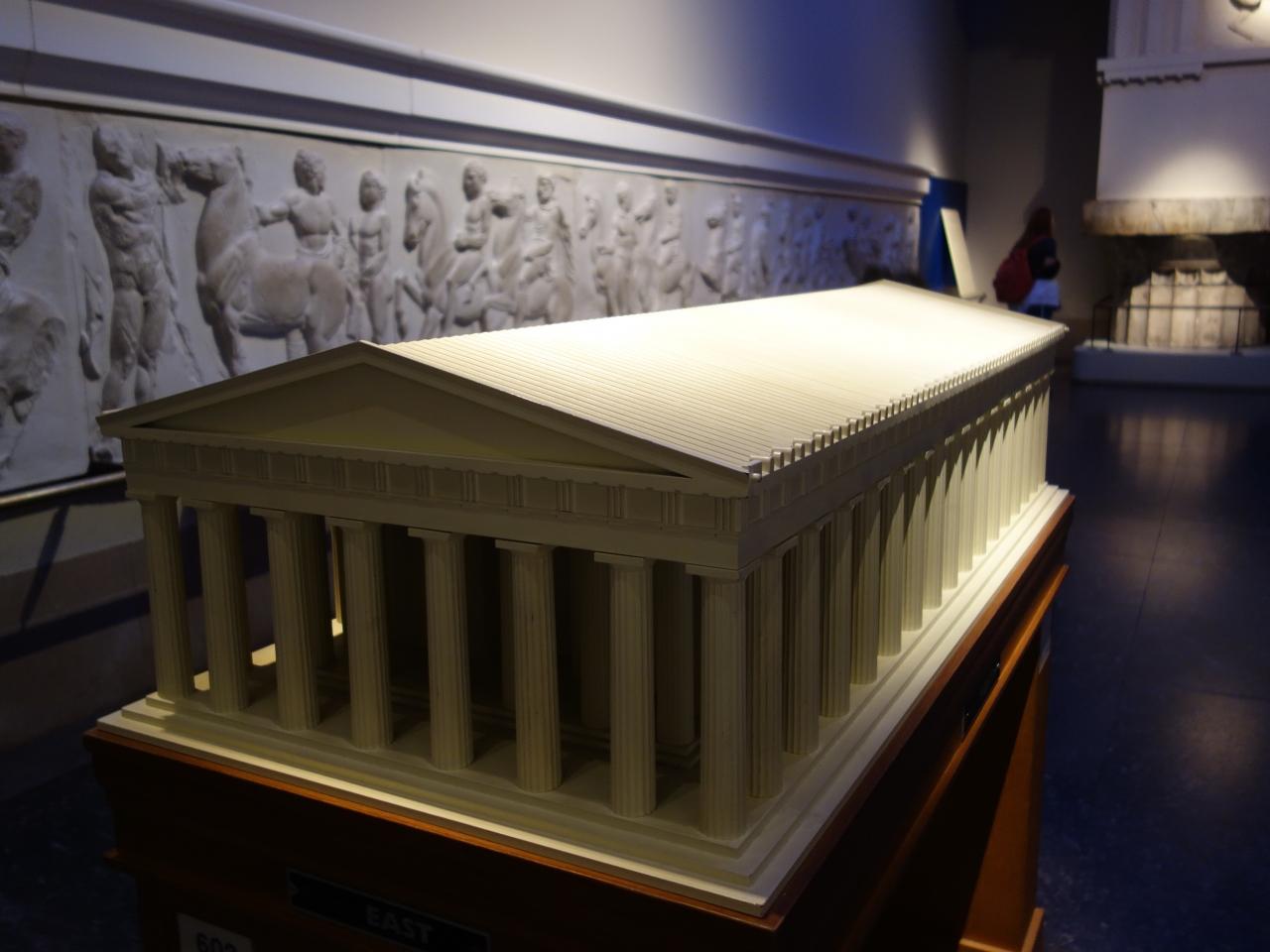
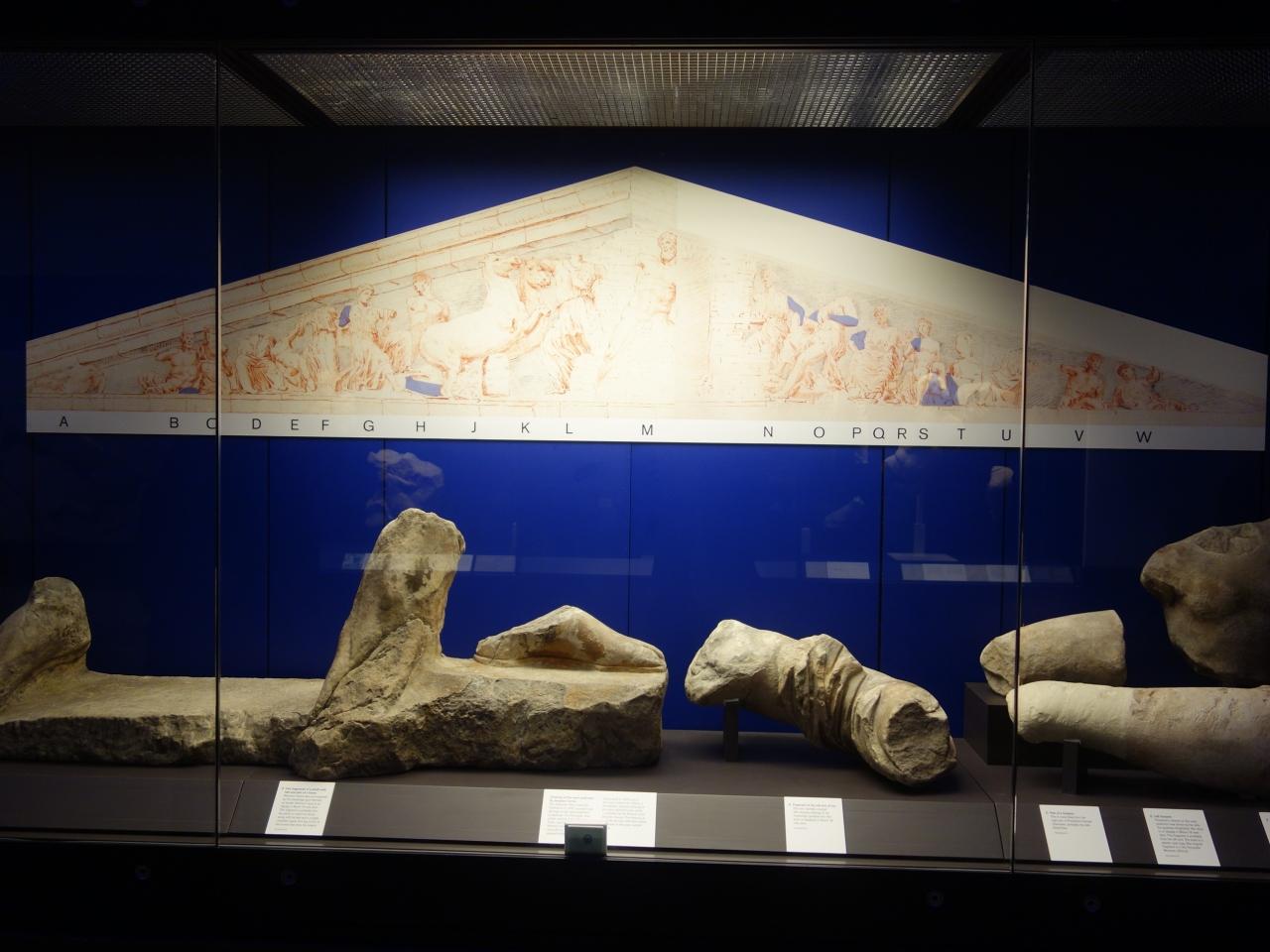
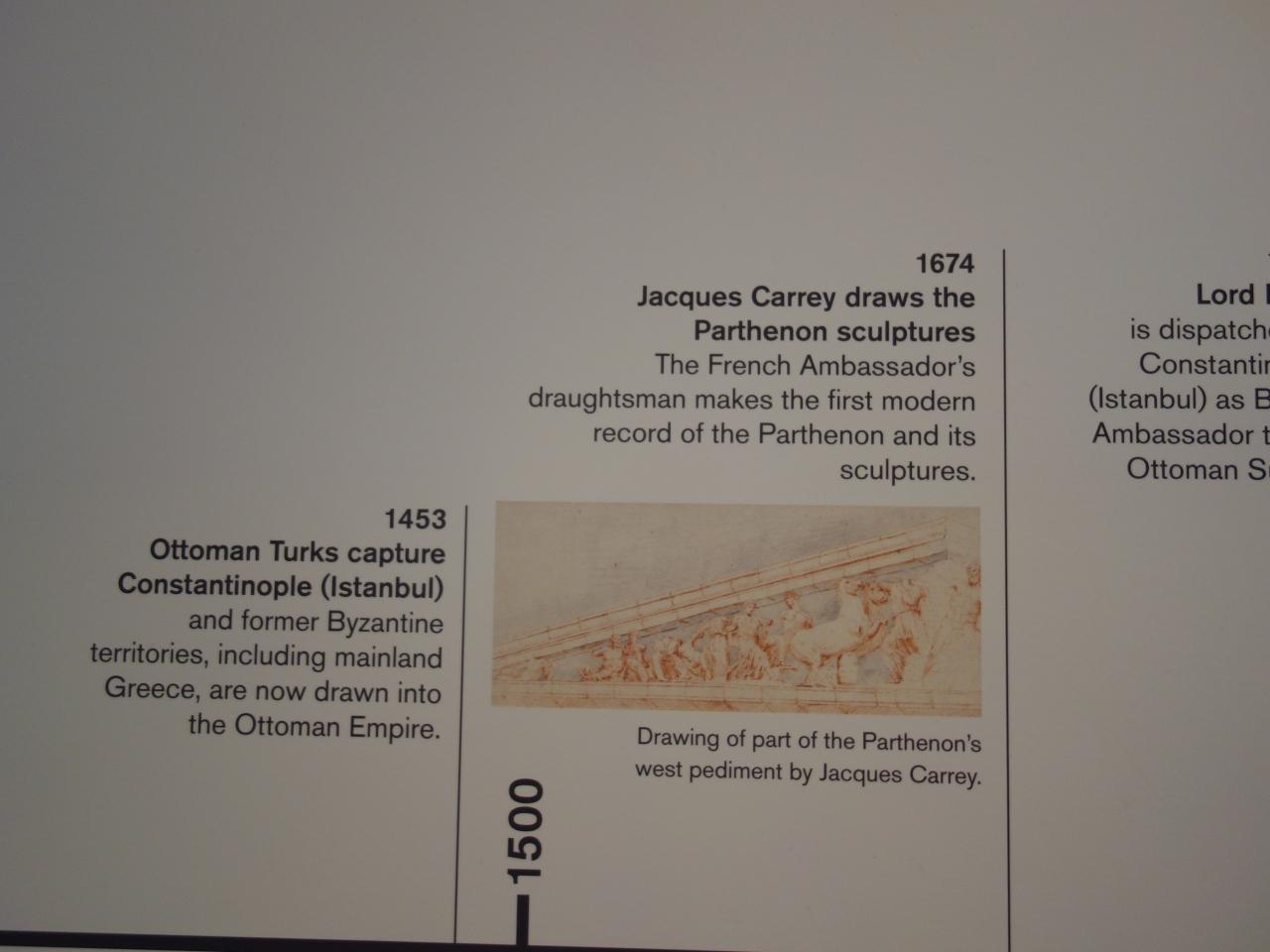
The east pediment
Pediments are the triangular gable ends of a Greek
temple, which were often filled with sculpture carved
all the way round.
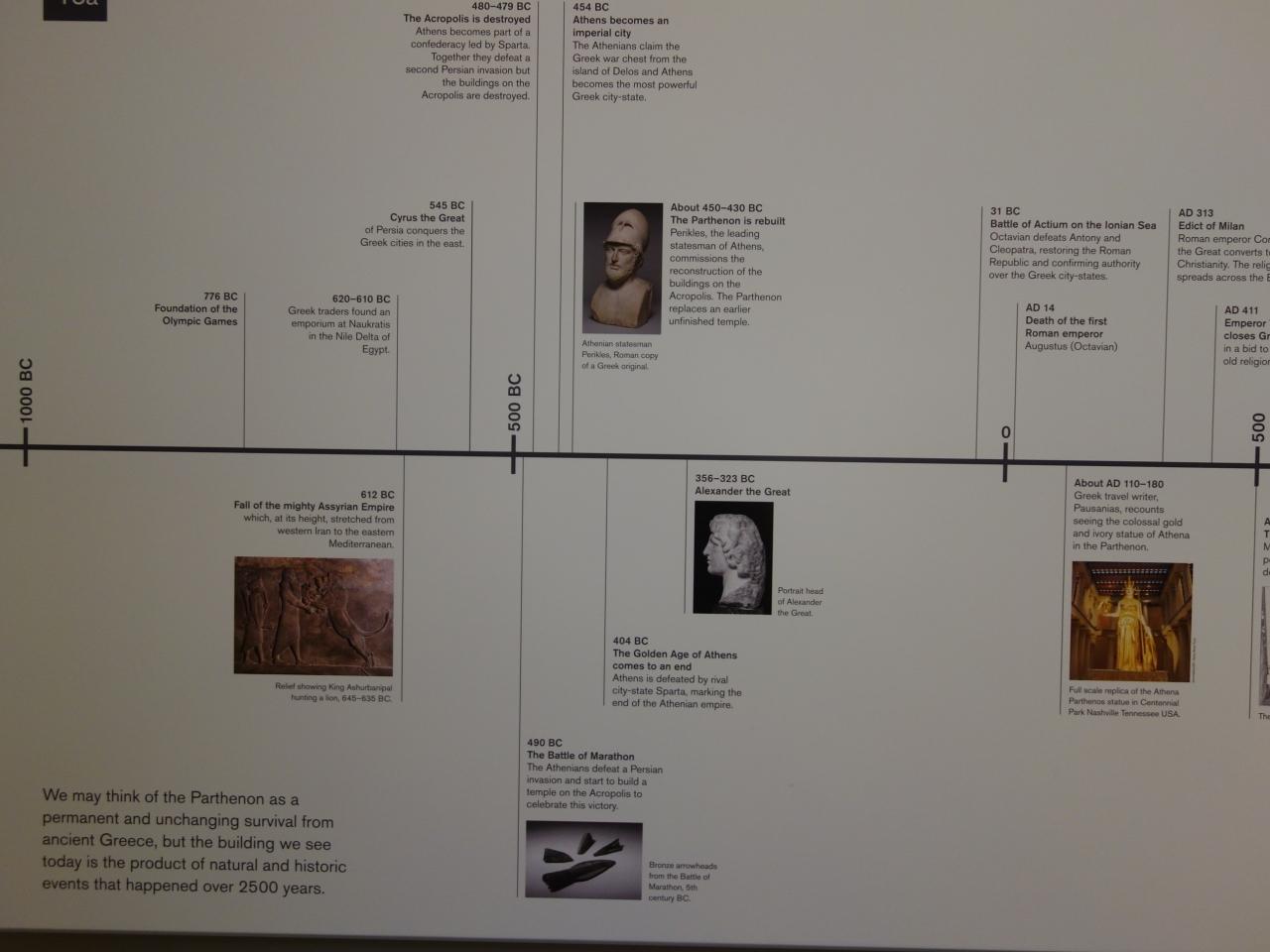
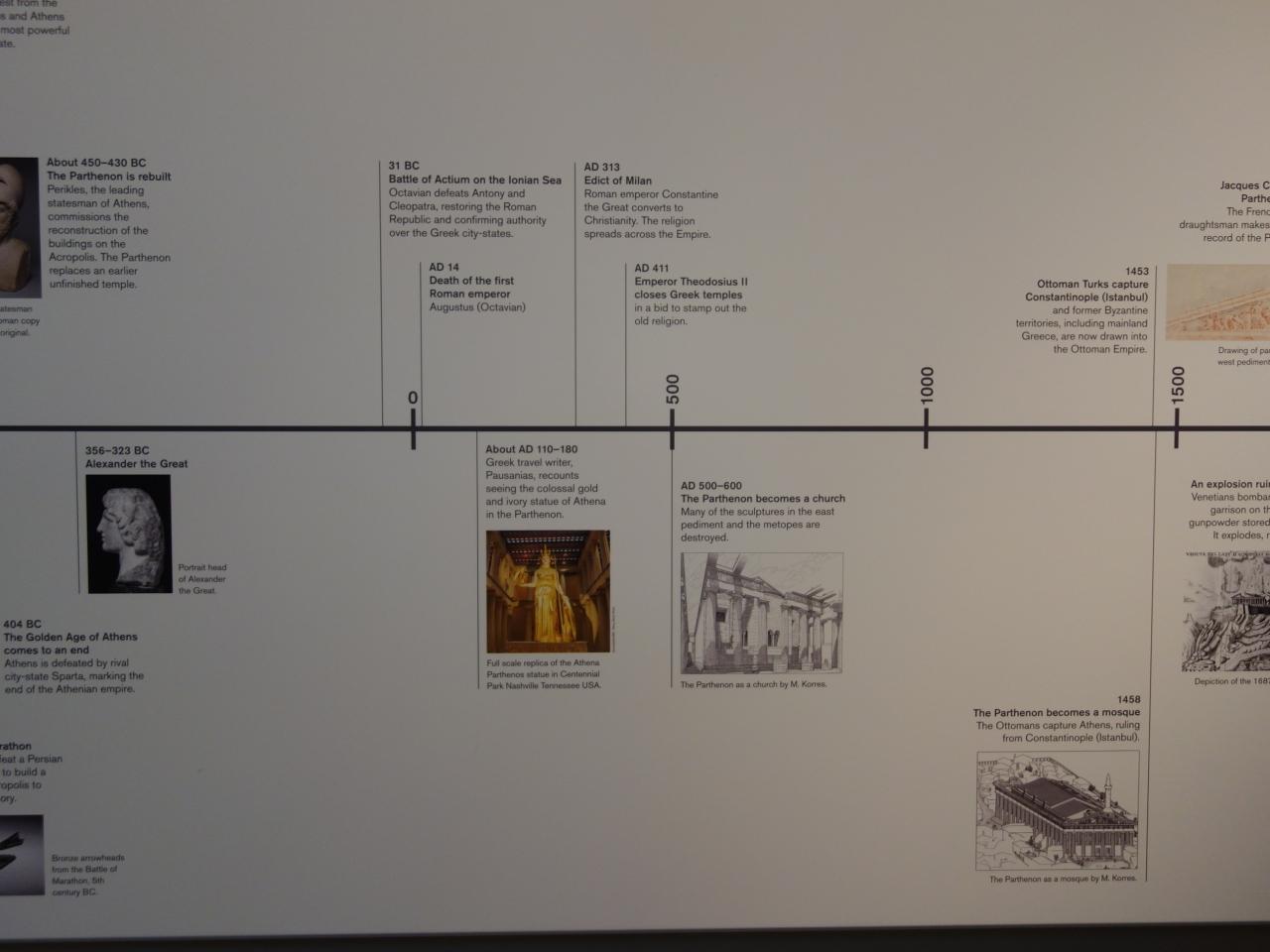
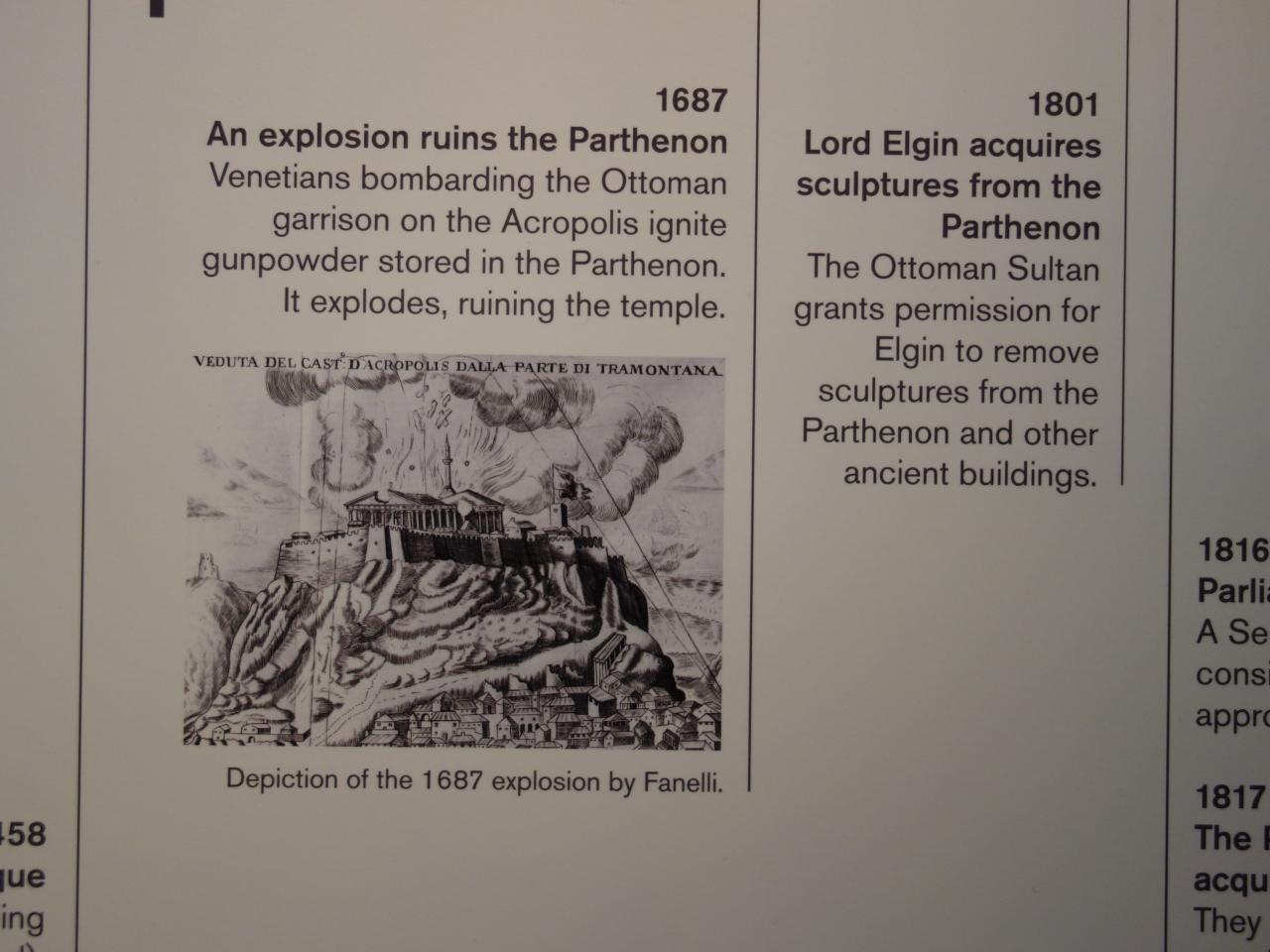
An explosion in 1687 destroyed much of the Parthenon.
Jacques Carrey's drawings, made in 1674, show that the
colossal figures which once occupied the centre of the
pediment were already missing at this time. Pausanias,
a Greek travel writer of the 2nd century AD, reports that
the east pediment of the Parthenon showed the birth
of Athena. The goddess was born fully grown and armed
from her father Zeus's head, which was split open by the
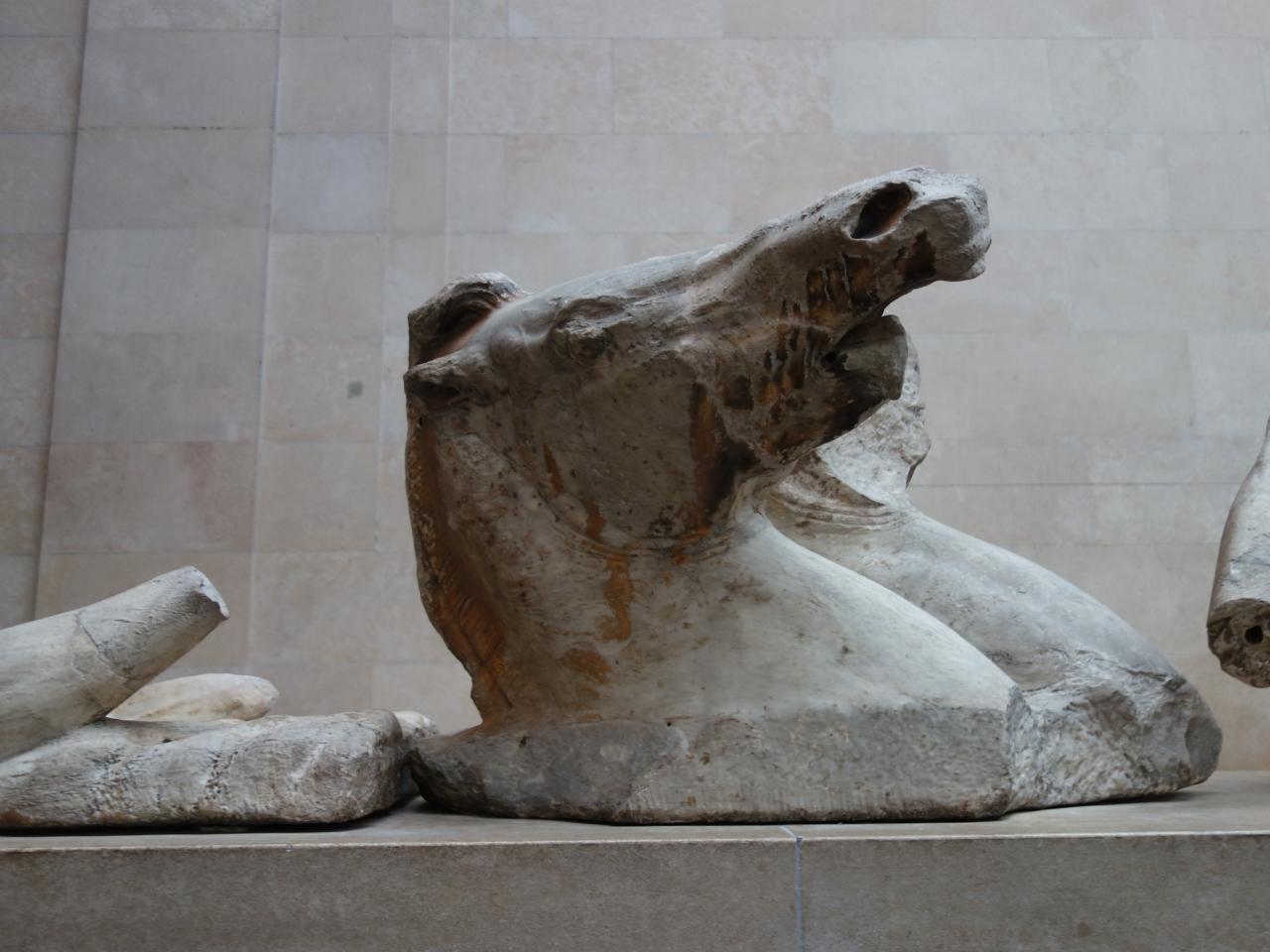
axe of Hephaistos, the smith god. The time of Athena's
birth was marked in the corners of the pediment. On the
left, are the remains of the sun god, Helios, rising at dawn
in his horse-drawn chariot. In the opposite corner Selene,
goddess of the moon, was shown descending in the
western sky, her horses exhausted by their journey. The
sculptors have cleverly arranged the figures to fit into the
triangular pediment while retaining their scale.
Drawings by Jacques Garrey from 1674 show the composition of the
sculptures before they were destroyed by an explosion in 1687.
262 -
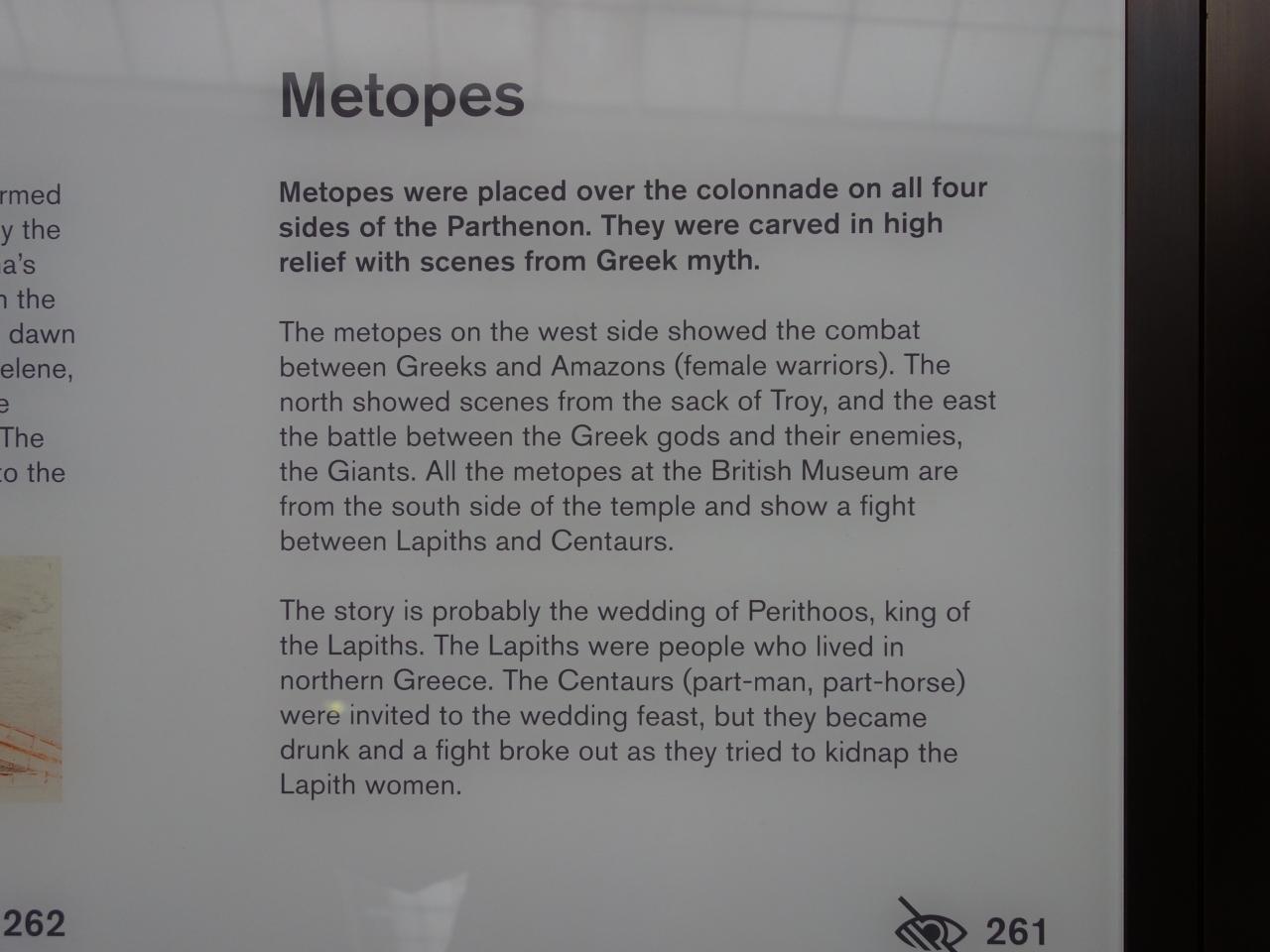
Metopes
Metopes were placed over the colonnade on all four
sides of the Parthenon. They were carved in high
relief with scenes from Greek myth.
The metopes on the west side showed the combat
between Greeks and Amazons (female warriors). The
north showed scenes from the sack of Troy, and the east
the battle between the Greek gods and their enemies,
the Giants. All the metopes at the British Museum are
from the south side of the temple and show a fight
between Lapiths and Centaurs.
The story is probably the wedding of Perithoos, king of
the Lapiths. The Lapiths were people who lived in
northern Greece. The Centaurs (part-man, part-horse)
were invited to the wedding feast, but they became
drunk and a fight broke out as they tried to kidnap the
Lapith women.
261 -
-
-
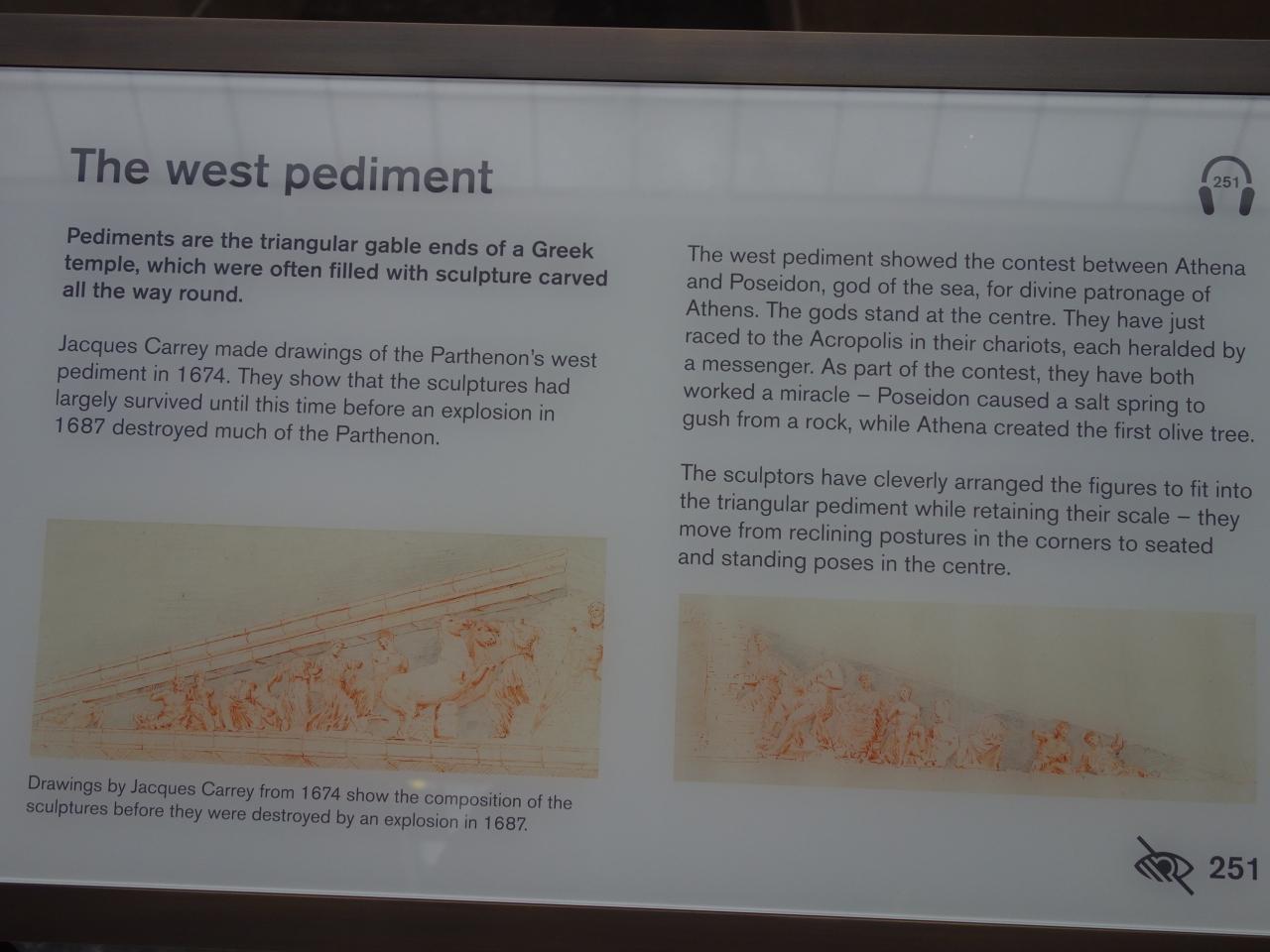
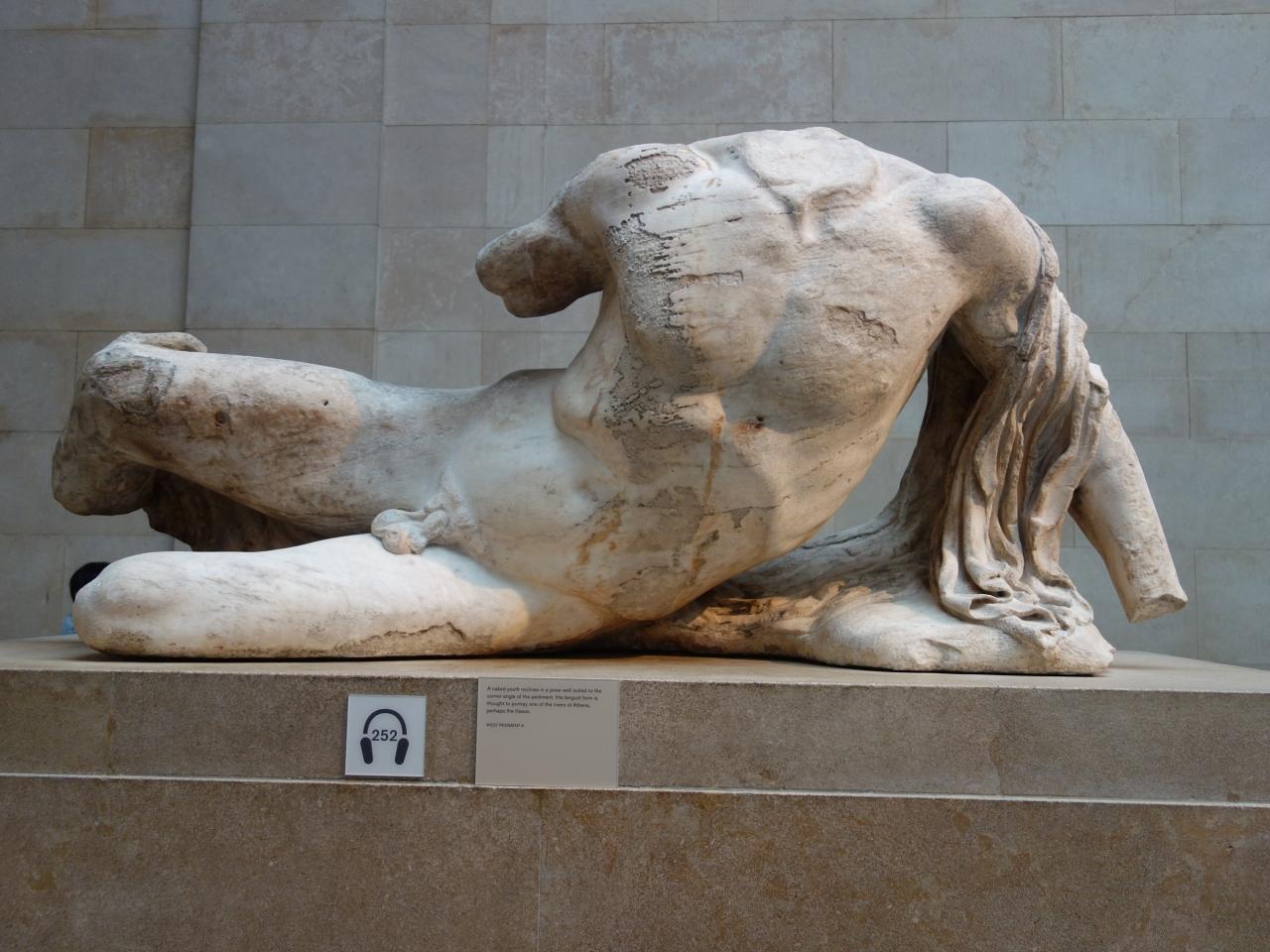
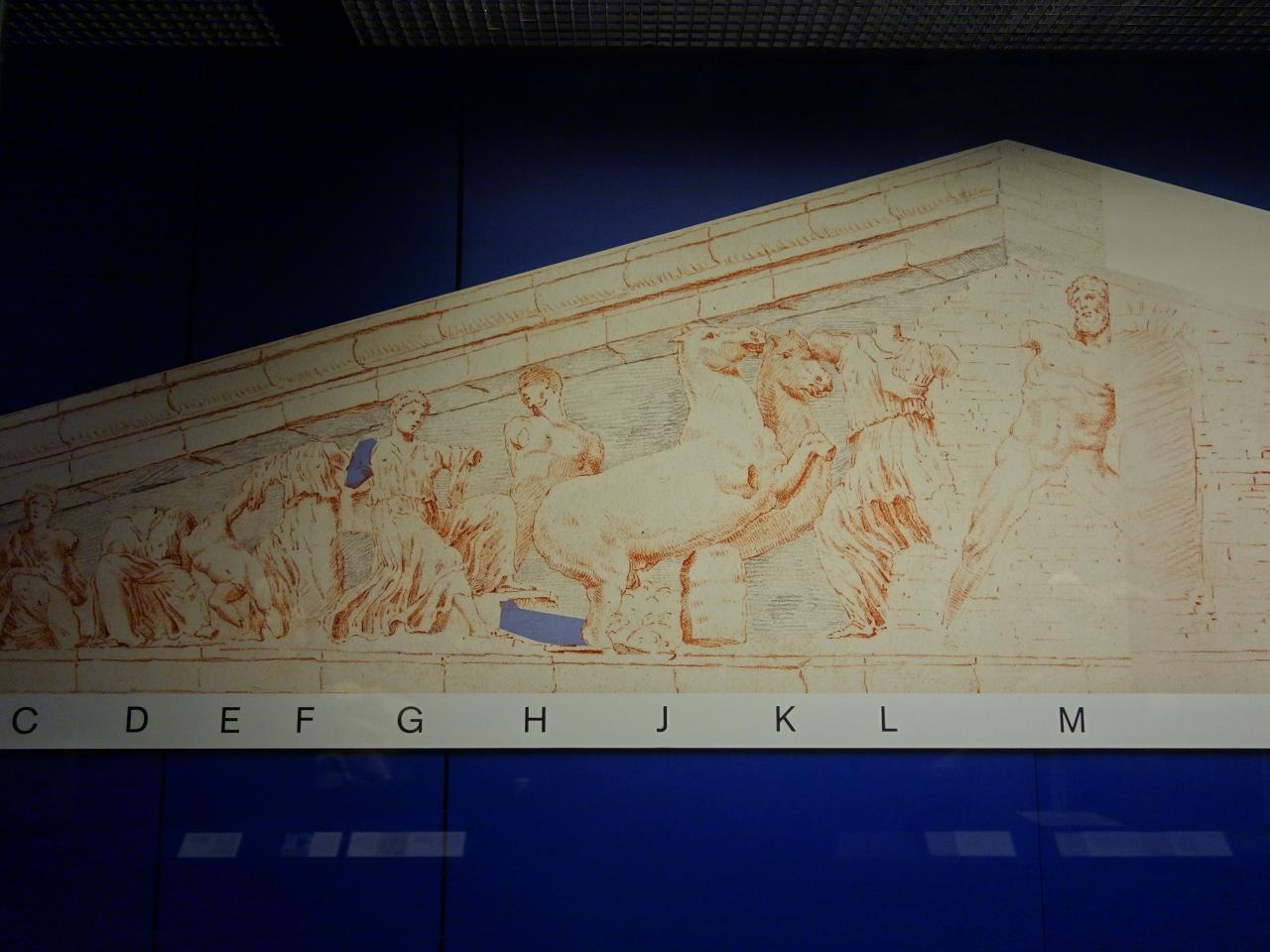
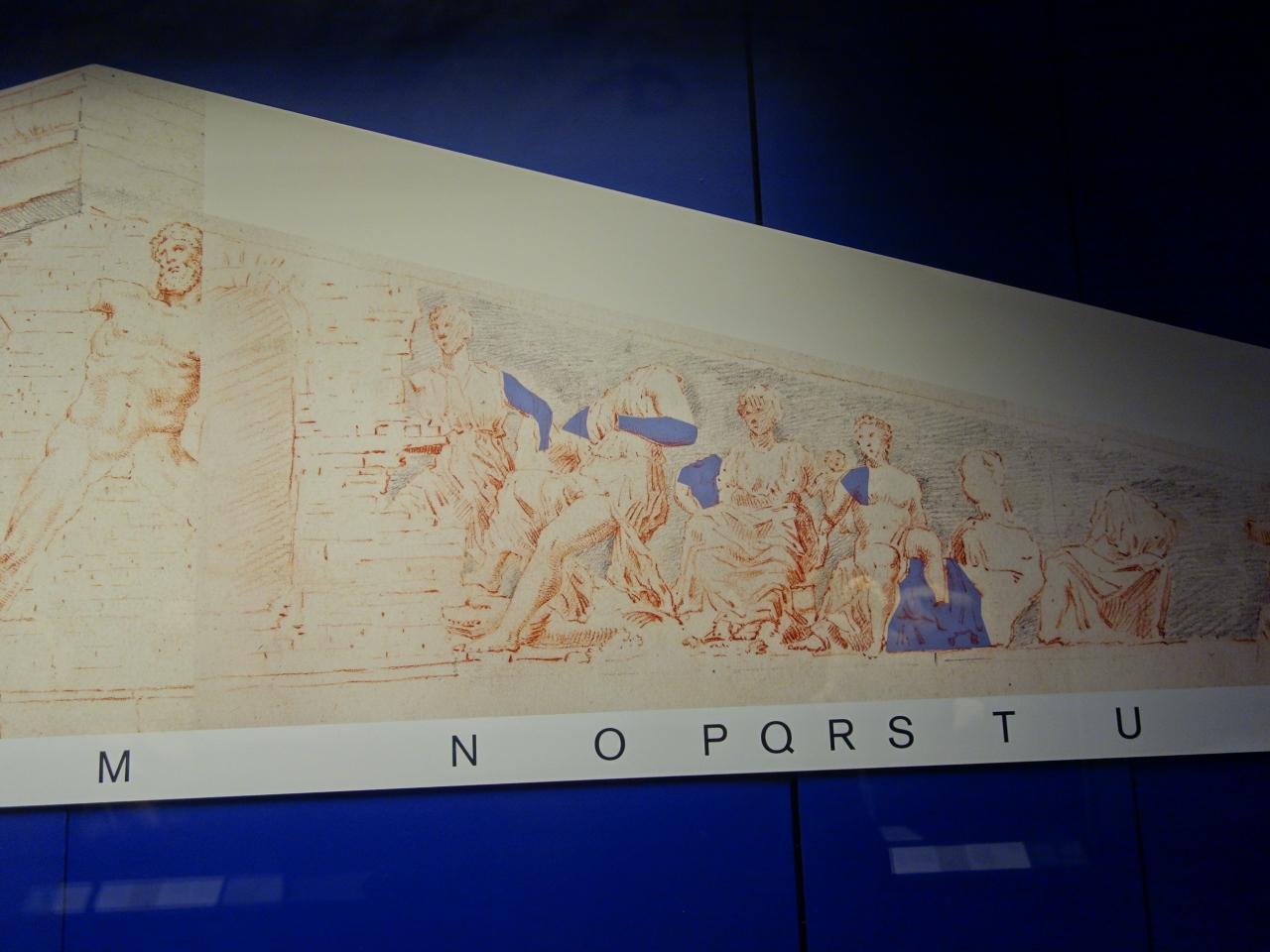
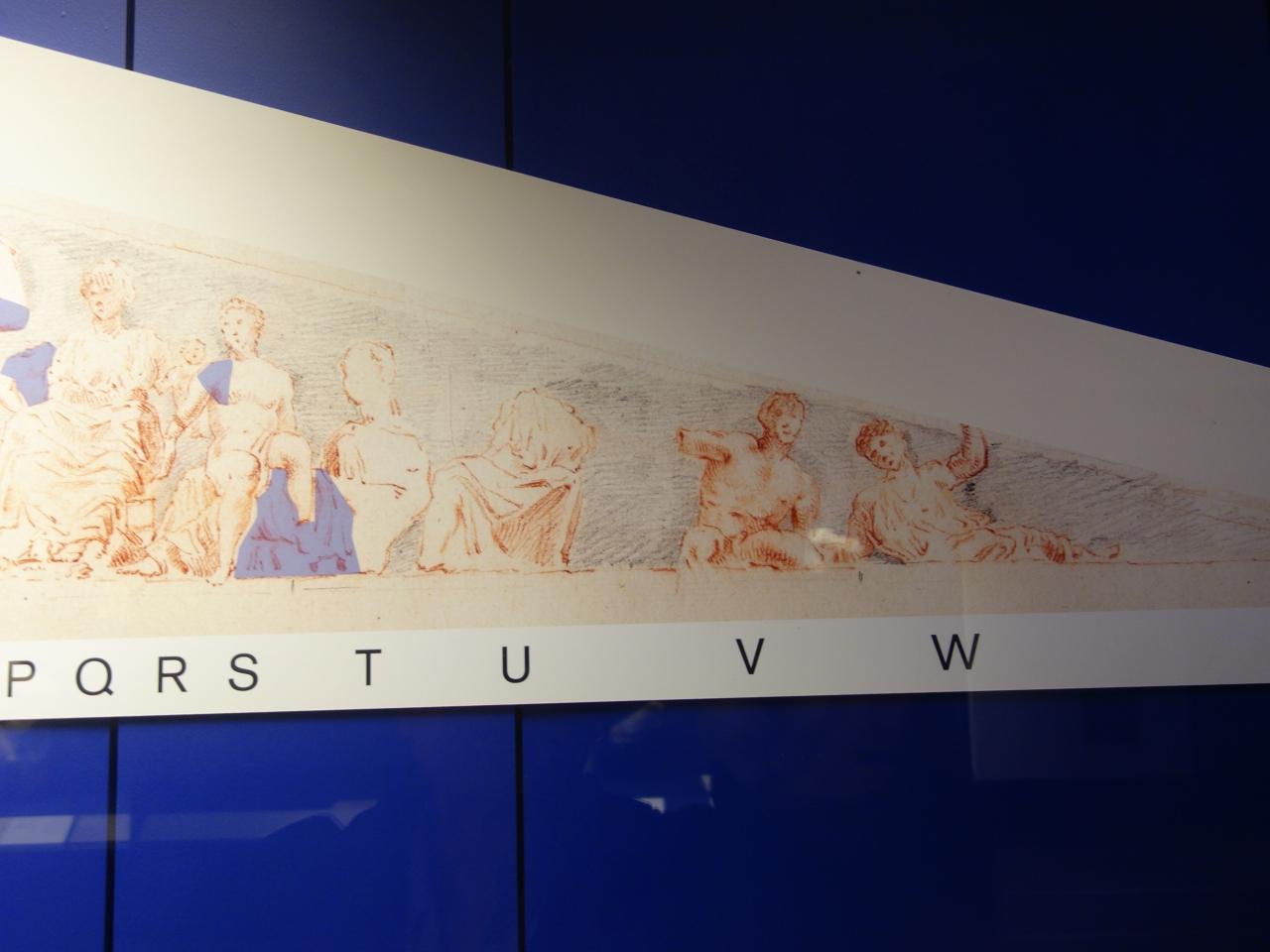
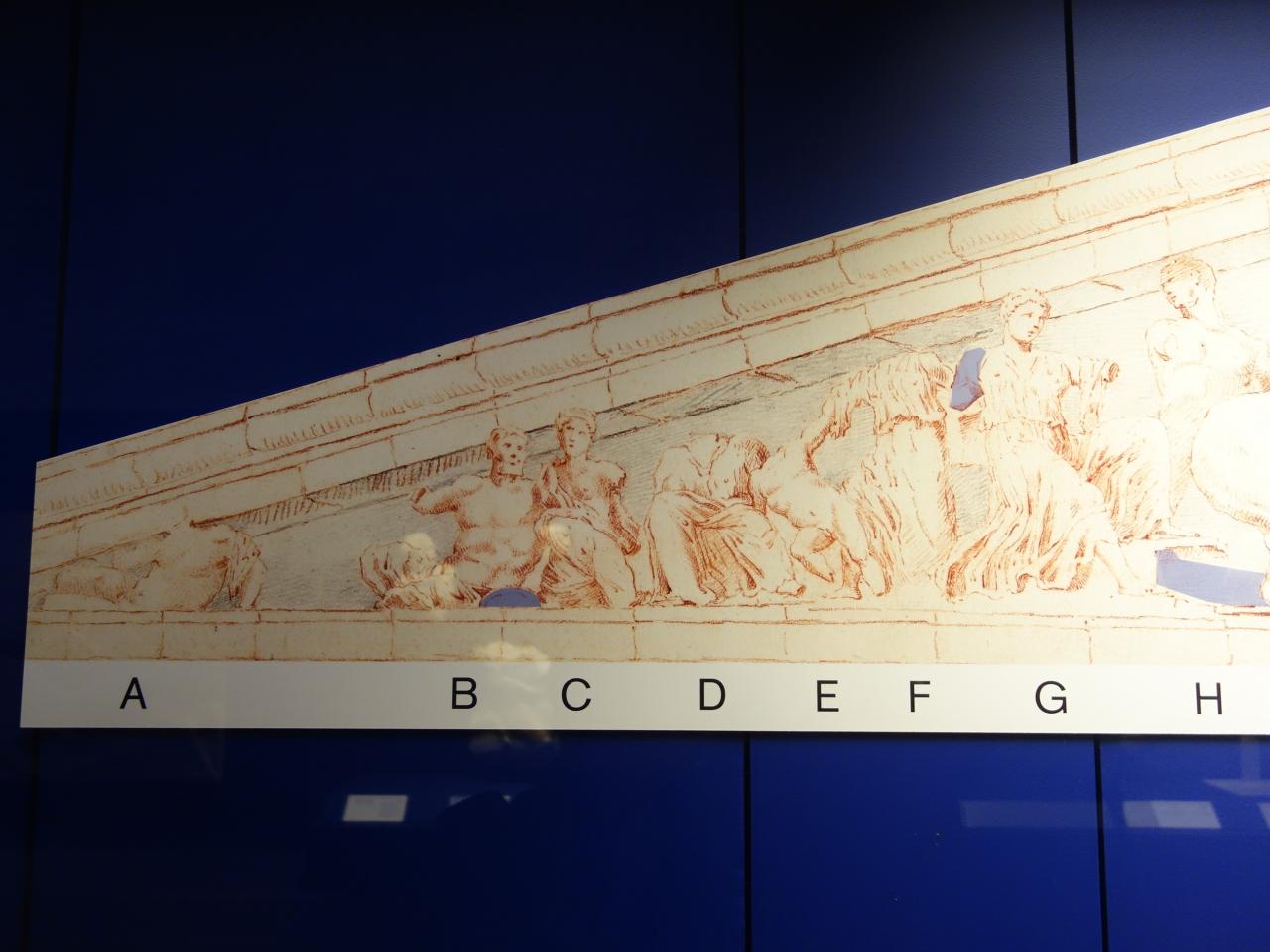
The west pediment
Pediments are the triangular gable ends of a Greek
temple, which were often filled with sculpture carved
all the way round.
Jacques Carrey made drawings of the Parthenon's west
pediment in 1674. They show that the sculptures had
largely survived until this time before an explosion in
1687 destroyed much of the Parthenon.
The west pediment showed the contest between Athena
and Poseidon, god of the sea, for divine patronage of
Athens. The gods stand at the centre. They have just
raced to the Acropolis in their chariots, each heralded by
a messenger. As part of the contest, they have both
worked a miracle ? Poseidon caused a salt spring to
gush from a rock, while Athena created the first olive tree.
The sculptors have cleverly arranged the figures to fit into
the triangular pediment while retaining their scale ? they
move from reclining postures in the corners to seated
and standing poses in the centre.
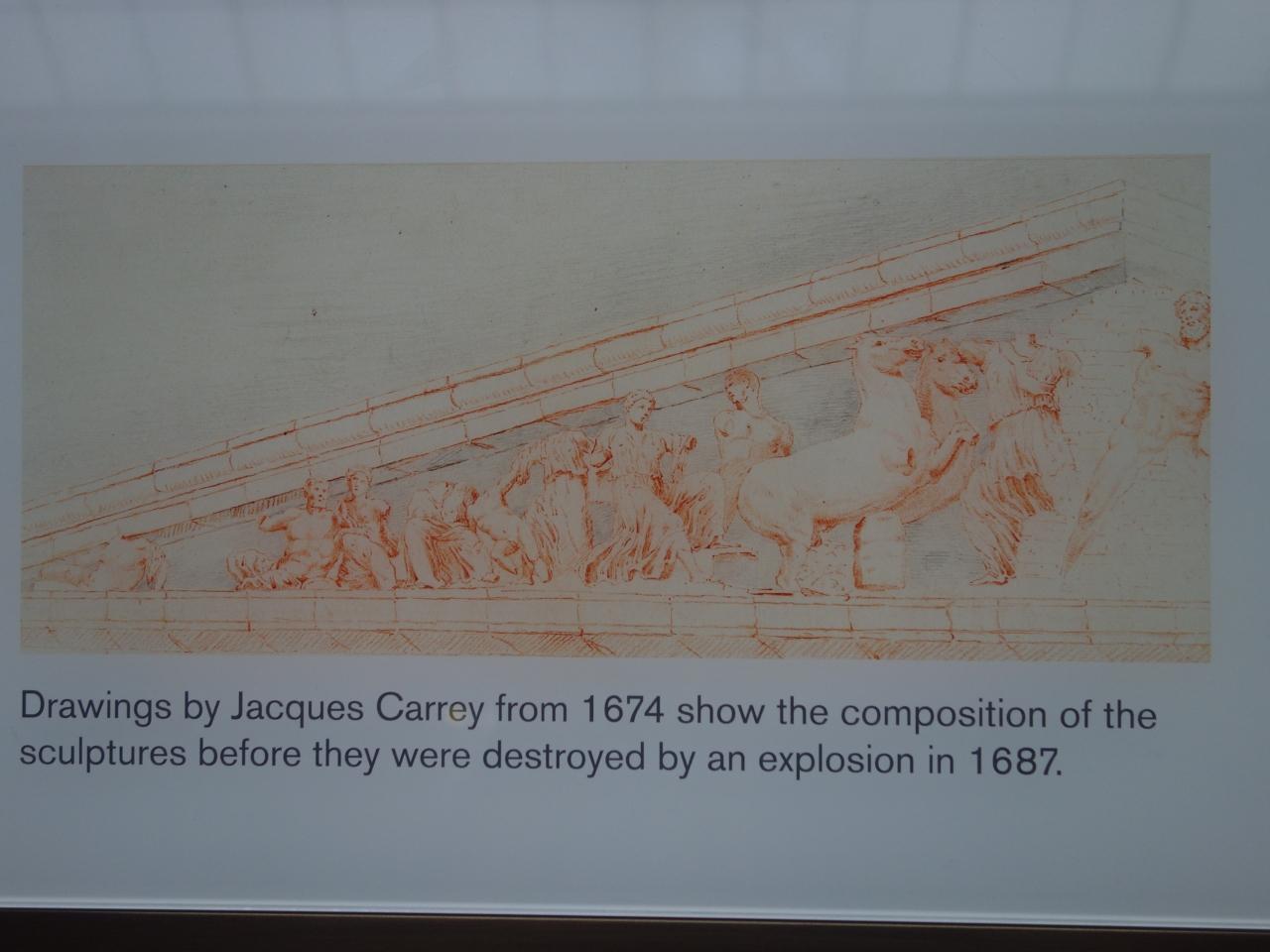
Drawings by Jacques Carrey from 1674 show the composition of the
sculptures before they were destroyed by an explosion in 1687.
251 -
-
-
-
-
-
-
-
-
-
-
-
-
-
-
-
-
-
-
-
-
-
-
-
-
-
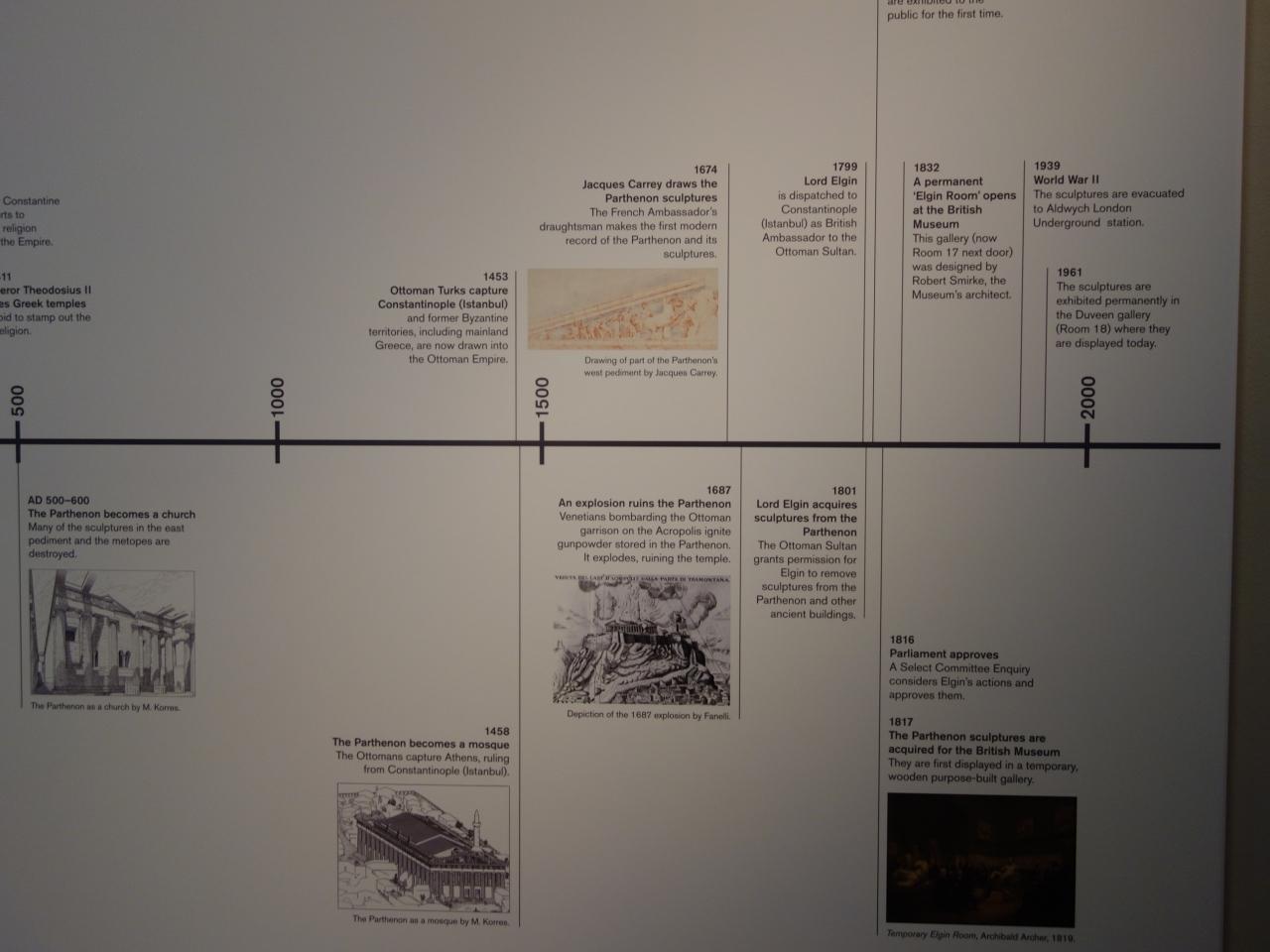
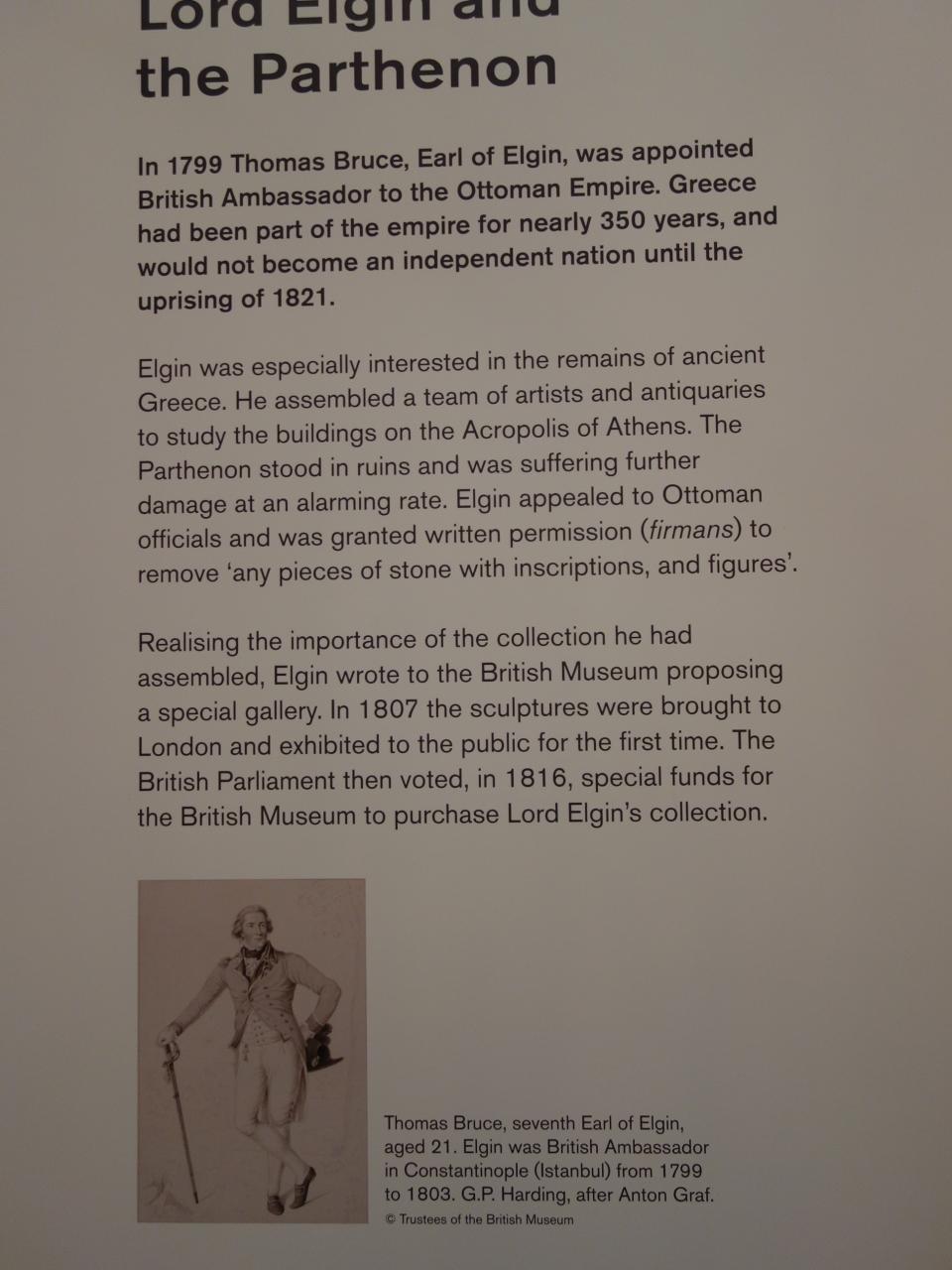
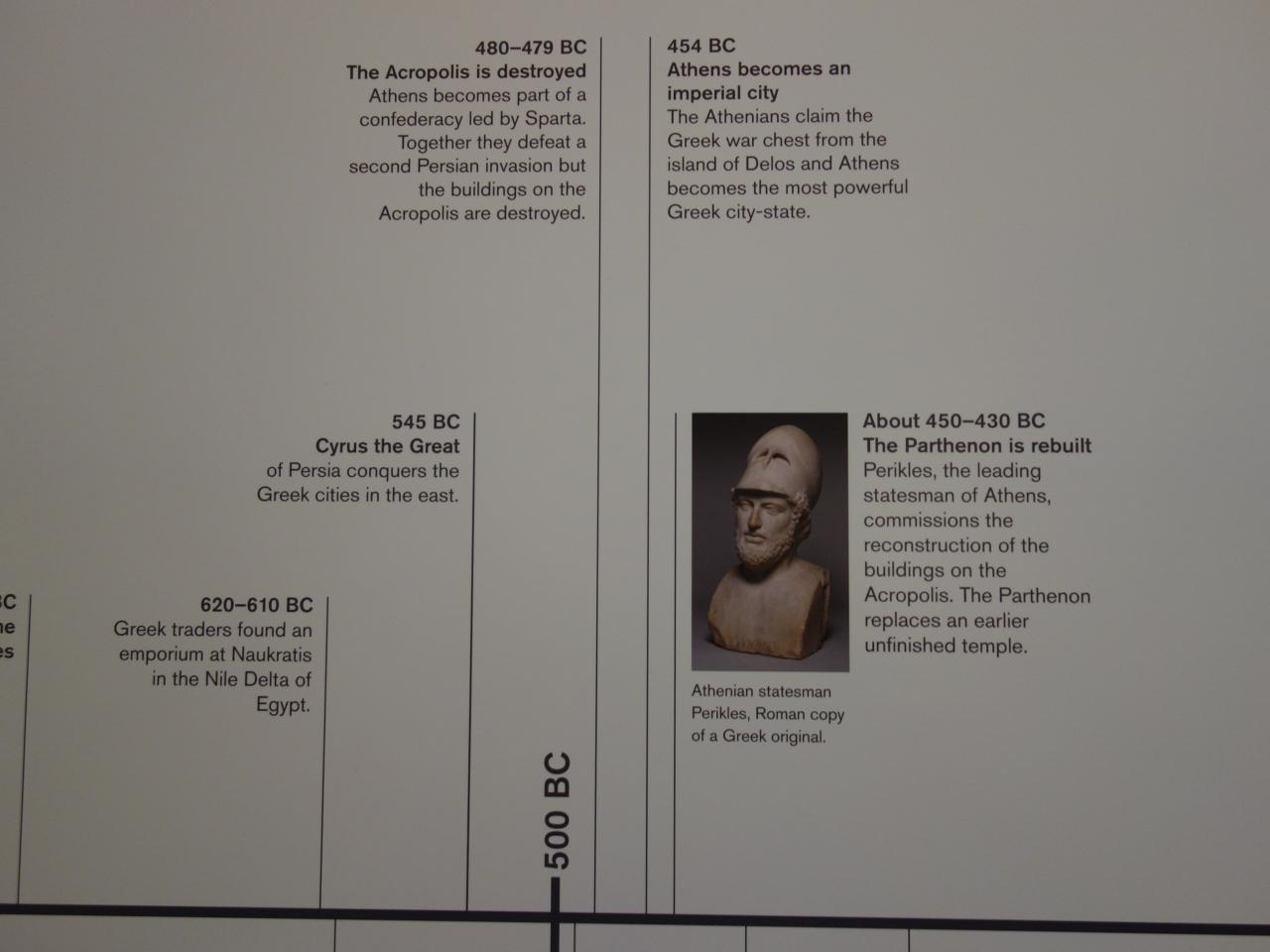
Lord Elgin and
the Parthenon
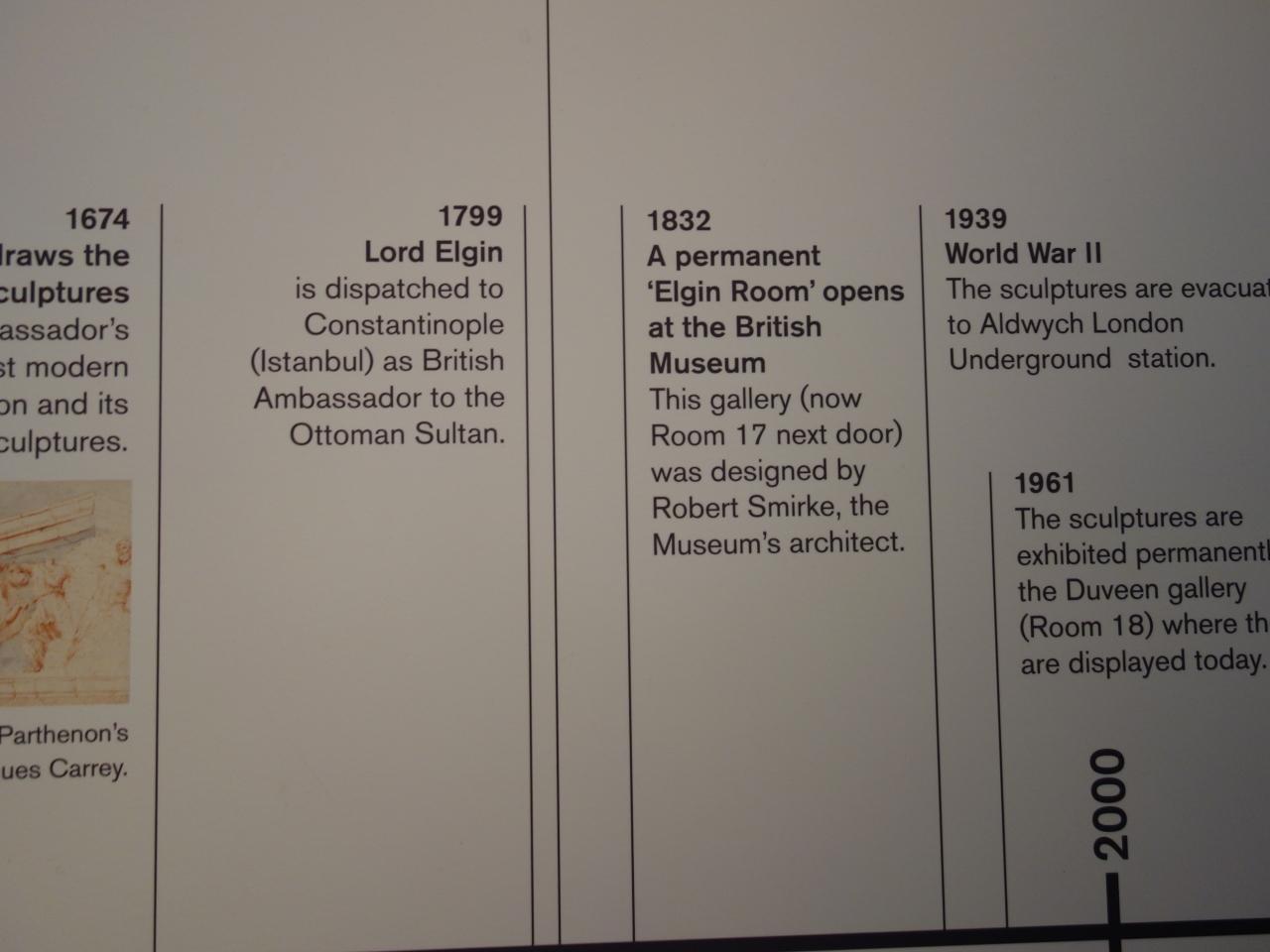
In 1799 Thomas Bruce, Earl of Elgin, was appointed
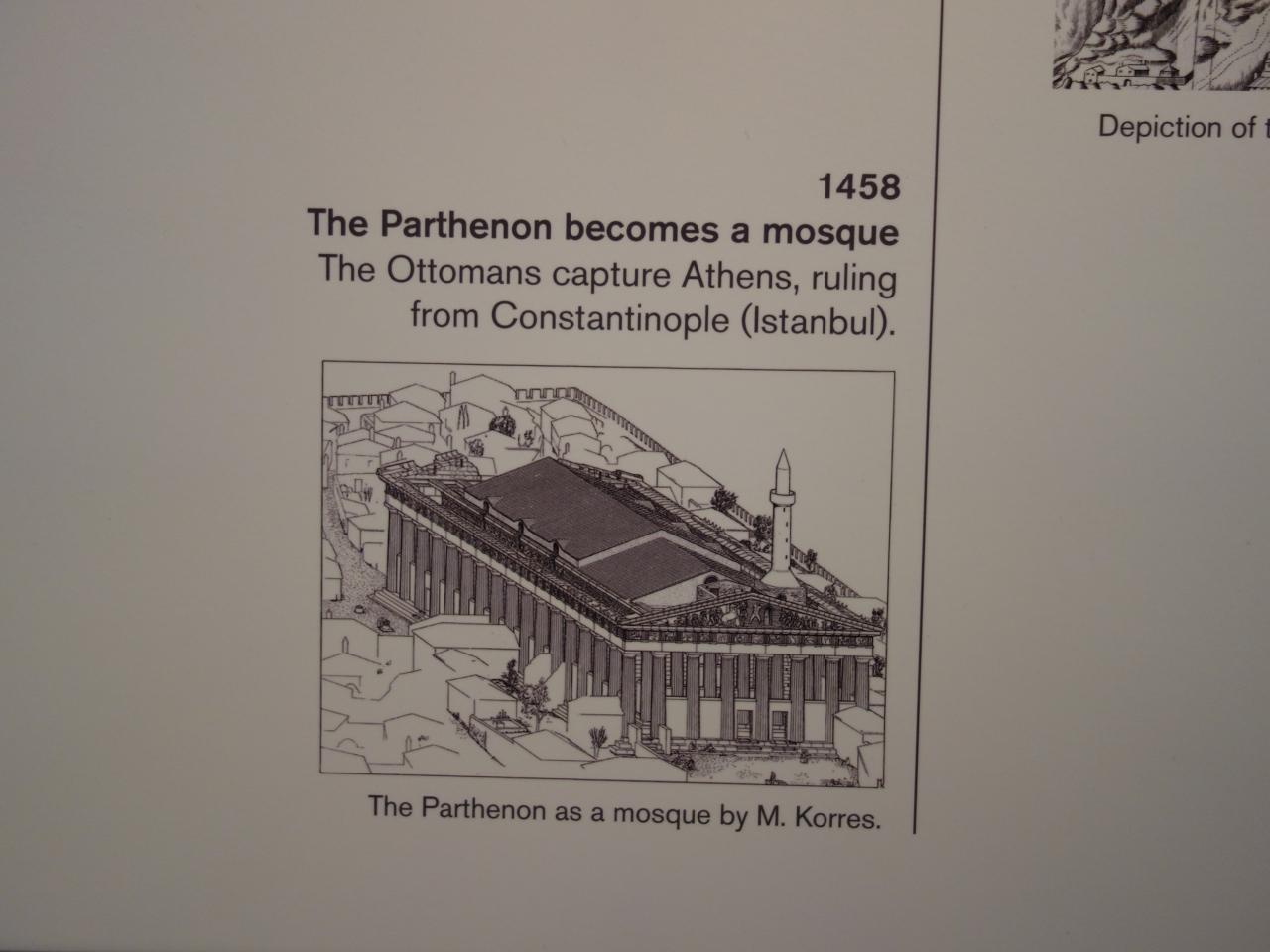
British Ambassador to the Ottoman Empire. Greece
had been part of the empire for nearly 350 years, and
would not become an independent nation until the
uprising of 1821.
Elgin was especially interested in the remains of ancient
Greece. He assembled a team of artists and antiquaries
to study the buildings on the Acropolis of Athens. The
Parthenon stood in ruins and was suffering further
damage at an alarming rate. Elgin appealed to Ottoman
officials and was granted written permission (firmans) to
remove 'any pieces of stone with inscriptions, and figures'.
Realising the importance of the collection he had
assembled, Elgin wrote to the British Museum proposing
a special gallery. In 1807 the sculptures were brought to
London and exhibited to the public for the first time. The
British Parliament then voted, in 1816, special funds for
the British Museum to purchase Lord Elgin's collection.
Thomas Bruce, seventh Earl of Elgin,
aged 21. Elgin was British Ambassador
in Constantinople (Istanbul) from 1799
to 1803. G.P. Harding, after Anton Graf.
c Trustees of the British Museum -
-
-
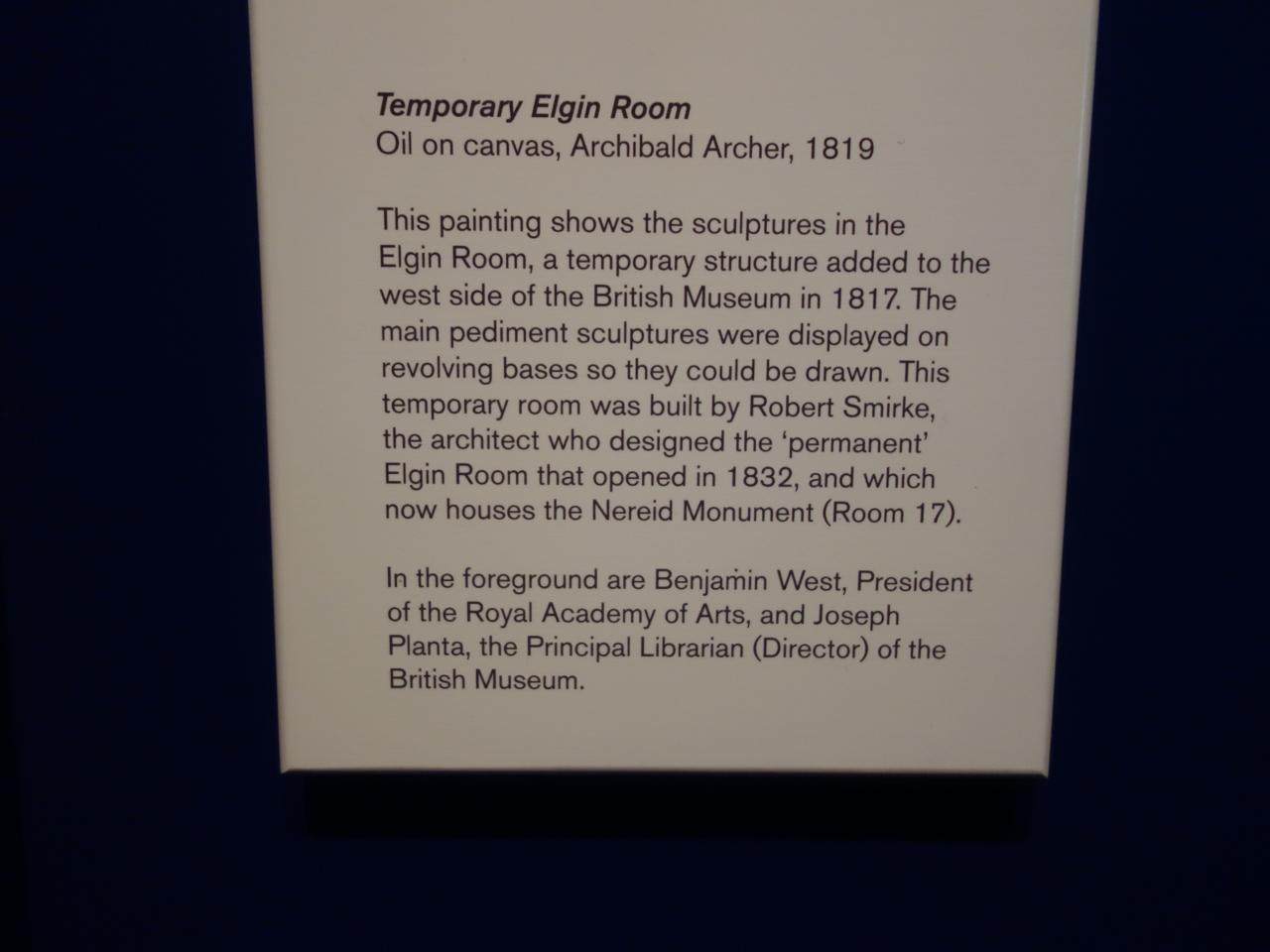
Temporary Elgin Room
Oil on canvas, Archibald Archer, 1819
This painting shows the sculptures in the
Elgin Room, a temporary structure added to the
west side of the British Museum in 1817. The
main pediment sculptures were displayed on
revolving bases so they could be drawn. This
temporary room was built by Robert Smirke,
the architect who designed the 'permanent'
Elgin Room that opened in 1832, and which
now houses the Nereid Monument (Room 17).
In the foreground are Benjamin West, President
of the Royal Academy of Arts, and Joseph
Planta, the Principal Librarian (Director) of the
British Museum. -
-
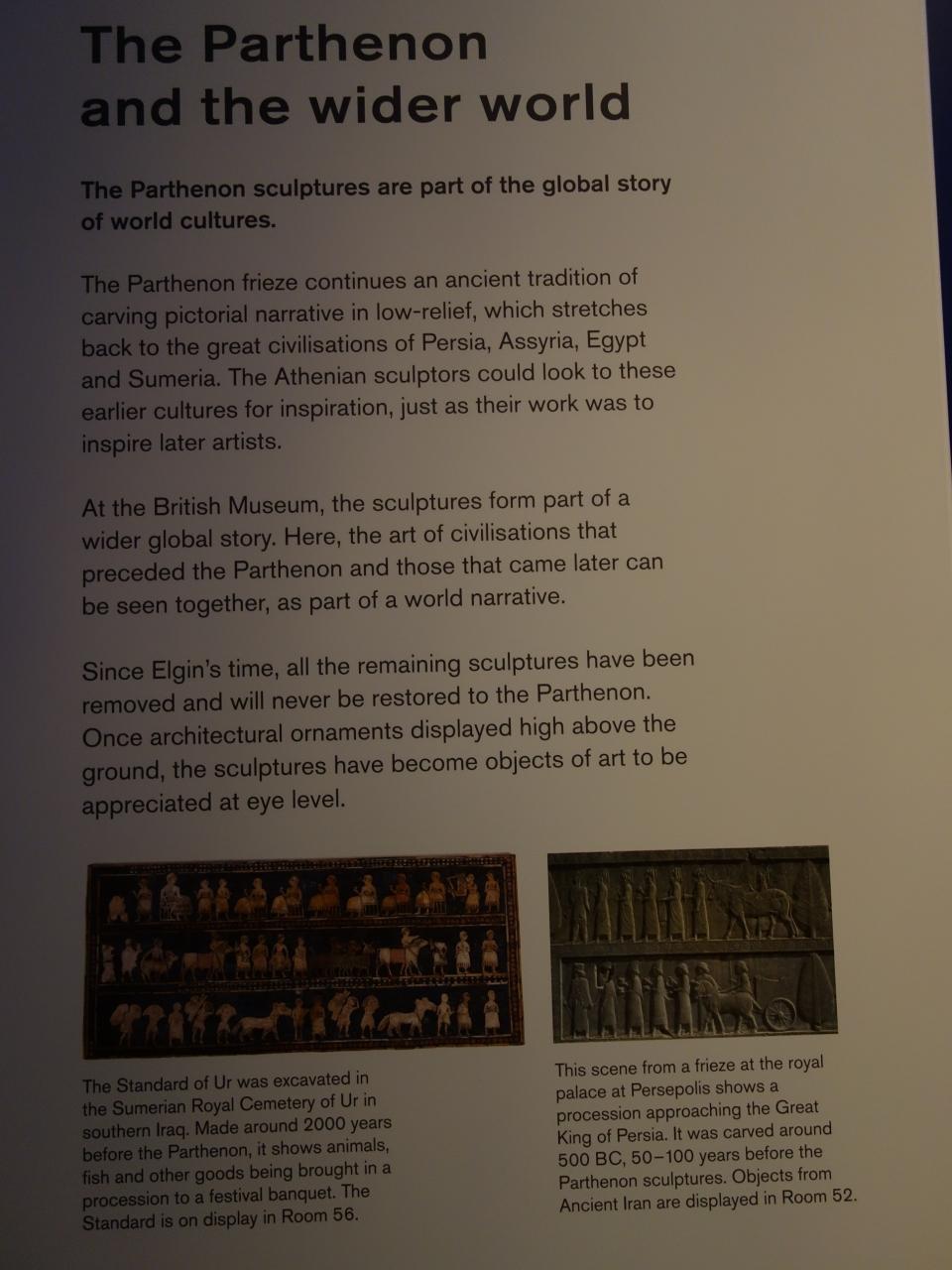
The Parthenon
and the wider world
The Parthenon sculptures are part of the global story
of world cultures.
The Parthenon frieze continues an ancient tradition of
carving pictorial narrative in low-relief, which stretches
back to the great civilisations of Persia, Assyria, Egypt
and Sumeria. The Athenian sculptors could look to these
earlier cultures for inspiration, just as their work was to
inspire later artists.
At the British Museum, the sculptures form part of a
wider global story. Here, the art of civilisations that
preceded the Parthenon and those that came later can
be seen together, as part of a world narrative.
Since Elgin's time, all the remaining sculptures have been
removed and will never be restored to the Parthenon.
Once architectural ornaments displayed high above the
ground, the sculptures have become objects of art to be
appreciated at eye level.
The Standard of Ur was excavated in
the Sumerian Royal Cemetery of Ur in
southern Iraq. Made around 2000 years
before the Parthenon, it shows animals,
fish and other goods being brought in a
procession to a festival banquet. The
Standard is on display in Room 56.
This scene from a frieze at the royal
palace at Persepolis shows a
procession approaching the Great
King of Persia. It was carved around
500 BC, 50-100 years before the
Parthenon sculptures. Objects from
Ancient Iran are displayed in Room 52. -
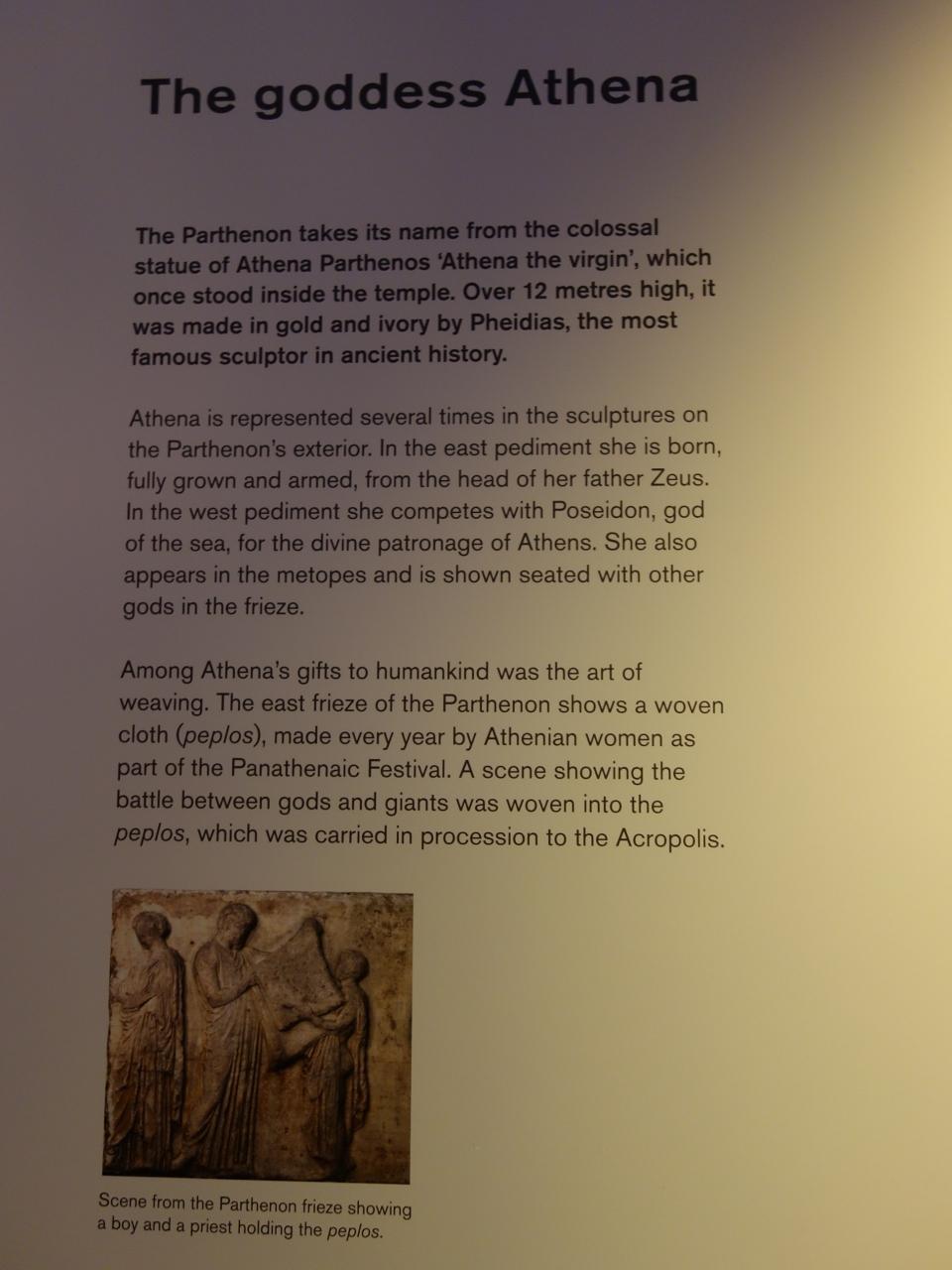
The goddess Athena
The Parthenon takes its name from the colossal
statue of Athena Parthenos 'Athena the virgin', which
once stood inside the temple. Over 12 metres high, it
was made in gold and ivory by Pheidias, the most
famous sculptor in ancient history.
Athena is represented several times in the sculptures on
the Parthenon's exterior. In the east pediment she is born.
fully grown and armed, from the head of her father Zeus.
In the west pediment she competes with Poseidon, god
of the sea, for the divine patronage of Athens. She also
appears in the metopes and is shown seated with other
gods in the frieze.
Among Athena's gifts to humankind was the art of
weaving. The east frieze of the Parthenon shows a woven
cloth (peplos), made every year by Athenian women as
part of the Panathenaic Festival. A scene showing the
battle between gods and giants was woven into the
peplos, which was carried in procession to the Acropolis.
Scene from the Parthenon frieze showing
a boy and a priest holding the peplos. -
-
-
-
-
-
-
-
-
-
-
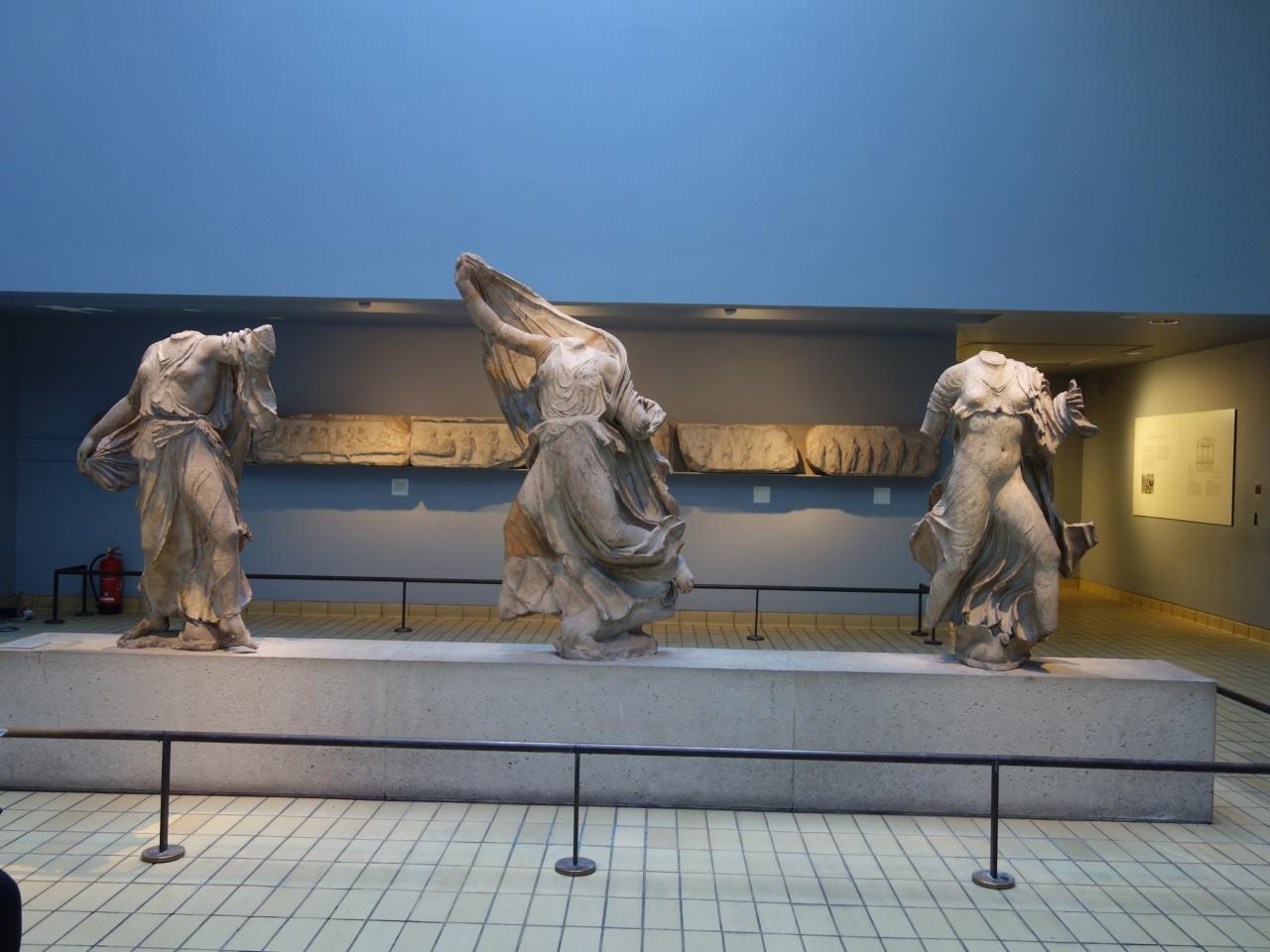
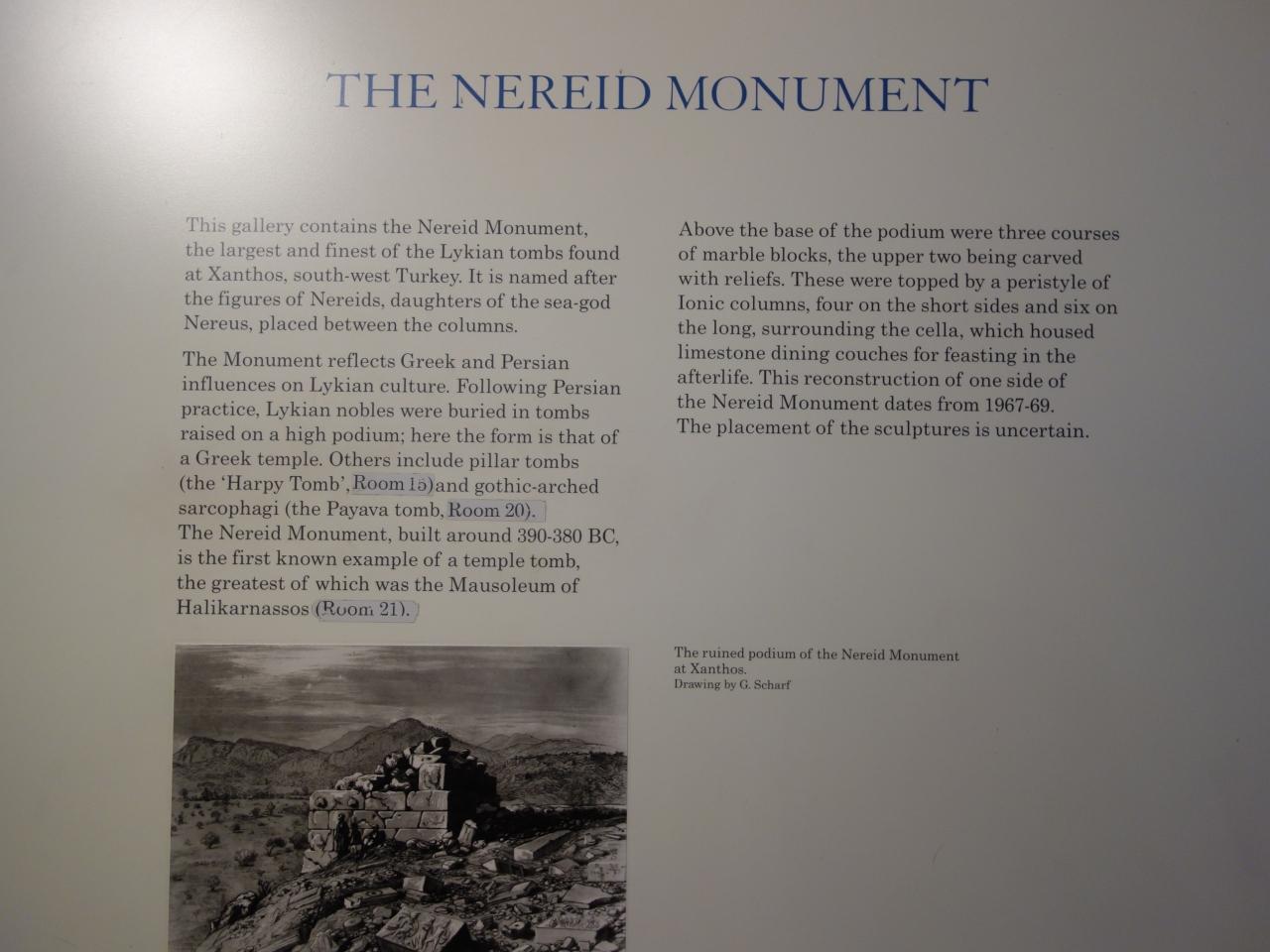
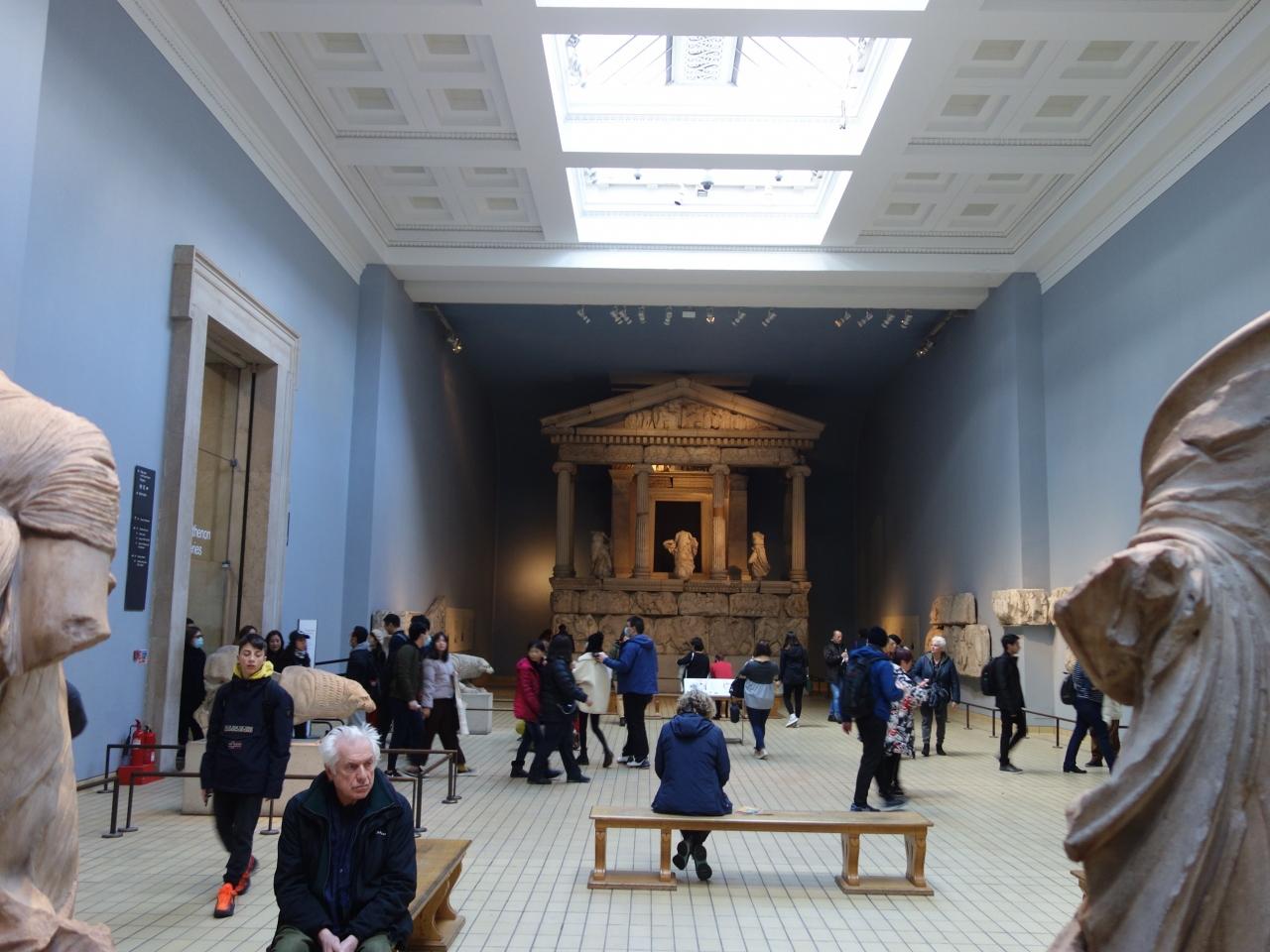
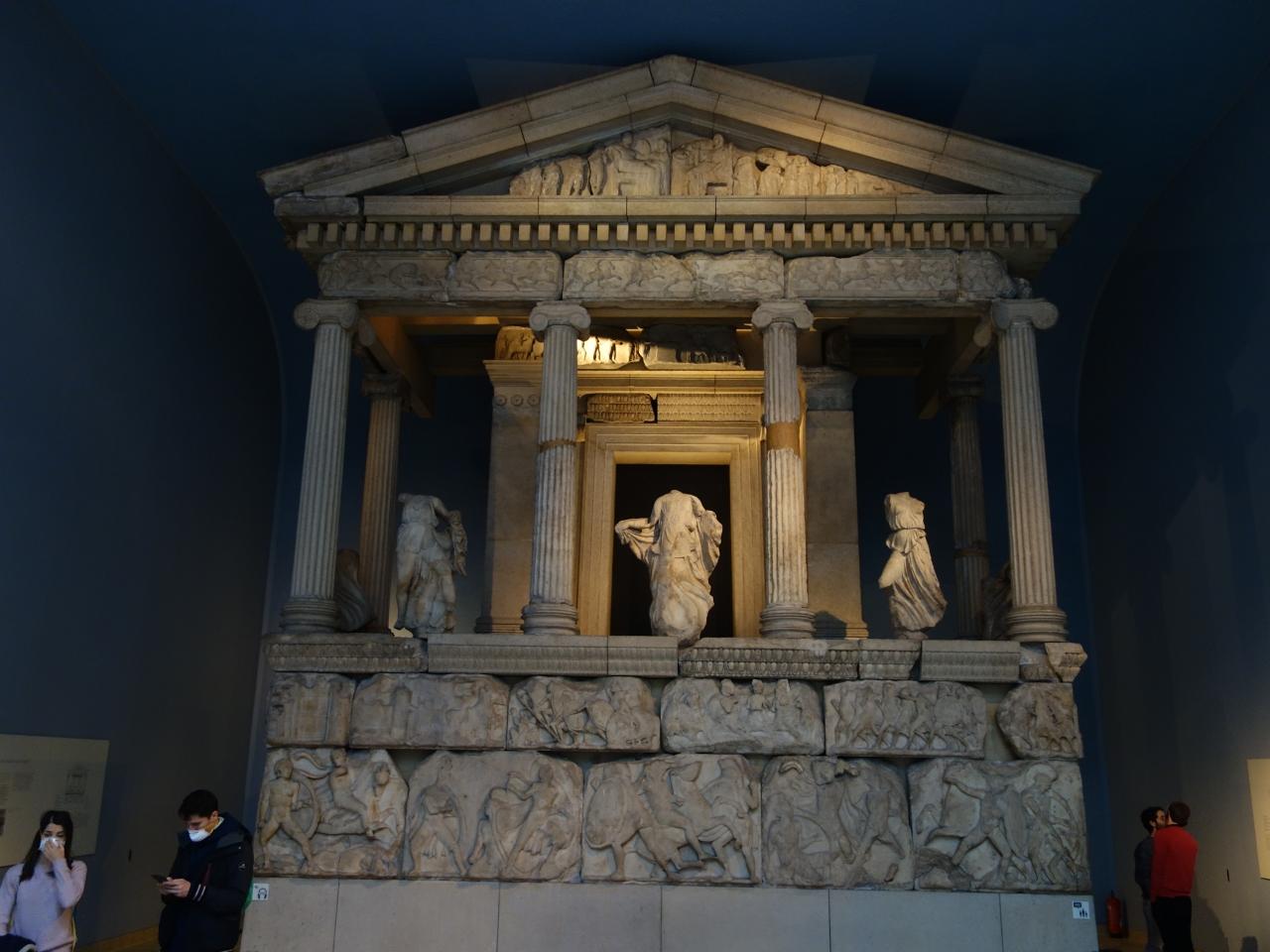
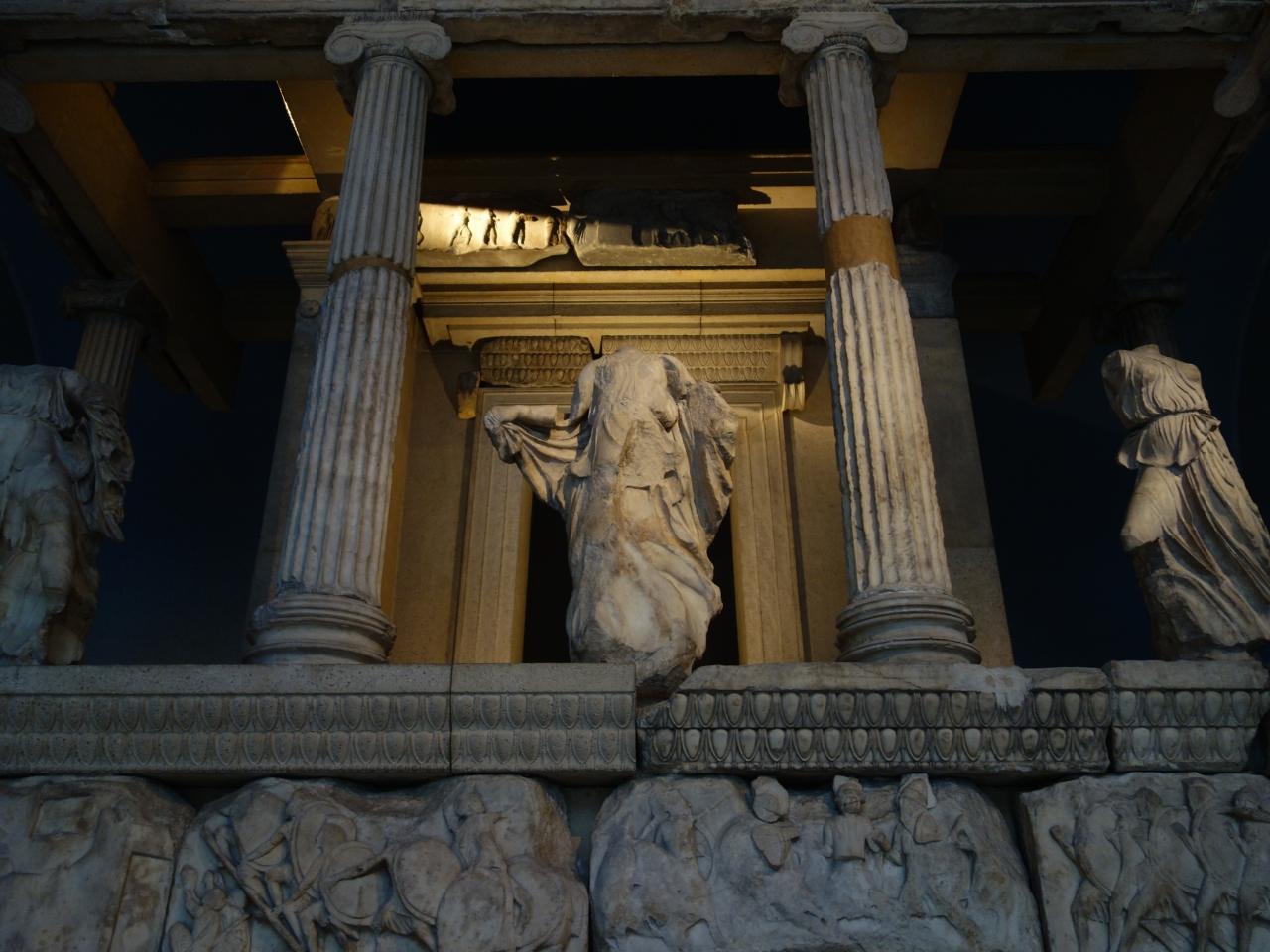
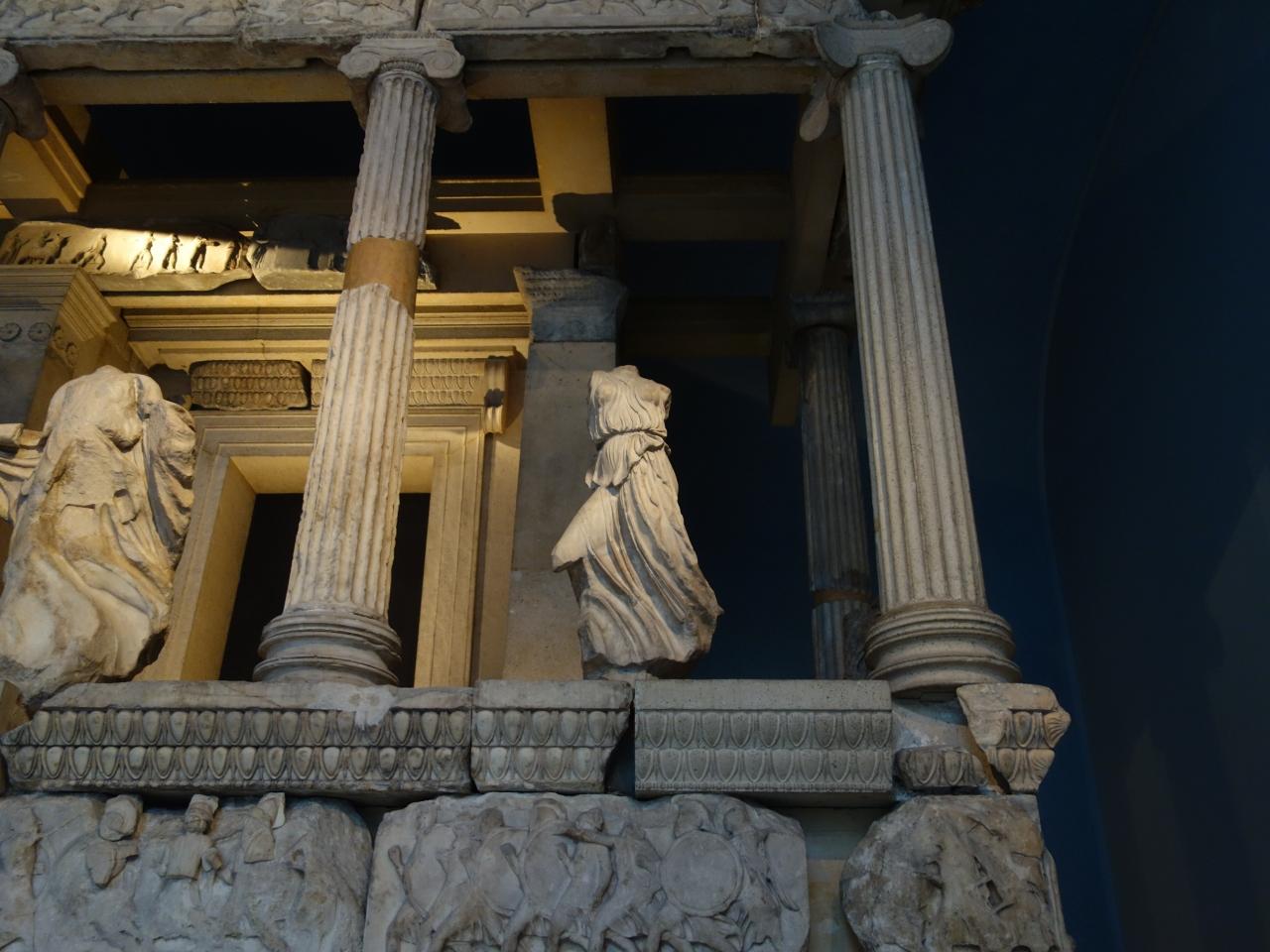
THE NEREID MONUMENT
This gallery contains the Nereid Monument,
the largest and finest of the Lykian tombs found
at Xanthos, south-west Turkey. It is named after
the figures of Nereids, daughters of the sea-god
Nereus, placed between the columns.
The Monument reflects Greek and Persian
influences on Lykian culture. Following Persian
practice, Lykian nobles were buried in tombs
raised on a high podium; here the form is that of
a Greek temple. Others include pillar tombs
(the 'Harpy Tomb', Room 16)and gothic-arched
sarcophagi (the Payava tomb, Room 20).
The Nereid Monument, built around 390-380 BC,
is the first known example of a temple tomb,
the greatest of which was the Mausoleum of
Halikarnassos (Room 21).
Above the base of the podium were three courses
of marble blocks, the upper two being carved
with reliefs. These were topped by a peristyle of
Ionic columns, four on the short sides and six on
the long, surrounding the cella, which housed
limestone dining couches for feasting in the
afterlife. This reconstruction of one side of
the Nereid Monument dates from 1967-69.
The placement of the sculptures is uncertain.
The ruined podium of the Nereid Monument
at Xanthos.
Drawing by G. Scharf -
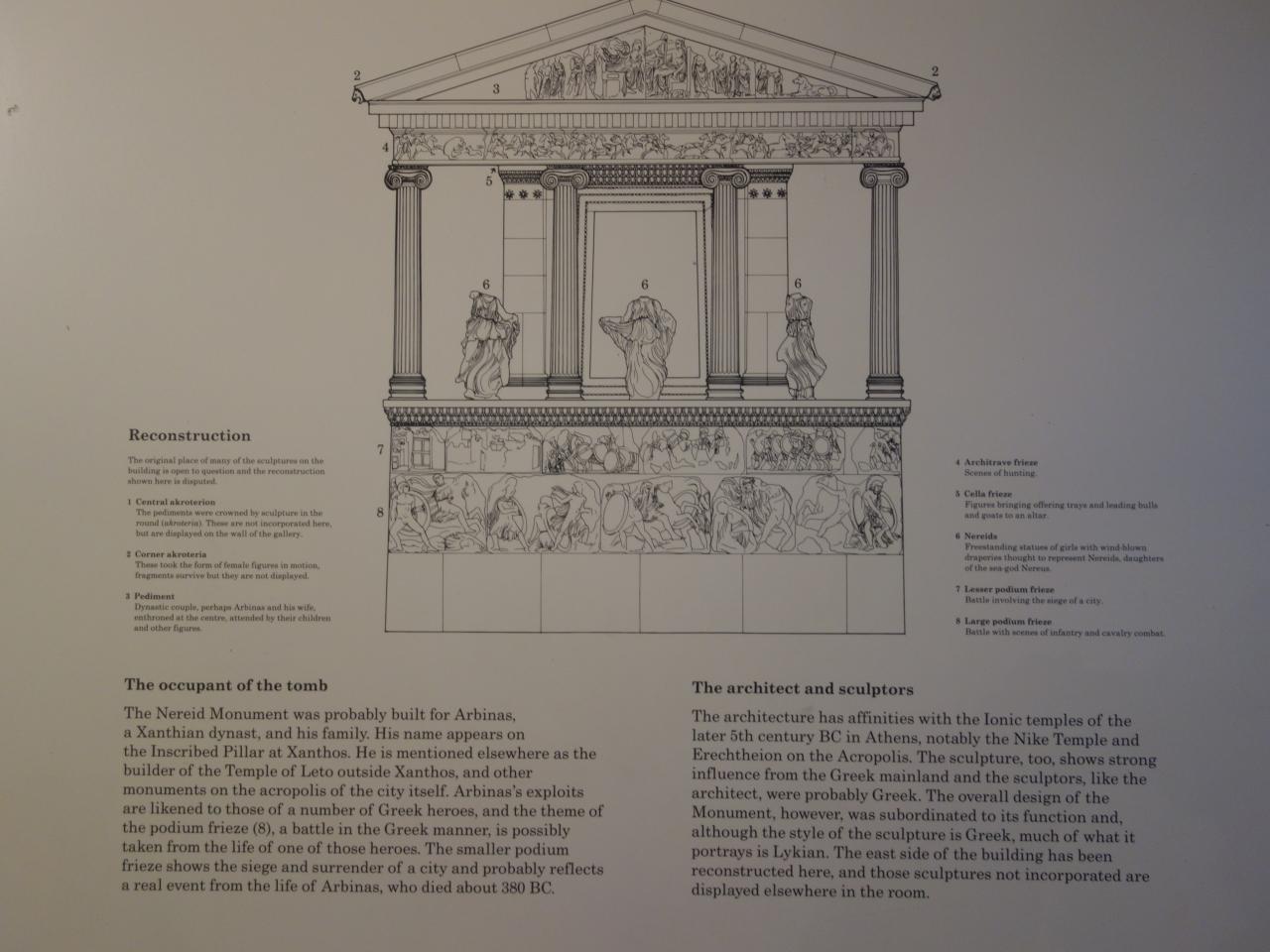
Reconstruction
The original piece of many of the sculptures on the
building is open to question and the reconstruction
shown here is disputed.
I Central akroterion
The pediments were crowned by sculpture in the
round takroteria). These Are 1105 incorporated here,
but are displayed on the wall of the gallery.
2 Corner akroteria
These took the form of female figures in motion,
fragments survive but they are not displayed.
3 Pediment
Dynastic couple, perhaps Arbinas and his wife,
enthroned ett the centre, attended by their children
and other figures.
4 Architrave frieze
Scenes of hunting
5 Cella frieze
Figures bringing offering trays and leading bulls
and goats to an altar.
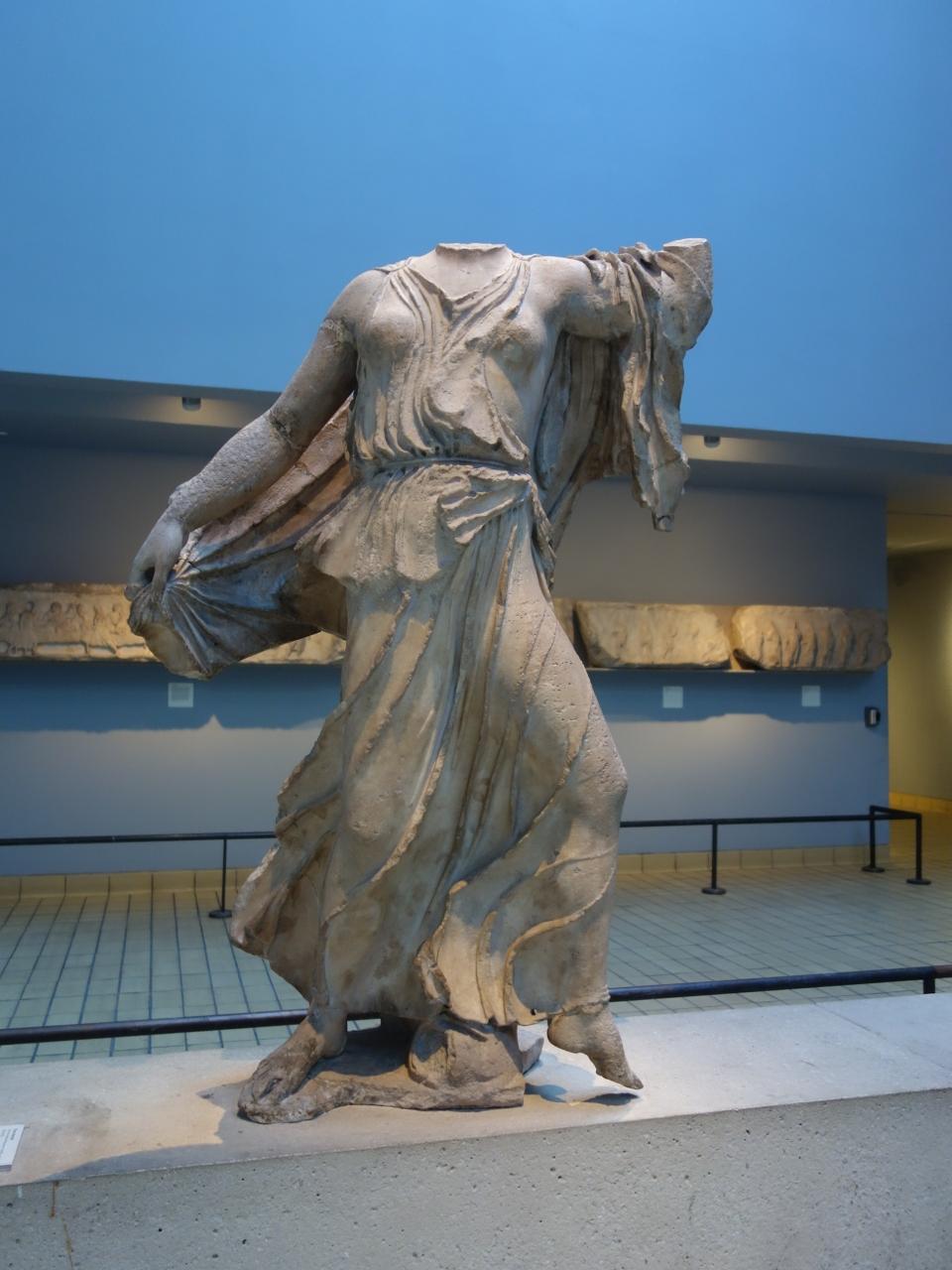
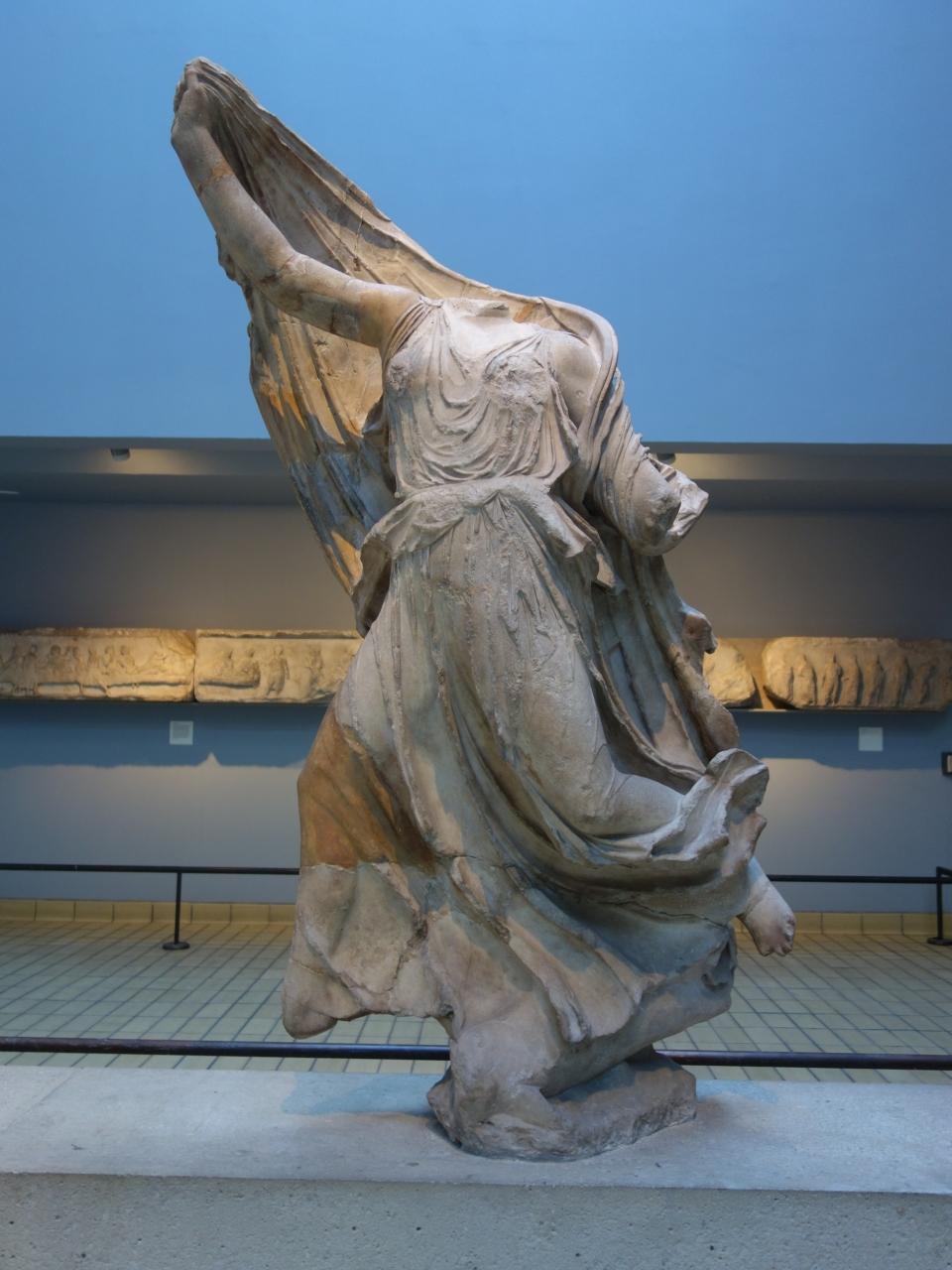
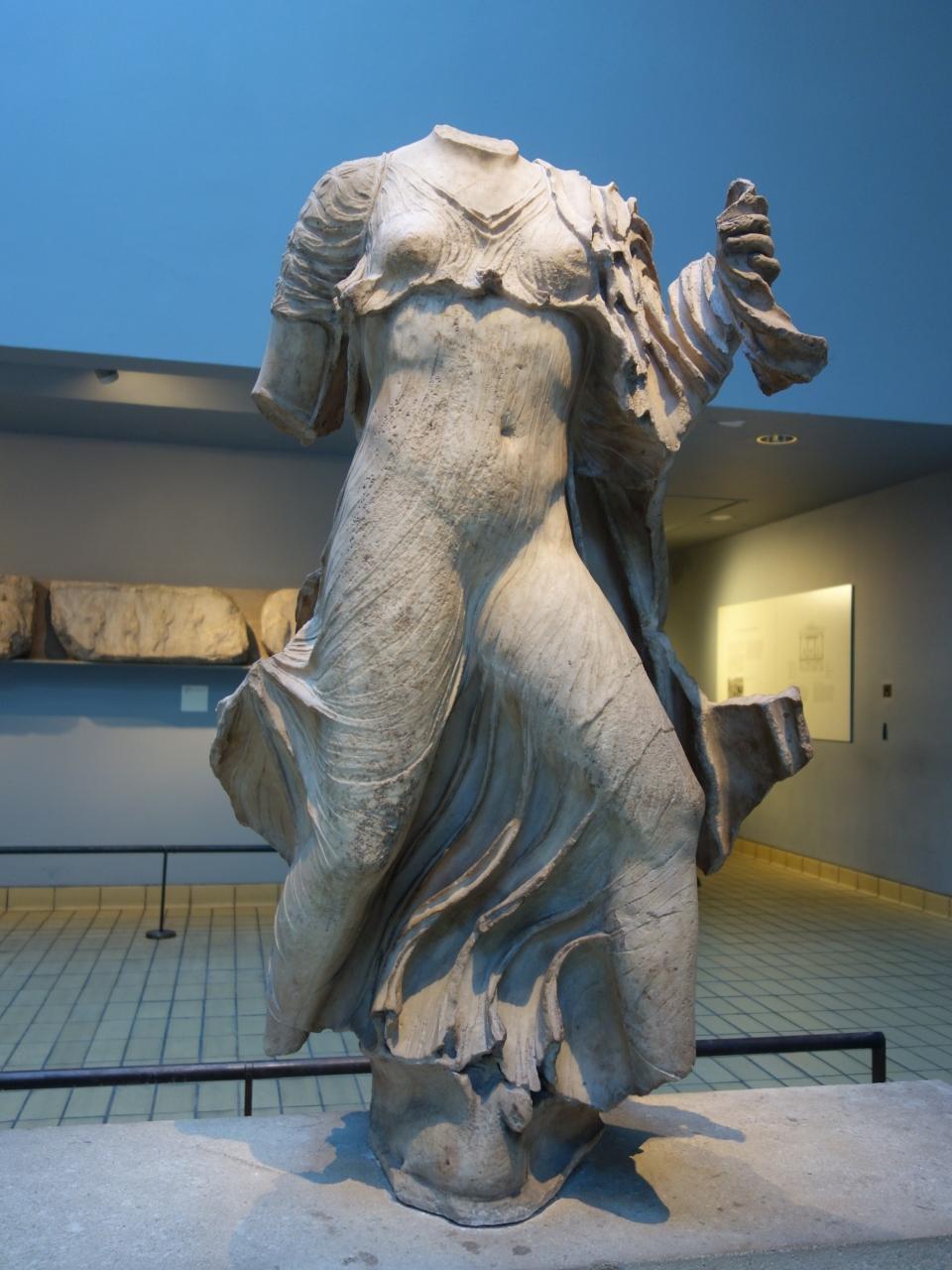
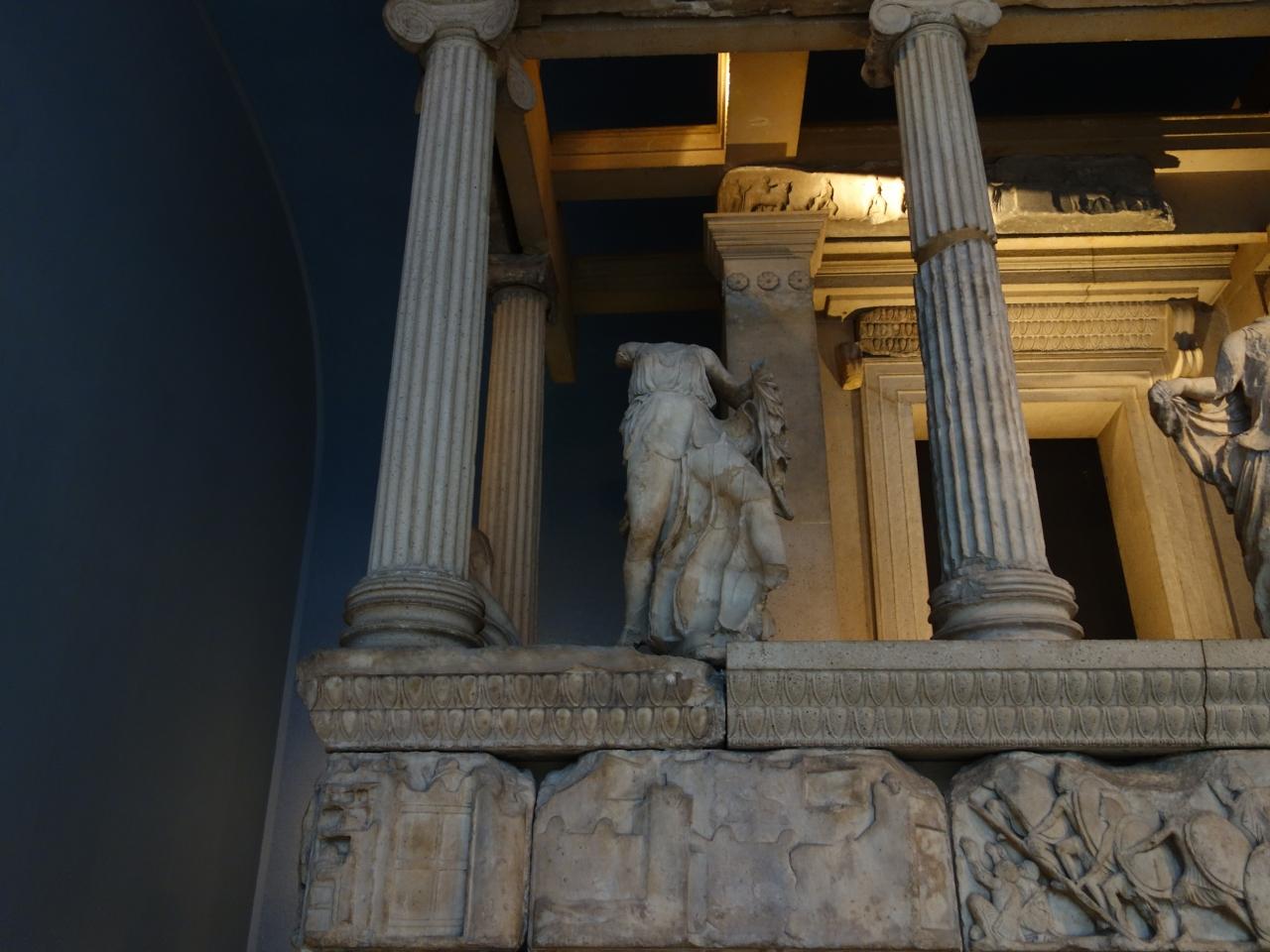
6 Nereids
Freestanding statues or girls with wind-blown
draperies thought to represent Nereids, daughters
of the sea-god Nereus,
7 Lesser podium frieze
Battle involving the siege of a city.
8 Large podium frieze
Battle with scenes of infantry and calvalry combat.
The occupant of the tomb
The Nereid Monument was probably built for Arbinas,
a Xanthian dynast, and his family. His name appears on
the Inscribed Pillar at Xanthos. He is mentioned elsewhere as the
builder of the Temple of Leto outside Xanthos, and other
monuments on the acropolis of the city itself. Arbinas's exploits
are likened to those of a number of Greek heroes, and the theme of
the podium frieze (8), a battle in the Greek manner, is possibly
taken from the life of one of those heroes. The smaller podium
frieze shows the siege and surrender of a city and probably reflects
a real event from the life of Arbinas, who died about 380 BC.
The architect and sculptors
The architecture has affinities with the Ionic temples of the
later 5th century BC in Athens, notably the Nike Temple and
Erechtheion on the Acropolis. The sculpture, too, shows strong
influence from the Greek mainland and the sculptors, like the
architect, were probably Greek. The overall design of the
Monument, however, was subordinated to its function and,
although the style of the sculpture is Greek, much of what it
portrays is Lykian. The east side of the building has been
reconstructed here, and those sculptures not incorporated are
displayed elsewhere in the room. -
-
-
-
-
-
-
-
-
-
-
-
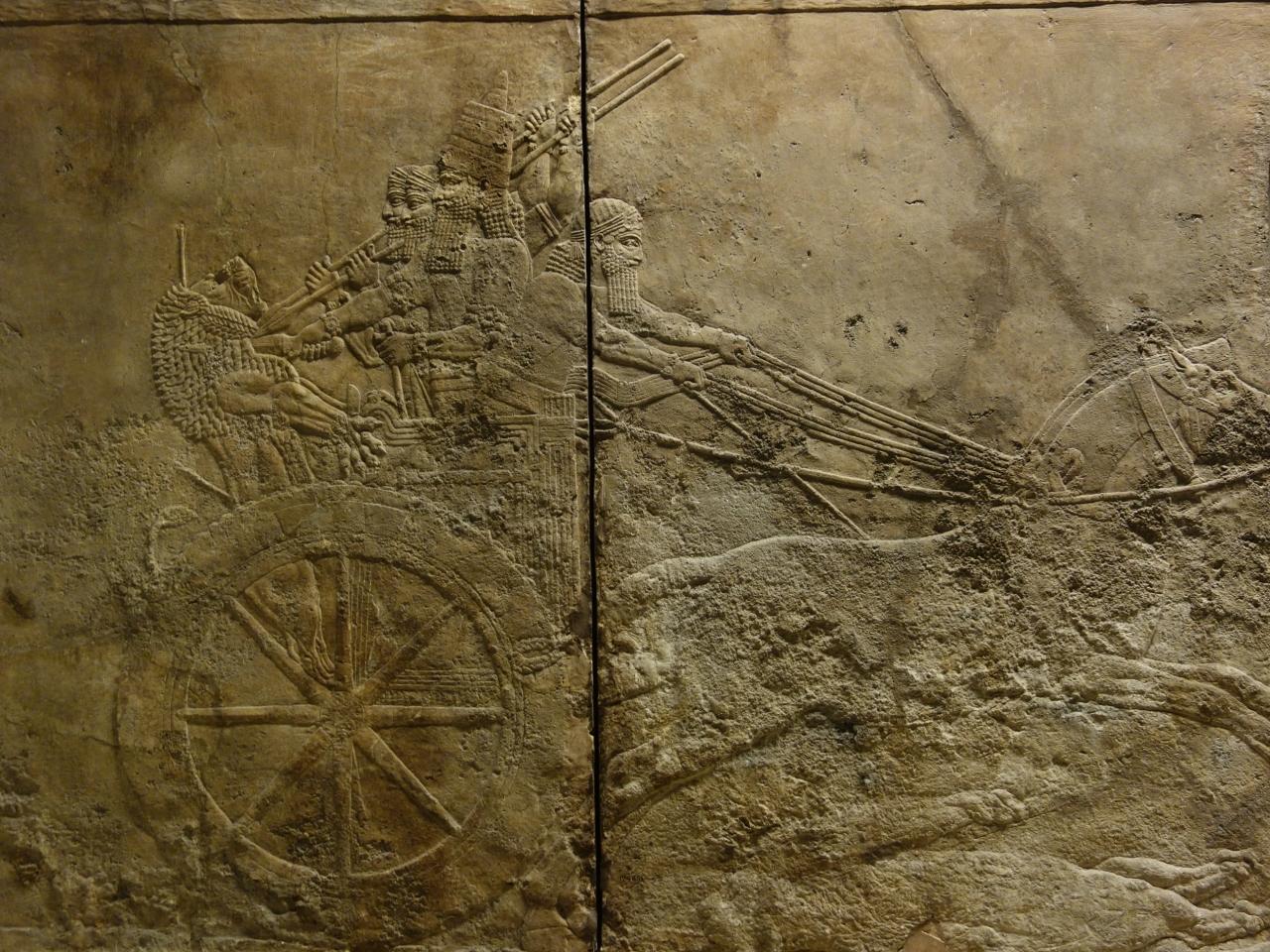
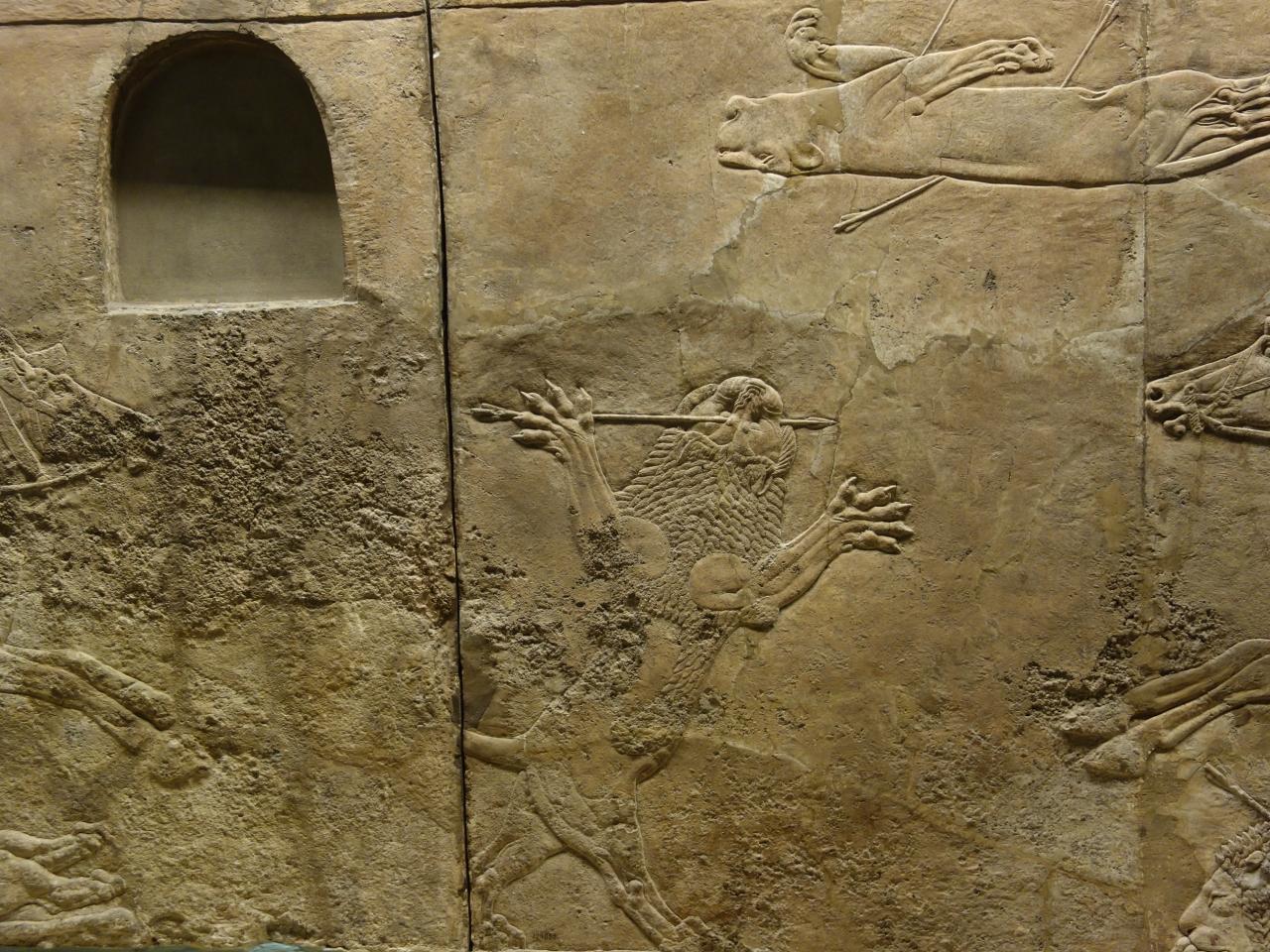
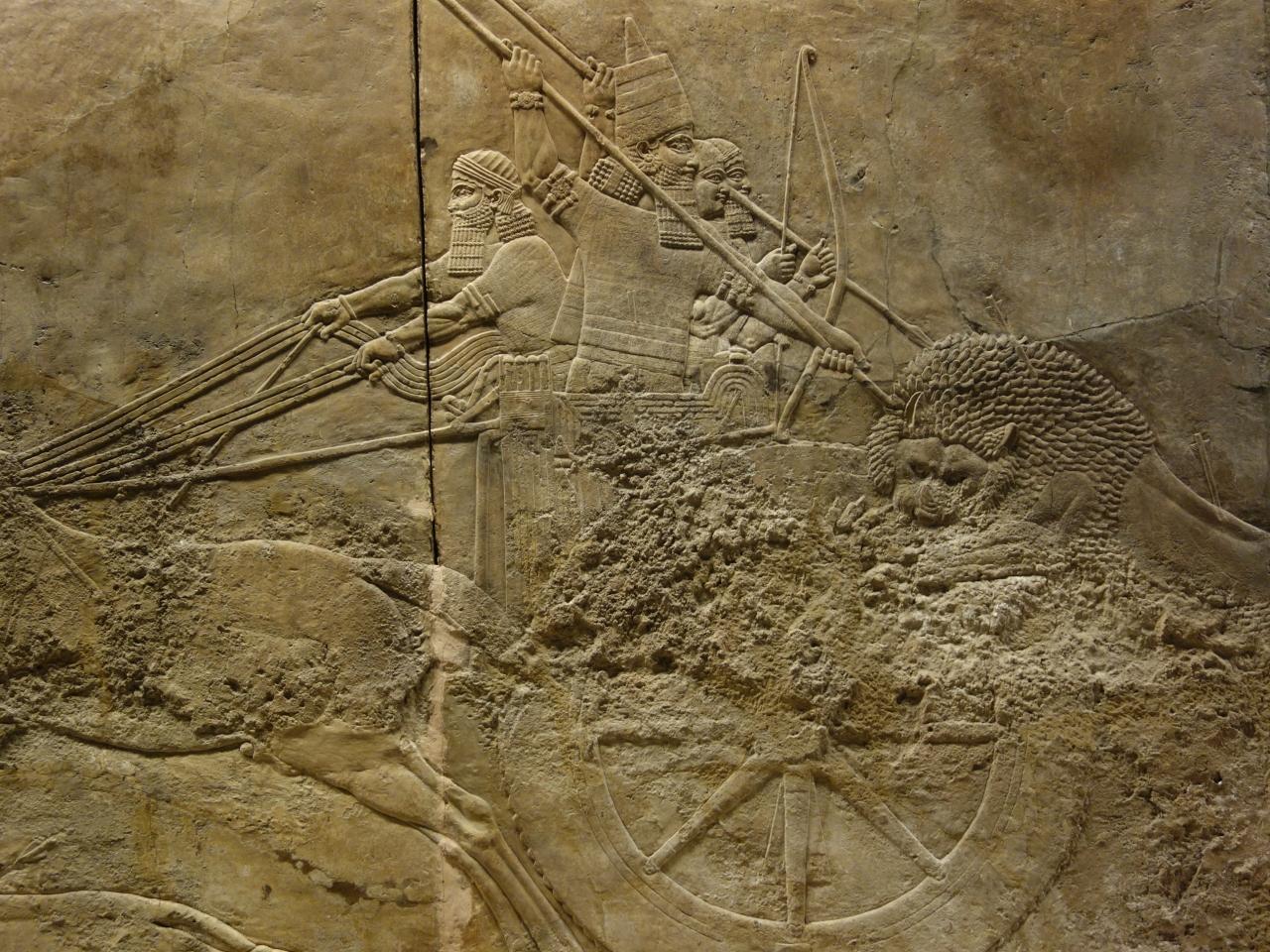
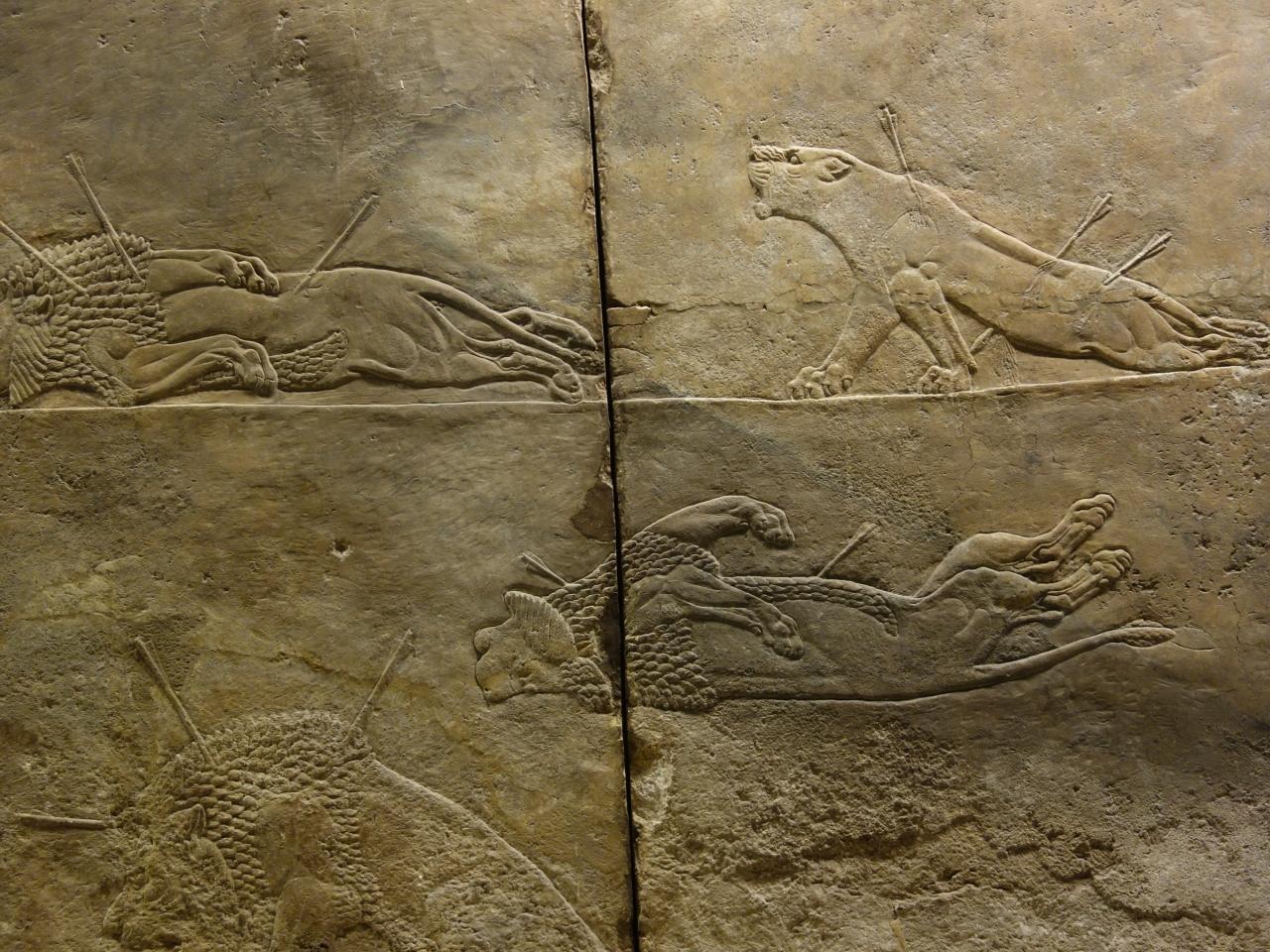
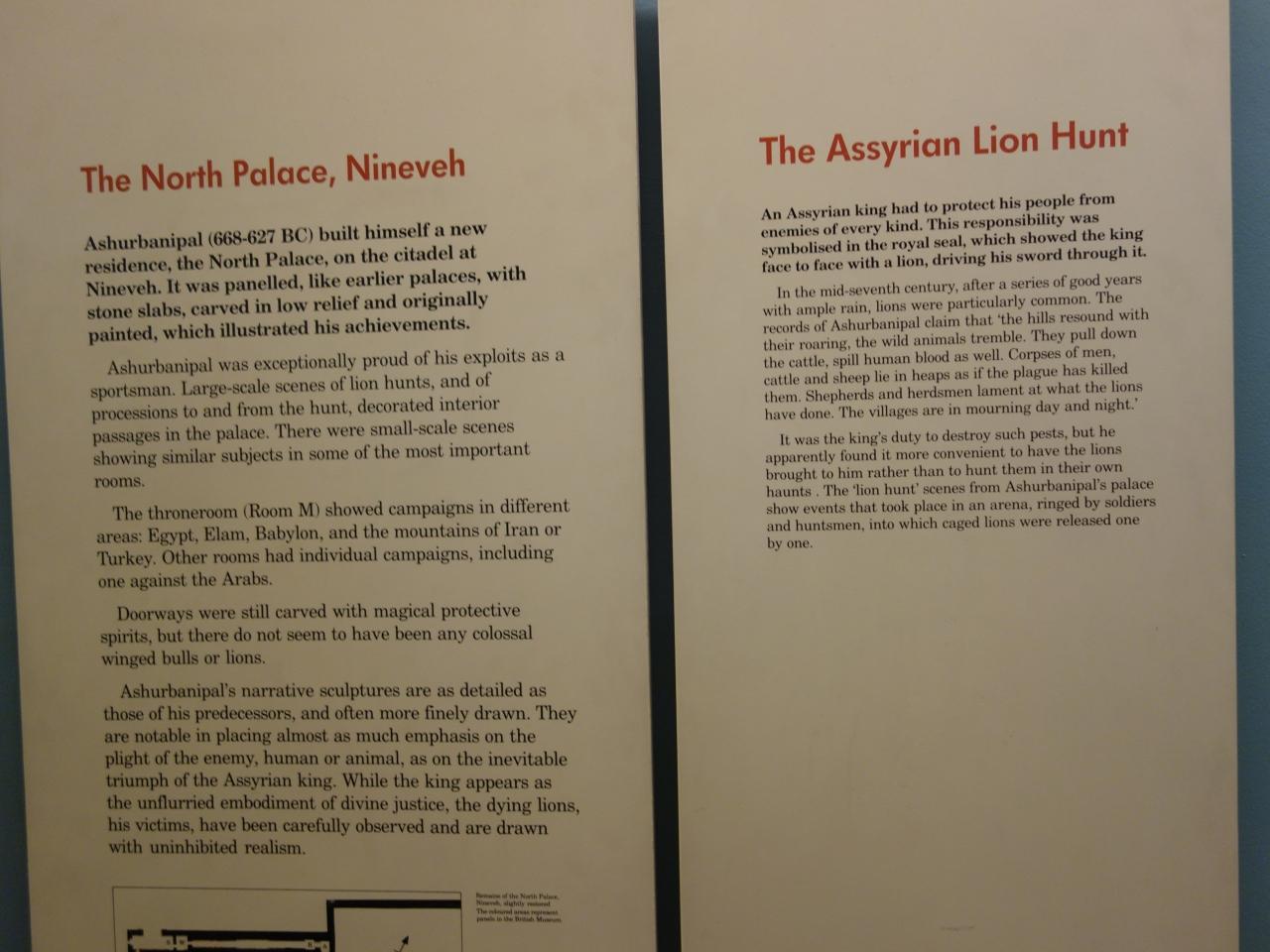
The North Palace, Nineveh
Ashurbanipal (668-627 ltC) built himself a new
residence, the North Palace, on the citadel at
Nineveh. It was panelled, like earlier palaces, with
stone slabs, carved in low relief and originally
painted, which illustrated his achievements.
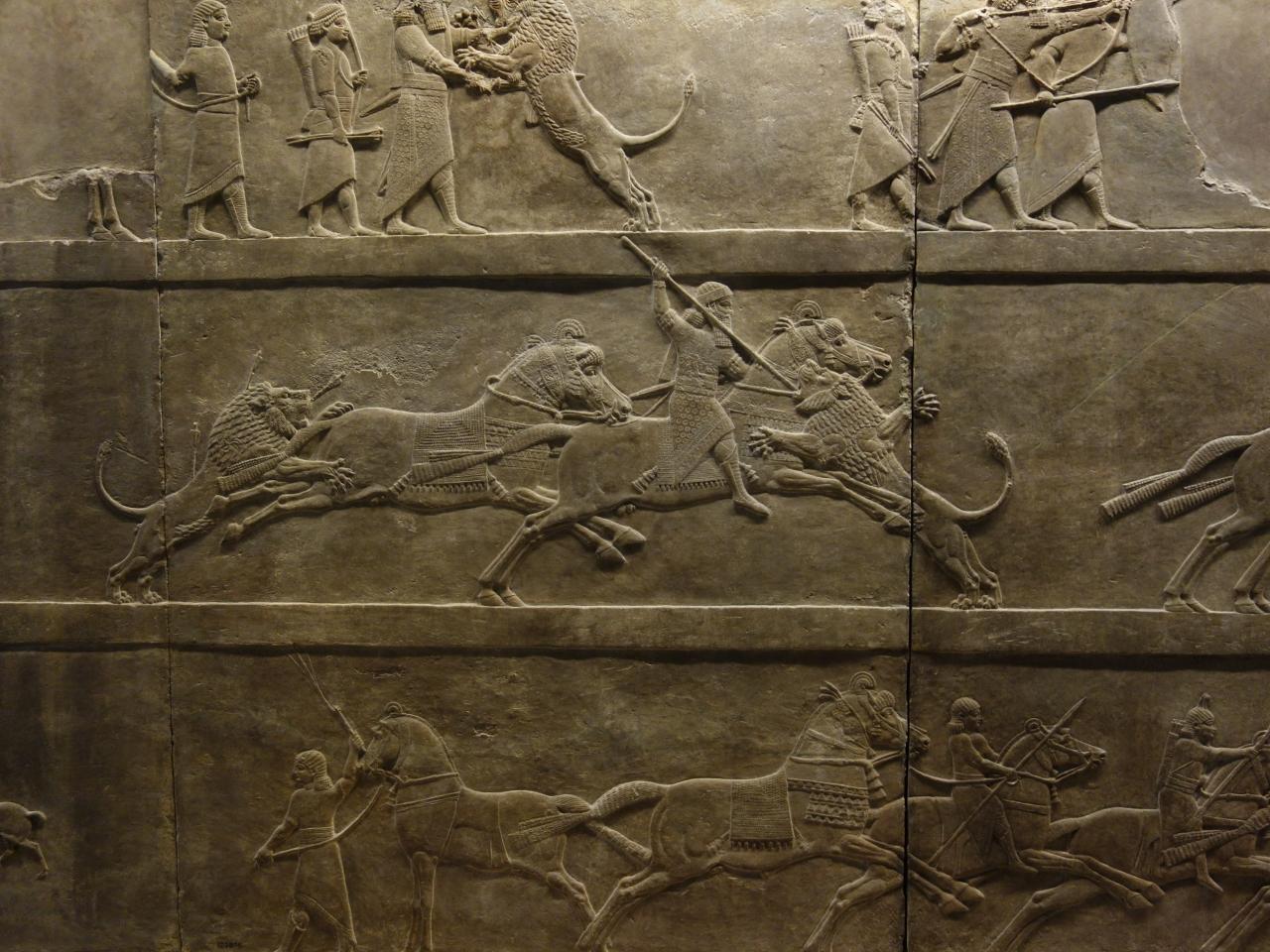
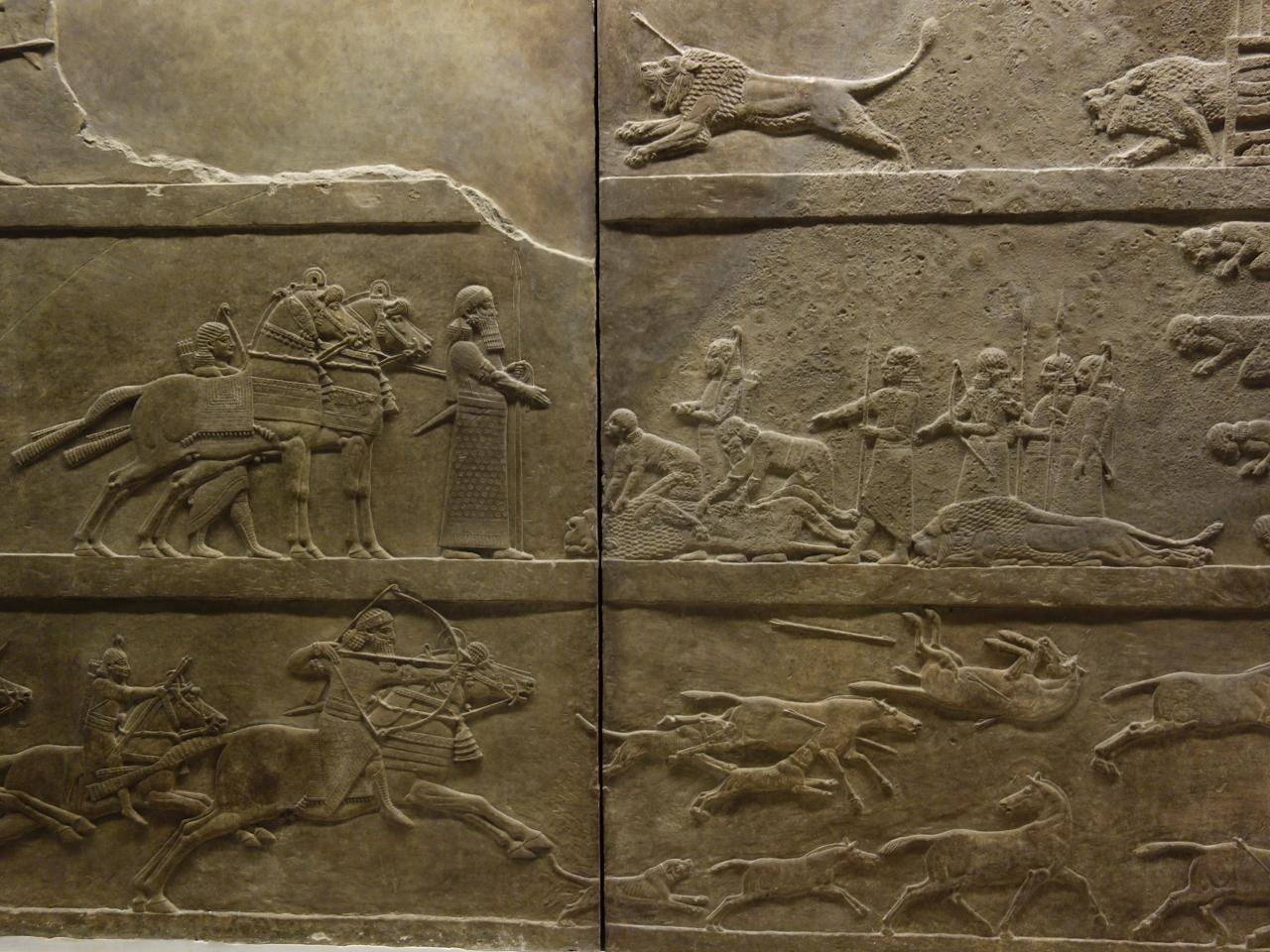
Ashurbanipal was exceptionally proud of his exploits a
sportsman. Large-scale scenes of lion hunts, and of
processions to and from the hunt, decorated interior
passnes in the palace. There were small-scale scenes
showing similar subjects in some of the most important
rooms.
The thronerooni (Room M) showed campaigns in different
areas: Egypt, Elam, Babylon, and the mountains of lran or
Turkey. Other rooms had individual campaigns, including
one against the Arabs.
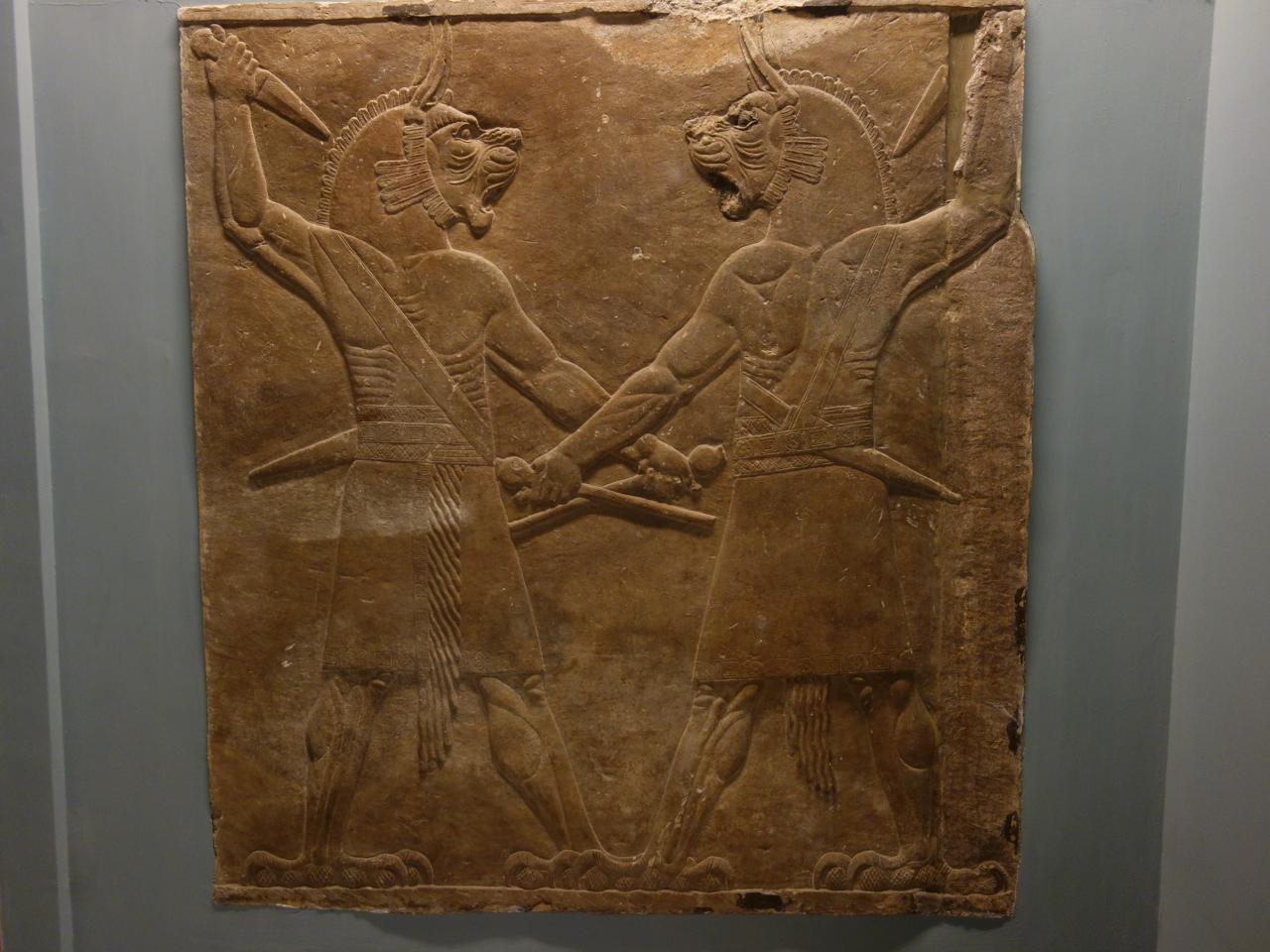
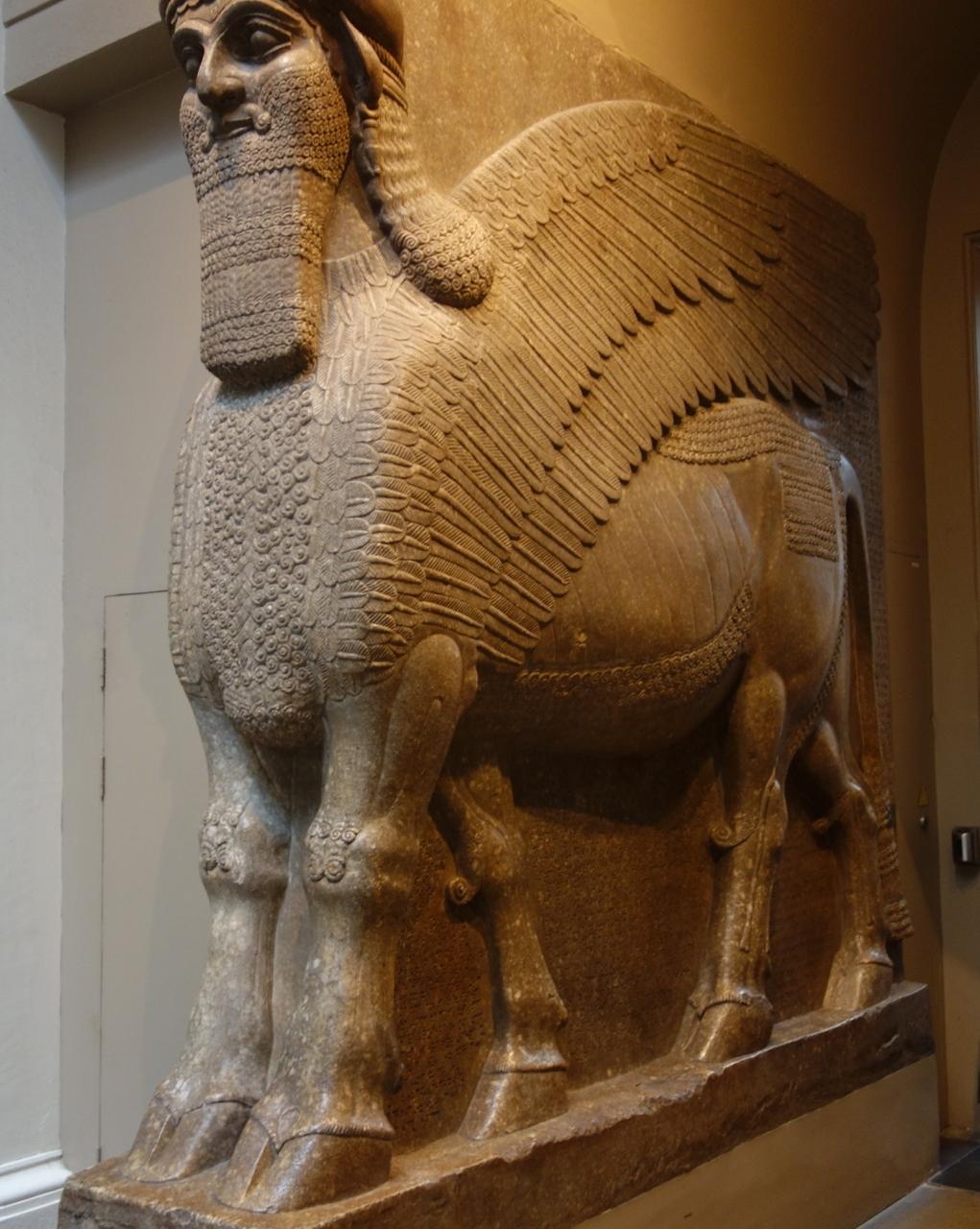
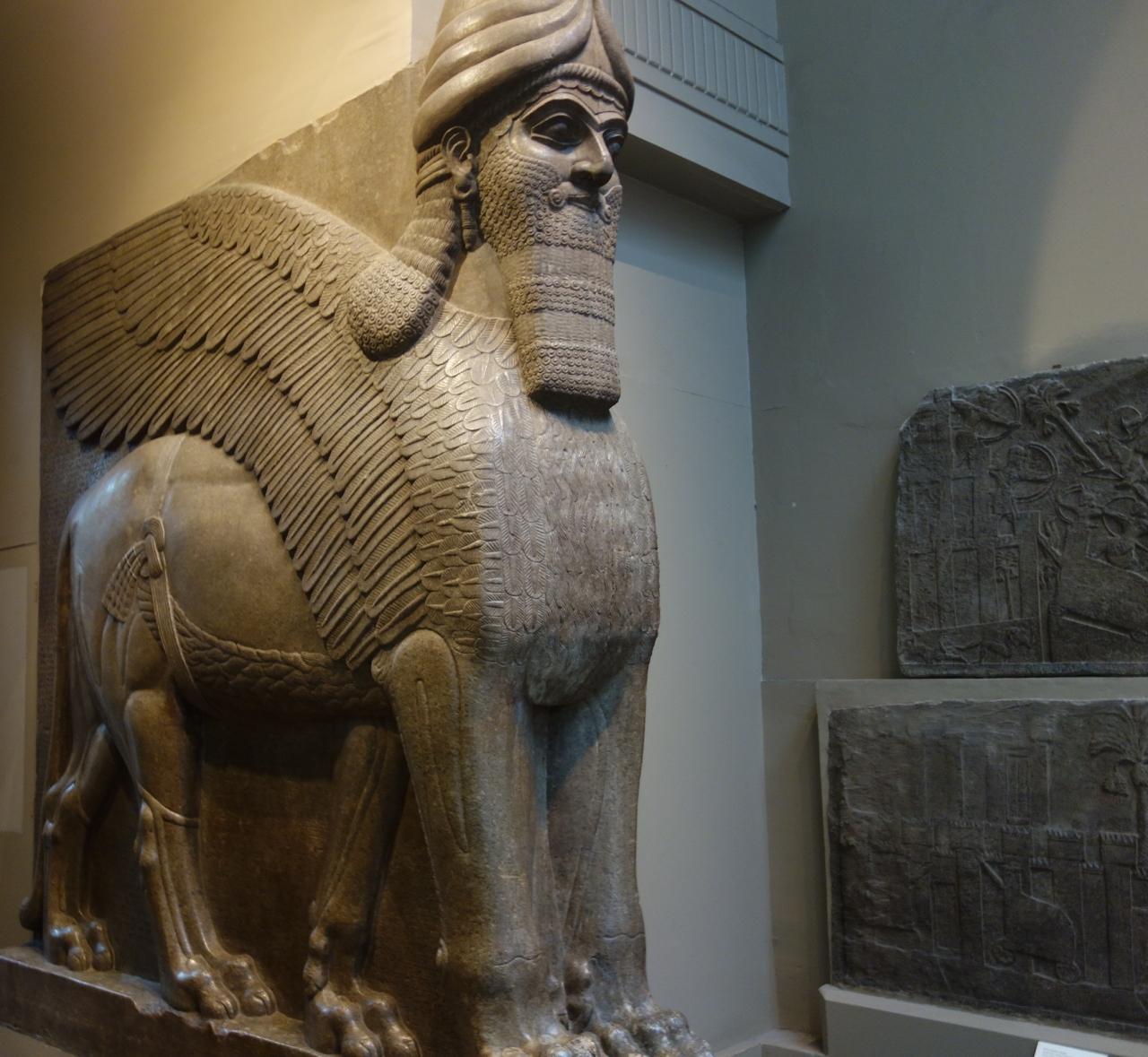
Doorways were still carved with magical protective
spirits, but there do not seem to have been any colossal
winged bulls or lions.
Ashurbanipal's narrative sculptures are as detailed as
those of his predecessors, and often more finely drawn. They
are notable in placing almost as much emphasis on the
plight of the enemy, human or animal, as on the inevitable
triumph of the Assyrian king. While the king appears as
the unflurried embodiment of divine justice, the dying lions,
his victims, have been carefully observed and are drawn with
uninhibited realism.
An Assyrian king had to protect his people from
enemies of every kind. This responsibility was
symbolised in the royal seal, which showed the king
face to face with a lion, driving his sword through it.
In the mid-seventh century, after a series of good years
with ample rain, lions were particularly common. The
records of Ashurbanipal claim that 'the hills resound with
their roaring, the wild animals tremble. They pull down
the cattle, spill human blood as well. Corpses of men,
cattle and sheep lie in heaps as if the plague has killed
them. Shepherds and herdsmen lament at what the lions
have done. The villages are in mourning day and night.'
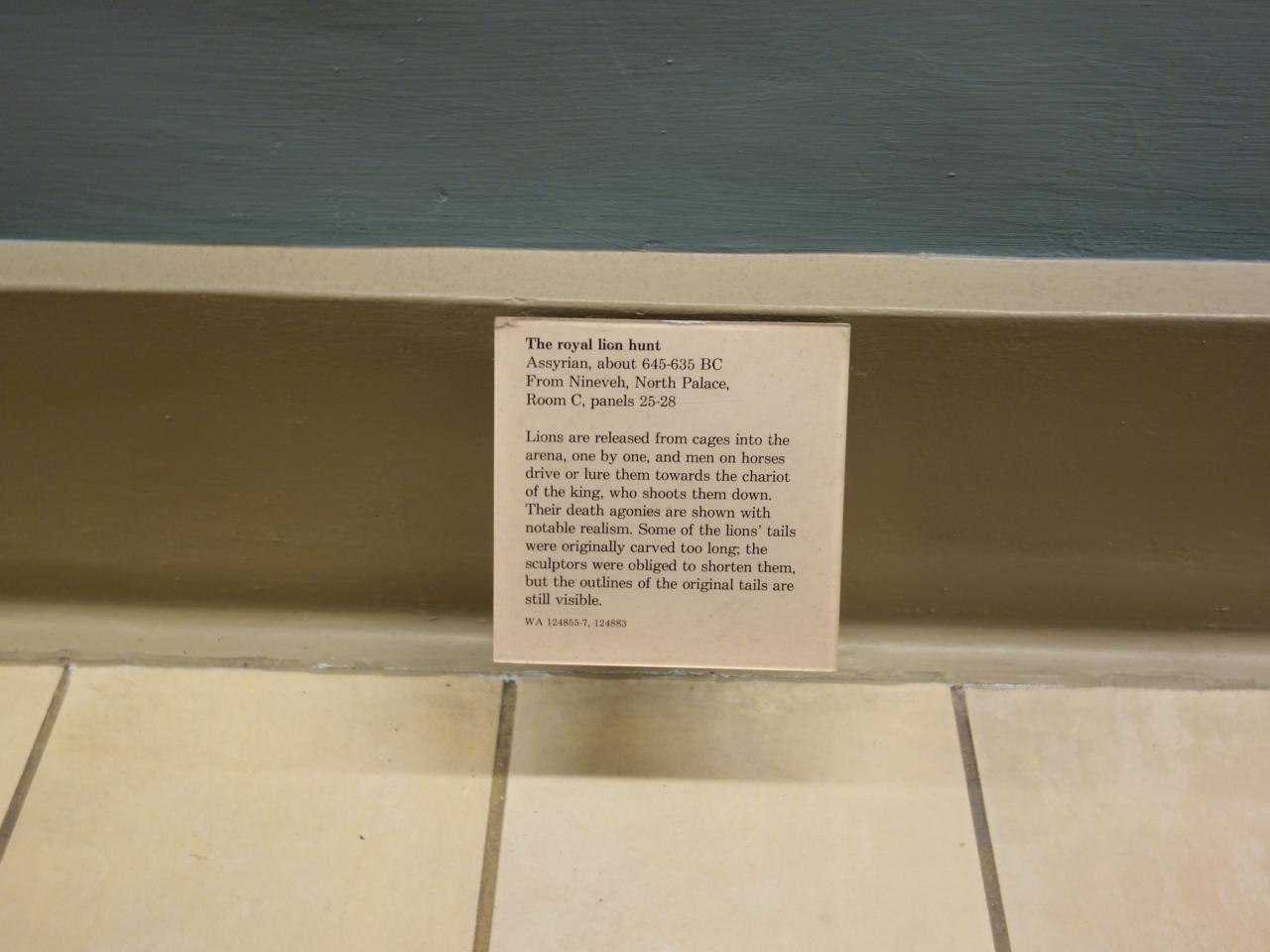
It was the king's duty to destroy such pests, but he
apparently found it more convenient to have the lions
brought to him rather than to hunt them in their own
haunts. The 'lion hunt' scenes from Ashurbanipal's palace
show events that took place in an arena, ringed by soldiers
and huntsmen, into which caged lions were released one
by one. -
-
-
-
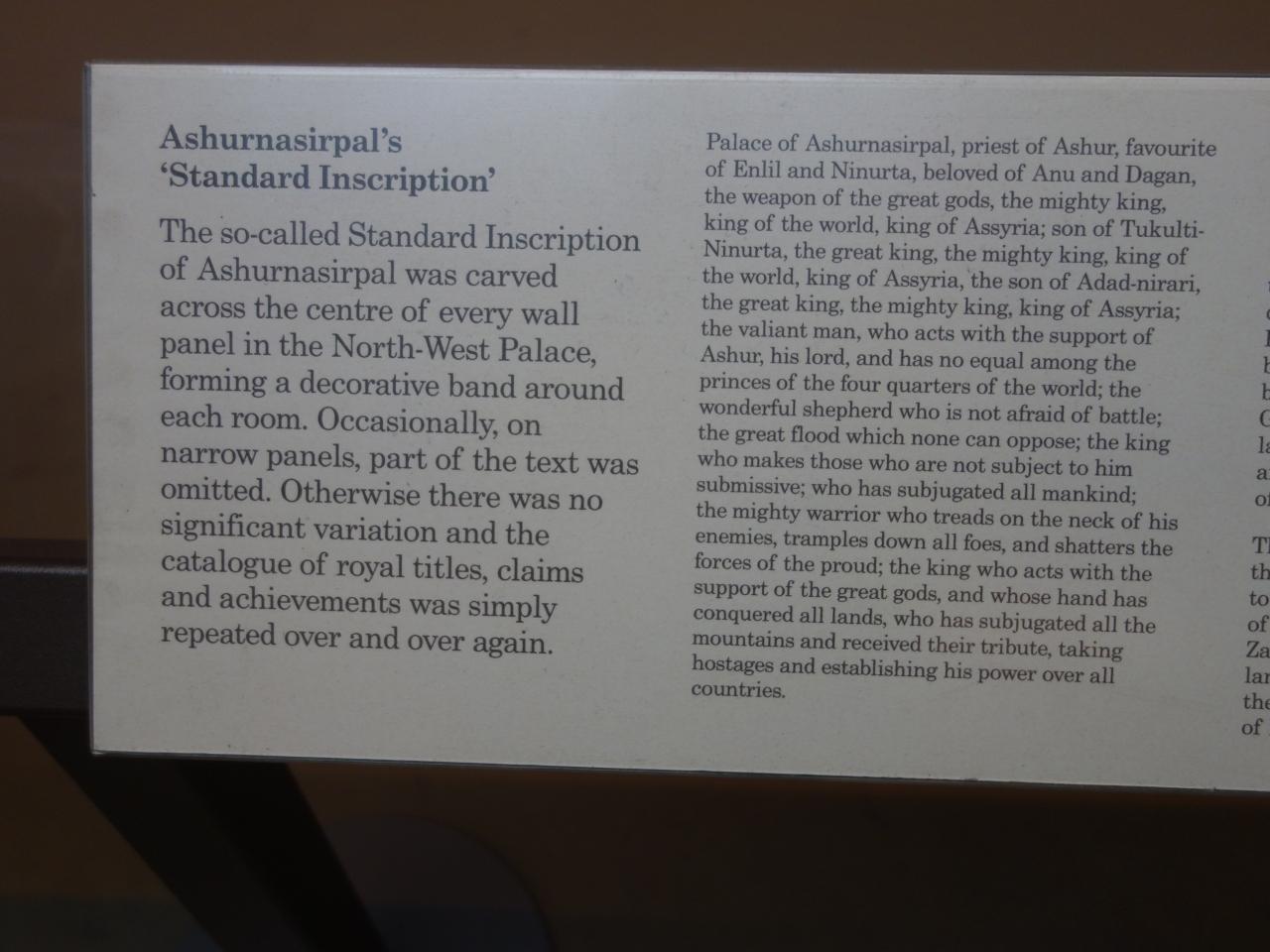
Ashurnasirpal's
`Standard Inscription'
The so-called Standard Inscription
of Ashurnasirpal was carved
across the centre of every wall
panel in the North-West Palace,
forming a decorative band around
each room. Occasionally, on
narrow panels, part of the text was
omitted. Otherwise there was no
significant variation and the
catalogue of royal titles, claims
and achievements was simply
repeated over and over again.
Palace of Ashurnasirpal, priest of Ashur, favourite
of Enlil and Ninurta, beloved of Anu and Dagan,
the weapon of the great gods, the mighty king,
king of the world, king of Assyria; son of Tukulti-
Ninurta, the great king, the mighty king, king of
the world, king of Assyria, the son of Adad-nirari,
the great king, the mighty king, king of Assyria;
the valiant man, who acts with the support of
Ashur, his lord, and has no equal among the
princes of the four quarters of the world; the
wonderful shepherd who is not afraid of battle;
the great flood which none can oppose; the king
who makes those who are not subject to him
submissive; who has subjugated all mankind;
the mighty warrior who treads on the neck of his
enemies, tramples down all foes, and shatters the
forces of the proud; the king who acts with the
support of the great gods, and whose hand has
conquered all lands, who has subjugated all the
mountains and received their tribute, taking
hostages and establishing his power over all
countries. -
When Ashur, the lord who called me by my name
and has made my kingdom great, entrusted his
merciless weapon to my lordly arms, I overthrew
the widespread troops of the land of Lullume in
battle. With the assistance of Shamash and Adad,
the gods who help me, I thundered like Adad the
destroyer over the troops of the Nairi lands,
Habhi, Shubaru, and Nirib. I am the king who has
brought into submission at his feet the lands from
beyond the Tigris to Mount Lebanon and the
Great Sea [the Mediterranean], the whole of the
land of Laqe, the land of Suhi as far as Rapiqu,
and whose hand has conquered from the source
of the river Subnat to the land of Urartu.
The area from the mountain passes of Kirruri to
the land of Gilzanu, from beyond the Lower Zab
to the city of Til-Bari which is north of the land
of Zaban, from the city of Til-sha-abtani to Til-sha-
Zabdani, Hirimu and Harutu, fortresses of the
land of Karduniash [Babylonia], I have restored to
the borders of my land. From the mountain passes
of Babite to the land of Hashmar I have counted
the inhabitants as peoples of my land. Over the
lands which I have subjugated I have appointed my
governors, and they do obeisance.
I am Ashurnasirpal, the celebrated prince, who
reveres the great gods, the fierce dragon, conqueror
of the cities and mountains to their furthest
extent, king of rulers who has tamed the stiff-
necked peoples, who is crowned with splendour,
who is not afraid of battle, the merciless champion
who shakes resistance, the glorious king, the
shepherd, the protection of the whole world, the
king, the word of whose mouth destroys mountains
and seas, who by his lordly attack has forced fierce
and merciless kings from the rising to the setting
sun to acknowledge one rule.
The former city of Kalhu [Nimrud], which
Shalmaneser king of Assyria, a prince who
preceded me, had built, that city had fallen into
ruins and lay deserted. That city I built anew.
I took the peoples whom my hand had conquered
from the lands which I had subjugated, from the
land of Suhi, from the whole of the land of Laqe,
from the city of Sirqu on the other side of the
Euphrates, from the furthest extent of the land of
Zamua, from Bit-Adini and the land of Hatte, and
from Lubarna, king of the land of Patina, and
made them settle there.
I removed the ancient mound and dug down to the
water level. I sank the foundations 120 brick
courses deep. A palace with halls of cedar, cypress,
juniper, box-wood, meskannu-wood, terebinth and
tamarisk, I founded as my royal residence for my
lordly pleasure for ever.
Creatures of the mountains and seas I fashioned
in white limestone and alabaster, and set them
up at its gates. I adorned it, and made it glorious,
and set ornamental knobs of bronze all around it.
I fixed doors of cedar, cypress, juniper and
meskannu-wood in its gates. I took in great
quantities, and placed there, silver, gold, tin,
bronze and iron, booty taken by my hands from
the lands which I had conquered. -
-
-
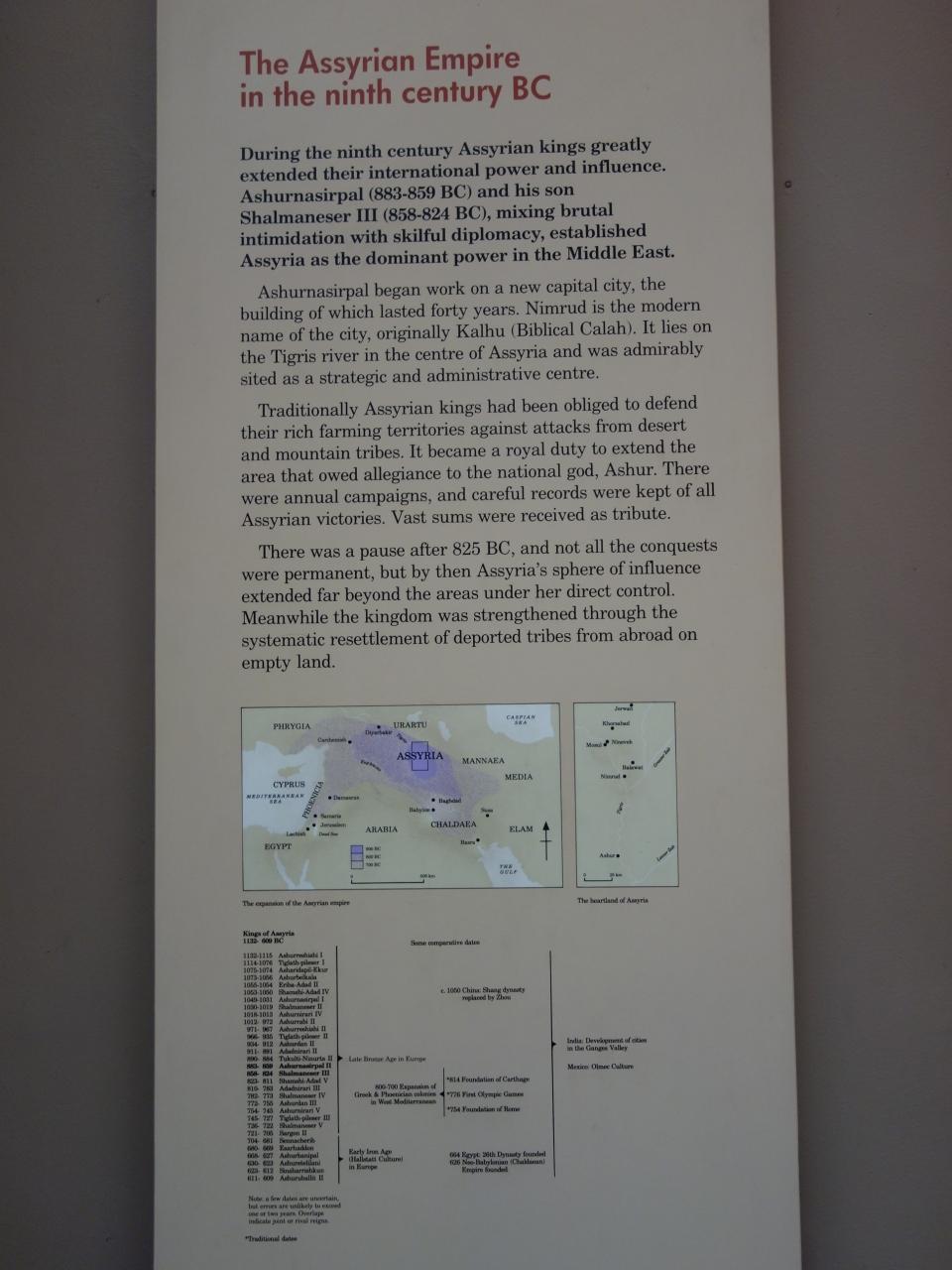
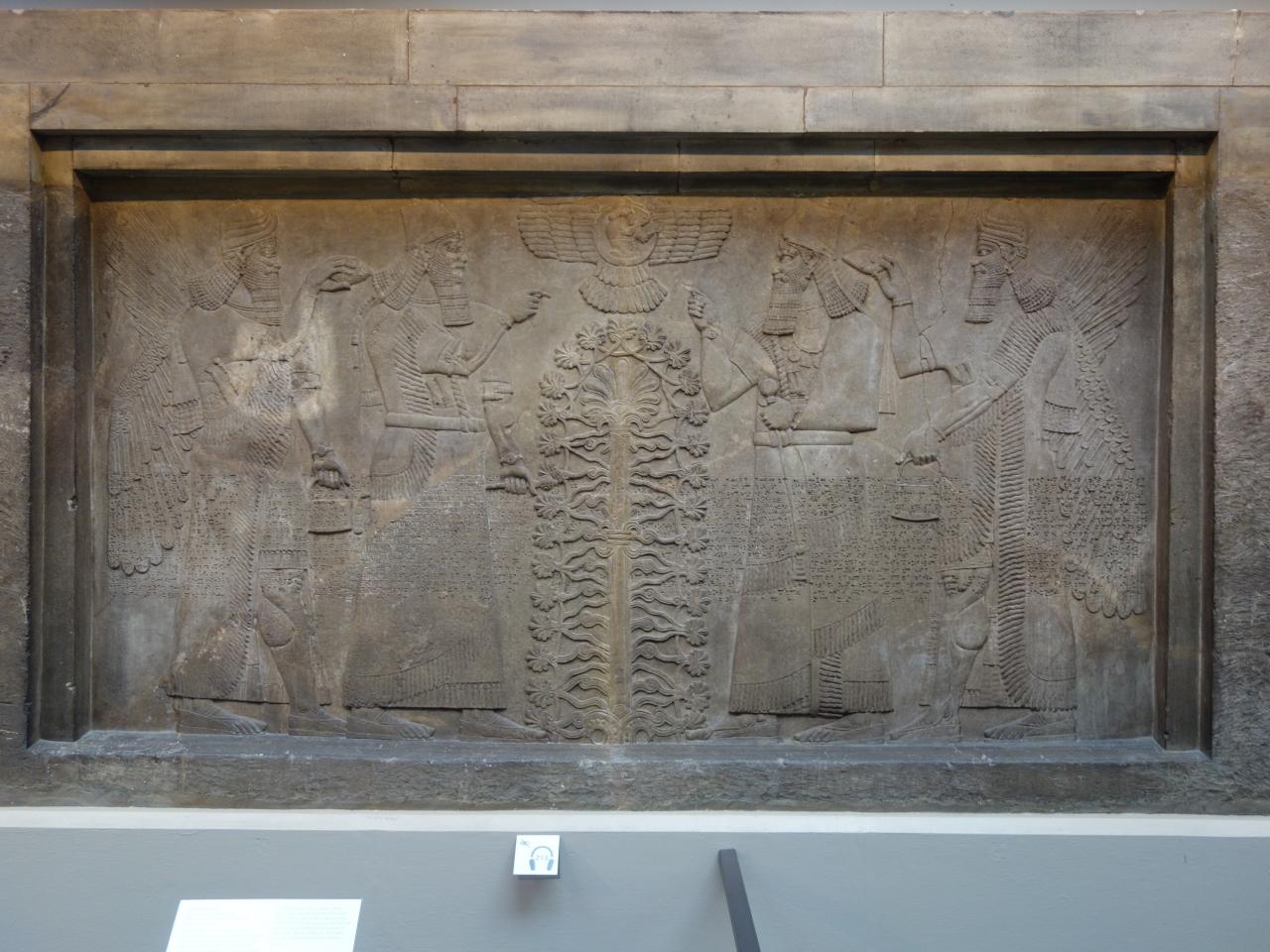
The Assyrian Empire
in the ninth century BC
During the ninth century Assyrian kings greatly
extended their international power and influence.
Ashurnasirpal (883-859 BC) and his son
Shalmaneser III (858-824 BC), mixing brutal
intimidation with skilful diplomacy, established
Assyria as the dominant power in the Middle East.
Ashurnasirpal began work on a new capital city, the
building of which lasted forty years. Nimrud is the modern
name of the city, originally Kalhu (Biblical Calah). It lies on
the Tigris river in the centre of Assyria and was admirably
sited as a strategic and administrative centre.
Traditionally Assyrian kings had been obliged to defend
their rich farming territories against attacks from desert
and mountain tribes. It became a royal duty to extend the
area that owed allegiance to the national god, Ashur. There
were annual campaigns, and careful records were kept of all
Assyrian victories. Vast sums were received as tribute.
There was a pause after 825 BC, and not all the conquests
were permanent, but by then Assyria's sphere of influence
extended far beyond the areas under her direct control.
Meanwhile the kingdom was strengthened through the
systematic resettlement of deported tribes from abroad on
empty land. -
-
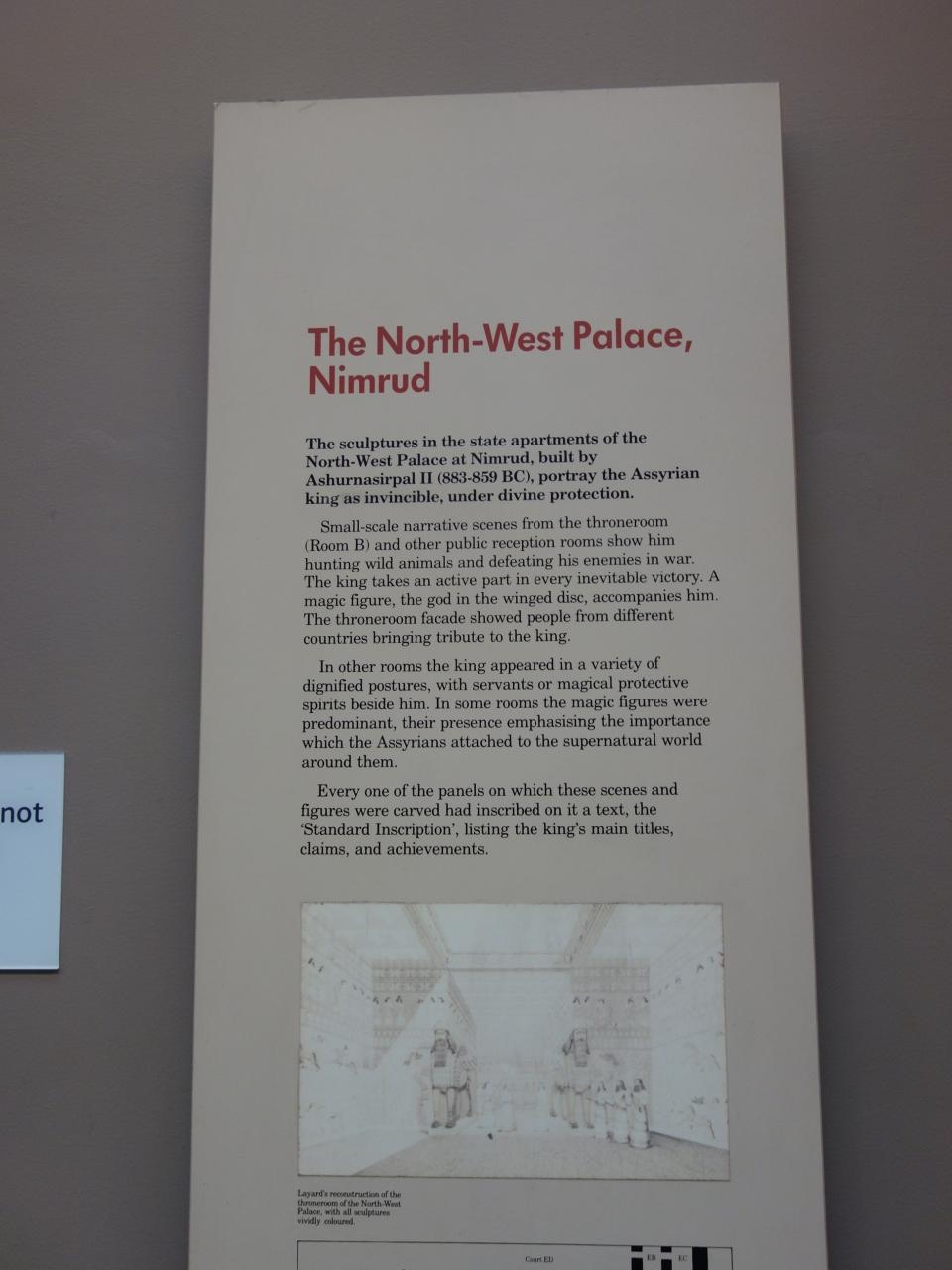
The North-West Palace,
Nimrud
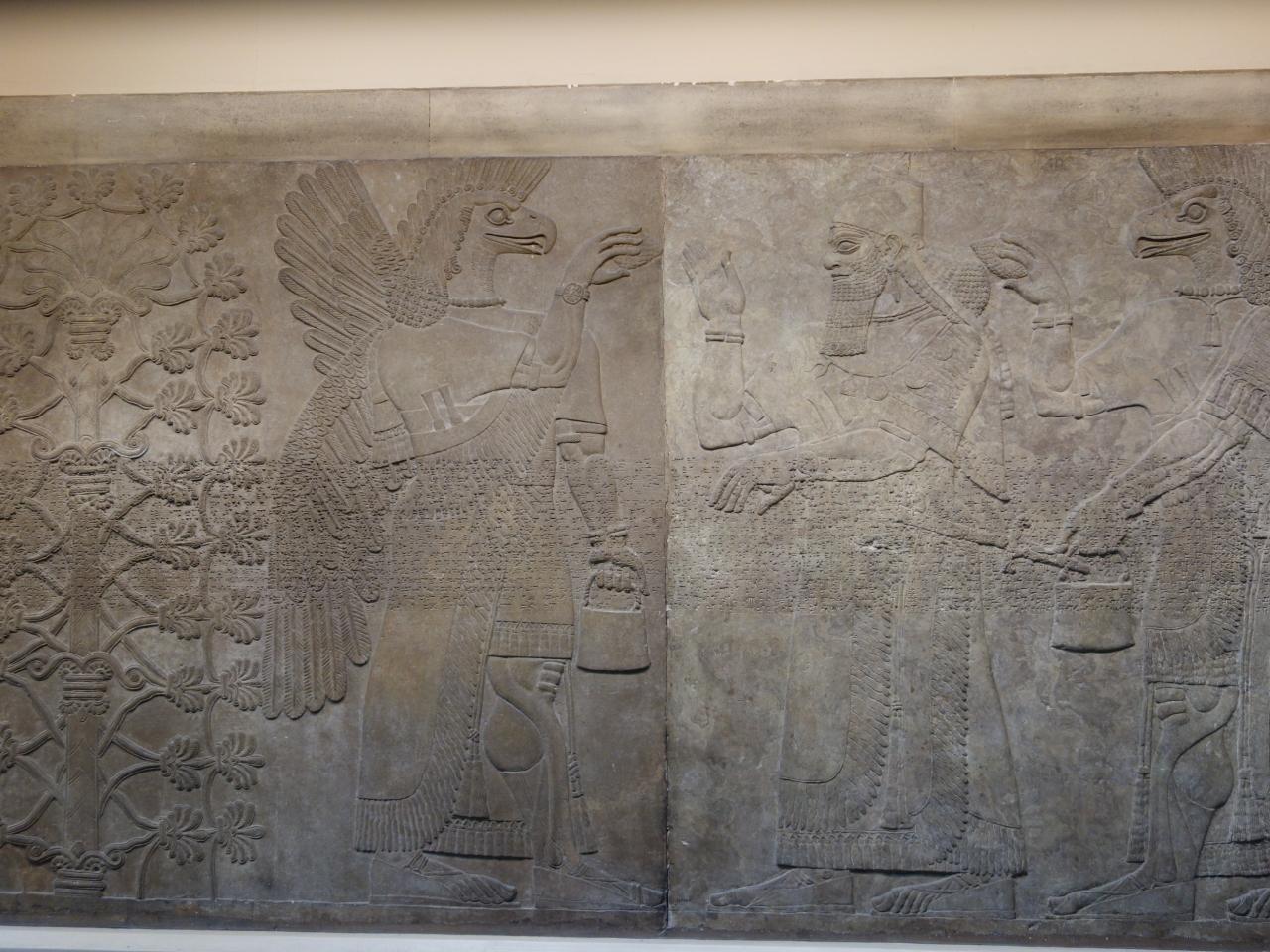
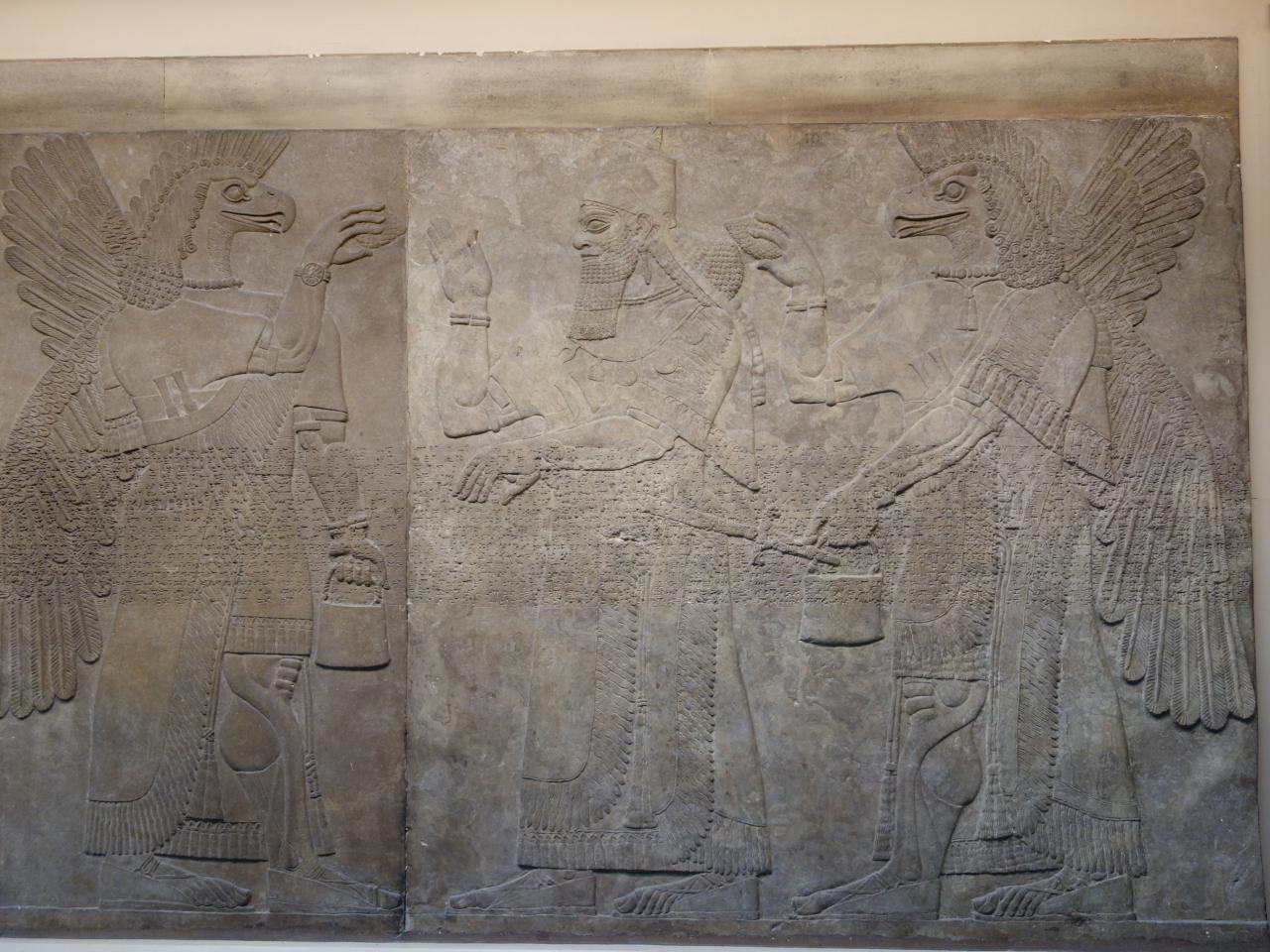
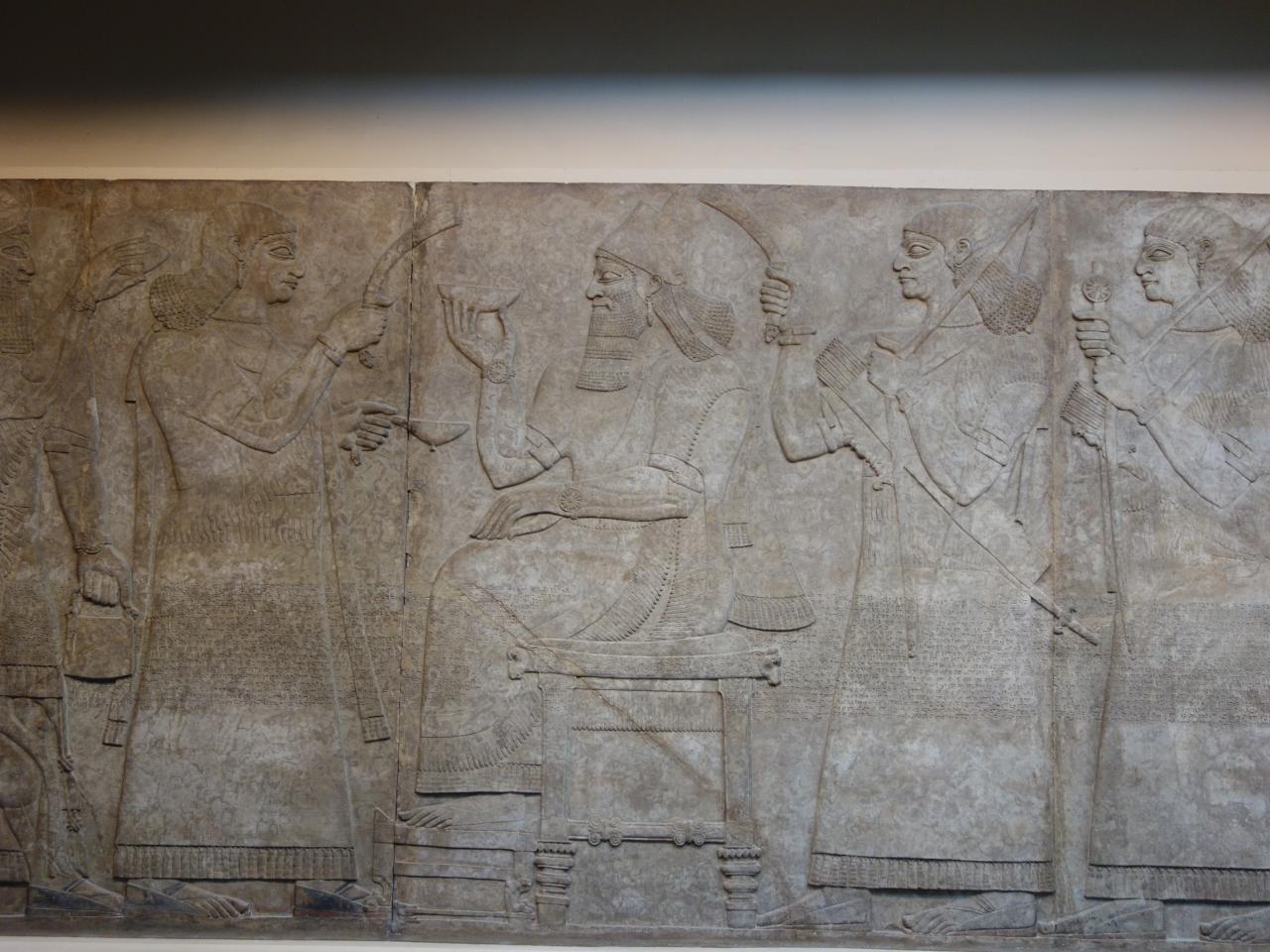
The sculptures in the state apartments of the
North-West Palace at Nimrud, built by
Ashurnasirpal II (883-859 BC), portray the Assyrian
king as invincible, under divine protection.
Small-scale narrative scenes from the throneroom
(Room B) and other public reception rooms show him
hunting wild animals and defeating his enemies in war.
The king takes an active part in every inevitable victory. A
magic figure, the god in the winged disc, accompanies him.
The throneroom facade showed people from different
countries bringing tribute to the king.
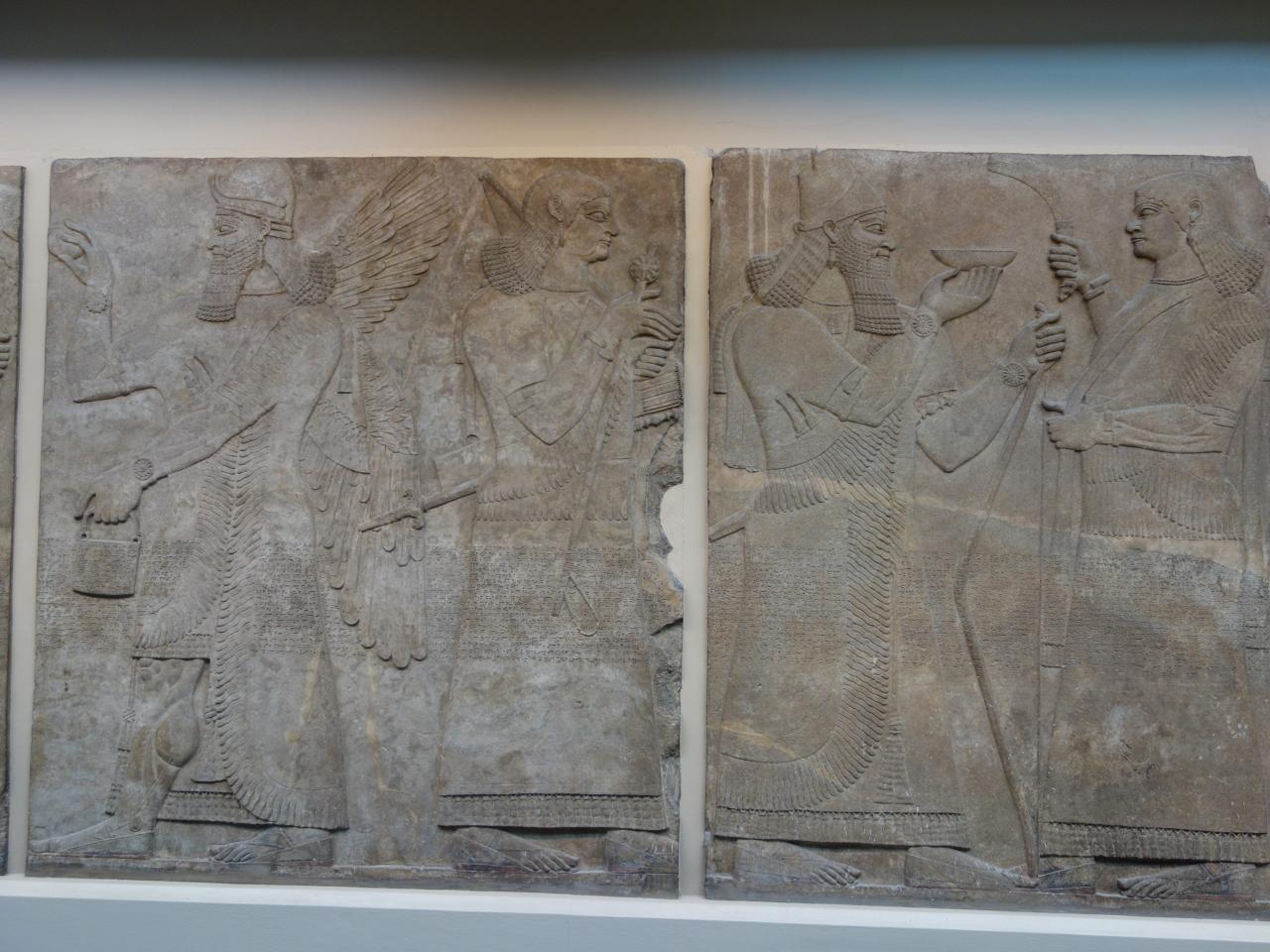
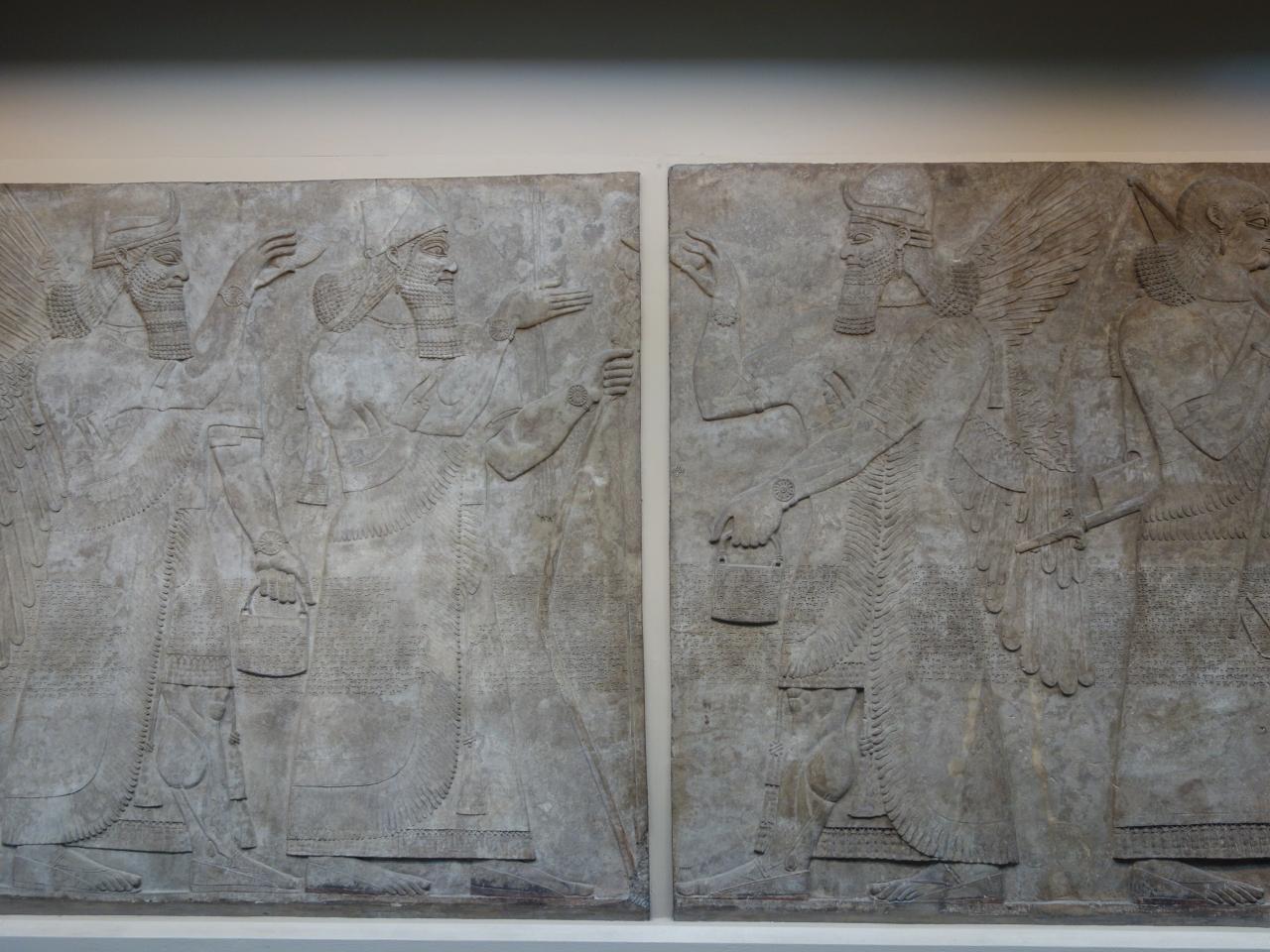
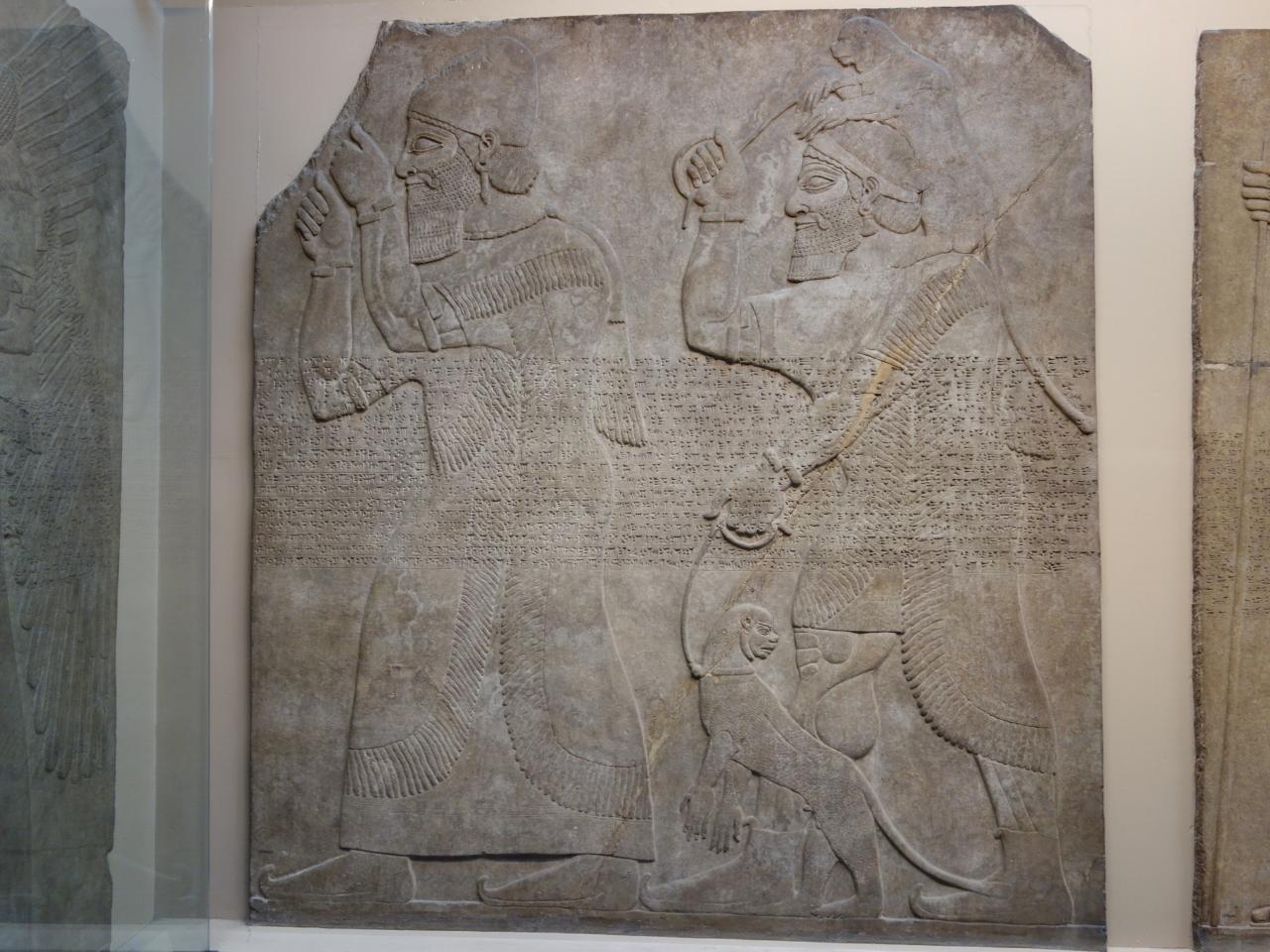
In other rooms the king appeared in a variety of
dignified postures, with servants or magical protective
spirits beside him. In some rooms the magic figures were
predominant, their presence emphasising the importance
which the Assyrians attached to the supernatural world
around them.
Every one of the panels on which these scenes and
figures were carved had inscribed on it a text, the
`Standard Inscription', listing the king's main titles,
claims, and achievements.
Layard's reconstruction of the
throneroom of the North-West
Palace, with all sculptures
vividly coloured. -
-
-
-
-
-
-
-
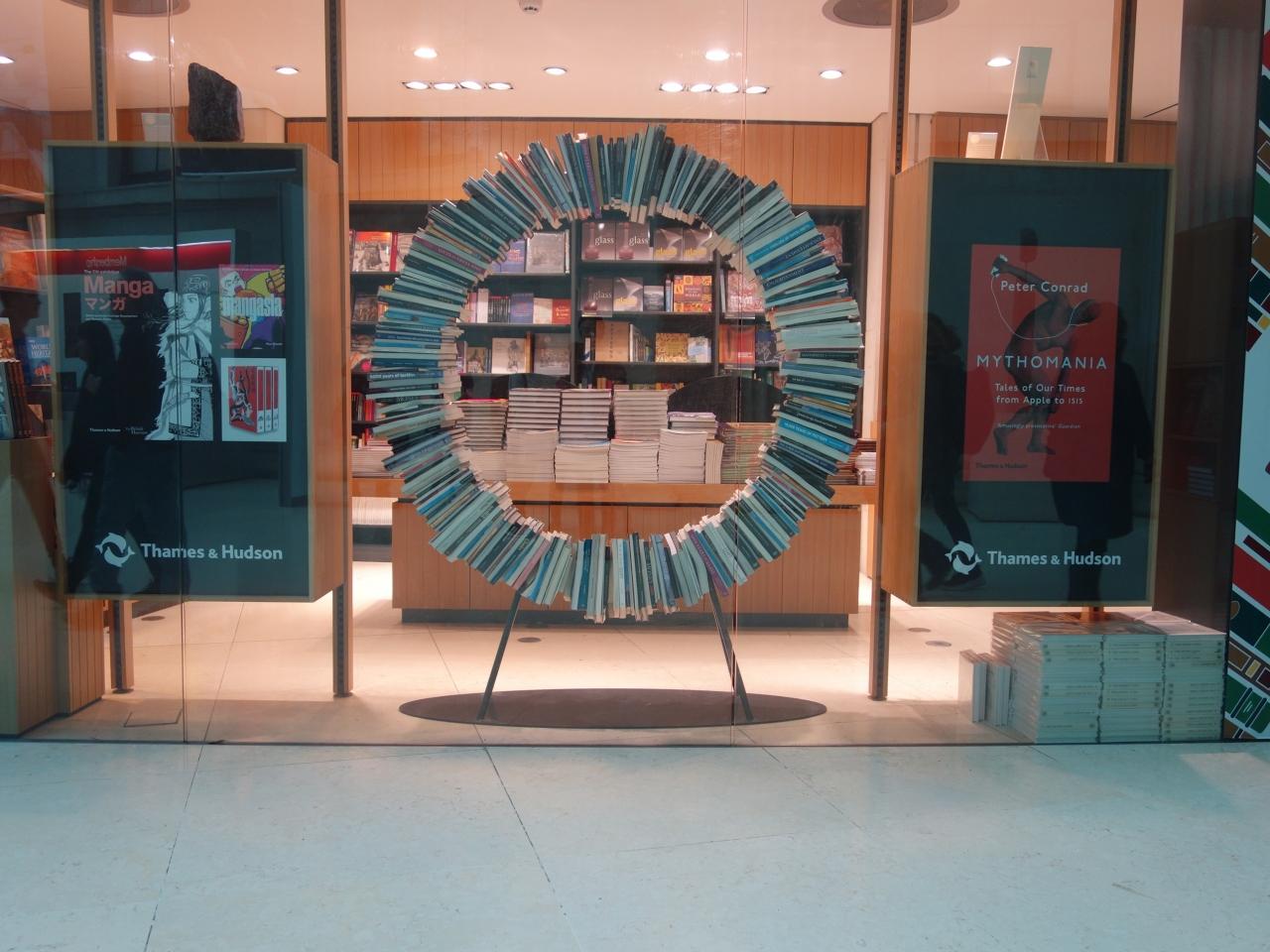
大英博物館グッヅが置いてあります。品揃えは豊富ですが。。。 by nomonomoさん
大英博物館 ミュージアムショップ お土産店
-
-
-
-
-
大英帝国の栄華の歴史です。批判も忘れないように。 by nomonomoさん
大英博物館 博物館・美術館・ギャラリー
-
-
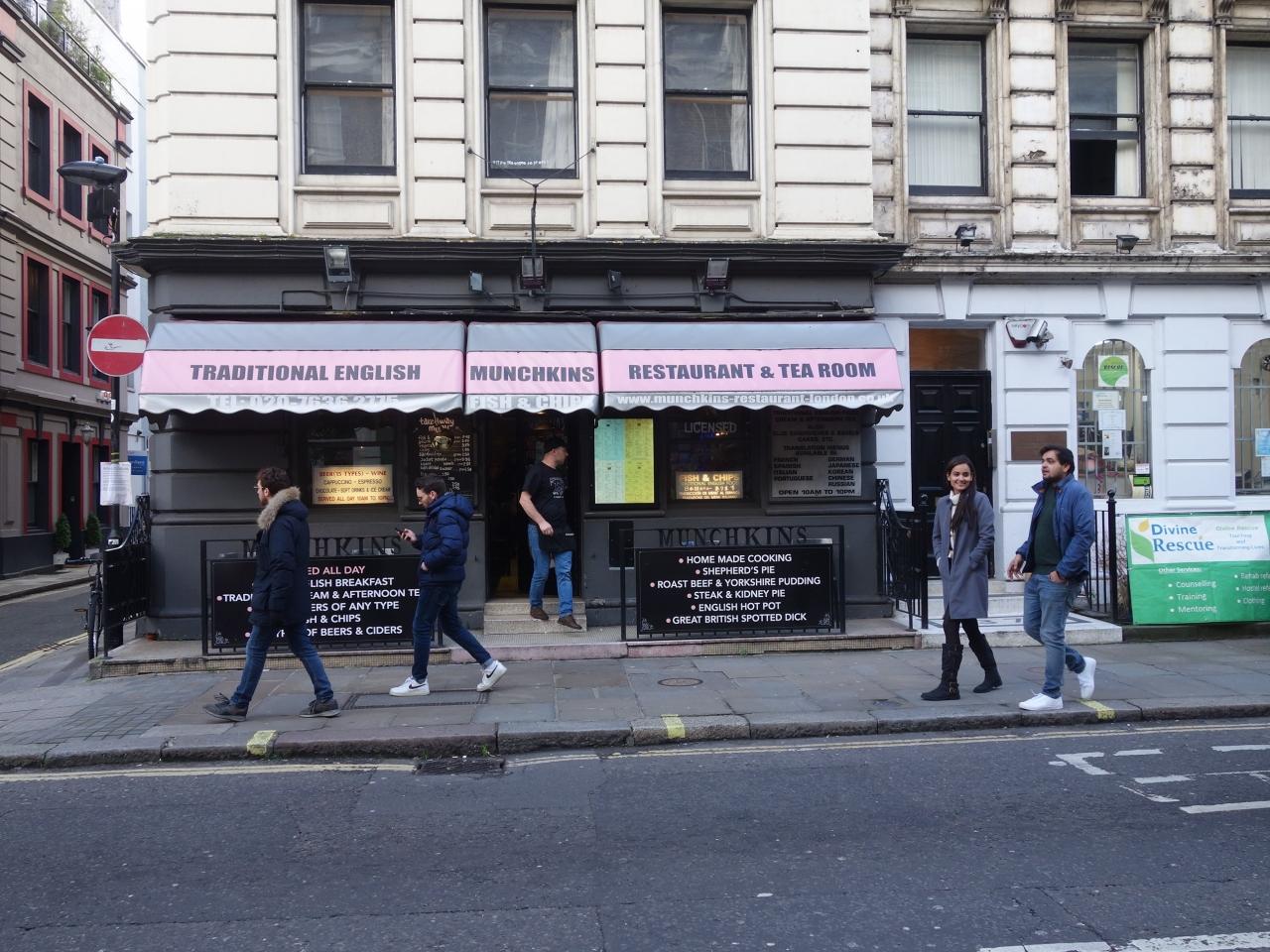
マンチキンズ レストラン 地元の料理
-
去年行った,Tea and Tattle が見えます。
ティー アンド タトル カフェ


![When Ashur, the lord who called me by my name <br />and has made my kingdom great, entrusted his<br />merciless weapon to my lordly arms, I overthrew<br />the widespread troops of the land of Lullume in <br />battle. With the assistance of Shamash and Adad,<br />the gods who help me, I thundered like Adad the <br />destroyer over the troops of the Nairi lands,<br />Habhi, Shubaru, and Nirib. I am the king who has <br />brought into submission at his feet the lands from<br />beyond the Tigris to Mount Lebanon and the<br />Great Sea [the Mediterranean], the whole of the <br />land of Laqe, the land of Suhi as far as Rapiqu, <br />and whose hand has conquered from the source <br />of the river Subnat to the land of Urartu.<br /><br />The area from the mountain passes of Kirruri to<br />the land of Gilzanu, from beyond the Lower Zab <br />to the city of Til-Bari which is north of the land <br />of Zaban, from the city of Til-sha-abtani to Til-sha- <br />Zabdani, Hirimu and Harutu, fortresses of the <br />land of Karduniash [Babylonia], I have restored to<br />the borders of my land. From the mountain passes<br />of Babite to the land of Hashmar I have counted<br /><br />the inhabitants as peoples of my land. Over the<br />lands which I have subjugated I have appointed my<br />governors, and they do obeisance. <br /><br />I am Ashurnasirpal, the celebrated prince, who<br />reveres the great gods, the fierce dragon, conqueror <br />of the cities and mountains to their furthest<br />extent, king of rulers who has tamed the stiff-<br />necked peoples, who is crowned with splendour, <br />who is not afraid of battle, the merciless champion<br />who shakes resistance, the glorious king, the<br />shepherd, the protection of the whole world, the <br />king, the word of whose mouth destroys mountains<br />and seas, who by his lordly attack has forced fierce<br />and merciless kings from the rising to the setting <br />sun to acknowledge one rule. <br /><br />The former city of Kalhu [Nimrud], which <br />Shalmaneser king of Assyria, a prince who<br />preceded me, had built, that city had fallen into <br />ruins and lay deserted. That city I built anew. <br />I took the peoples whom my hand had conquered <br />from the lands which I had subjugated, from the <br /><br /><br /><br />land of Suhi, from the whole of the land of Laqe, <br />from the city of Sirqu on the other side of the <br />Euphrates, from the furthest extent of the land of <br />Zamua, from Bit-Adini and the land of Hatte, and <br />from Lubarna, king of the land of Patina, and <br />made them settle there.<br /> <br />I removed the ancient mound and dug down to the <br />water level. I sank the foundations 120 brick <br />courses deep. A palace with halls of cedar, cypress, <br />juniper, box-wood, meskannu-wood, terebinth and<br />tamarisk, I founded as my royal residence for my <br />lordly pleasure for ever.<br /><br />Creatures of the mountains and seas I fashioned <br />in white limestone and alabaster, and set them <br />up at its gates. I adorned it, and made it glorious,<br />and set ornamental knobs of bronze all around it. <br />I fixed doors of cedar, cypress, juniper and <br />meskannu-wood in its gates. I took in great <br />quantities, and placed there, silver, gold, tin, <br />bronze and iron, booty taken by my hands from <br />the lands which I had conquered.](https://cdn.4travel.jp/img/tcs/t/pict/src/64/97/91/src_64979134.jpg?1581606171)


利用規約に違反している投稿は、報告する事ができます。
旅行記グループ
London, winter 2020 (2)
-
前の旅行記
London(4.3) Sloane Street を歩く。お金持ちの,お金持ちによる,お金持ちのためのスト...
2020/02/01~
ロンドン
-
次の旅行記
London(4.5) Little Venice で水遊び。ロンドンにもヴェニスがあるのです。
2020/02/01~
ロンドン
-
London(4.1) 今日からBrexit。喜ぶ人は喜んでいますけど,どうなるのでしょうか。
2020/02/01~
ロンドン
-
London(4.2) Partridges Food Market から朝がはじまります。
2020/02/01~
ロンドン
-
London(4.3) Sloane Street を歩く。お金持ちの,お金持ちによる,お金持ちのためのスト...
2020/02/01~
ロンドン
-
London(4.4) British Museum は古代文明にくわしい。今回はギリシャとアッシリアを見ま...
2020/02/01~
ロンドン
-
London(4.5) Little Venice で水遊び。ロンドンにもヴェニスがあるのです。
2020/02/01~
ロンドン
-
London(4.6) The Quince Tree Cafe で植物に囲まれて、素敵なランチをいただきま...
2020/02/01~
ロンドン
-
London(4.7) Marylebone High Street を Baker St. から Oxfo...
2020/02/01~
ロンドン
-
London(5.1) Petticoat Lane Market は洋服中心の路上マーケット。安い。
2020/02/02~
ロンドン
-
London(5.2) Old Spitalfields Market は古さと新しさが同居している。
2020/02/02~
ロンドン
-
London(5.3) 新しいほうのSpitalfie1ds は"l"の代わりに'1' を使っている。
2020/02/02~
ロンドン
-
London(5.4) Backyard Market は屋内のマーケット。おしゃれで、品がある。
2020/02/02~
ロンドン
-
London(5.5) Brick Lane Market は,その猥雑さに脱帽。ディープな下町ですね。
2020/02/02~
ロンドン
-
London(5.6) Columbia Road Flower Market。花の多さと、人の多さに圧倒さ...
2020/02/02~
ロンドン
-
London(5.7) The Princess of Shoreditch までローストビーフを食べに行っ...
2020/02/02~
ロンドン
-
London(5.8) Oxford Street ですてきなランチ。ローストビーフをいただきました。
2020/02/02~
ロンドン
-
London(5.9) Carnaby StreetにKingly Court。Sohoは次々と新しくなって...
2020/02/02~
ロンドン
-
London(5.10) Liberty の Arthur's Restaurant でお茶しました。ケーキ...
2020/02/02~
ロンドン
-
London(5.11) Regent Streetのお散歩。Oxford CircusからPiccadil...
2020/02/02~
ロンドン
-

London(6.1) Underground Piccadilly Line で Heathrow Air...
2020/02/03~
ロンドン
-

London(6.2) Heathrow Airport Terminal 5 の散策。時間つぶしです。
2020/02/03~
ロンドン
-

BAのオンボロ B777 に乗りました。機齢19.4年。LHR-HND。 最悪のフライトでした。
2020/02/03~
ロンドン
-
羽田空港で久しぶりの和食を食す。日本は食事のバラエティーが豊かです。
2020/02/04~
羽田
-

羽田空港で日がな飛行機の発着をみる。あきないですね。
2020/02/04~
羽田
-

Boeing737-800 に乗りました。HND-NGO JL209。あっという間に名古屋に着きました。
2020/02/04~
羽田
旅行記グループをもっと見る
コメントを投稿する前に
十分に確認の上、ご投稿ください。 コメントの内容は攻撃的ではなく、相手の気持ちに寄り添ったものになっていますか?
サイト共通ガイドライン(利用上のお願い)報道機関・マスメディアの方へ 画像提供などに関するお問い合わせは、専用のお問い合わせフォームからお願いいたします。
この旅行で行ったスポット

この旅行で行ったグルメ・レストラン
ロンドン(イギリス) の旅行記



ロンドン(イギリス) の人気ホテル

フォートラベル公式LINE@
おすすめの旅行記や旬な旅行情報、お得なキャンペーン情報をお届けします!
QRコードが読み取れない場合はID「@4travel」で検索してください。
\その他の公式SNSはこちら/
旅行記グループ London, winter 2020 (2)
0
122