


2019/11/30 - 2019/12/03
5850位(同エリア17288件中)

something like thatさん
- something like thatさんTOP
- 旅行記357冊
- クチコミ161件
- Q&A回答1件
- 379,454アクセス
- フォロワー25人
パリ滞在2日目
ヴェルサイユ宮殿、ピカソ美術館
ヴェルサイユ宮殿(ベルサイユ宮殿) (前半)
Château de Versailles
ピカソ美術館
Musée National Picasso-Paris
※美術館シリーズで紹介予定
- 旅行の満足度
- 4.5
- 観光
- 4.5
- 同行者
- 一人旅
- 交通手段
- 徒歩
- 旅行の手配内容
- 個別手配
-

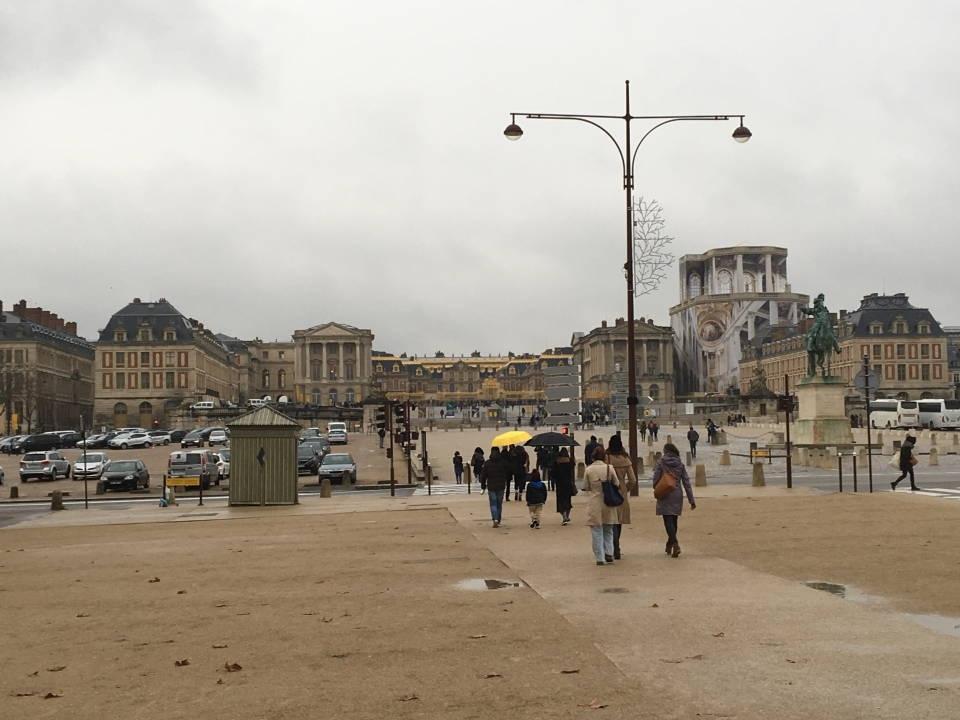
最寄りの駅から歩きます。
-
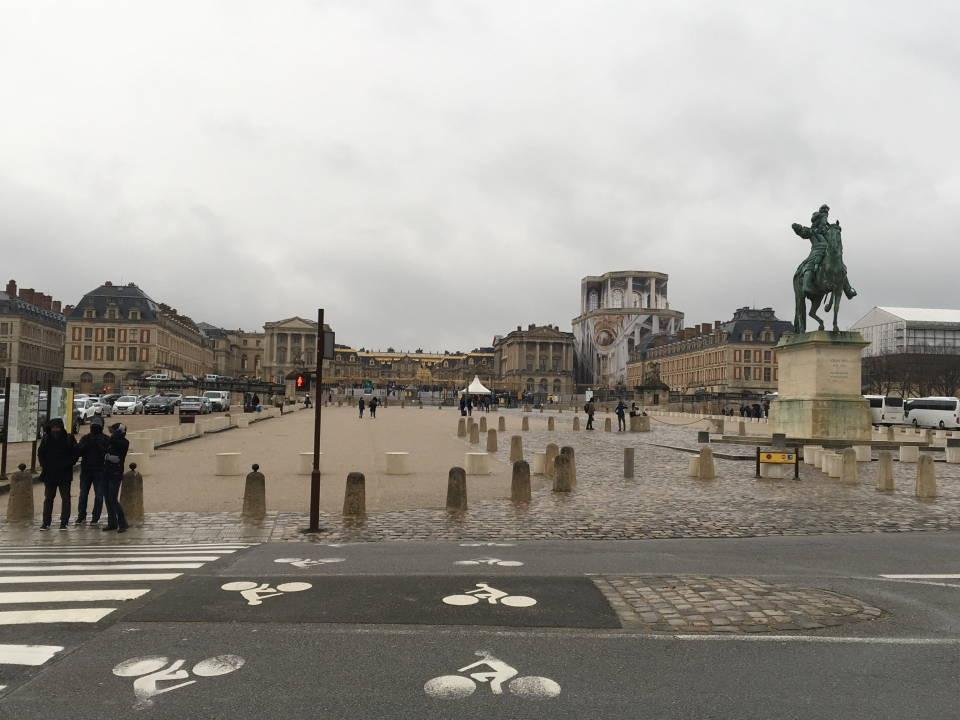
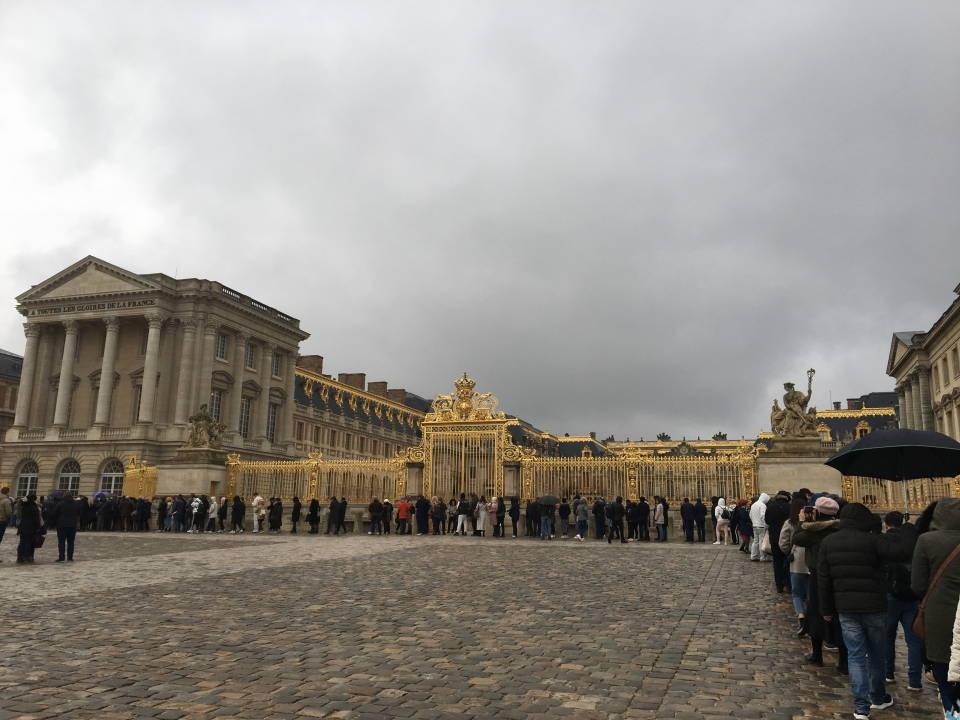
ヴェルサイユ宮殿が見えてきました。
-
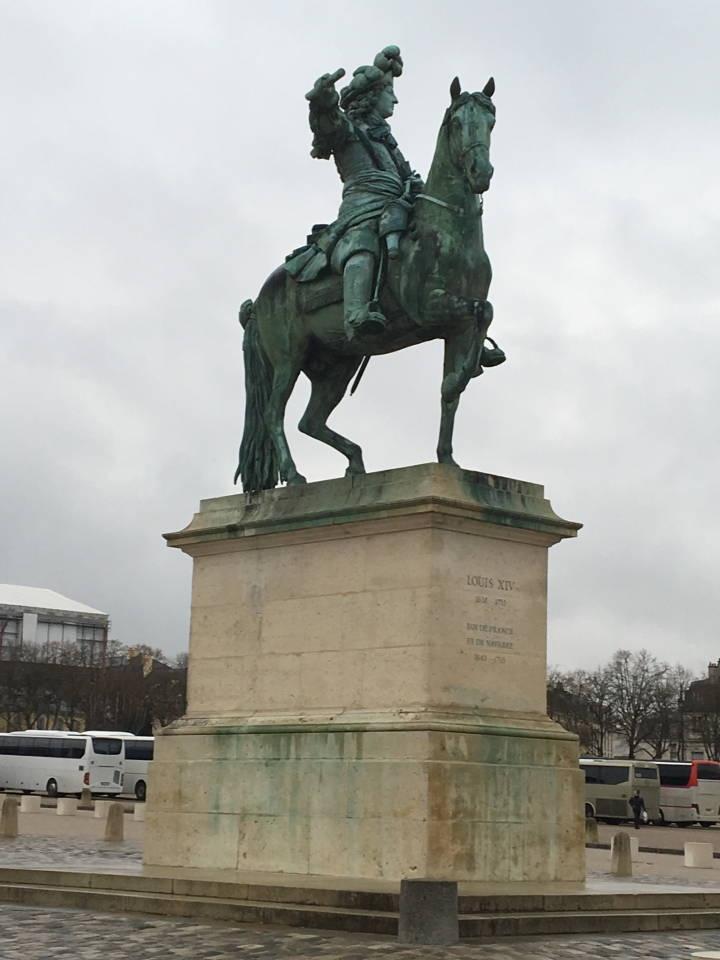
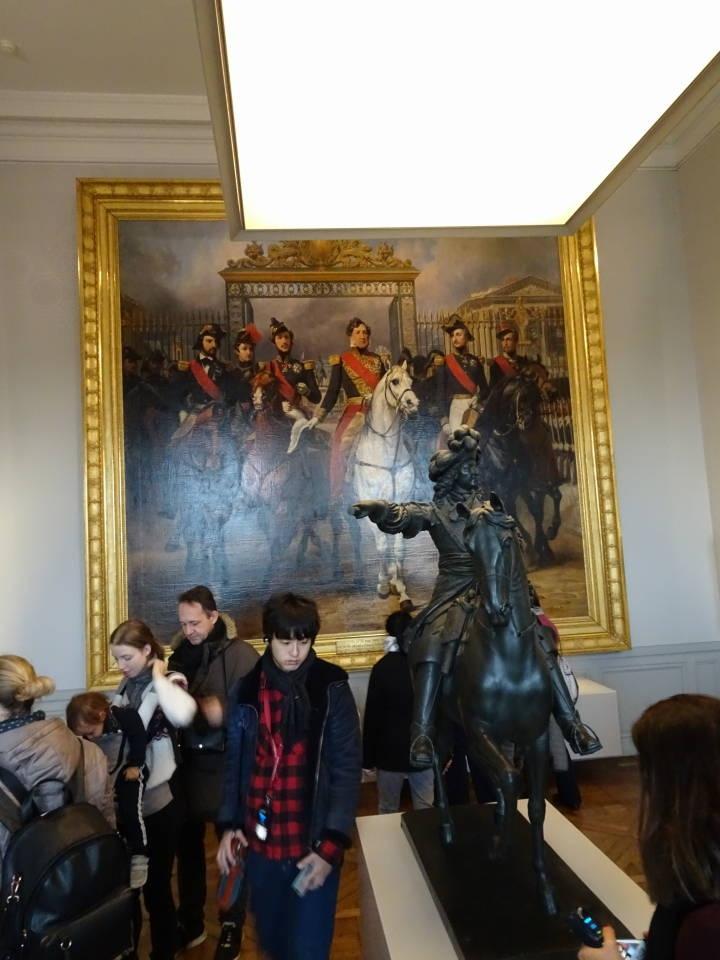
ルイ14世騎馬像
-
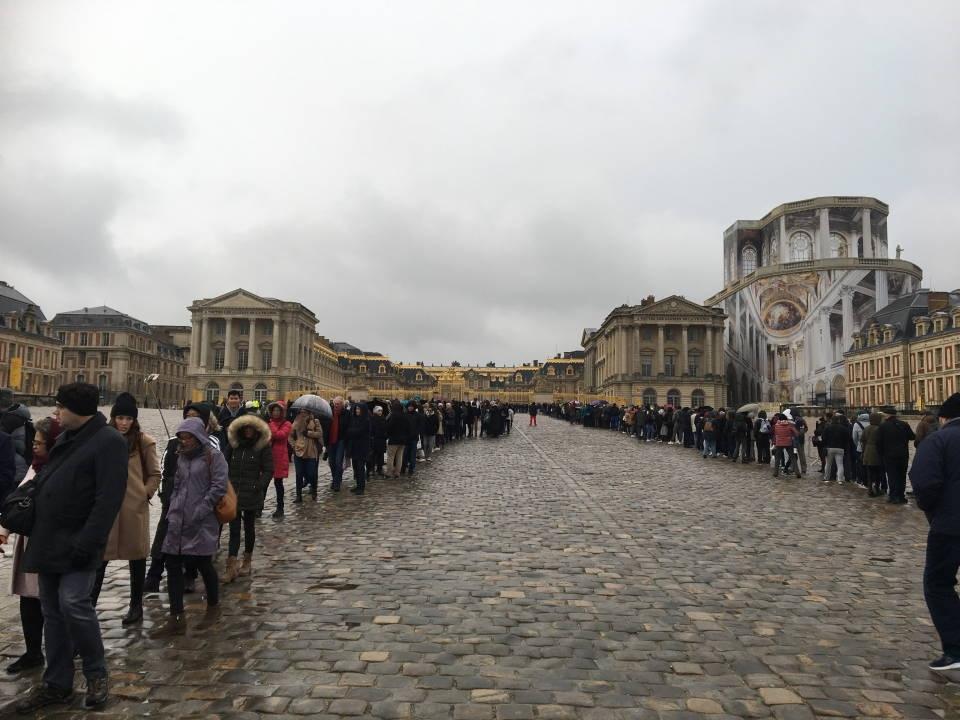
行列。。。。
-
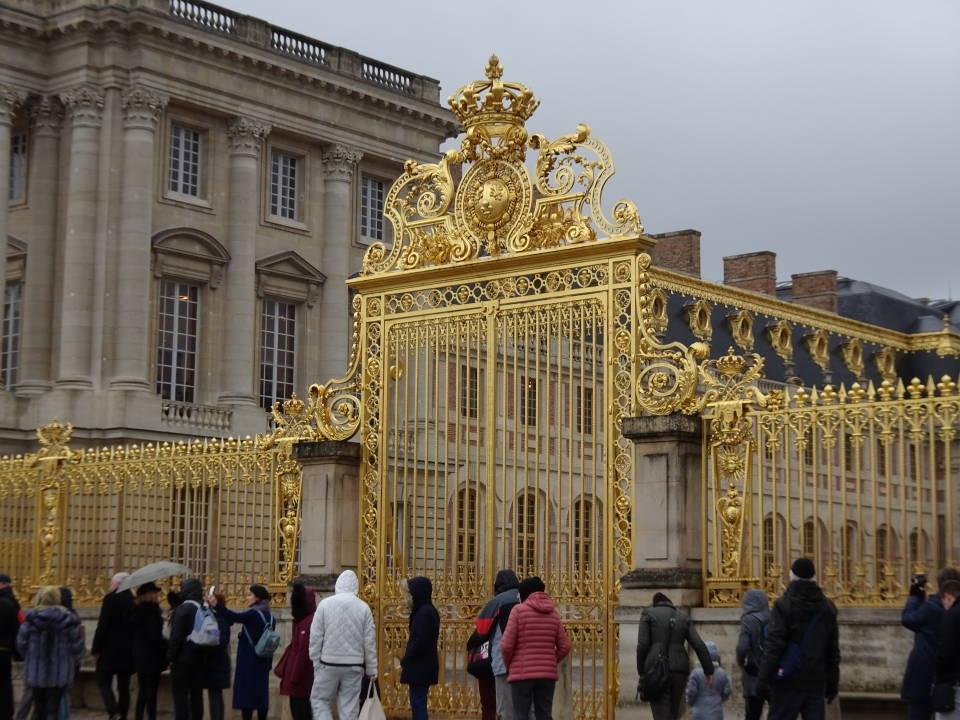
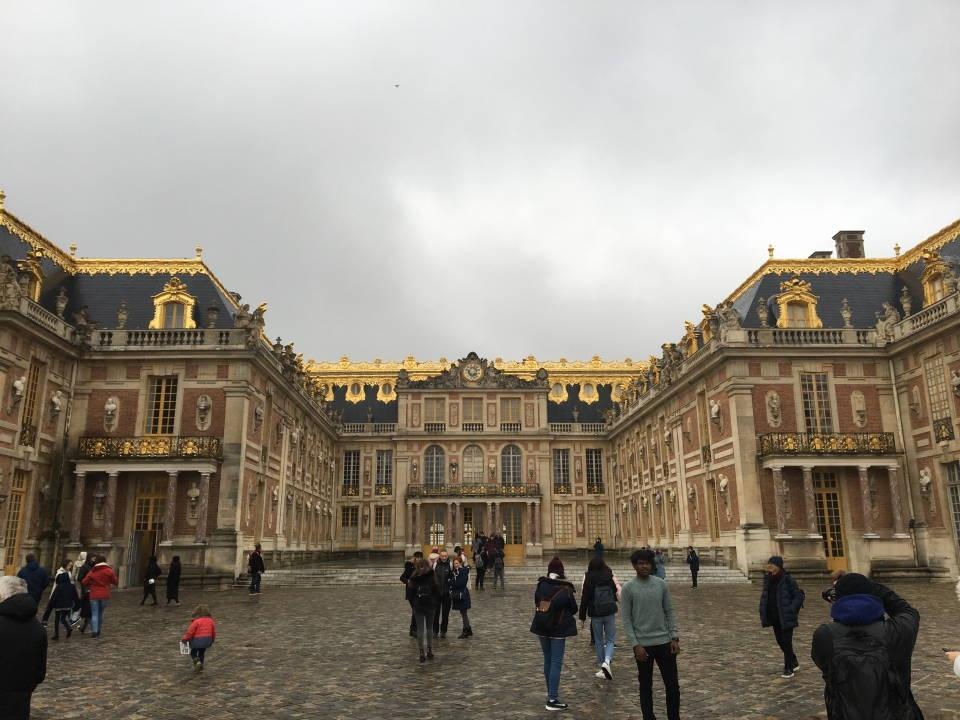
ヴェルサイユ宮殿
-
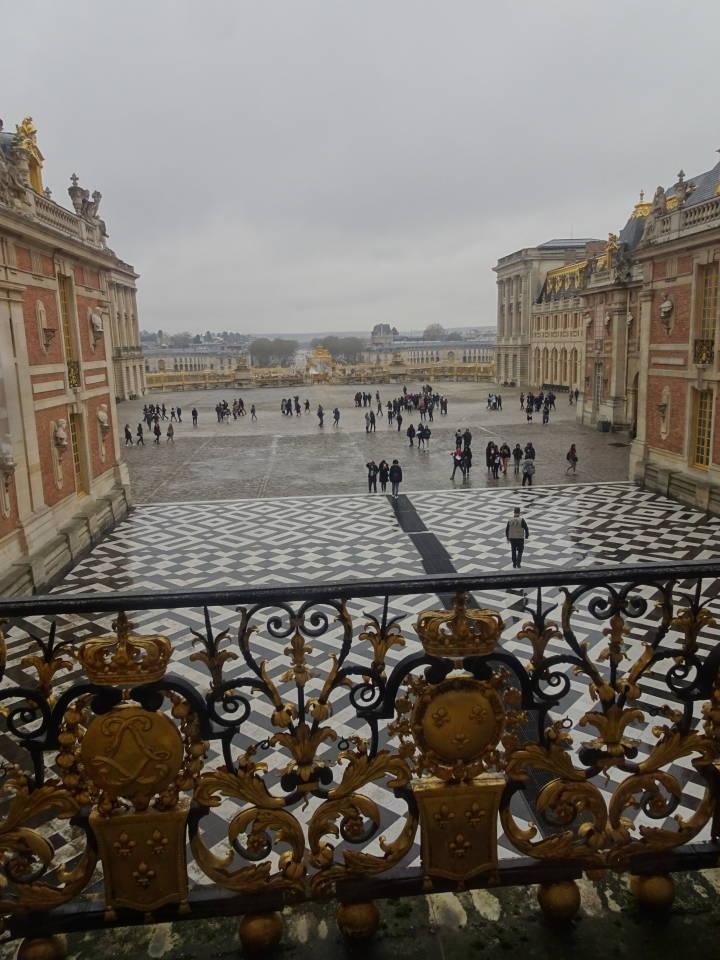
1789 年に始まったフランス革命中に、革命政府は全体が金で装飾されていたこの正門の取り壊しを命ずる。この門は 2008 年に復元され、10 万枚の金箔で装飾されている。
宮殿の門の外で多くの市民が貧困と飢餓に苦しむなか、宮殿の内部は豪華さと贅沢な生活があり、隔てるこの豪華な門は、憎しみの対象となっていた。 -
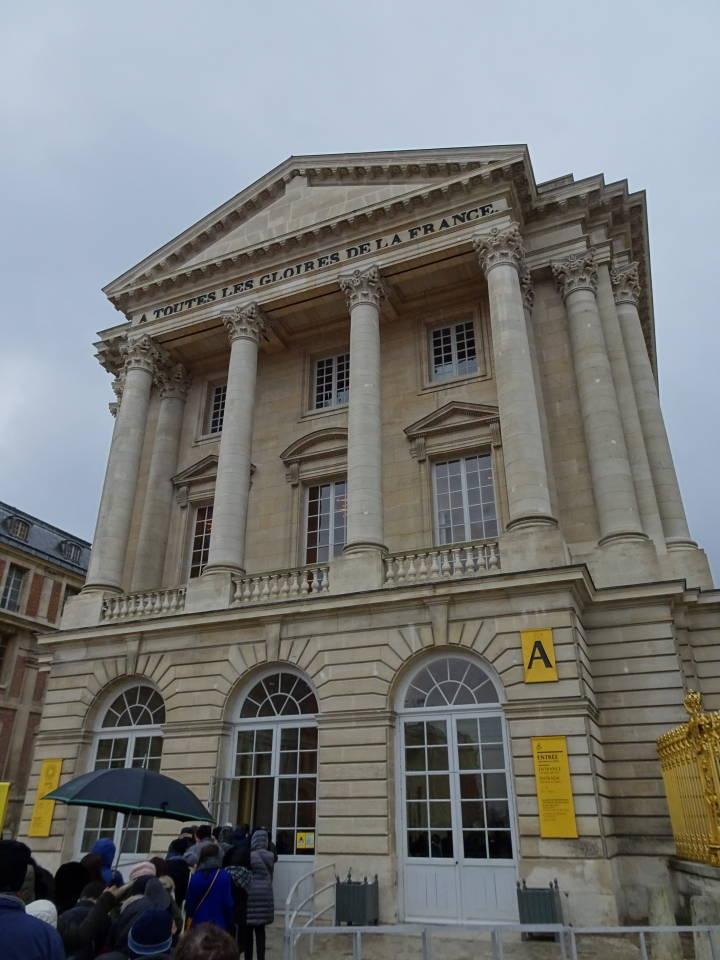
ヴェルサイユ宮殿
-
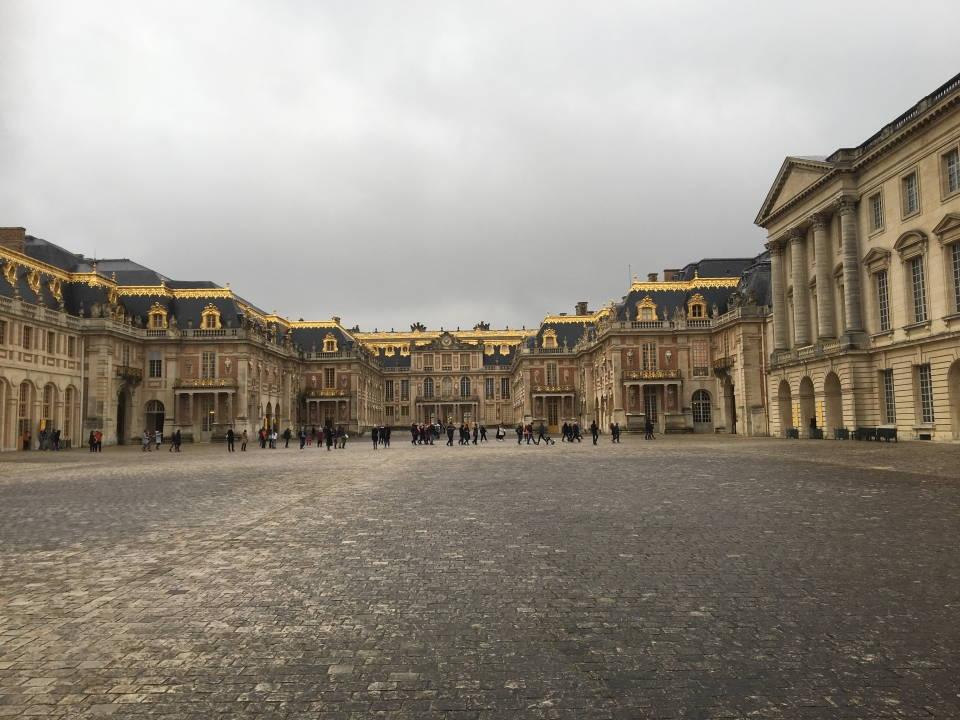
ヴェルサイユ宮殿
ようやく入り口に。 -
改めて、、、
ヴェルサイユ宮殿(Palais de Versailles)は、1682年、フランス王ルイ14世(1638年 - 1715年、在位1643年 - 1715年)が建てたフランスの宮殿(建設当初は離宮)である。ヴェルサイユ城(Château de Versailles)ともいい、フランス語ではこちらの表記がよく使用されている。
パリの南西22キロメートルに位置するイヴリーヌ県ヴェルサイユにある。主な部分の設計はマンサールとル・ブランによっておこなわれ、庭園はアンドレ・ル・ノートルによって造営された。バロック建築の代表作で、豪華な建物と広大な美しい庭園で有名である。(wikiより) -
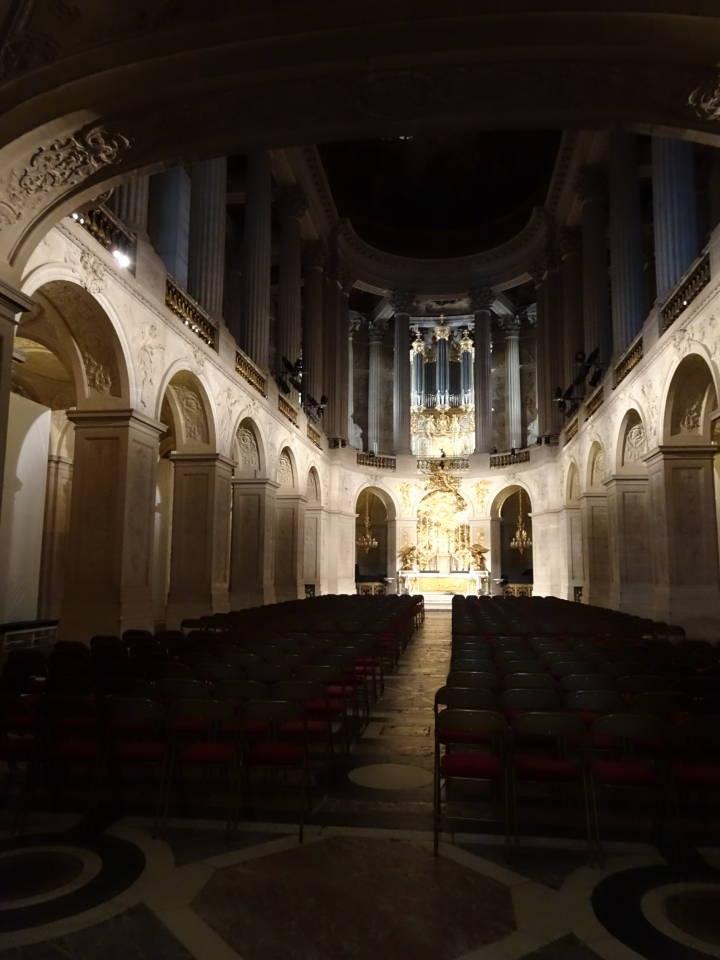
Royal Chapel
-
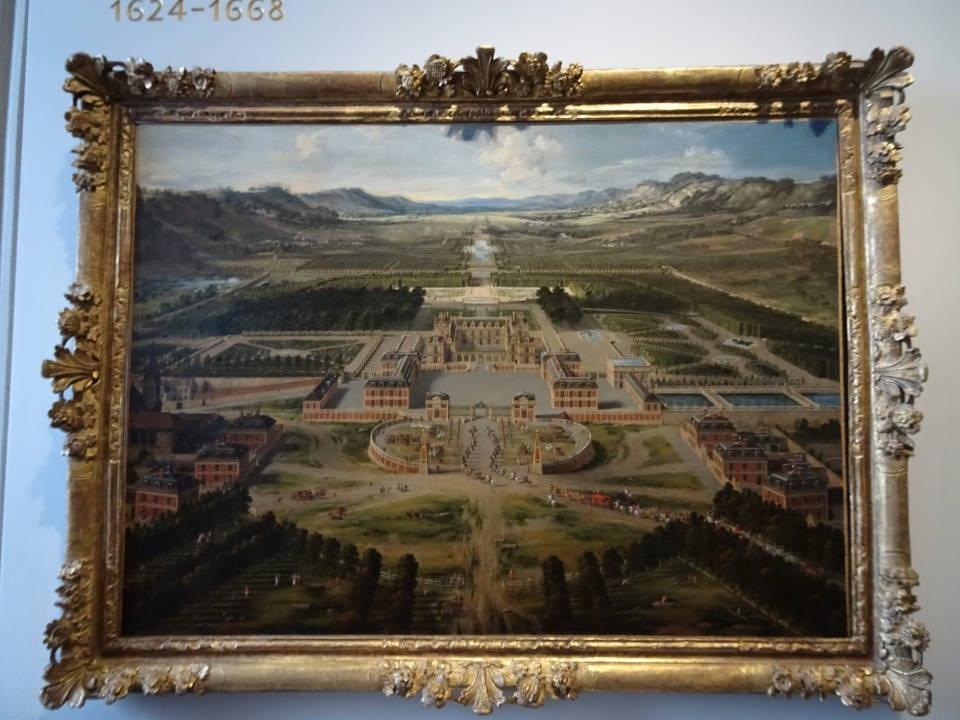
ベルサイユ宮殿の絵
-
ヴェルサイユ宮殿
-
ヴェルサイユ宮殿
-
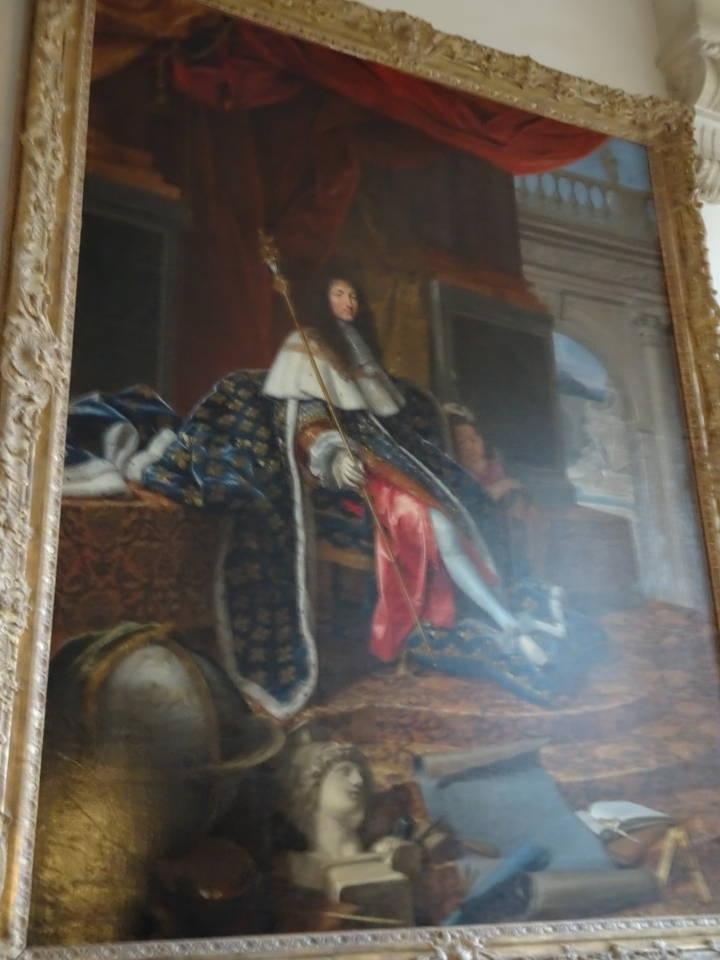
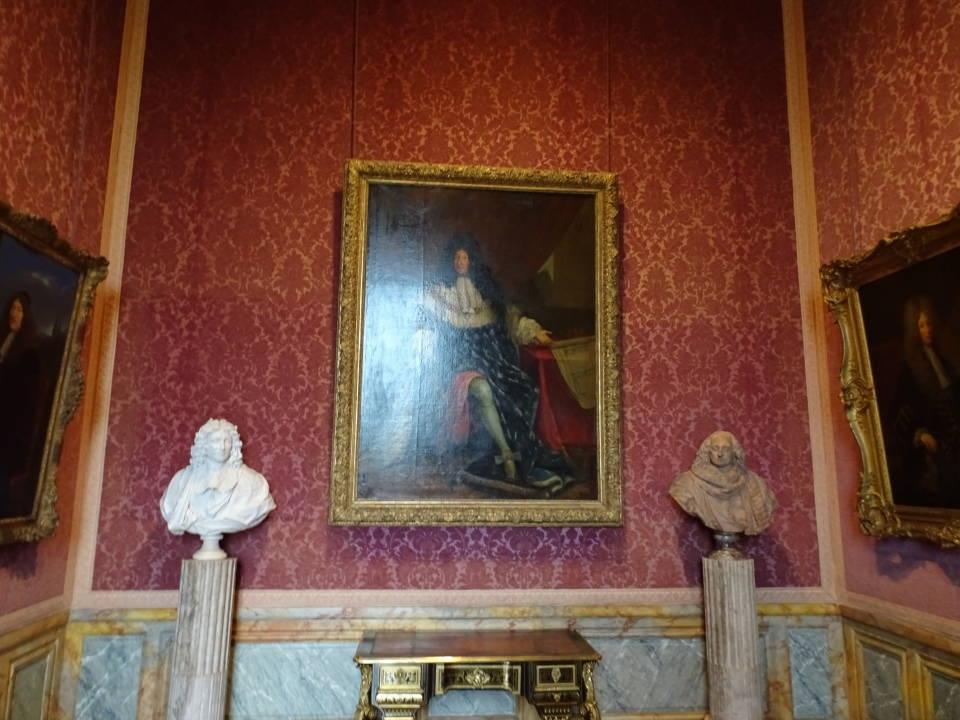
ルイ14世の肖像画。
-
ヴェルサイユ宮殿
-
ヴェルサイユ宮殿
-
ヴェルサイユ宮殿
-
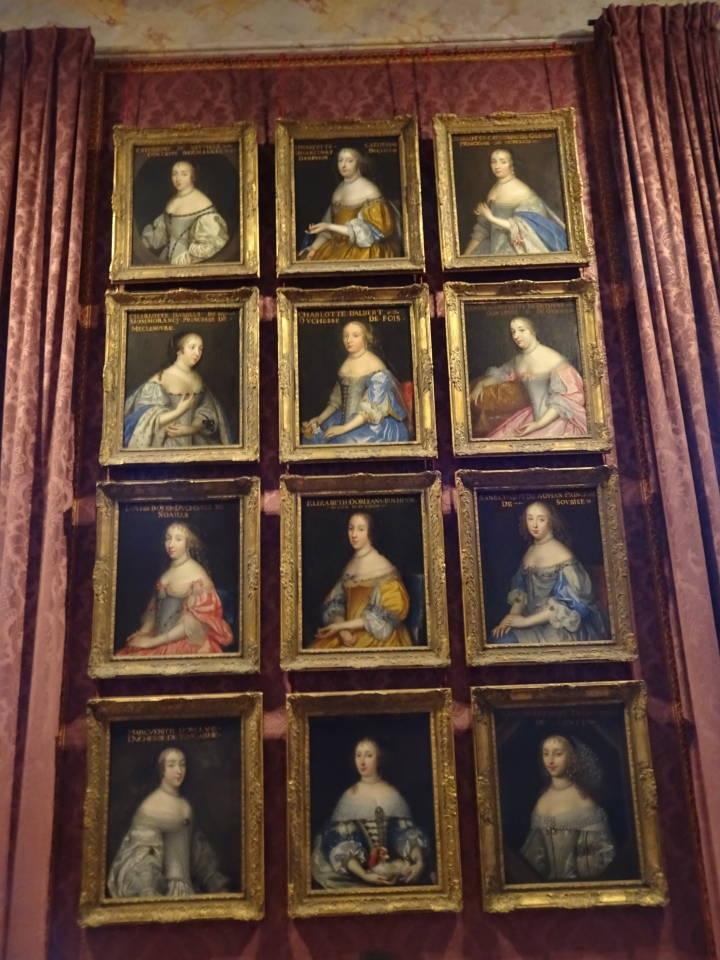
ミュンヘンでも見たような美人画。
-
ルイ14世
-
ルイ14世
-
-
-
Royal Chapel
2階から。 -
-
-
ヘラクレスの部屋
Hercules Room
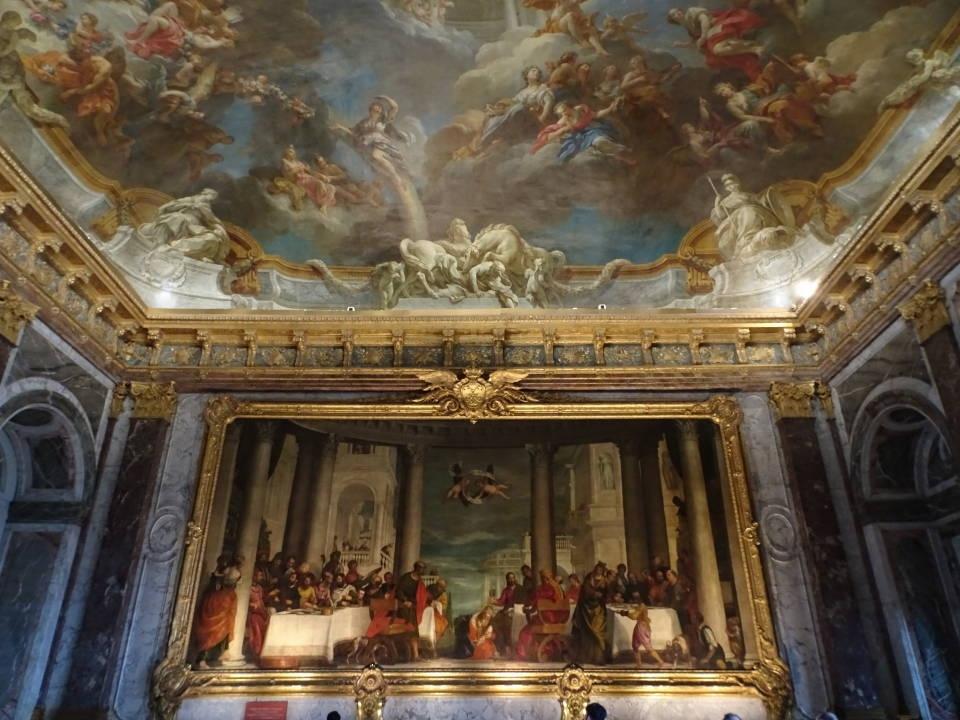
最初の部屋は天井画の題材からヘラクレスの部屋と呼ばれる広い部屋。
正面にはベロネーゼの大作が飾られる。
「シモン家の宴」
カリアーリ・パオロ・ヴェロネーゼ(1528-1588)、1570年
1507年から1573年にベネチア出身の偉大な芸術家によってセルヴィテス修道院のために描かれ、1664年に総督から外交面での衝突の埋め合わせとしてルイ14世に送られたこの作品は、1730年になってヴェルサイユ宮殿にヘラクレスの間が作られたことにより、ようやく安住の地を見つけたのでした。革命時に宮殿に残されたこの絵は、ルイ・フィリップの治世のはじめに宮殿を離れ、そして1961年に宮殿の家具・調度品取替え方針により再び戻ってきたのです。以前にも修復が行われたにもかかわらず、1990年のはじめのこの作品は、取り分け分厚く黄色くなった古い絵の具により黒ずみ、陰鬱な雰囲気を醸し出していました。
作品の歴史と損傷に関する調査と共に、「基本的」で大がかりな修復作業が行われました。これにより、この作品は国王の大居室の装飾としての輝きを取り戻し、ルイ14世の嗜好とルネッサンス期の偉大なベネチアの画家が、偉大な時代のフランス芸術と、ヘラクレスの間で混じり合う光の時代のフランス芸術に与えた影響を浮き彫りにしています。(ベルサイユ宮殿の公式サイトより引用) -
ヘラクレスの部屋
Hercules Room
反対側の壁に飾られている絵。
The Hercules Room was the last room to be built by Louis XIV at the end of his reign. From 1682 the space had been occupied by the palace chapel, which covered two floors and served until 1710, when it was replaced by the current Royal Chapel. A floor was laid to create a new room, but the decoration was not finished until the reign of Louis XV, who, in 1730, brought the huge painting by Veronese, The Meal in the House of Simon, to Paris from the Gobelins, where it had been stored since its arrival in France as a gift from the Republic of Venice to Louis XIV in 1664. Work on the Hercules Room was completed in 1736, when François Lemoyne finished the ceiling painting depicting The Apotheosis of Hercules. This vast, impressive, allegorical work, depicting no fewer than 142 persons, can be considered on a par with masterpieces by Italian fresco painters. It was created, however, using the marouflage technique, i.e. the scenes were painted on canvas and then stuck onto the ceiling. Despite being made First Painter to the King by Louis XV in return for his work, Lemoyne committed suicide a year later, in 1737, exhausted by this huge project which had taken four years to complete.(from official website) -
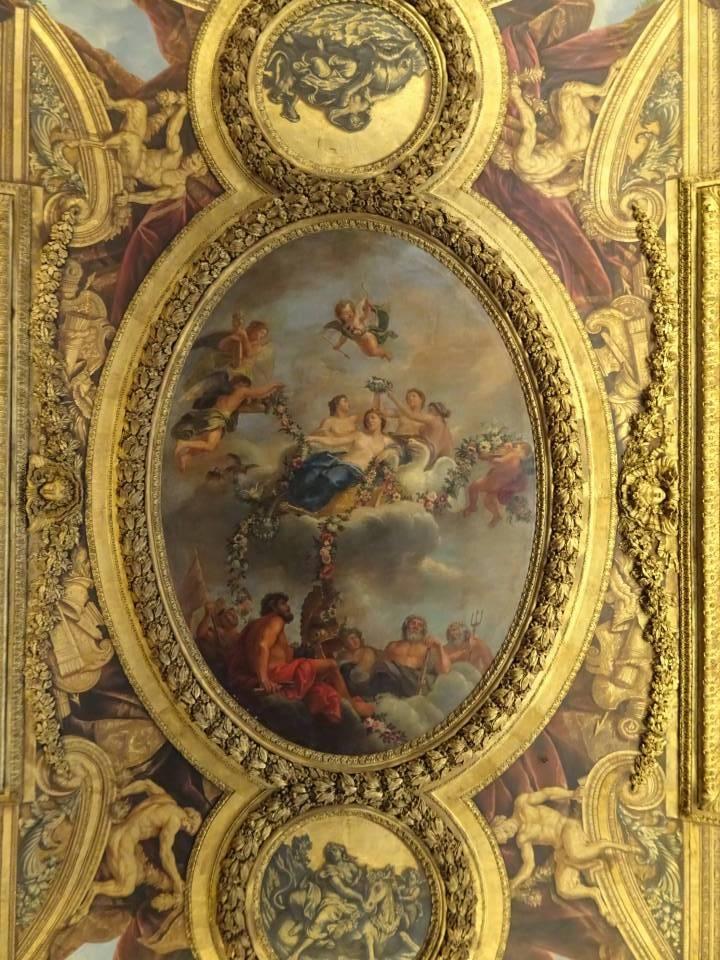
ヘラクレスの部屋
Hercules Room
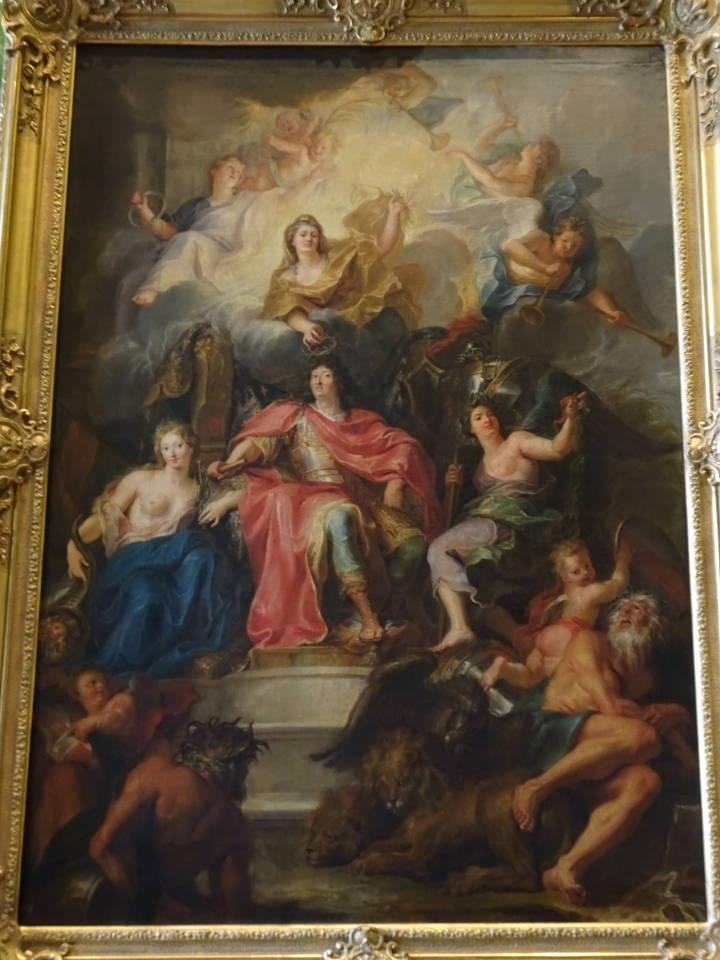
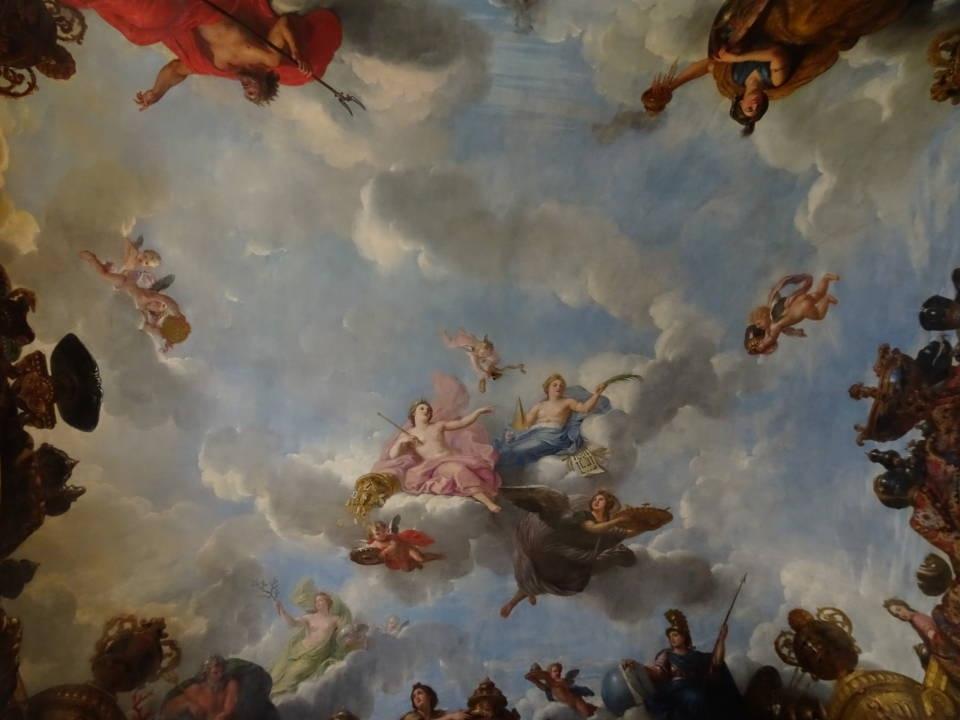
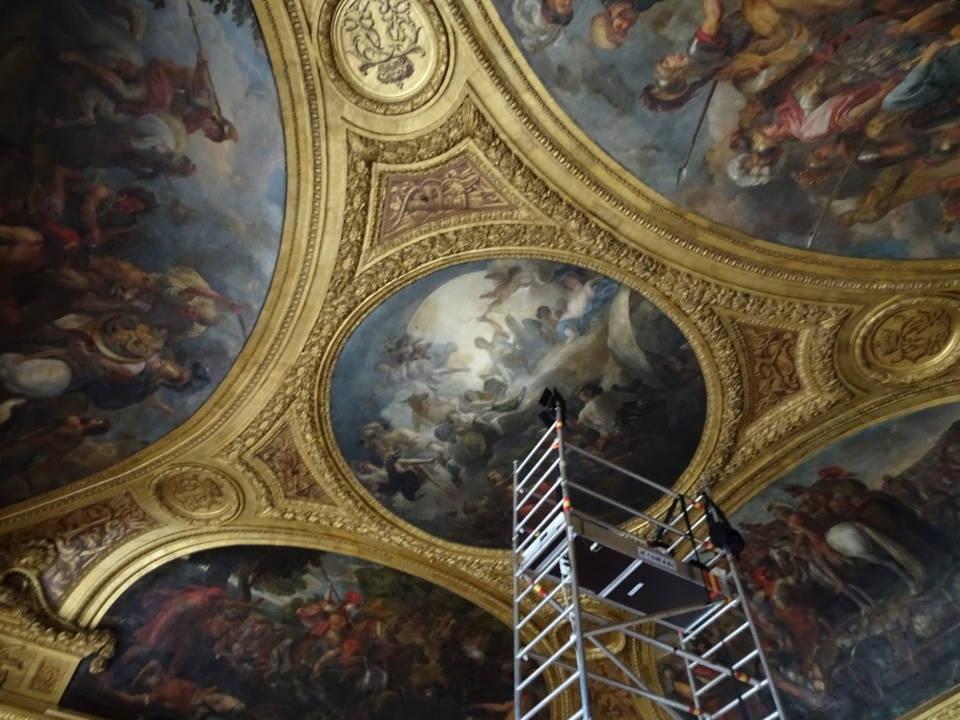
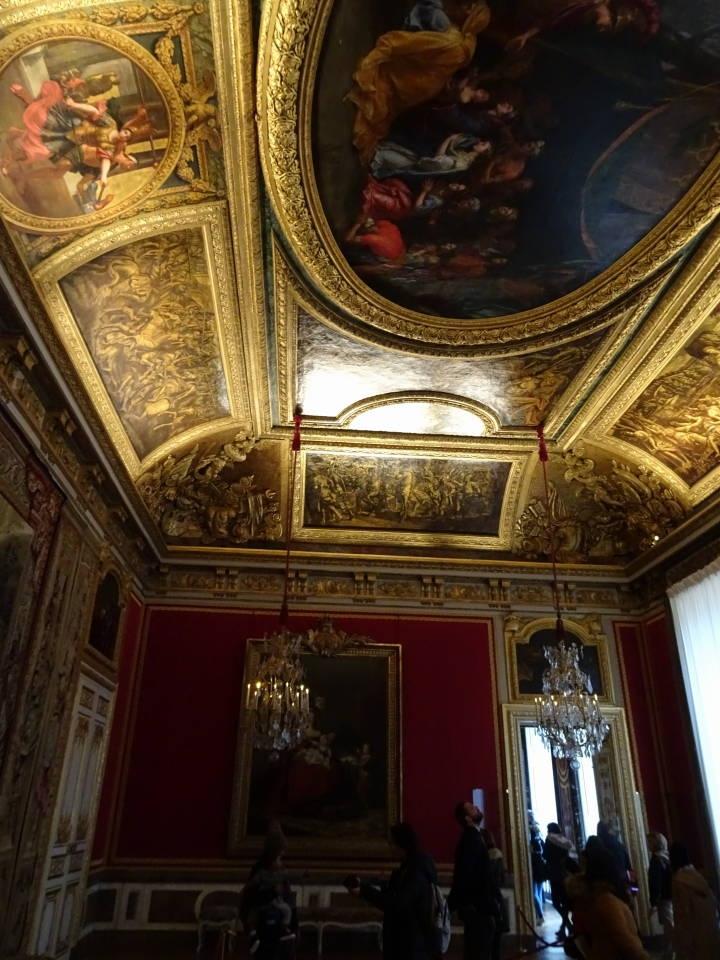
天井画。「ヘラクレスの栄光」。フランソワ・ルモワーヌ作
The first salon of the King's Grand Apartment, the Hercules salon was created at the end of Louis XIV's reign. The works on the Hercules salon lasted until 1736, when Francois Lemoine completed the painting of the vault depicting the Apotheosis of Hercules, which was supposed to show that "Virtue raises man above himself". This vast allegorical composition with 142 figures aimed to rival the masterpieces of the Italian fresco painters but it was painted on primed canvases, i.e. glued onto the support. The work was so exhausting that the young painter, despite the success of his work, committed suicide shortly afterwards.
Francois Lemoine(フランソワ・ルモワーヌ)
パリでフランス王室の御者の息子に生まれた。父親が亡くなった後、母親が画家のロベール・ル・ヴラック・ド・トゥルニエール(Robert Le Vrac de Tournières)と再婚したことから、美術の道に進むことになった。13歳の1701年に、王立絵画彫刻アカデミーに入学し、ルイ・ガローシュ(Louis Galloche: 1670-1761)に学んだ。1713年までガローシュのもとで学び、後年は助手として働いた。1711年にローマ賞を受賞した。1718年にアカデミーの会員になった。1723年になって、イタリアを旅し、ボローニャ、ローマ、ナポリ、ヴェネツィアを旅しフランスに戻った。パリでスタジオを開き、ルモワーヌが教えた画家には、フランソワ・ブーシェやシャルル=ジョゼフ・ナトワール、ドナシャン・ノノットらがいた。1728年、ヴェルサイユ宮殿の一室の天井画の依頼を王室から受け、1733年から1736年まで取り組み、その作品は賞賛を受けた。1733年に王立絵画彫刻アカデミーの教授に任じられ[1] 、1736年に、国王の筆頭画家に任命された。
その翌年の1737年、パリで自殺した。理由は、過剰な仕事量や、王室画家たちの中での軋轢、妻の死や不安定な性格、芸術的完成度を達成できないことへの欲求不満など、さまざまに推測されている。剣で、胸と喉を合計9回刺したと伝えられている。(wikiより) -
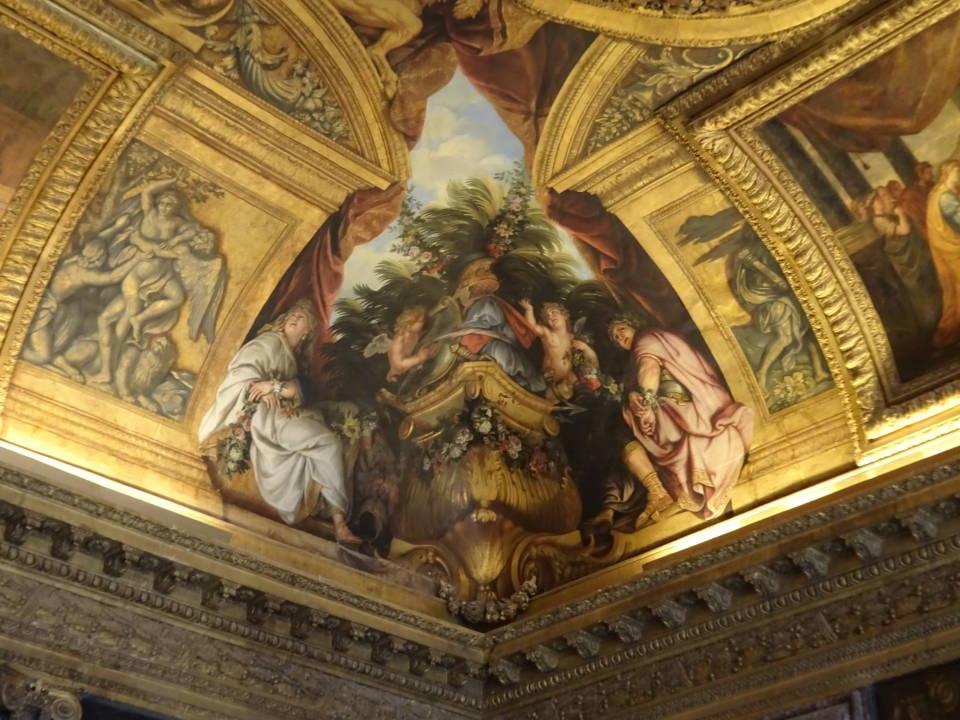
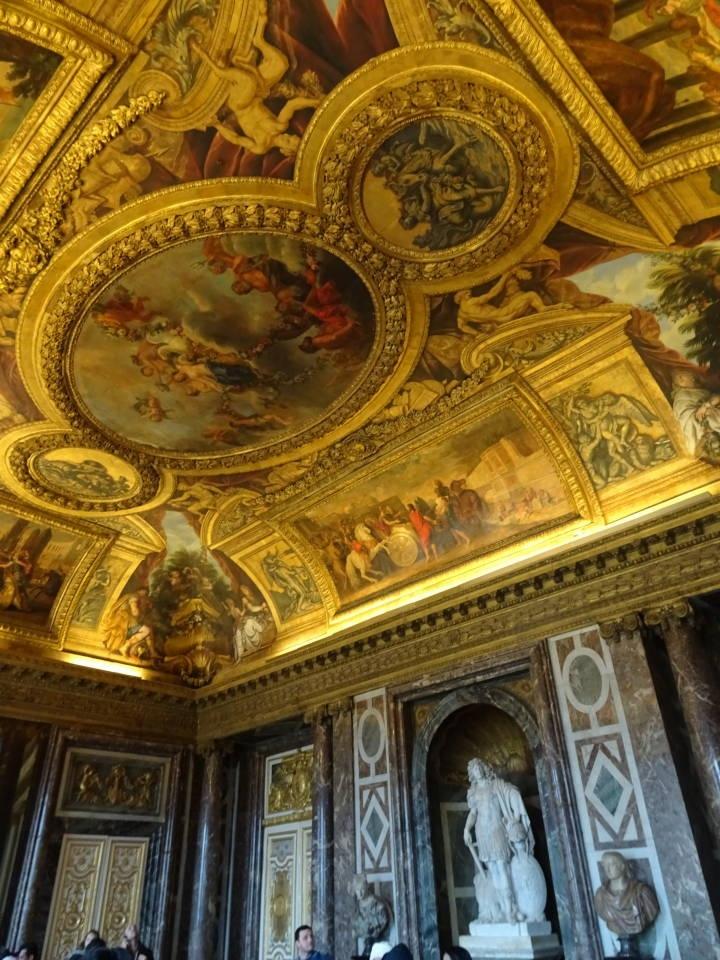
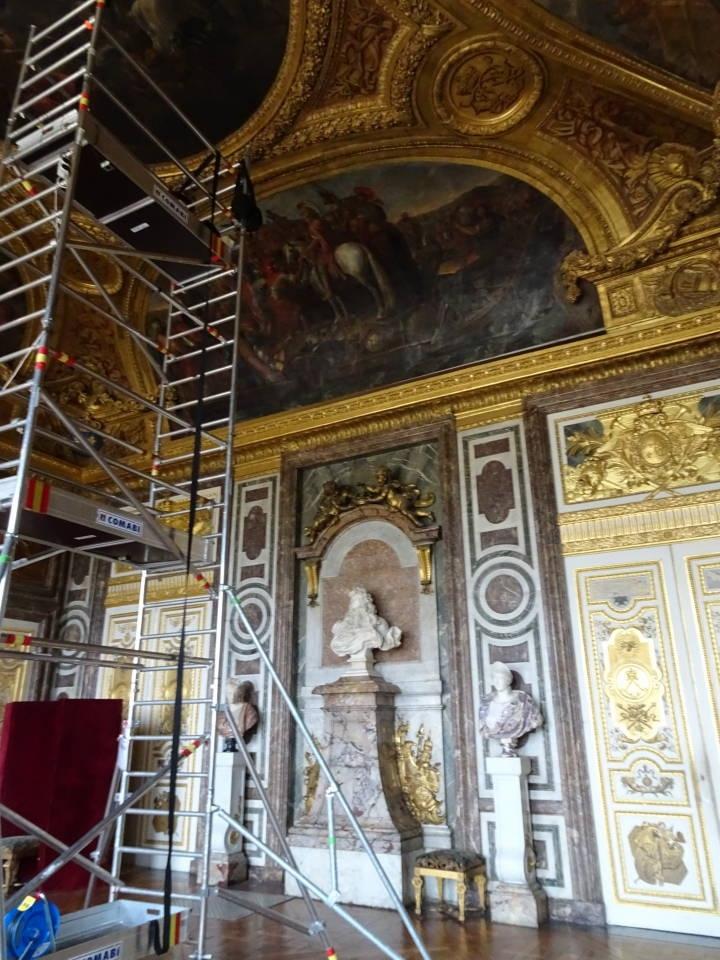
豊穣の間
Salon de l’Abondance
Abundance Salon
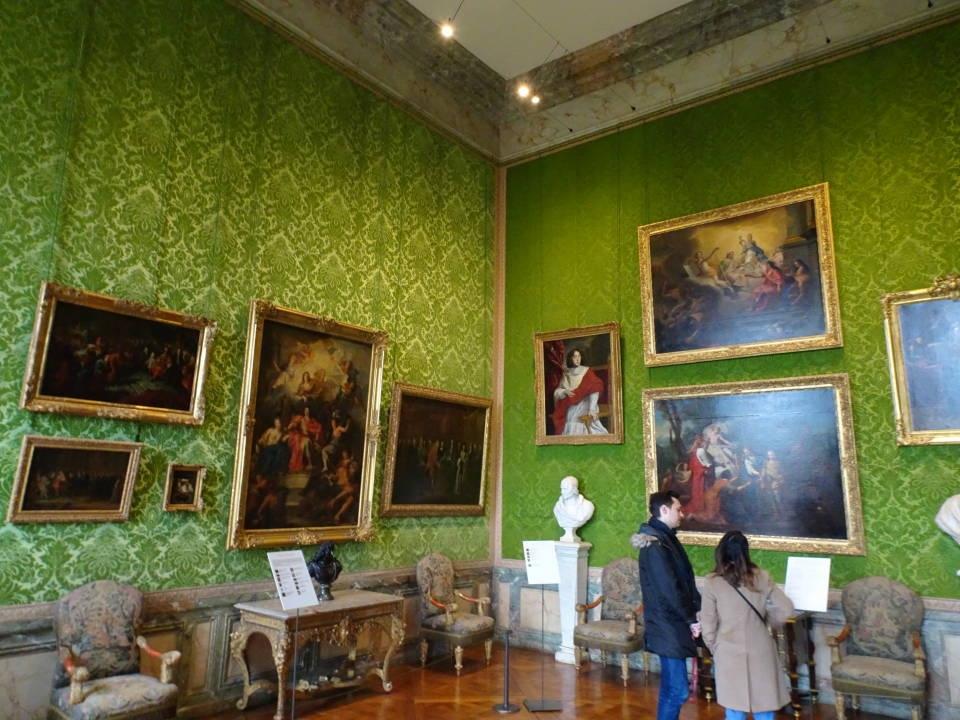
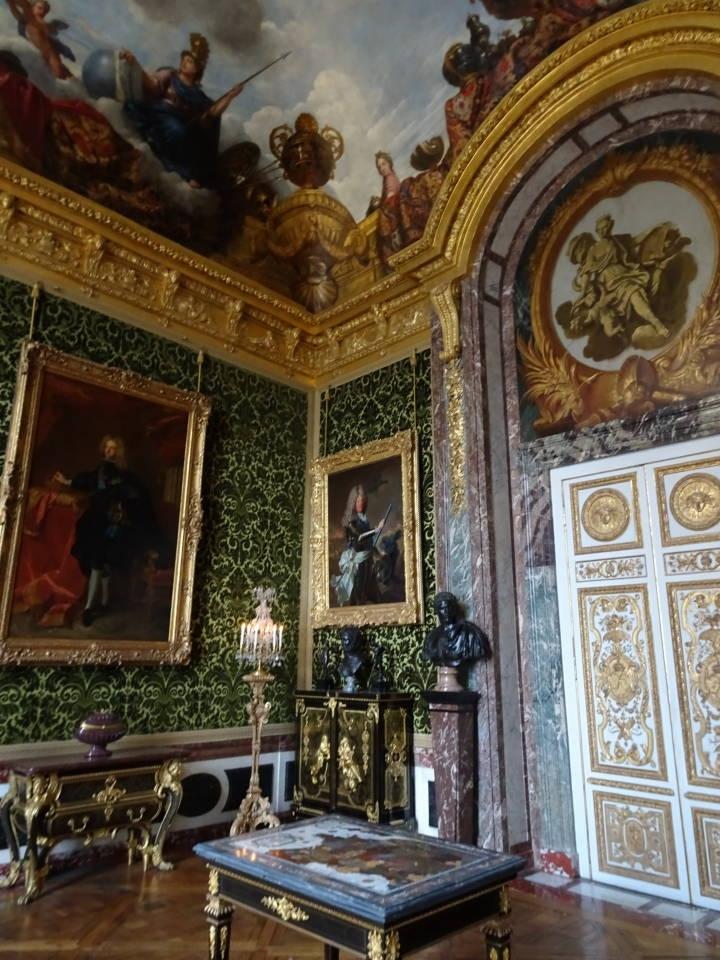
左の絵
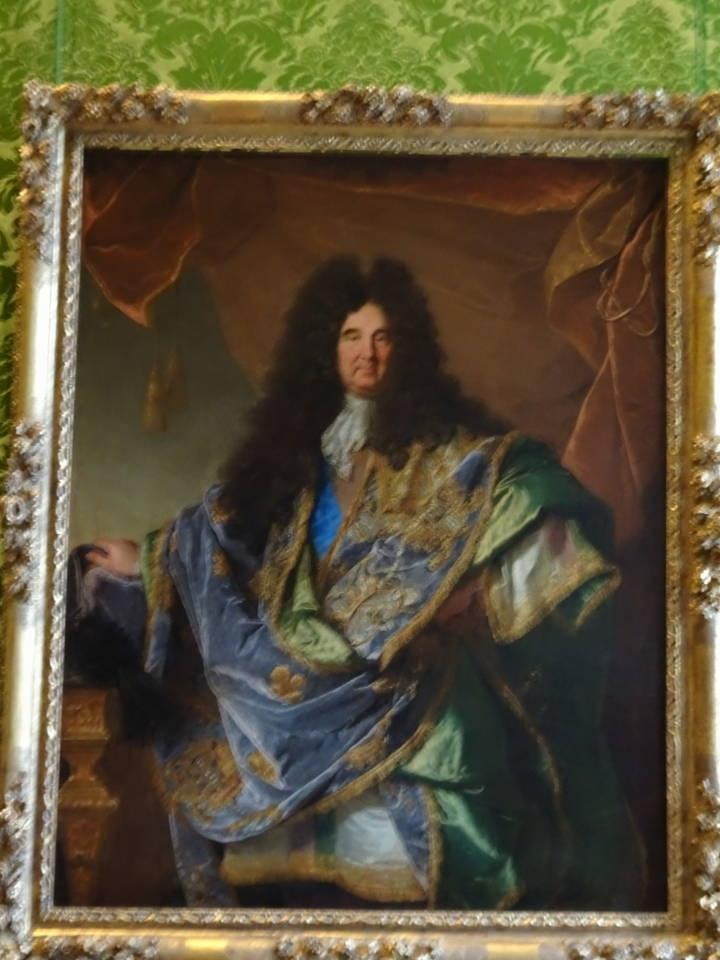
Philip V, king of Spain フェリペ5世 (スペイン王)
イアサント・リゴー(Hyacinthe Rigaud) 1701年
During Evening gatherings, the Room of Abundance served as a refreshment room where coffee, wines and liqueurs were served on a sideboard. It was also the antechamber of Louis XIV’s Collection Room, or Room of Rare Objects (now Louis XVI’s Games Room) which could be entered through the end door. The king liked to show his guests the silver vases, gems and medallions kept there which served as a source of inspiration for the decoration of the vault, including a depiction of the royal vessel over the door. The King’s Vessel was a valuable object in the form of a mastless ship which was placed on the king’s table during important occasions or on the sideboard. It contained the sovereign’s serviette and was a symbol of power which had to be hailed by everyone who passed by.(from official website) -
豊穣の間
Salon de l’Abondance
Abundance Salon
天井画 -
ヴィーナスの部屋
Salon de Vénus
Venus Room
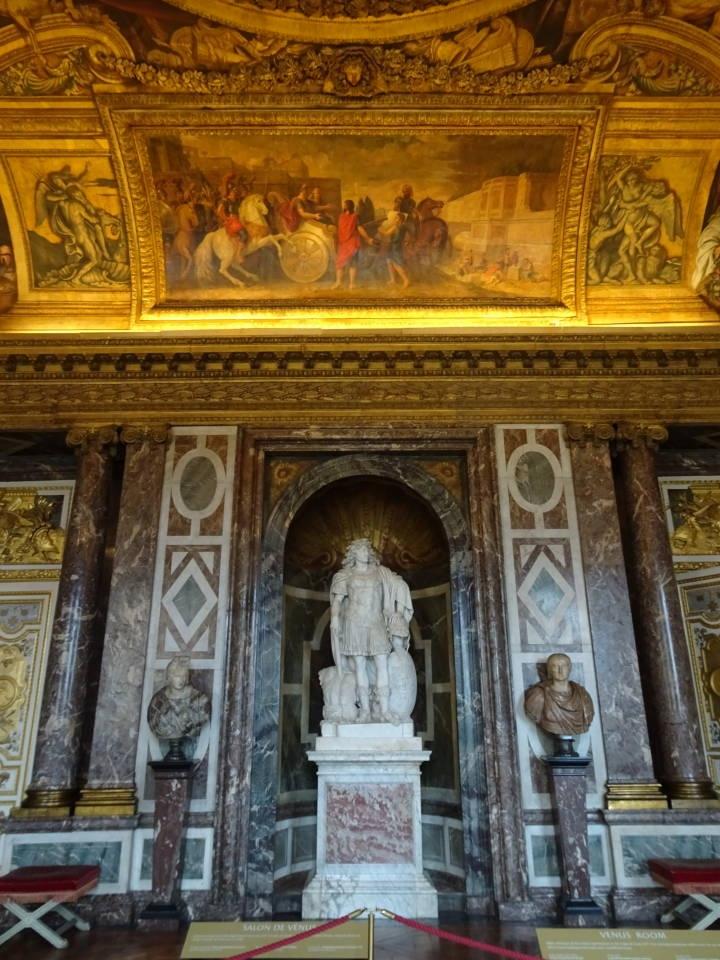
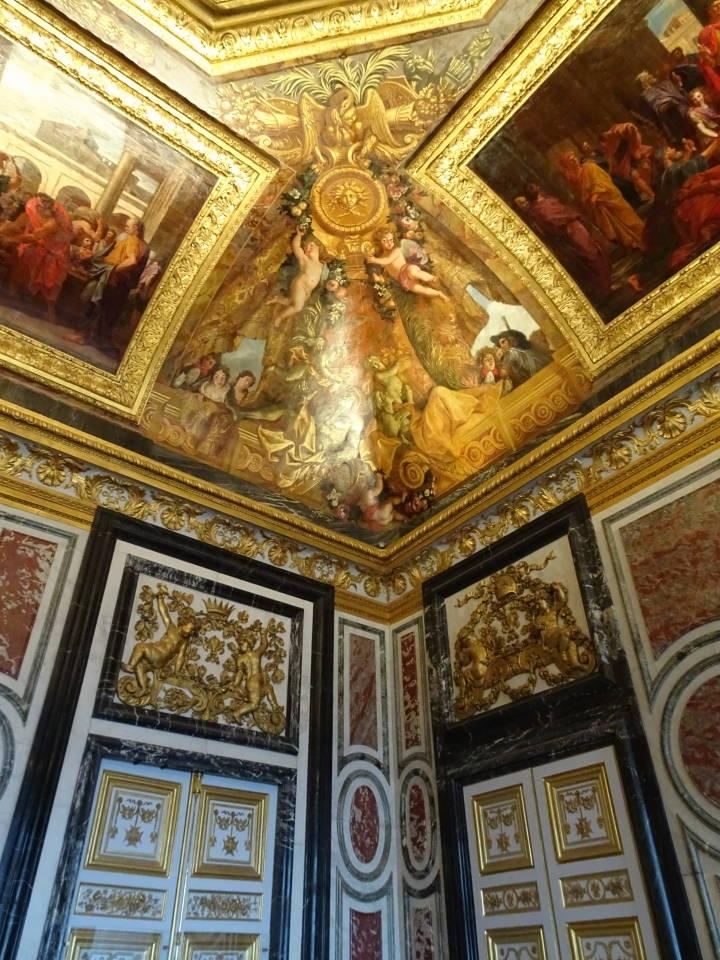
This salon, as well as Diana’s Salon, formed the main access to the Grand Apartment, since the grand staircase, known as the "Ambassadors’ Staircase" (destroyed in 1752) ended here. Like all the following rooms, this salon takes its name from a planet, the theme linked to the solar myth which inspired all the decor of Versailles in the 1670s. Here Venus is depicted on the ceiling with the features of the Goddess of Love who, in Greek Antiquity, was associated with this planet. -
ヴィーナスの部屋
Salon de Vénus
Venus Room
This room, as well as the Diana Room, constituted the main entrance to the King's State Apartment because it was at the top of the great staircase known as the “Ambassadors’ Staircase”, before it was destroyed in 1752. Like all the other rooms, this room was named after a planet, following a running theme linked to sun mythology which inspired the decoration in Versailles during the 1670s. In this room Venus is depicted on the ceiling as the goddess of love, associated with the planet in Ancient Greece. The paintings decorating the arches show great men or heroes from antiquity whose actions, inspired by the goddess, often alluded more or less obviously to the deeds of Louis XIV. For example, the arch depicting Alexander marrying Roxana evokes the king’s own wedding, while the arch illustrating Emperor Augustus watching Roman circus games refers to the carousel in 1662, held in honour of Queen Maria Theresa.
The decoration in the Venus room is the most Baroque of all the State Apartment. It is the only place where Le Brun created dialogue between the architecture, sculptures and paintings, which were sometimes real and sometimes fake, such as the marble pilasters and columns created through perspective paintings by Jacques Rousseau, and the two trompe-l’oeil statues of Louis XIV near the windows, by Jean Warin.
During Evening gatherings, this room contained tables covered with baskets of flowers, pyramids of rare fresh fruit such as oranges and lemons, and marzipan and candied fruits.(from official website) -
ヴィーナスの部屋
Salon de Vénus
Venus Room
壁の角から出てきているような表現。 -
ヴィーナスの部屋
Salon de Vénus
Venus Room -
ダイアナの部屋
Salon de Diane
Diana Room
In Ancient Greek mythology, Diana was the goddess of the hunt, the sister of Apollo, the sun god, and was also associated with the moon. The central section of the ceiling, painted by Gabriel Blanchard, depicts Diana watching over navigation and hunting scenes. The arches illustrate the same two themes, celebrating Louis XIV’s cynegetic taste (Cyrus hunting the wild boar by Audran; Alexander hunting the lion, by La Fosse) and making allusions to the royal navy, which was undergoing considerable expansion by Colbert at the time (Julius Cesar sending Roman settlers to Carthage by Audran; Jason and the Argonautes, by La Fosse). The painting by Charles de La Fosse over the fireplace depicts The Sacrifice of Iphigenia (showing last-minute intervention by Diana). Opposite, above the console, is Diana and Endymion by Gabriel Blanchard. The ancient busts are from collections belonging to Cardinal Mazarin which were bequeathed to Louis XIV.
Like the Venus Room, the Diana room served as a vestibule to the King's State Apartment. During Evening gatherings under Louis XIV it was used as a Billiards Room. Two tiers of seating were installed to allow people to watch the games at which the king, who was very skilled, often excelled. (from official website) -
ダイアナの部屋
Salon de Diane
Diana Room
狩猟の女神、ディアナ、英語読みでダイアナ。 -
マルスの部屋
Mars Room
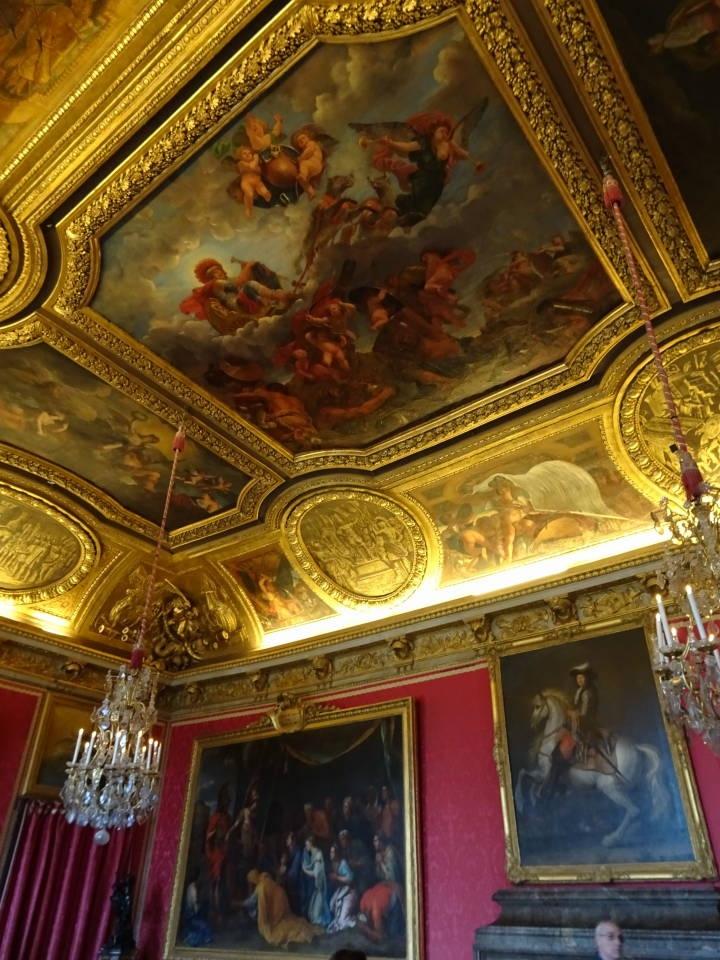
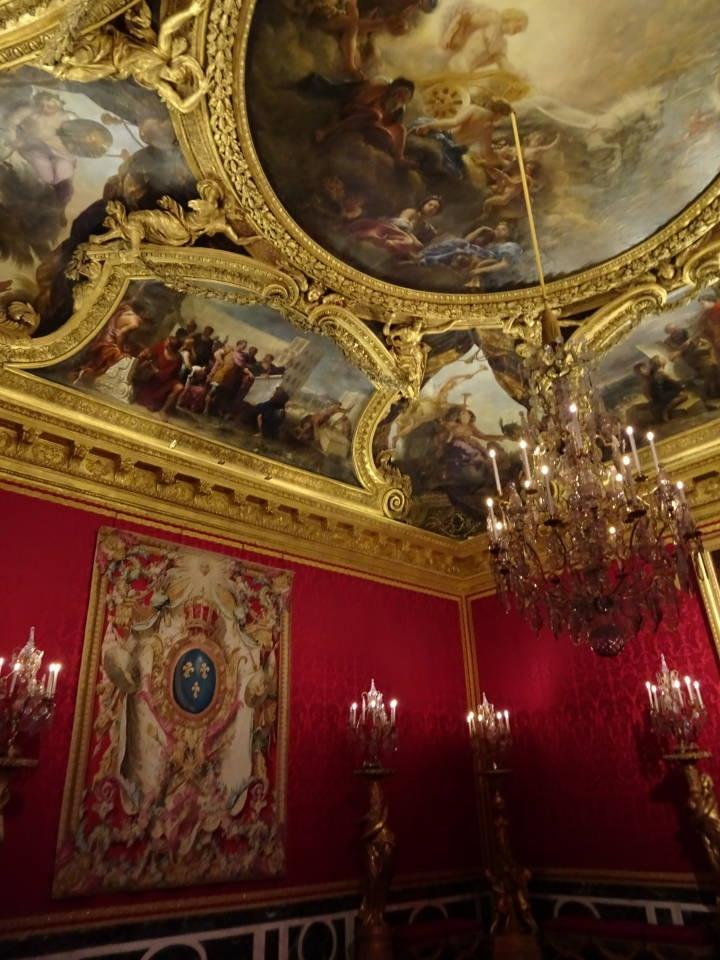
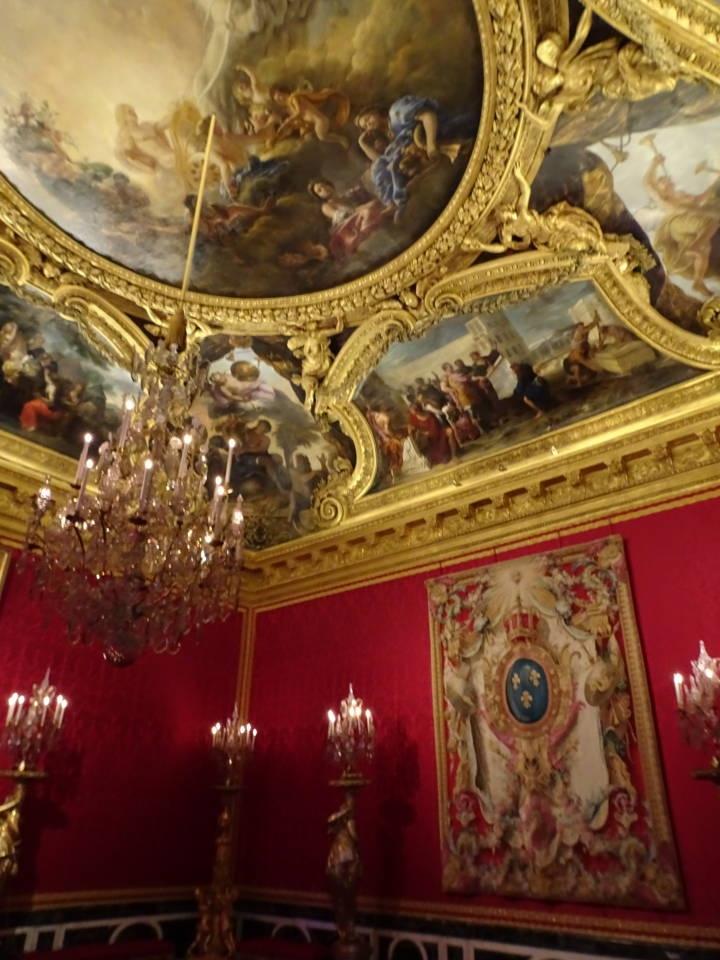
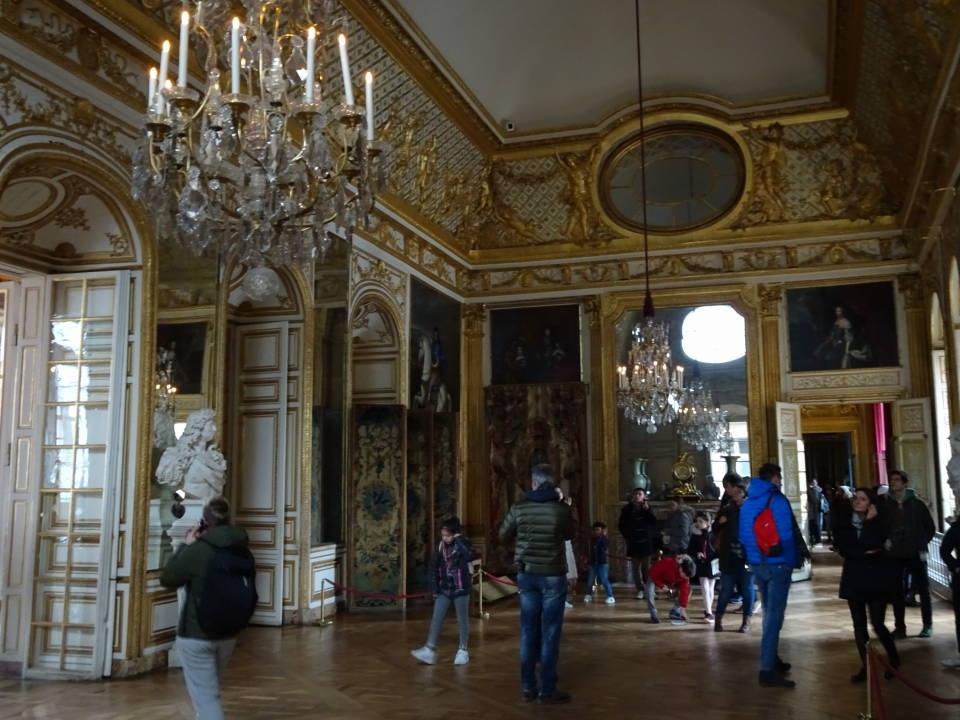
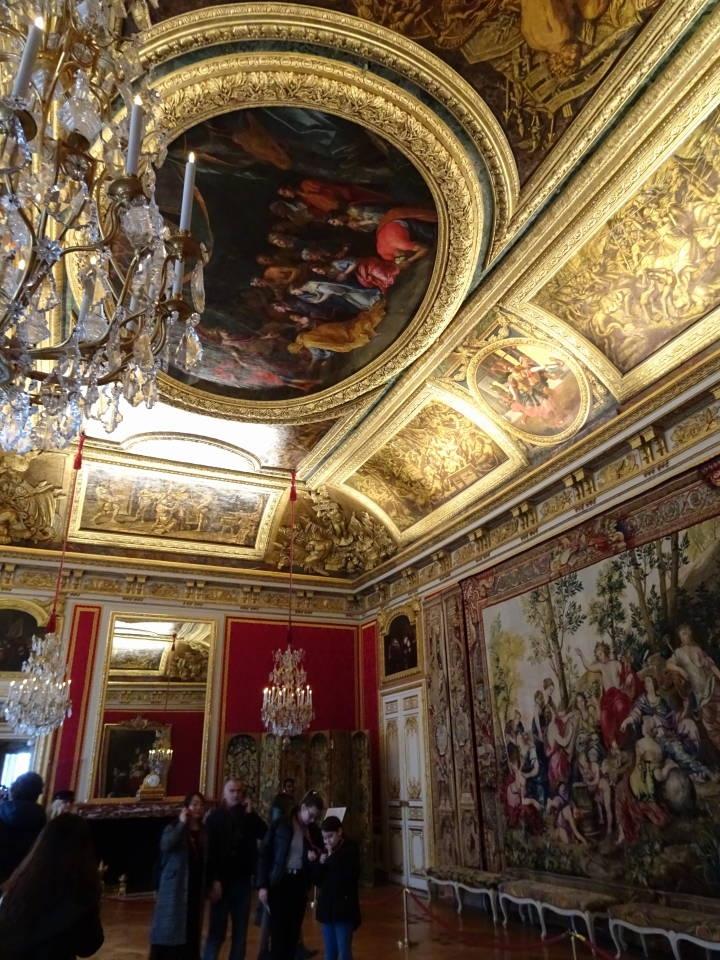
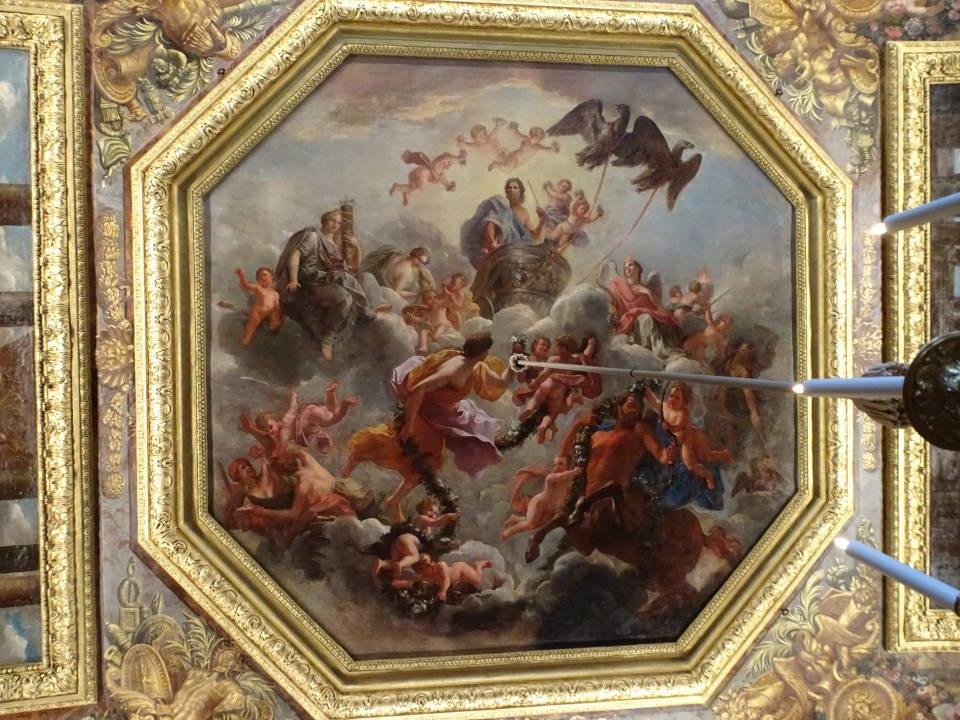
Mars is a planet but also the God of War. The choice of this military theme which inspired all the decoration of the salon can be explained by the fact that this large room was originally meant to serve as the guard room for the parade apartment. It was later reserved, at evening soirees, for music and dancing, so that it was commonly known as the "ballroom".
In the centre of the ceiling, Mars on a chariot drawn by wolves. The work is framed by two compositions; one, to the east: Victory supported by Hercules followed by Abundance and Felicity; the other, to the west: Terror, Fury and Fright taking over the powers of Earth. -
マルスの部屋
Mars Room
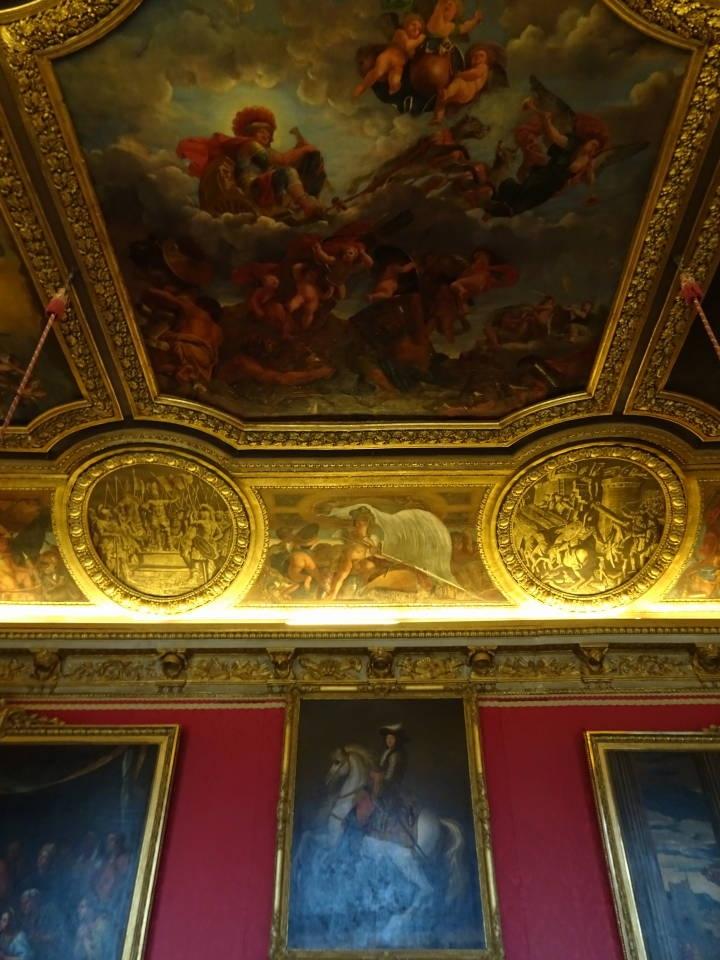
天井画。マルスのチャリオットはオオカミに引かれている。
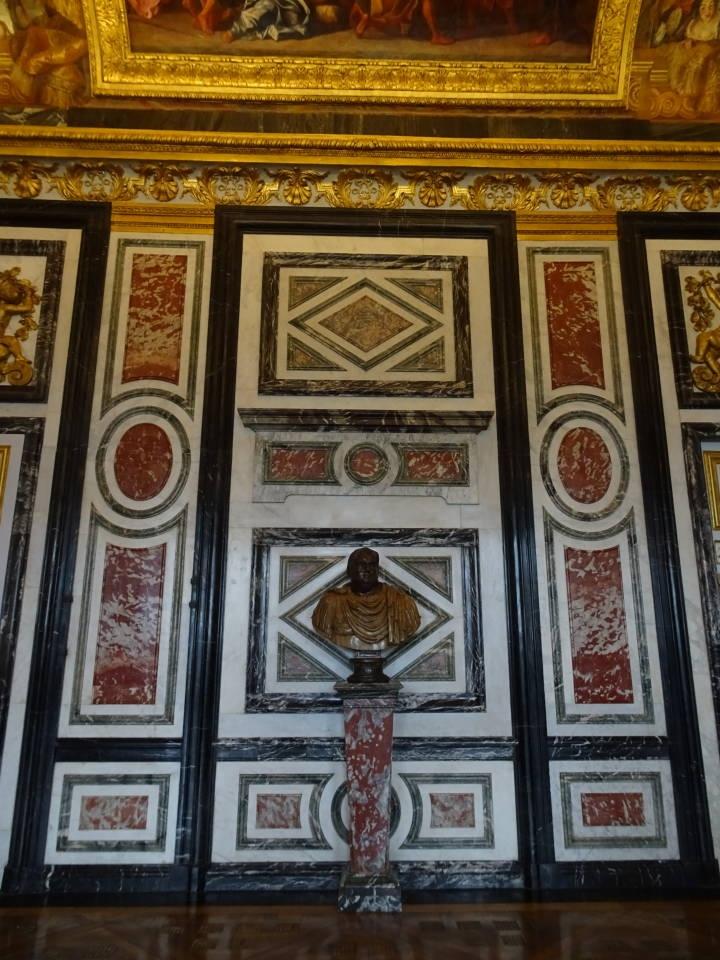
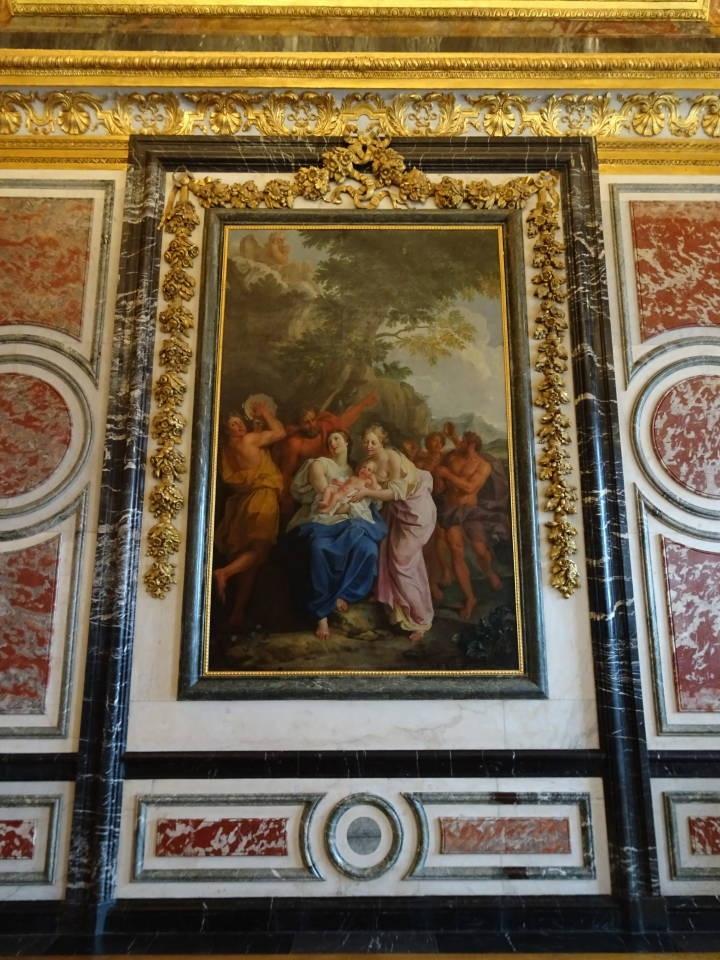
The Mars Room followed on from the two previous rooms and marked the start of the King’s Apartment. It was used as a Guard Room, making its dedication to the god of war highly appropriate. In the centre of the ceiling is a painting by Claude Audran of Mars on a chariot pulled by wolves. On either side of the work are two other compositions. The one to the east is by Jouvenet, called Victory supported by Hercules and followed by Abundance and Felicity. The other, to the west, is by Houasse and called Terror, Fury and Horror take possession of the powers of the earth. The arches have been decorated using gold camaieu and celebrate war victories by sovereigns from Antiquity, which naturally correspond to the military triumphs of the king, evoked in the gilded stucco spandrels by the Marsy brothers. Last but not least, the military character of the room is highlighted by the decoration on the cornice composed of a variety of helmets and military headgear.
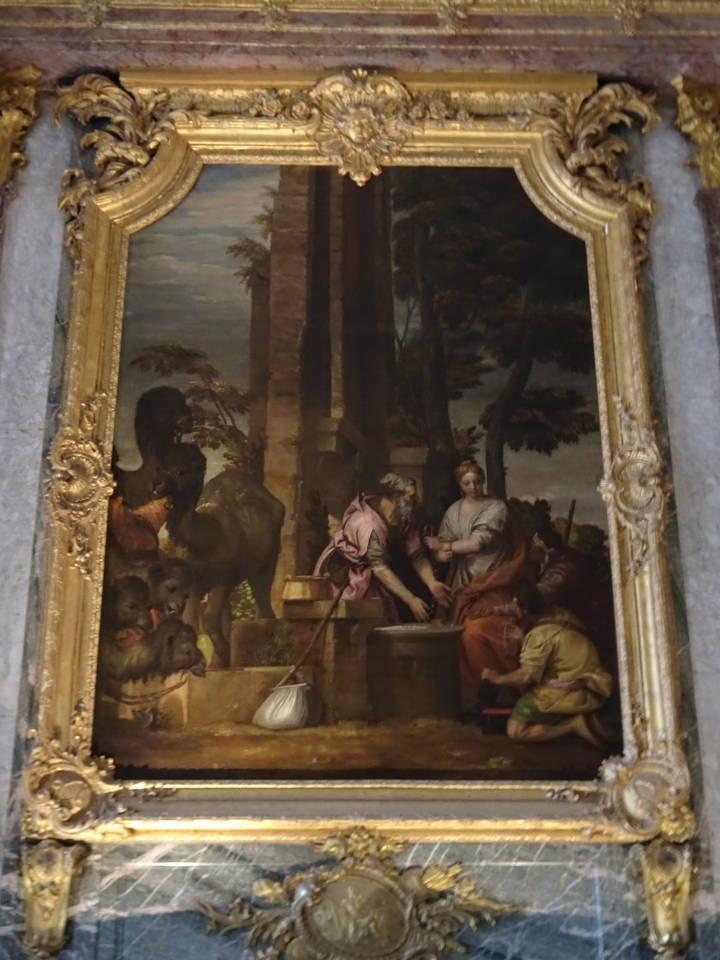
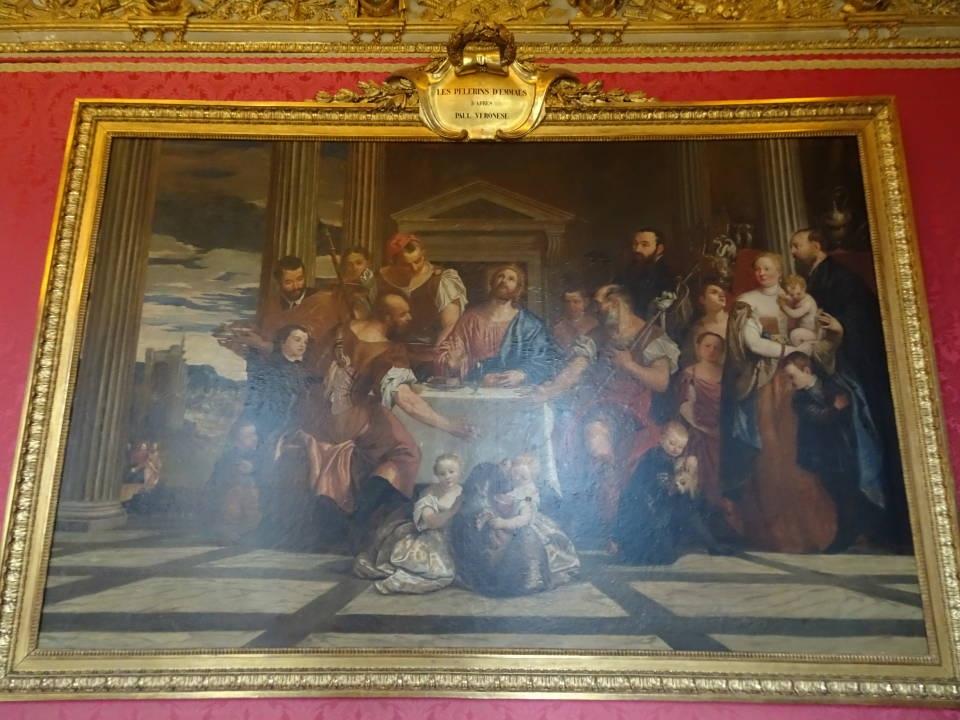
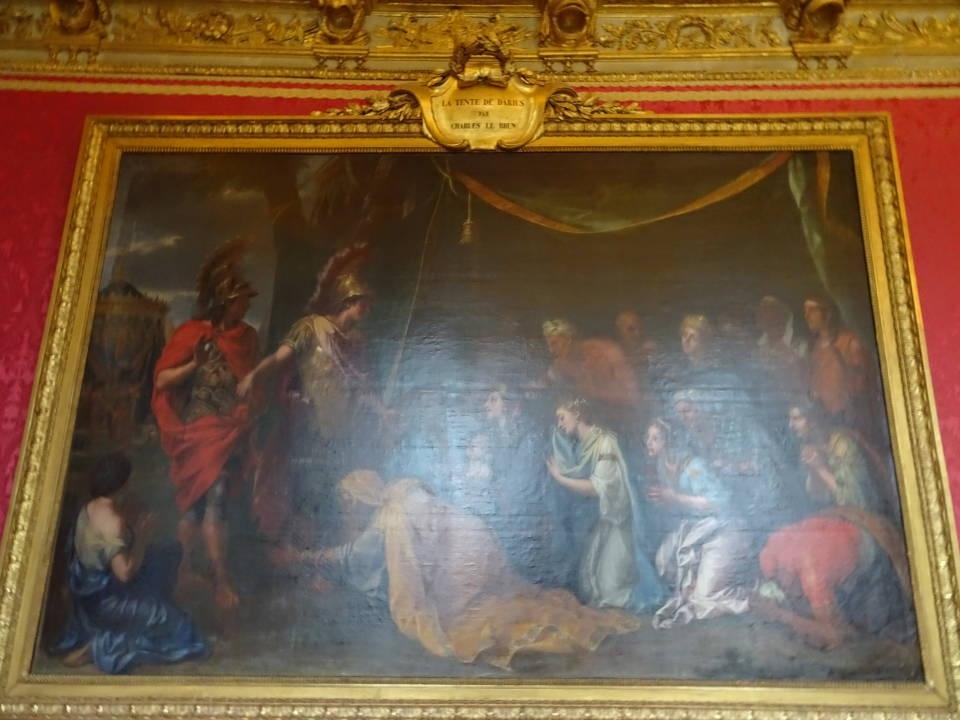
To the left of the chimney is The Family of Darius before Alexander by Charles Le Brun. To the right is The Pilgrims of Emmaus, in the style of Veronese. These two works were hung as a pair upon the king’s request, and demonstrate the desire to show that French painters could rival the greatest Italian masters. Until 1750 there were two platforms on either side of the fireplace, where the two paintings currently hang, which were for the musicians during Evening gatherings when the room was used for music and dancing.
On the side walls are two State portraits of Louis XV and Marie Leszczyńska, both painted by Carle Van Loo. Over the door are four paintings from Château de Saint-Germain-en-Laye by Simon Vouet, illustrating the royal virtues: Temperance, Prudence, Justice and Strength.(from official website) -
マルスの部屋
Mars Room
右側の絵。
「エマウス(エマオ)の巡礼者」 ヴェロネーゼ
聖書に書かれている「エマオの巡礼」の場面。
巡礼中の二人の弟子は男を夕食に招待した。男はパンを手に取り、祝福を与え、それを裂いて、彼らに渡したとき、二人は男がキリストだと気づく。
その瞬間、キリストは消え去った。二人は急いでエルサレムへ引き返し、キリストの復活を他の使徒たちに伝えた。
登場人物が多く描かれすぎていない? -
マルスの部屋
Mars Room
左側の絵「ダリウスのテント」 ル・ブラン(Charles Le Brun)
The Queens of Persia at the Feet of Alexander, also called The Tent of Darius
In this scene from the life of Alexander the Great(マケドニアのアレクサンダー大王), the Persian Queens lie prostrated at his feet soon after his victory at Issus in 333. Accompanied by his faithful Hephaestion(ヘファイスティオン), he visits the Queen of Persia holding her son Ochus in her arms. -
マルスの部屋
Mars Room -
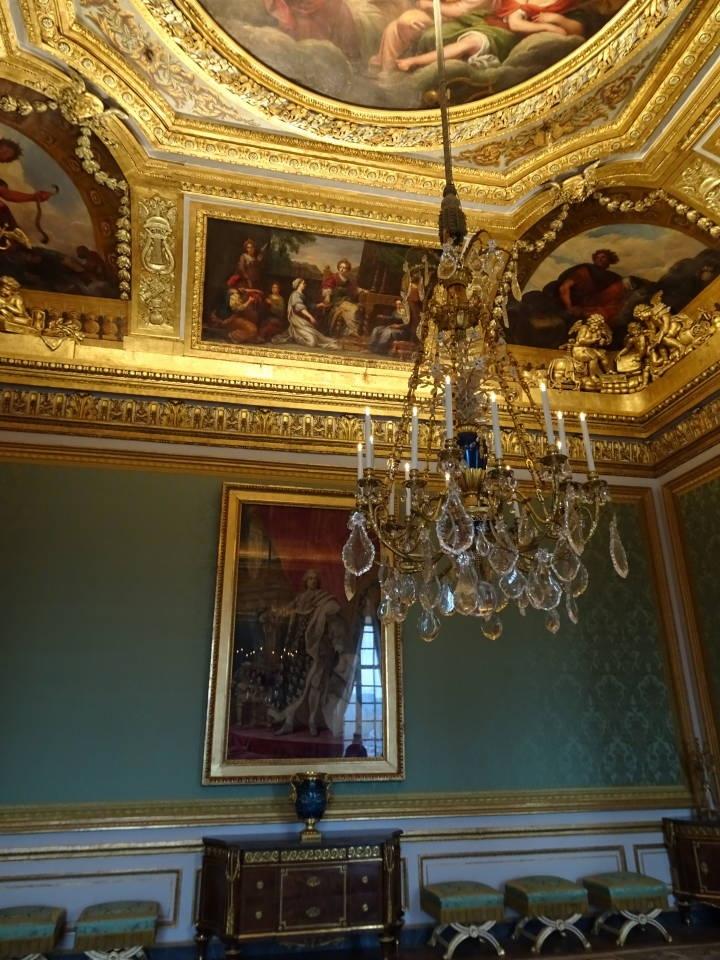
メルクリウスの間
Salon de Mercure
メルクリウス (Mercurius) はローマ神話のデイ・コンセンテス (Dei Consentes) の一人であり、商人や旅人の守護神である。英語読みでマーキュリー (Mercury) とも表記される。
ルイ14世が亡くなった際にこの広間に遺体が一週間安置されていた。 -
メルクリウスの間
Salon de Mercure
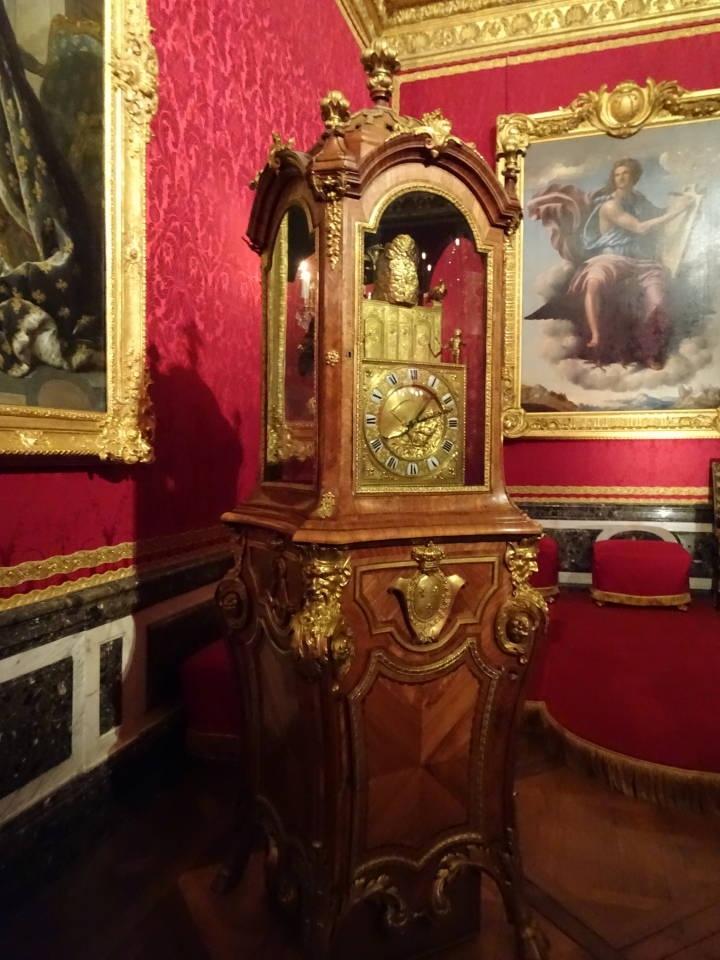
アントワーヌ・モランがルイ14世に贈ったカラクリ時計(1706年) -
メルクリウスの間
Salon de Mercure
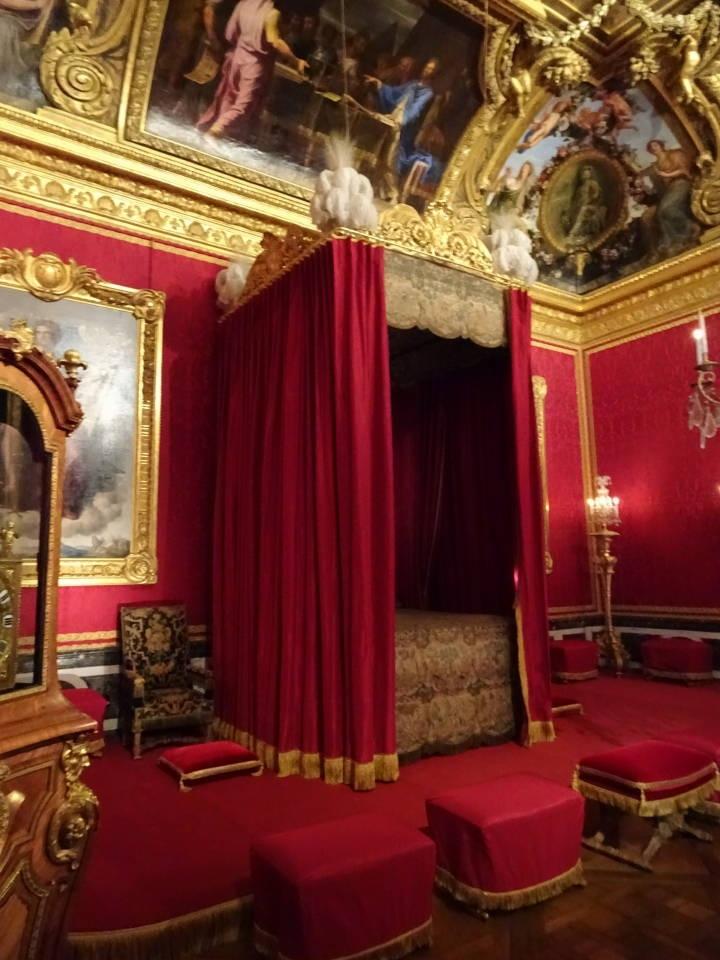
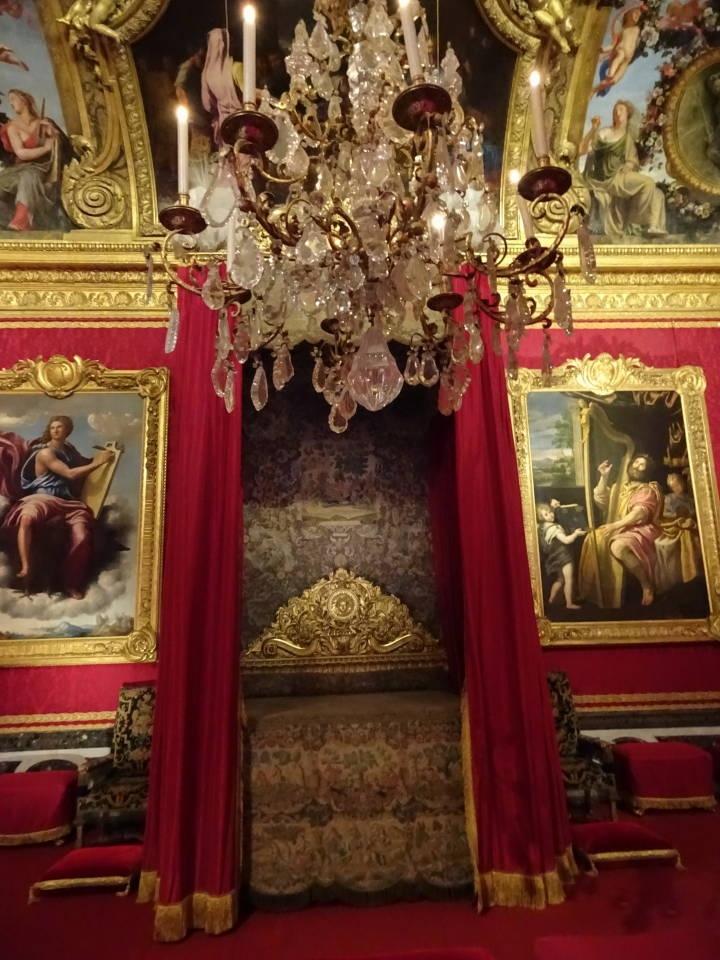
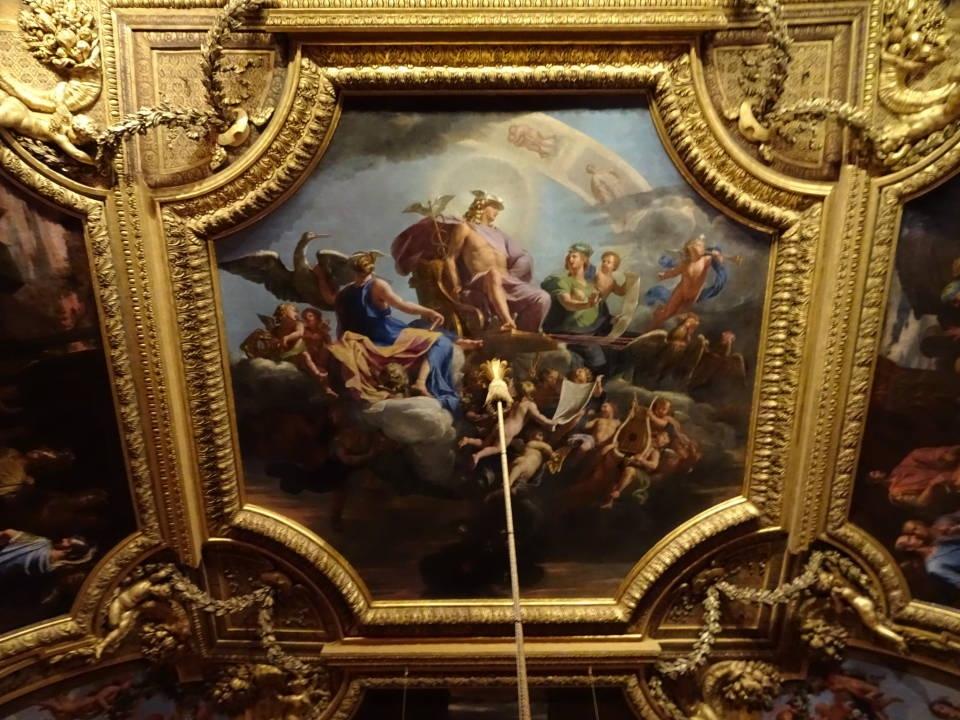
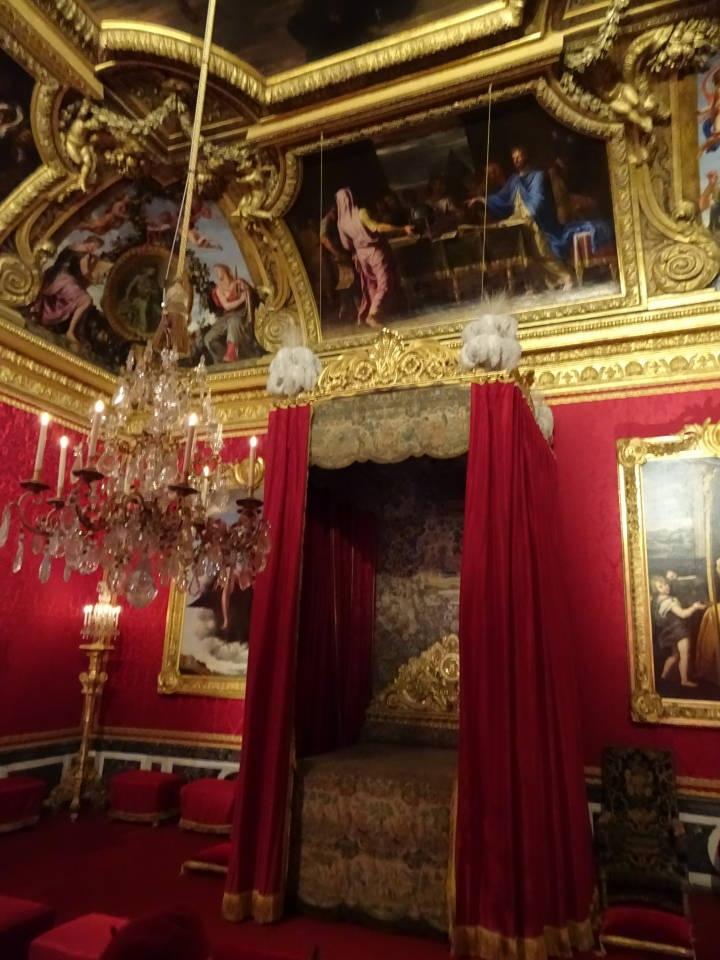
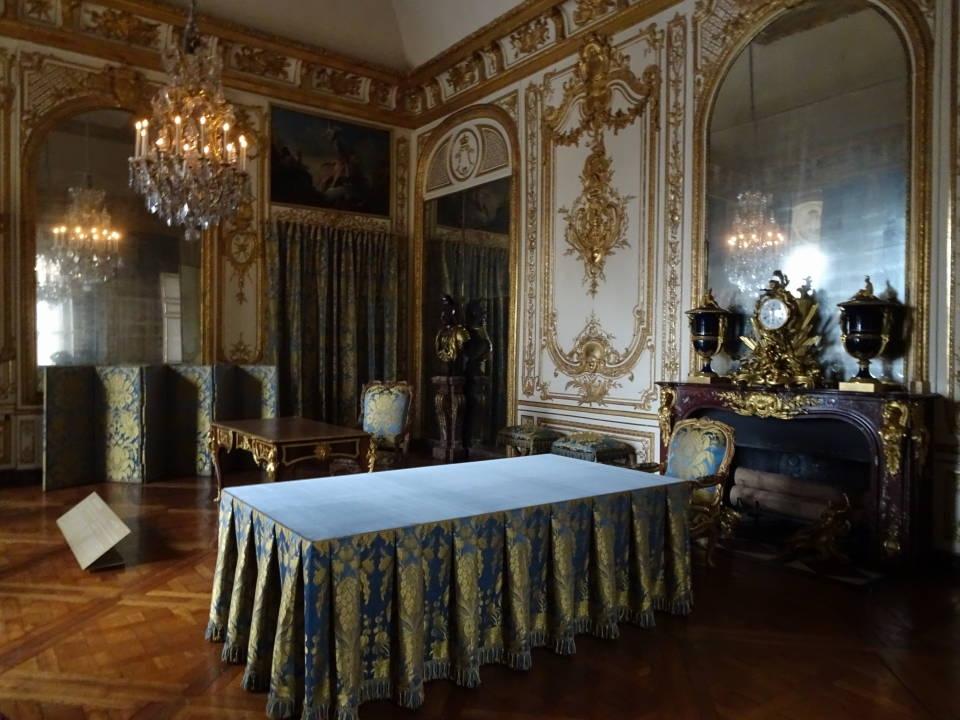
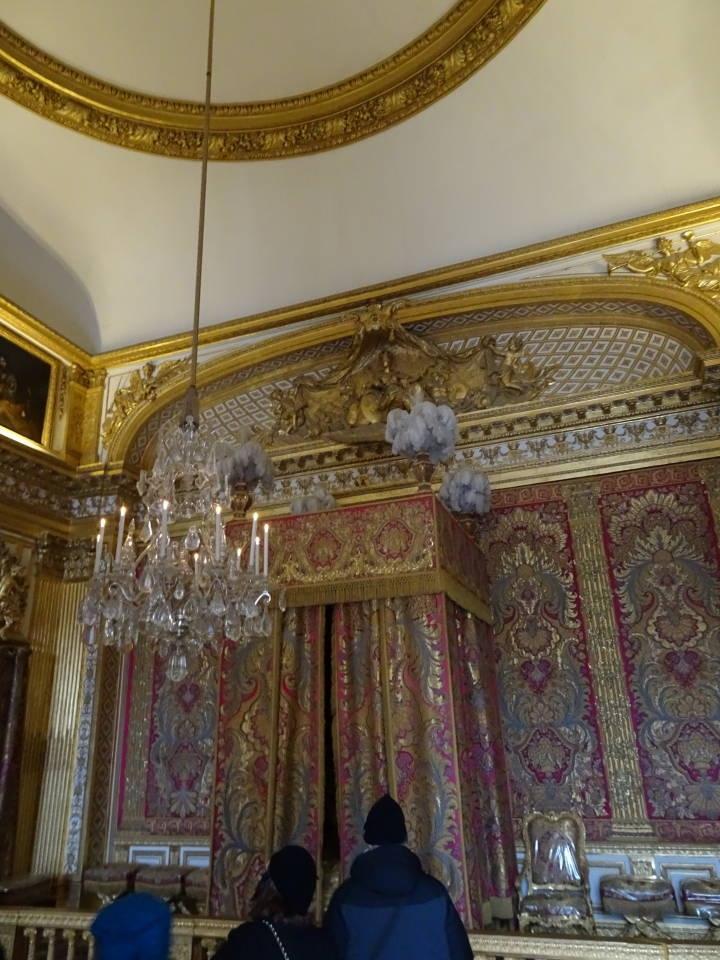
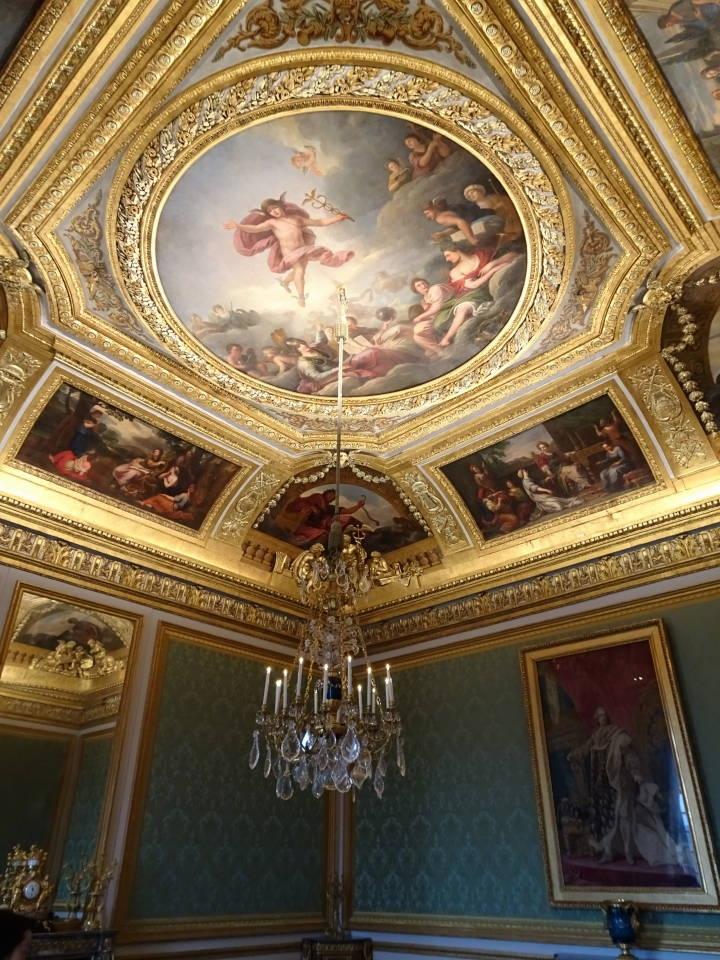
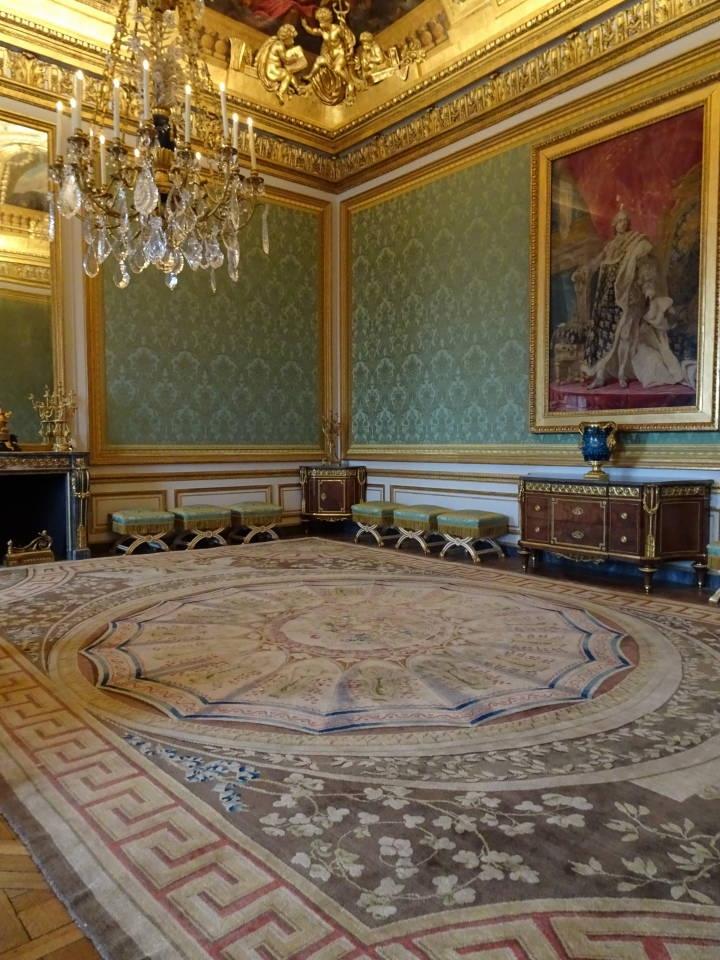
The Mercury Room was originally the royal bedchamber in the King's State Apartment and was referred to as the “bedroom”, although the bed was removed early on in winter to make room for games tables. Tables, mirrors, andirons and magnificently chased chandeliers made in solid silver by the Gobelins silversmiths once decorated the walls, ceilings and fireplace, until 1689 when Louis XIV had to melt them down to finance the War of the League of Augsburg. The alcove was separated from the rest of the room by a balustrade, also in silver. Brocades ? fabric made using gold and silver thread ? once hung from the walls and bed, but were later used in their turn to support the War of Spanish Succession. One of the rare moments in which the Mercury Room actually served as a bedchamber was when the Duke of Anjou, the grandson of Louis XIV, was proclaimed King of Spain, and slept here for three weeks before travelling to his kingdom. It was also in this room that the coffin containing the body of Louis XIV was displayed from 2 to 10 September 1715.
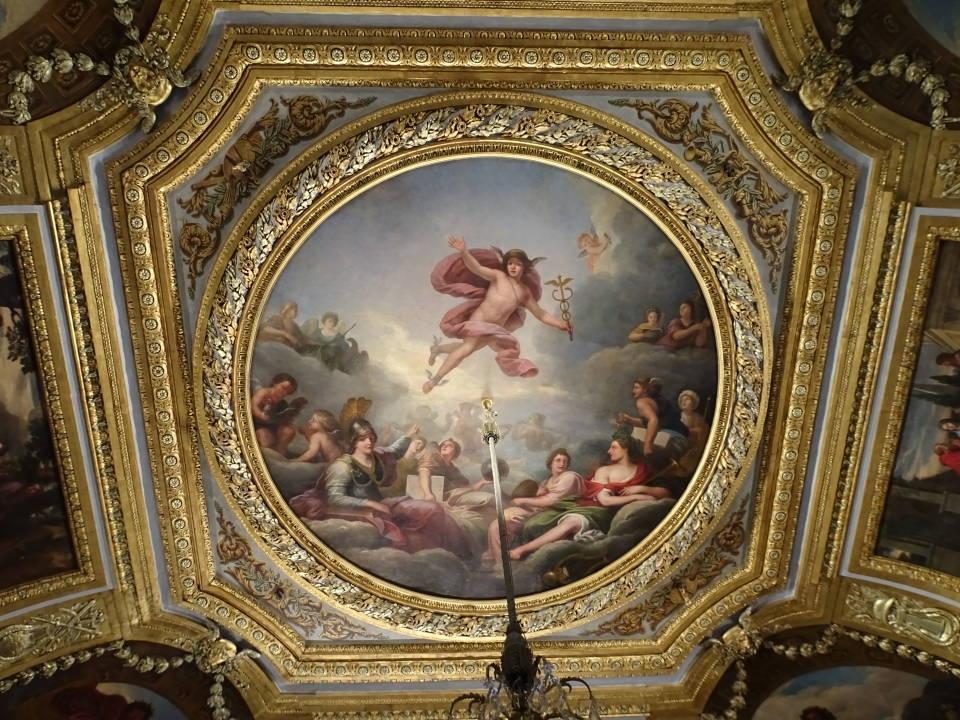
The ceiling was painted by Jean-Baptiste de Champaigne and depicts Mercury on his chariot pulled by two roosters. Mercury was the patron god of trade, arts and sciences and, as the gods’ messenger, of ambassadors. These themes are depicted in the arches in the ceiling: Alexander the Great bringing various foreign animals to Aristotle to allow him to write his Natural History; Augustus receiving Indian ambassadors; Alexander receiving Ethiopian ambassadors and Ptolemy Philadelphus talking with wise men in the library of Alexandria. These scenes evoke events from the reign of Louis XIV, such as the reception of ambassadors from far-off countries, development of the royal library, and publication of Histoire naturelle by Claude Perrault in the collection in the King’s Cabinet in 1671.
The bed currently in the room was brought here by Louis-Philippe while Versailles was being made over into a museum. On either side are two paintings that Louis XIV was particularly fond of, and which he hung in his bedroom: David playing the harp by Domenico Zampieri, and Saint John on Patmos, attributed at the time to Raphael.(from official website) -
メルクリウスの間
Salon de Mercure
「2羽のニワトリに引かれた戦車にのるメリクリウス」シャンペーニュ作
天井には戦車に乗る知識の神メルクリウス。馬車をひいているのはよく見るとニワトリ(この写真ではわかりづらいけど)。ニワトリは、フランスを象徴する動物で、サッカーやラグビーの代表ユニフォームに雄鶏のエンブレムが付けられている。フランス人の祖先ガリア人と雄鶏のGallusガリアがラテン語で同じ発音であることかららしい。 -
メルクリウスの間
Salon de Mercure
ちなみにこの部屋だけはグーグルのストリートビューではモザイクがかかってみることができない。マルスの間の隣は、アポロの間になっている。 -
アポロの部屋
Salon d'Apollon
Apollo Room
Designed as the sovereign’s Ceremonial Room, the Apollo Room was used as a throne room from 1682 onwards. The celling was dedicated to the Sun King, the arts and peace. The symbol of the sun, adopted early on by Louis XIV, is illustrated through the image of Apollo on his chariot surrounded by allegorical figures. The arches illustrate the king’s magnificence and magnanimity though various examples from Antiquity: Vespasien building the Colosseum; Augustus building the port of Miseno, Porus before Alexander and Coriolan entreated by his wife and mother to spare Rome.
Until 1689 Louis XIV’s famous silver throne (a huge wooden armchair 2.6m tall and covered with silver plaques and sculptures) once stood here on a platform beneath a baldaquin. This extraordinary throne was melted down and replaced by a succession of gilded chairs in styles that varied according to the period.
Over the fireplace is the most famous portrait of Louis XIV, by Hyacinthe Rigaud. The painter made the original portrait in 1701 upon a personal request by the king, who wanted to give it to his grandson who had recently become king of Spain. Exceedingly pleased with the result, Louis XIV decided to keep the original for himself and commissioned copies from the artist. The copy in Versailles was made in 1702. The original painting hangs in the Musée du Louvre.(from official website) -
アポロの部屋
Salon d'Apollon
Apollo Room
フランス国王、ルイ14世(1638~1715年)
イアサント・リゴー(Hyacinthe Rigaud) 1702年
よく見る絵です。 -
アポロの部屋
Salon d'Apollon
Apollo Room -
アポロの部屋
Salon d'Apollon
Apollo Room -
戦争の間
Le salon de la Guerre
The War Room
角部屋まで来ました。次はどうやら、鏡の間。 -
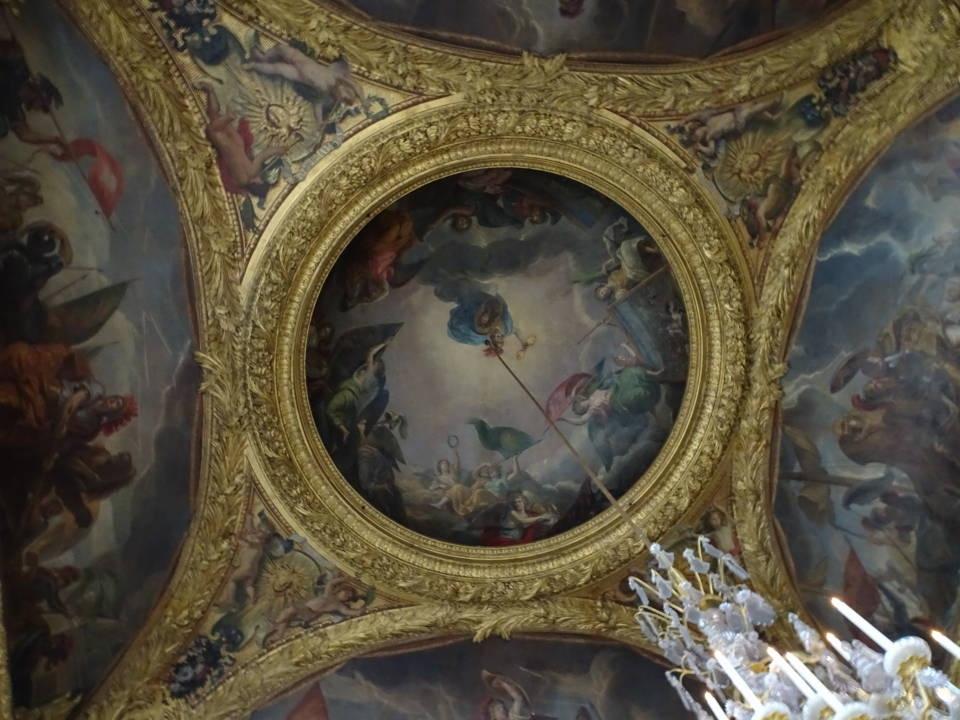
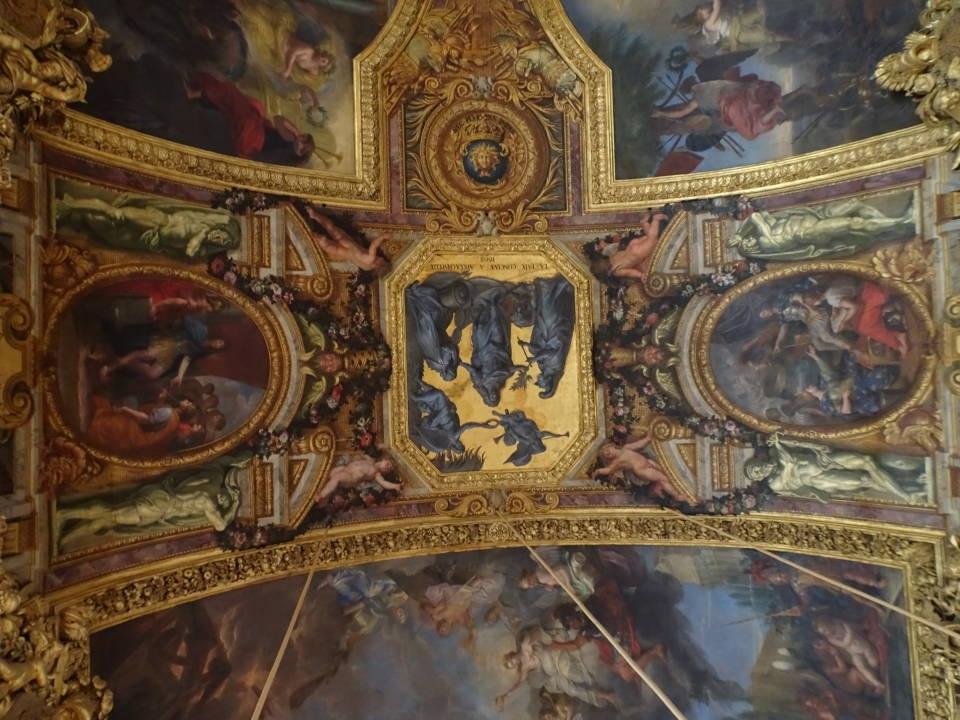
戦争の間
Le salon de la Guerre
The War Room
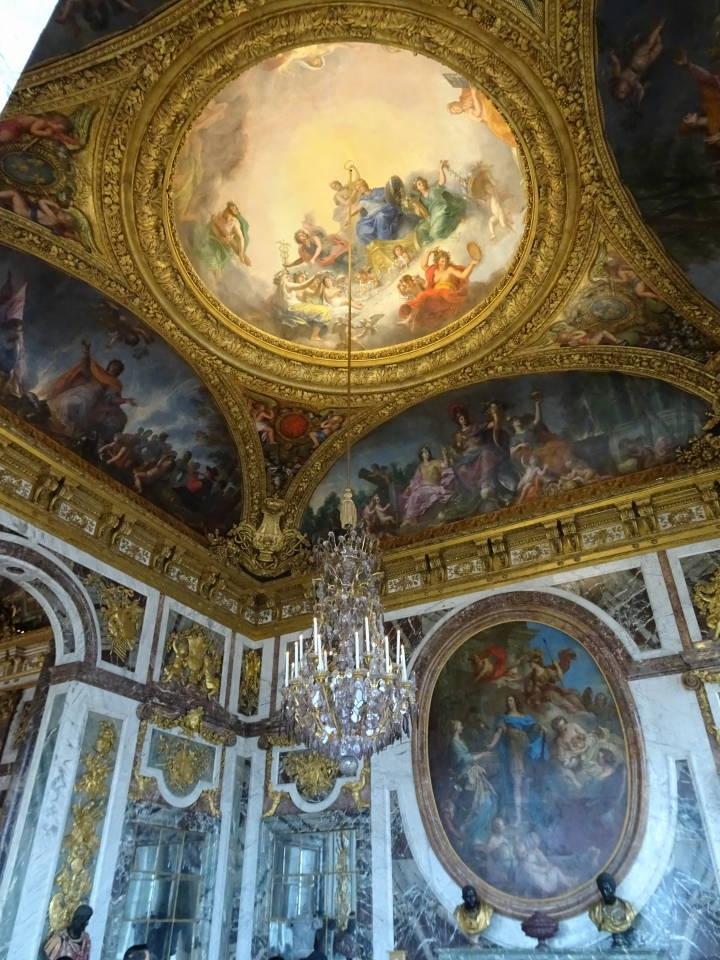
天井画。わかりにくいけど、シャンデリアが垂れ下がっている中央には擬人化されたフランスの女神がいて、彼女のもつ盾にはルイ14世が描かれている。
La France foudroyant ses ennemis
https://galeriedesglaces-versailles.fr/html/11/collection/guerre.html
https://galeriedesglaces-versailles.fr/html/11/collection/c37.html -
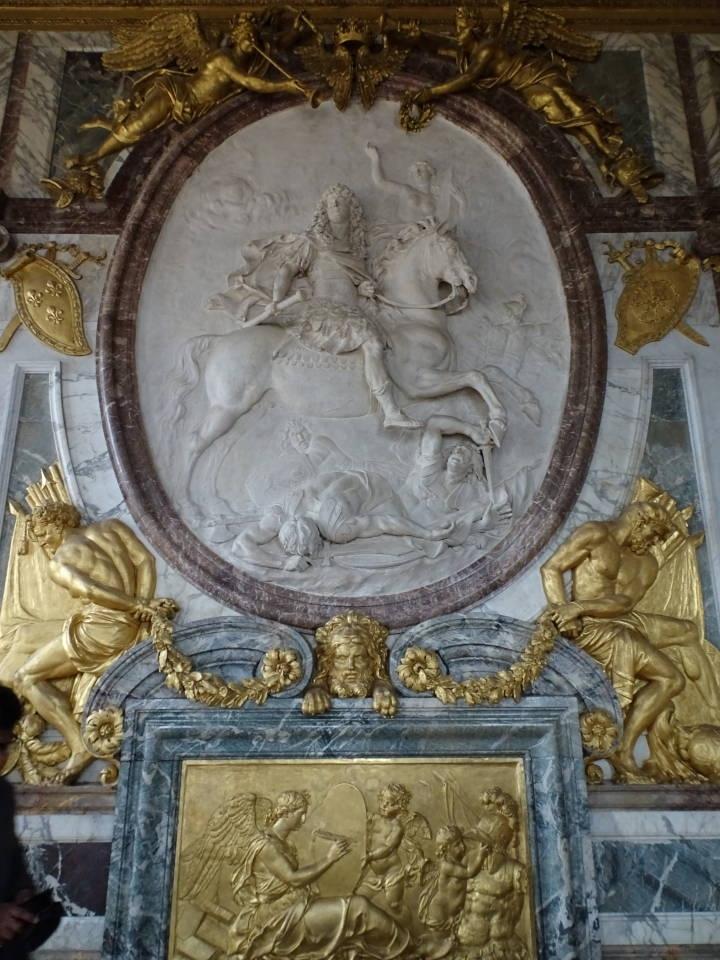
戦争の間
Le salon de la Guerre
The War Room
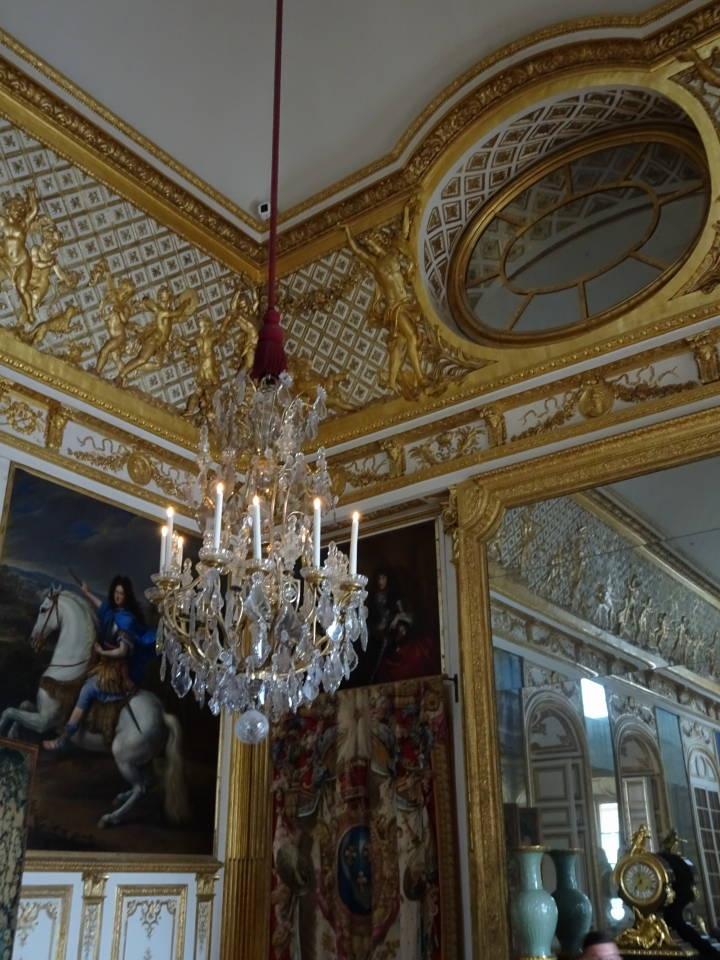
Hardouin Mansart started building the War Room in 1678. The decoration, completed by Le Brun in 1686, pays tribute to the military victories which led to the peace treaties of Nijmegen(ナイメーヘン和約). The walls are covered with marble panels decorated with six trophies and weapons in gilded bronze. The wall adjacent to the Apollo Room bears an oval stucco bas-relief depicting Louis XIV on horseback trampling his enemies. At the top of this masterpiece by Coysevox are two sculptures of Pheme, and two captives in chains huddle beneath it. Below, in the bas-relief in the fake fireplace, Clio, the muse of history, is recording the king’s great deeds for posterity. In the centre of the cupola ceiling is a personified depiction of France, armed and sitting on a cloud and surrounded by Victories. Her shield is decorated with a portrait of Louis XIV. Her three defeated enemies are depicted in the arches: Germany kneeling down with an eagle; Spain making threats with a roaring lion; Holland overturned on another lion. The fourth arch depicts Bellona, the goddess of war, in a rage of fury between Rebellion and Contention.
(from Official website) -
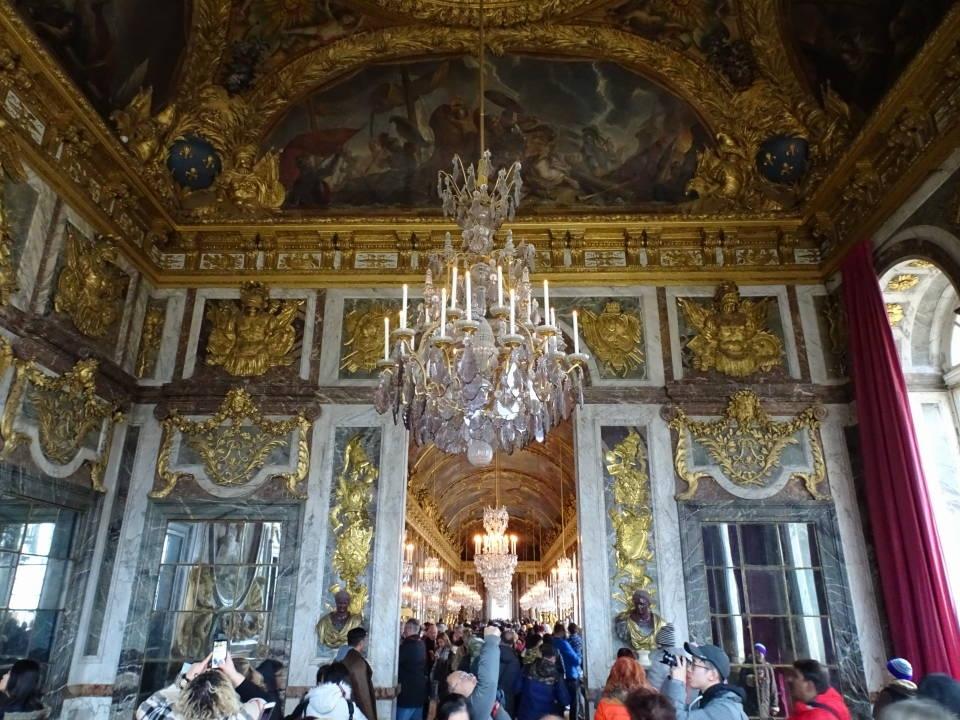
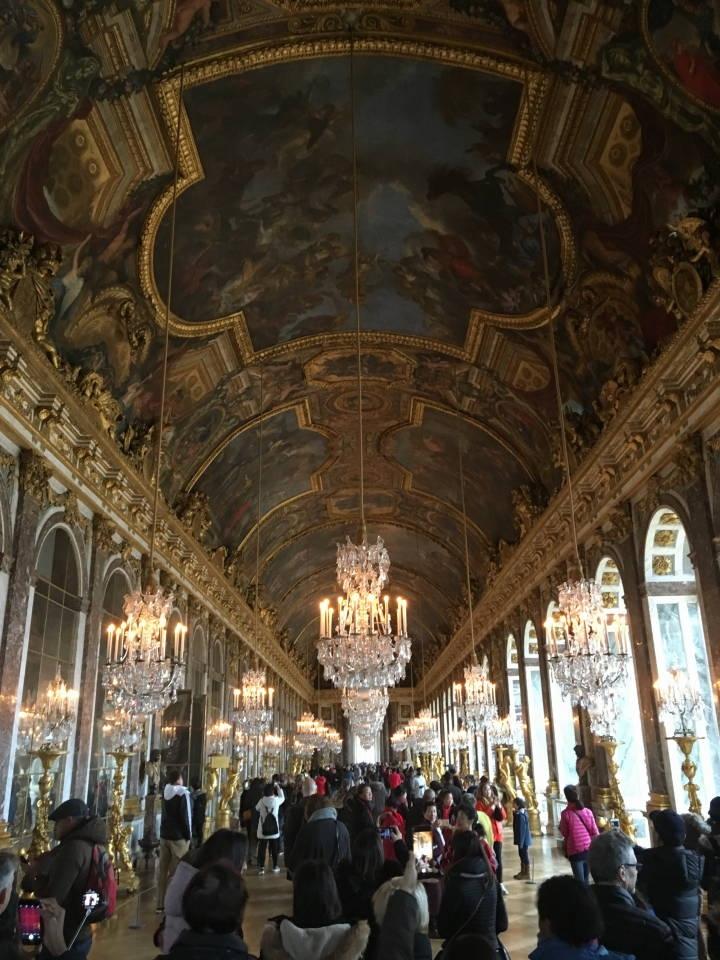
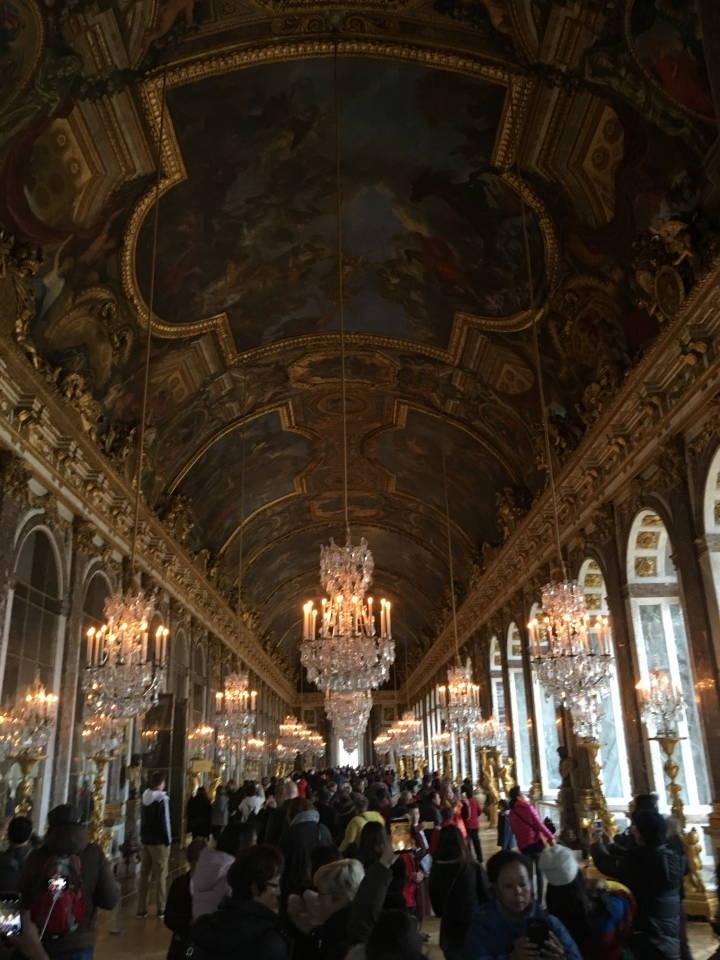
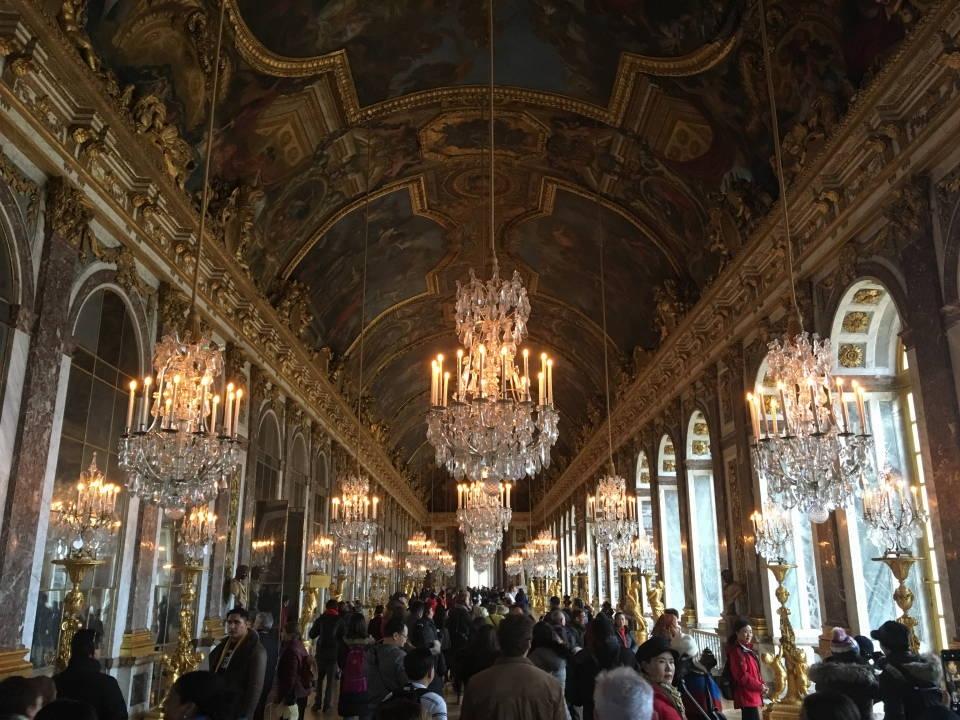
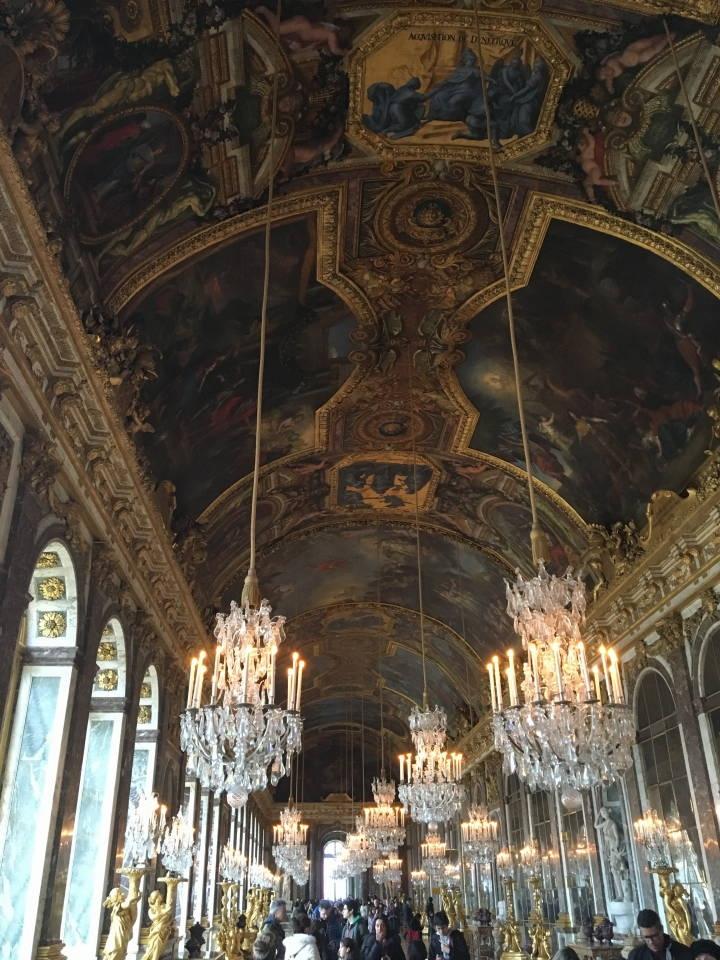
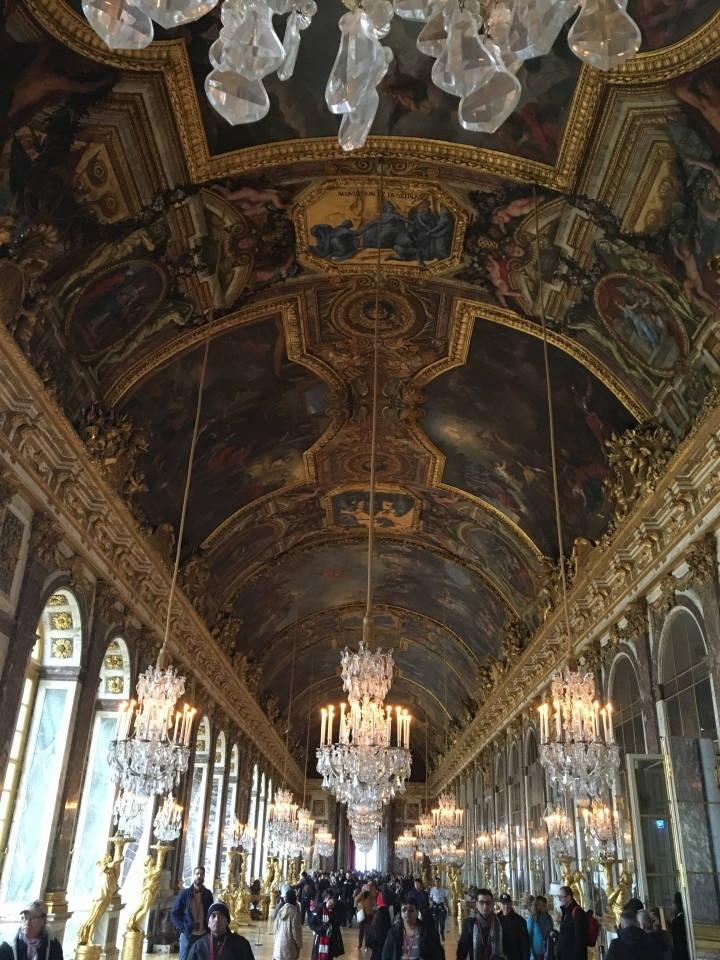
鏡の間
La galerie des Glaces
the Hall of Mirrors -
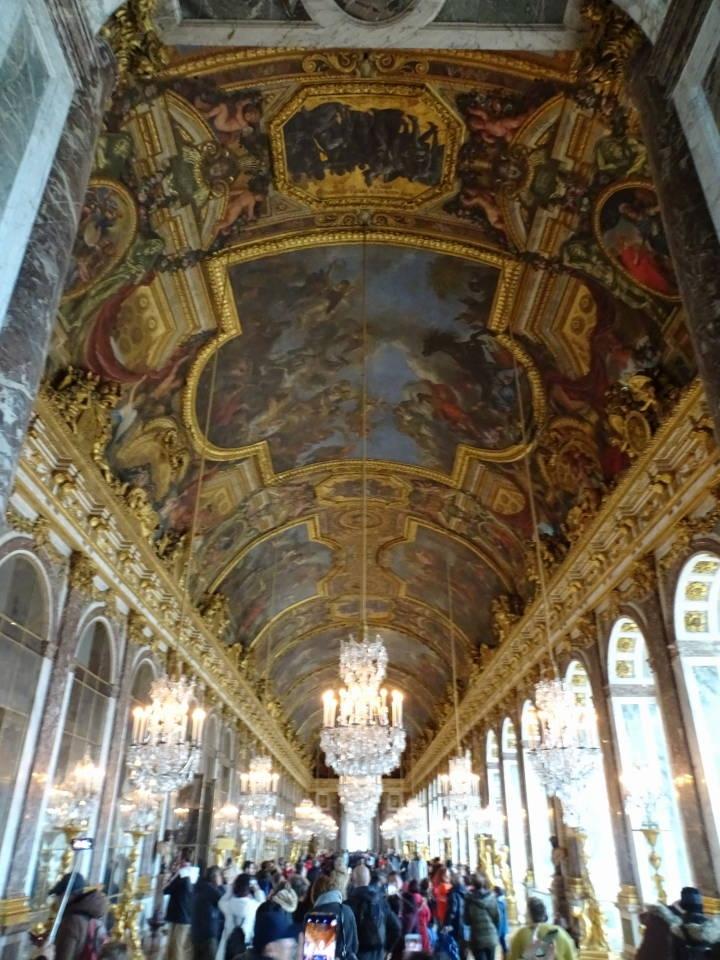
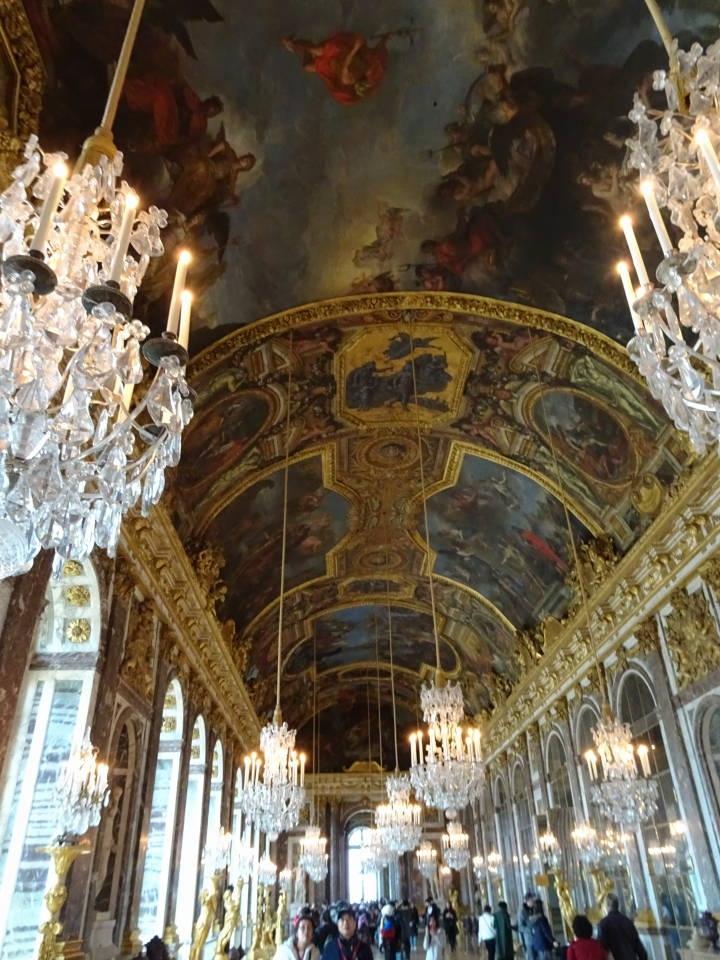
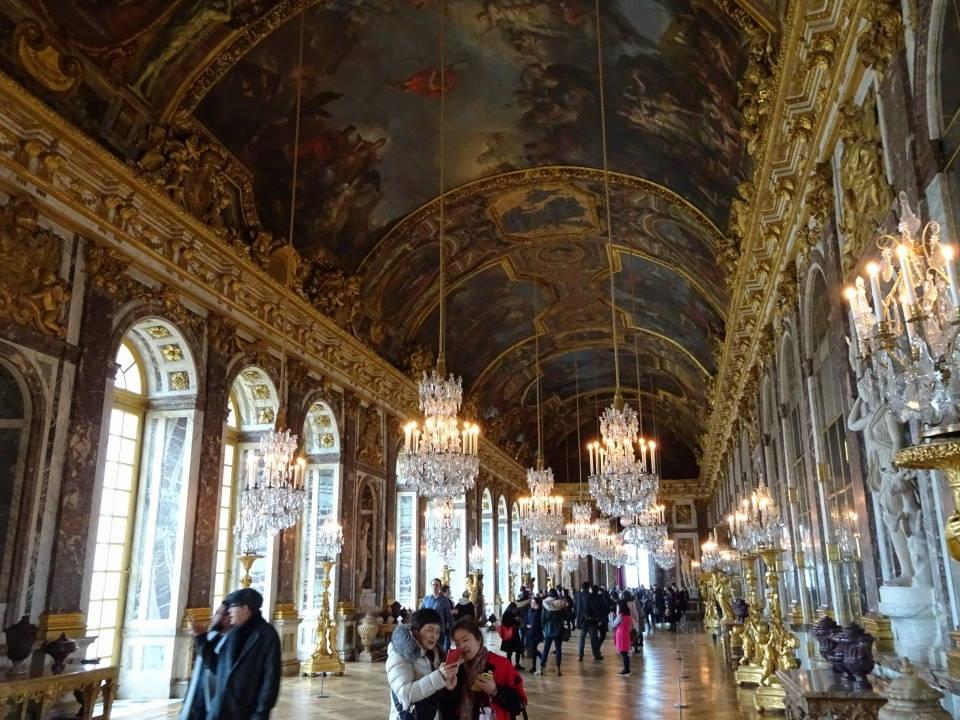
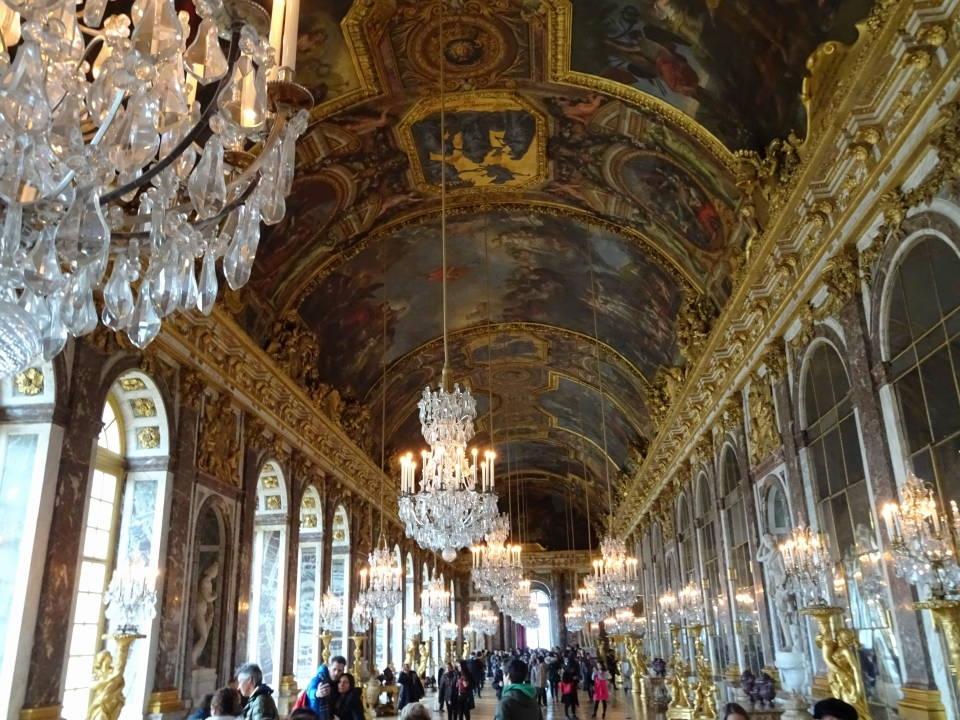
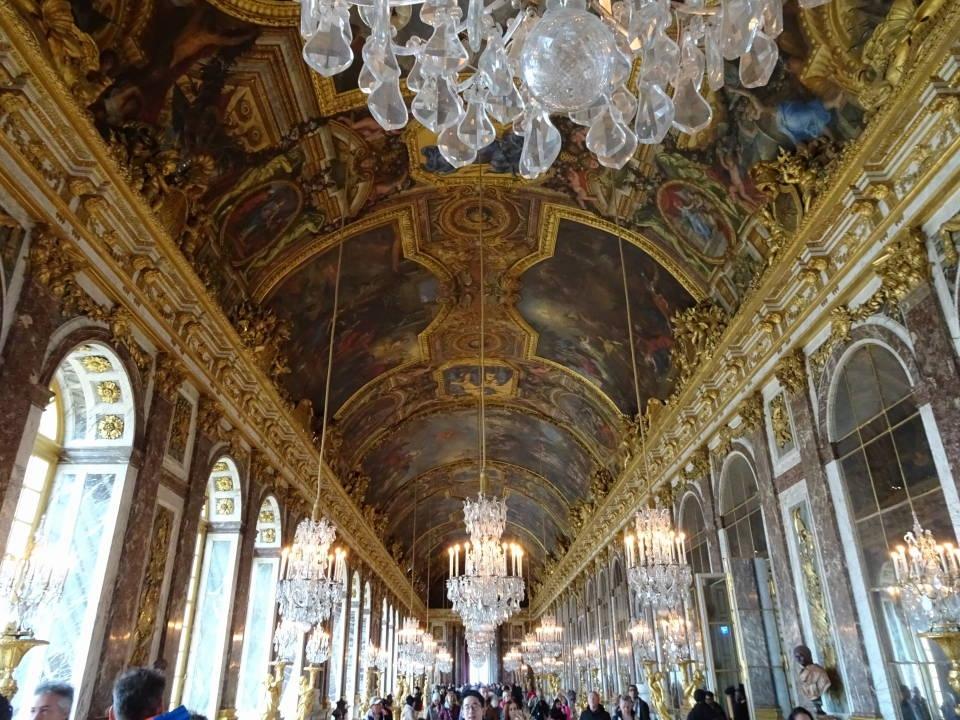
鏡の間
La galerie des Glaces
the Hall of Mirrors
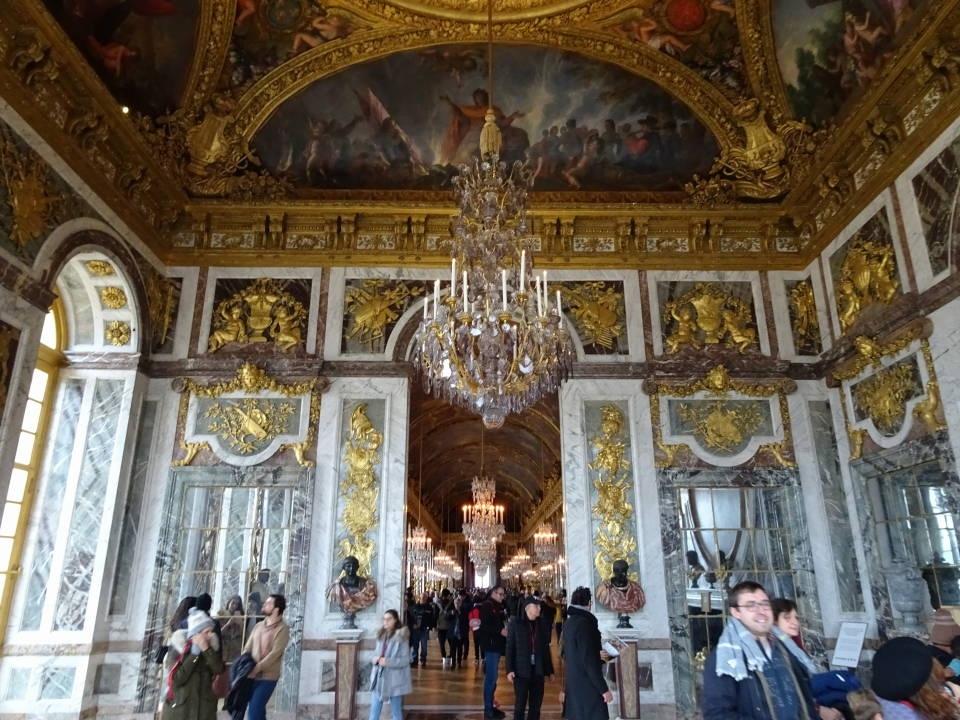
儀式や外国の賓客を謁見するために使われた鏡の間は、1871年にドイツ皇帝ヴィルヘルム1世の即位式が行われ、また第一次世界大戦後の対ドイツとの講和条約であるヴェルサイユ条約が調印された場所でもある。鏡の間にはたくさんの銀製品が飾られていたというが、ルイ14世は晩年になって、スペインとの王位継承争いが続いて戦費の捻出に困り、破産を免れるためにこれらを売って戦費に充てたという。(wikiより) -
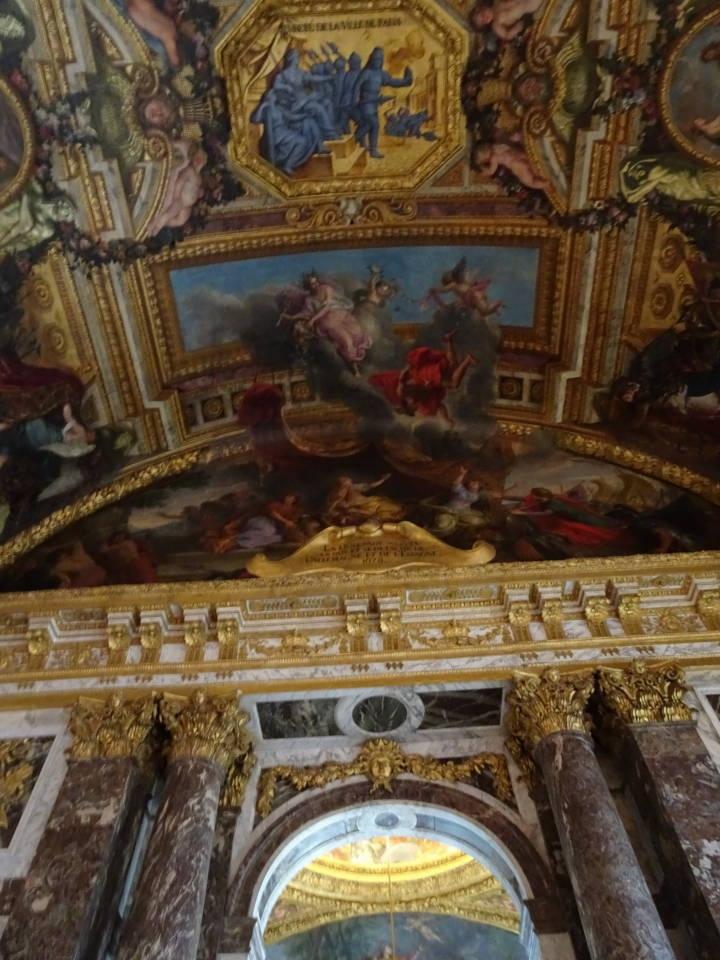
鏡の間
La galerie des Glaces
the Hall of Mirrors
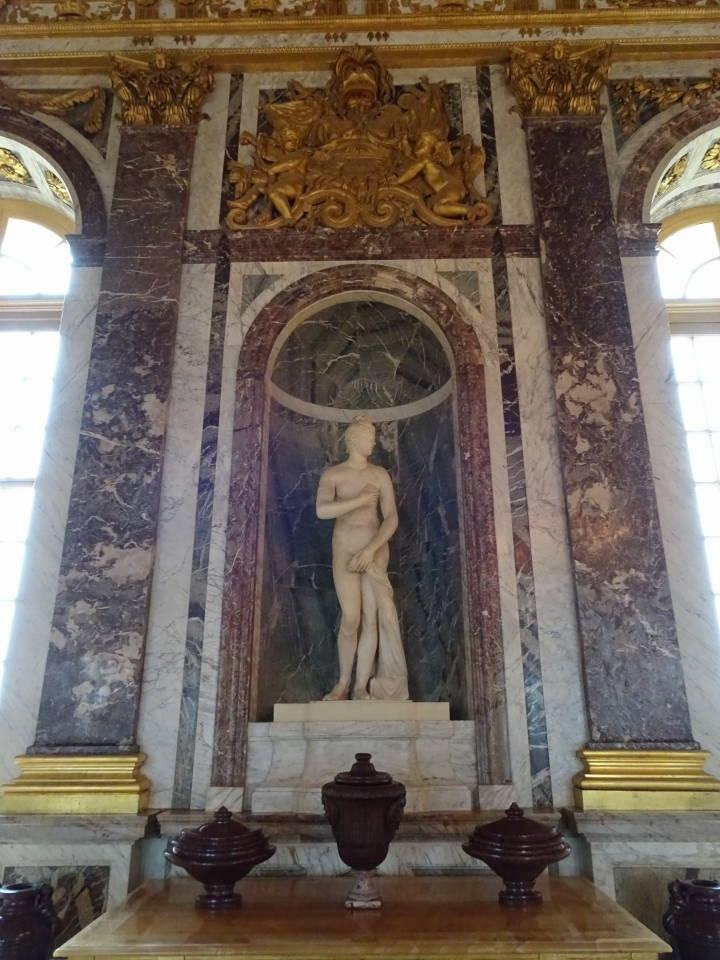
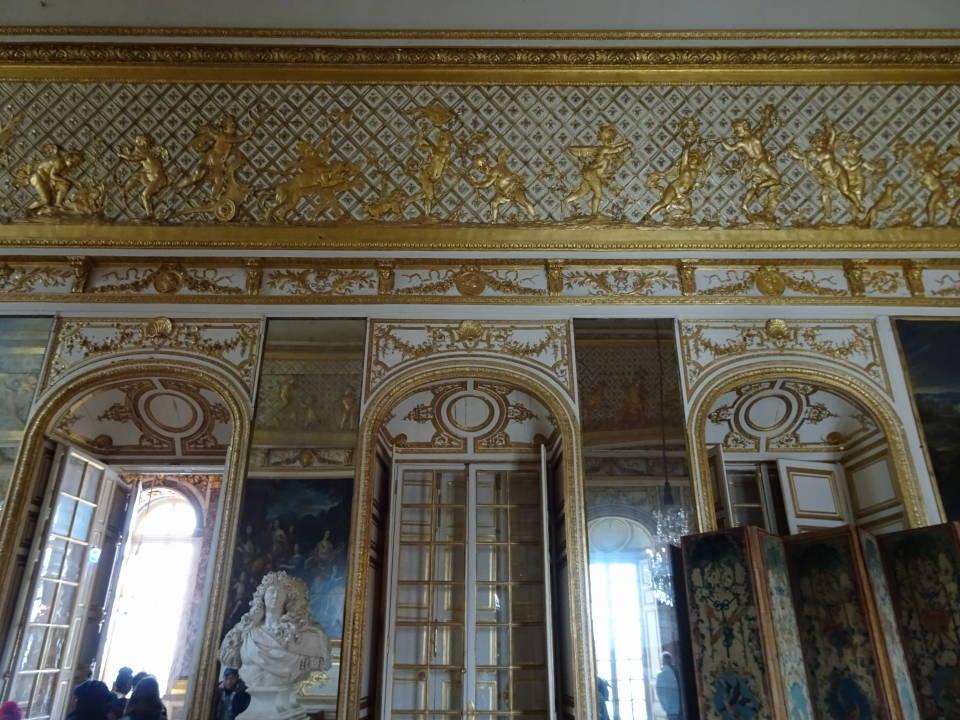
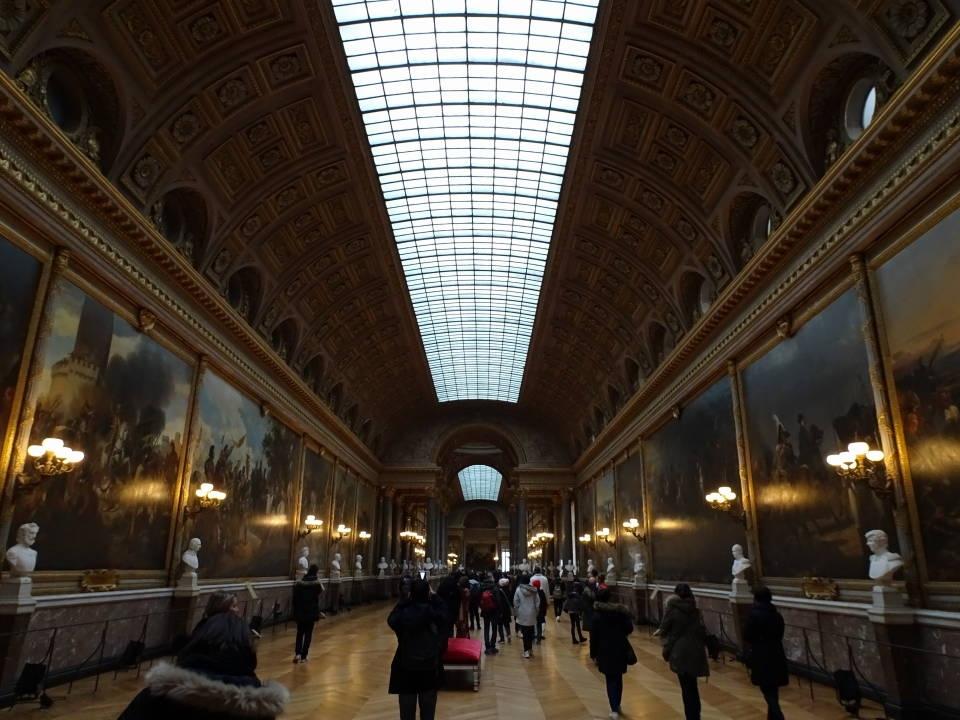
Following on from the victory over the three united powers, depicted in the War Room, the whole length of the Hall of Mirrors (73m) pays tribute to the political, economic and artistic success of France. Political successes are illustrated through the 30 painted compositions on the vaulted ceiling by Le Brun, which depict the glorious history of Louis XIV during the first 18 years of his reign, from 1661 to the peace treaties of Nijmegen. Military and diplomatic victories and reforms with a view to reorganising the kingdom are illustrated through allegories from Antiquity. Economic prosperity is revealed in the number and size of the 357 mirrors bedecking the 17 arches opposite the windows, demonstrating that the new French manufacture could rival the Venetian monopoly on mirror manufacturing. At the time such items were a great luxury. Artistic success is shown by the Rouge de Rance pilasters topped with capitals of gilded bronze based on a new design, which was referred to as “the French style” and was created by Le Brun upon the request of Colbert. The design incorporates the national emblems, with a fleur-de-lis topped by a royal sun between two Gallic roosters (the Latin word for rooster was gallus).(from official website) -
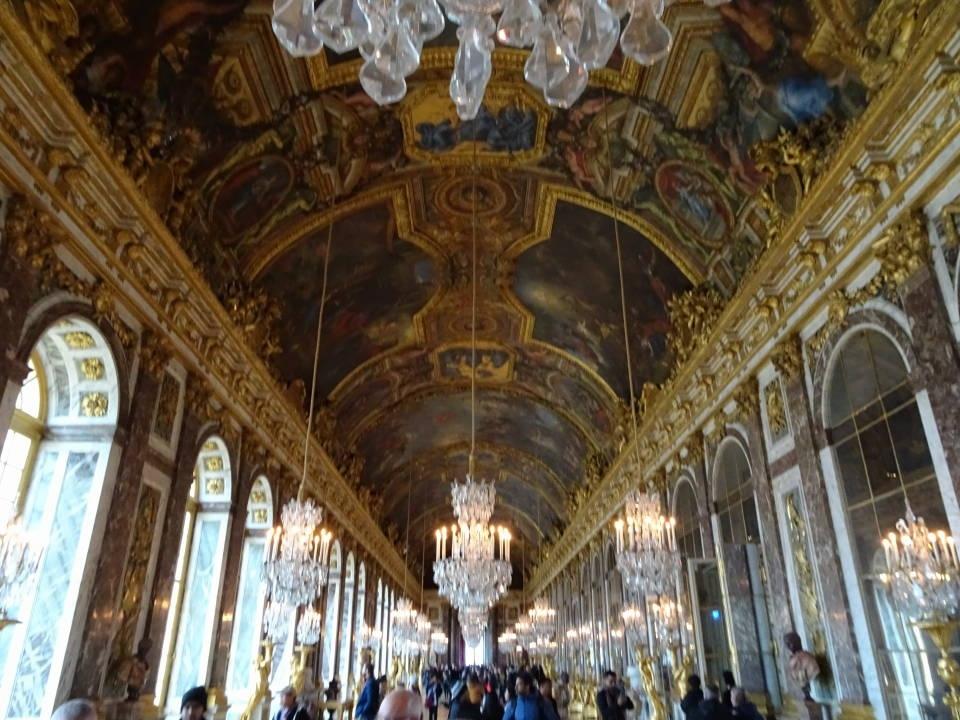
鏡の間
La galerie des Glaces
the Hall of Mirrors
Courtiers and visitors crossed the Hall of Mirrors daily, and it also served as a place for waiting and meeting. It was used for ceremonies on rare occasions, for example when sovereigns wanted an extra dash of lavishness for entertainment (balls or games) held for royal weddings or diplomatic receptions. During the latter events, the throne was placed on a platform at the end of the hall near the Peace Room, whose arch was closed off. Rarely has the show of power reached such a level of ostentation. In 1685 the Doge of Genoa and the ambassadors of Siam (1686), Persia (1715) and the Ottoman Empire (1742) crossed the full length of the gallery, under the scutiny of the French Court seated to either side on tiered seating, before they reached the king.
It was also here that the Treaty of Versailles was signed on 28 June 1919, ending the First World War. Since then, presidents of the Republic have continued to receive official guests here.(from official website) -
鏡の間
La galerie des Glaces
the Hall of Mirrors -
鏡の間
La galerie des Glaces
the Hall of Mirrors -
鏡の間
La galerie des Glaces
the Hall of Mirrors -
鏡の間
La galerie des Glaces
the Hall of Mirrors -
鏡の間
La galerie des Glaces
the Hall of Mirrors -
鏡の間
La galerie des Glaces
the Hall of Mirrors -
鏡の間
La galerie des Glaces
the Hall of Mirrors -
鏡の間
La galerie des Glaces
the Hall of Mirrors -
鏡の間
La galerie des Glaces
the Hall of Mirrors
https://galeriedesglaces-versailles.fr/html/11/collection/galerie.html -
鏡の間
La galerie des Glaces
the Hall of Mirrors
鏡の間と平行に部屋があり、そこも見学すると2回通ることに。 -
鏡の間
La galerie des Glaces
the Hall of Mirrors -
鏡の間
La galerie des Glaces
the Hall of Mirrors -
Council Study
Here, on different days, the king presided over the various Councils with his ministers as well as granting audiences and receiving oaths of loyalty.
鏡の間の裏にある部屋。 -
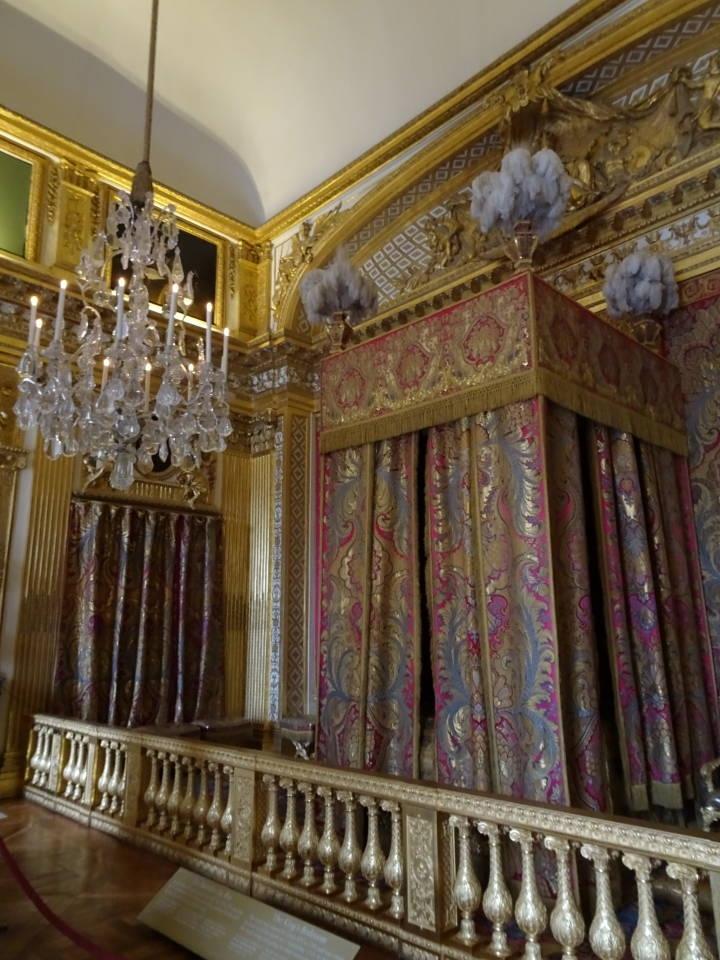
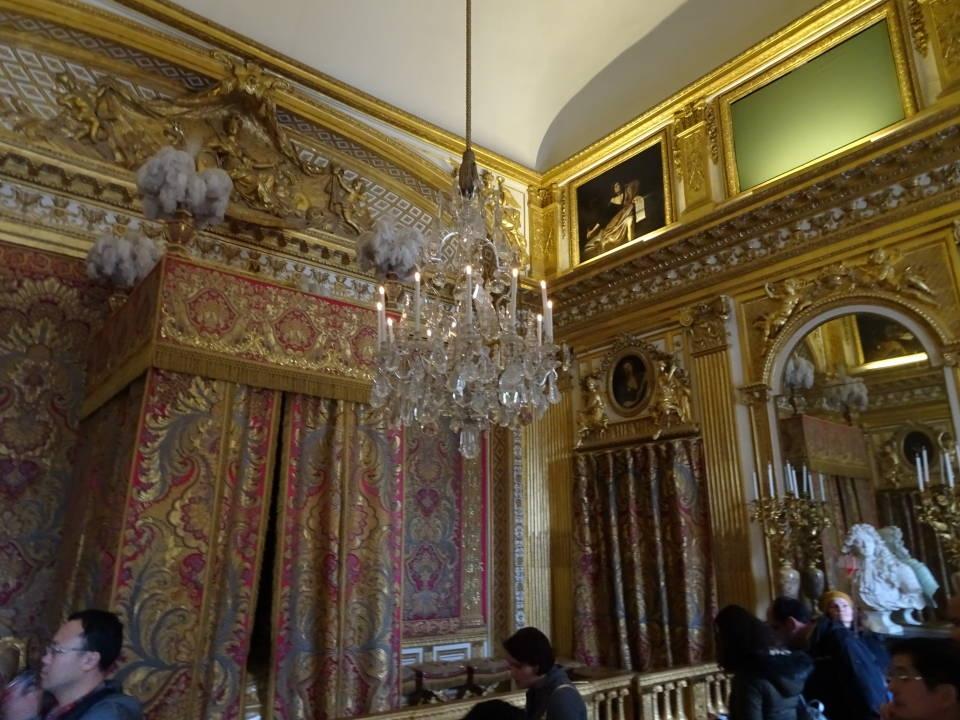
The King’s Bedroom
The room was created by Louis XIV in 1701 and was where he lived until his death on 1 September 1715. In this room the royal rising and going to sleep ceremonies took place. -
The King’s Bedroom
-
The King’s Bedroom
鏡の間は庭園に面しており、王の寝室は入り口の広間に面している。 -
The King’s Bedroom
-
The Bull's-Eye Room
This room takes its name from the oval shaped windows that are integrated into the ceiling frieze. Courtiers would wait here before being admitted into the king's bedroom. -
The Bull's-Eye Room
この窓が部屋の名前の由来か。 -
The Bull's-Eye Room
-
平和の間
Le salon de la Paix
The Peace Room
鏡の間から続く角部屋。
The Peace Room is symmetrical to the War Room and contains the same marble panel decoration and chased trophies of arms in gilded bronze. Here, however, Le Brun decorated the cupola and arches on the themes of the benefits of peace brought to Europe by France. From the beginning of Louis XIV’s reign this room was separated from the hall by a movable partition and was considered part of the Queen’s Apartment, constituting the final room after the Queen’s Chamber. During the reign of Louis XV, every Sunday Marie Leszczyńska gave concerts of religious or secular music, which played an important role in musical life in Versailles and which were continued by Marie-Antoinette during the subsequent reign. When required, the partition separating the room from the Hall of Mirrors was removed and the room formed part of the King's State Apartment.(from official website) -
平和の間
Le salon de la Paix
The Peace Room
天井画
https://galeriedesglaces-versailles.fr/html/11/collection/paix.html -
平和の間
Le salon de la Paix
The Peace Room
ここから先は女王の間になります。 -
王妃の寝室
The Queen’s Apartments, which overlook the Midi Parterre, are a series of rooms whose layout is identical to that of the King’s State Apartments to the north. Queen Maria Theresa, Louis XIV’s wife, was the first person to live in these apartments, but she died not long after moving in, in 1683. The layout of the first floor of the Palace was perfectly symmetrical, with the north belonging to the king and the south to the queen. This was soon changed, however, by the king, who decided to set aside all the rooms around the Marble Courtyard for his new apartments. The queen’s space became limited to her State Apartments ? which were modified by Marie Leszczyńska and later Marie-Antoinette ? and to a few smaller rooms for more private use situated behind the official apartments, overlooking two inner courtyards.The current tour route passes through the rooms in the opposite direction to the traditional order, since it starts in the bedchamber and ends in the Queen’s Guard Room, which originally marked the entrance to the Queen’s Apartments during the Ancien Régime.(from official website) -
王妃の寝室
the queen’s bedchamber
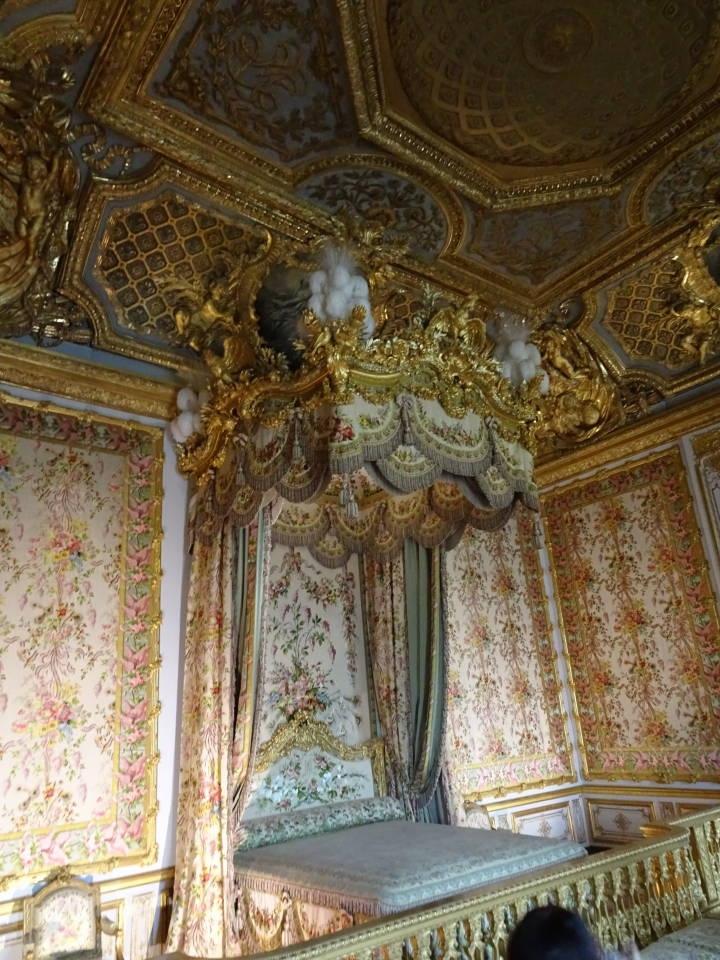
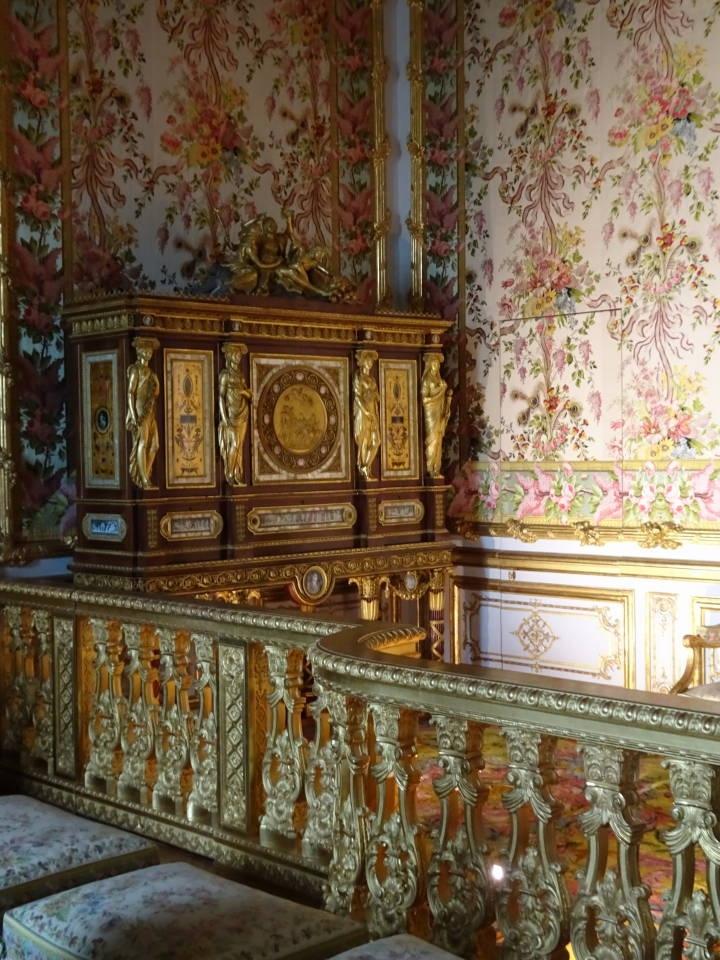
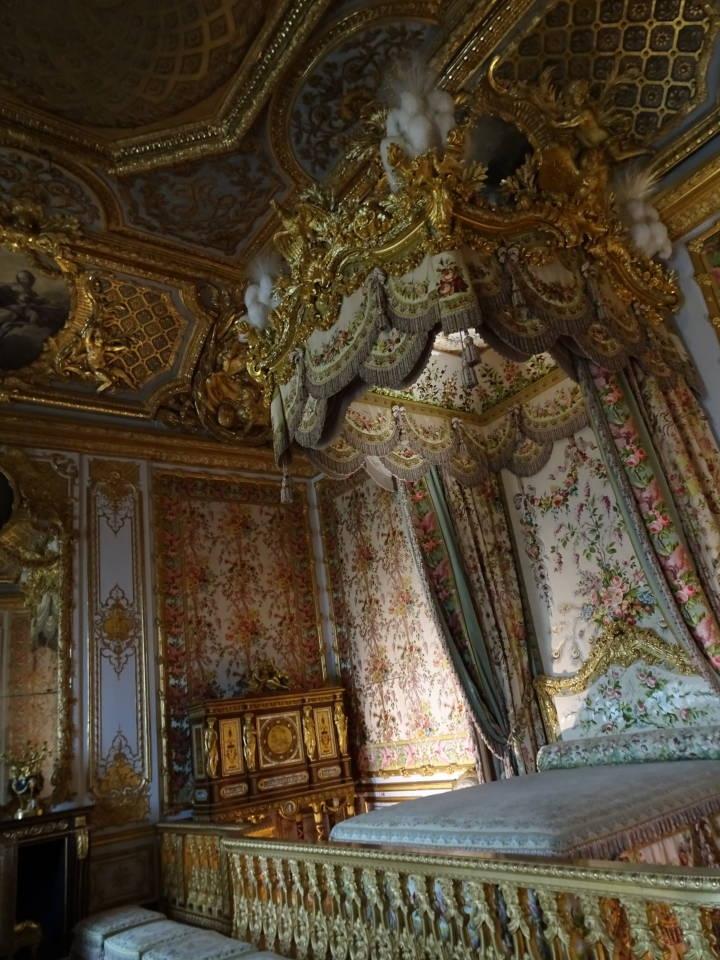
The Bedchamber is the most important room in the apartments and is where the Queen spent most of her time. It was where she slept, often with the king, and in the morning she received guests here during and after her toilette which, like the King’s getting-up ceremony, was a courtly affair controlled by strict etiquette.
It was also here that the queen gave birth, in public, to the Princes and Princesses of the Realm. The word “public”, however, is misleading, since in reality very few people were admitted to the bedchamber while the queen was giving birth. Only doctors, ladies in waiting, the governess of the Princes and Princesses of the Realm, the Princesses of the royal family and a few members of the church were allowed to enter. The rest of the Court waited in the other rooms in the Apartment, whose doors were all symbolically left open. The queen was placed on a labour bed brought in specially, and was hidden behind a screen or canvas tent. After giving birth she was placed back in her own bed while the whole court filed through to present their compliments. Nineteen Princes and Princesses of the Realm were born here between 1682 and 1786, and two queens died here: Maria-Theresa(マリー・テレーズ・ドートリッシュ、Marie Thérèse d'Autriche) in 1683 and Marie Leszczyńska(マリー・レクザンスカ) in 1768.
The decoration in the room still reflects the three queens who once occupied it. The partitions on the ceiling date back to the reign of queen Maria-Theresa, while the greyscale painting by Boucher and the wood panelling were added for Marie Leszczyńska. These elements survived the reign of Marie-Antoinette, who replaced the furniture and fireplace and put up paintings of her mother Empress Maria-Theresa and her brother, Emperor Joseph II.(from of official website)
王妃は公開出産でプライバシーはなかったとツアーガイドは説明しているみたいだけど、ここでは、「Public」に誤解を招くとちゃんと説明している。 -
王妃の寝室
the queen’s bedchamber
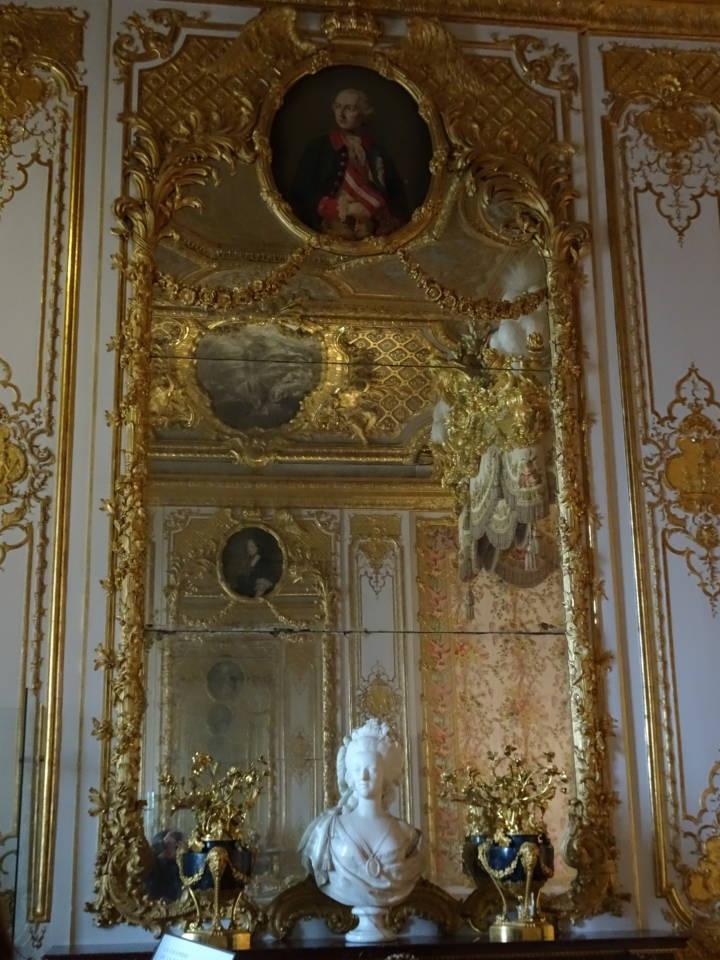
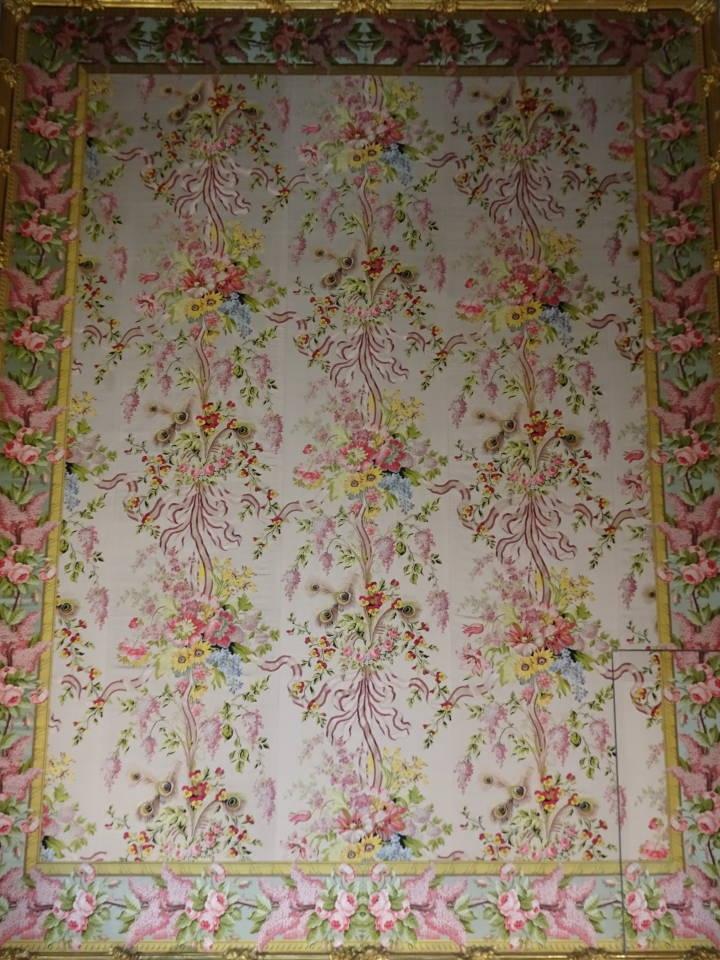
The jewellery cabinet commissioned to Schwerdfeger by Marie-Antoinette has been placed in its original position in the alcove to the left of the bed. Other pieces of furniture which were lost have been replaced by similar items, such as the sofa delivered for the Countess of Provence, the queen’s sister-in-law. The fabrics hanging on the bed and walls were re-woven in Lyon using the original patterns and the bed and balustrade have been remade using ancient documents.(from of official website) -
王妃の寝室
the queen’s bedchamber
マリーアントワネットの胸像 -
王妃の寝室
the queen’s bedchamber -
王妃の寝室
the queen’s bedchamber -
貴人の間
The nobles’ room
This room was used as a second antechamber. Queen Marie Leszczyńska held formal audiences here, seated under a canopy, as well as her Circle, the name given to the times spent in orderly conversation by the ladies of the Court. Marie-Antoinette, who was little fond of the Louis XIV style of the room, entrusted her architect Richard Mique with completely redecorating it, except for the ceiling which was kept. The walls were hung with apple-green damask bordered with a wide gold stripe. New, extremely modern and refined furniture was delivered. For example, when making the majestic commodes and corner cupboards for the room, the cabinetmaker Riesener abandoned the customary marquetry in favour of large panels of mahogany. Likewise, the gilded bronze decoration and the small tables in Bleu Turquin marble in this magnificent collection matched the decoration on the fireplace, which was also new.(from official website) -
貴人の間
The nobles’ room -
貴人の間
The nobles’ room -
貴人の間
The nobles’ room
Portrait of Louis XV in his royal costume
Pierre François Cozette 1769 - 1771 -
The royal table antechamber
Traditionally, public meals at the Royal Table, taken by the king and the royal family, were held in the Queen’s Antechamber. This lavish ceremony attracted a large number of curious onlookers. Only the members of the royal family were allowed to dine, while privileged duchesses, princesses or those holding important positions sat in front them on stools, and the other ladies and people whose rank granted them entry or who were admitted by the ushers stood around them. Louis XIV adhered strictly to this ceremonial performance almost every evening, whereas Louis XV more often preferred private dinners and Louis XVI and Marie-Antoinette only ate at the Royal Table once a week. One account at the time reported that “the King ate heartily, but the Queen didn’t even remove her gloves or unfold her serviette, which was a great mistake”. To brighten up what she considered to be a great chore, Marie-Antoinette requested that music was played during meals at the Royal Table, and a platform for musicians was installed in the room to this end.
The Queen's Royal Table Antechamber was restaured between 2009-2010 thanks to sponsorshipf from Martell & Co. (from official website) -
The royal table antechamber
-
The royal table antechamber
-
The royal table antechamber
-
The royal table antechamber
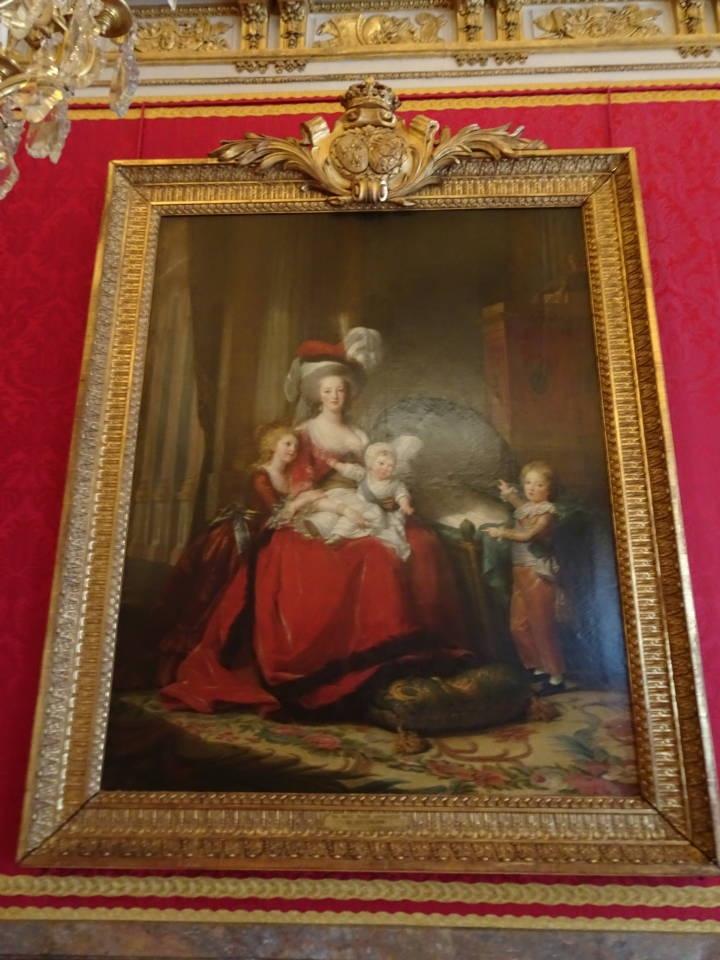
Marie-Antoinette de Lorraine-Habsbourg, queen of France, and her children
Elisabeth Louise Vigée-Lebrun 1787
In August 1787, when it was due to be exhibited publically in the Painting Salon (an annual exhibition of paintings in the Louvre on 25 August, feast day of Saint Louis), the reputation of Marie-Antoinette was so bad that the portraitist did not dare send it. She feared that the public would attack the Queen's image. The empty space inspired the famous quip "Here's the Deficit!" It was only when the administration insisted that the painting was delivered. The critics were divided: some praised "the softness of the flesh tones" and the quality of the draperies, while others thought the composition was not very successful because the portraitist was not at ease in such a large format. -
The royal table antechamber
天井画。 -
The royal table antechamber
-
The queen’s guard room
天井画 -
The queen’s guard room
Entry to the Queen’s Apartments from the Queen’s Staircase, also called the “Marble Staircase”, was controlled by the Guard Room, where 12 of the Queen’s Guards were on duty day and night. At Versailles only the king, queen and dauphin were allowed to have a personal guard composed of soldiers from the four elite companies of the King’s Guards. The large adjoining room, today called the “Coronation Room”, was assigned to them and served as a Guardhouse.
The Queen’s Guard Room is the only room in the Apartments in which the 17th-century decoration has been fully preserved, since the Queen never spent time here and there was therefore no need to modernise it. For this reason, it still contains the marble panelling characteristic of the State Apartments’ original condition, as well as the paintings which were brought here in 1680 from the old Jupiter Room, later replaced by the War Room.
It was also here that a group of rioters tried to enter the Queen’s Apartments at dawn on 6 October 1789. One of the ladies in waiting was warned by one of the queen’s guards and managed to bolt the door to the Royal Table Antechamber and help the queen hurry through to the king’s apartments via her private chambers.(from official website) -
The queen’s guard room
-
The queen’s guard room
-
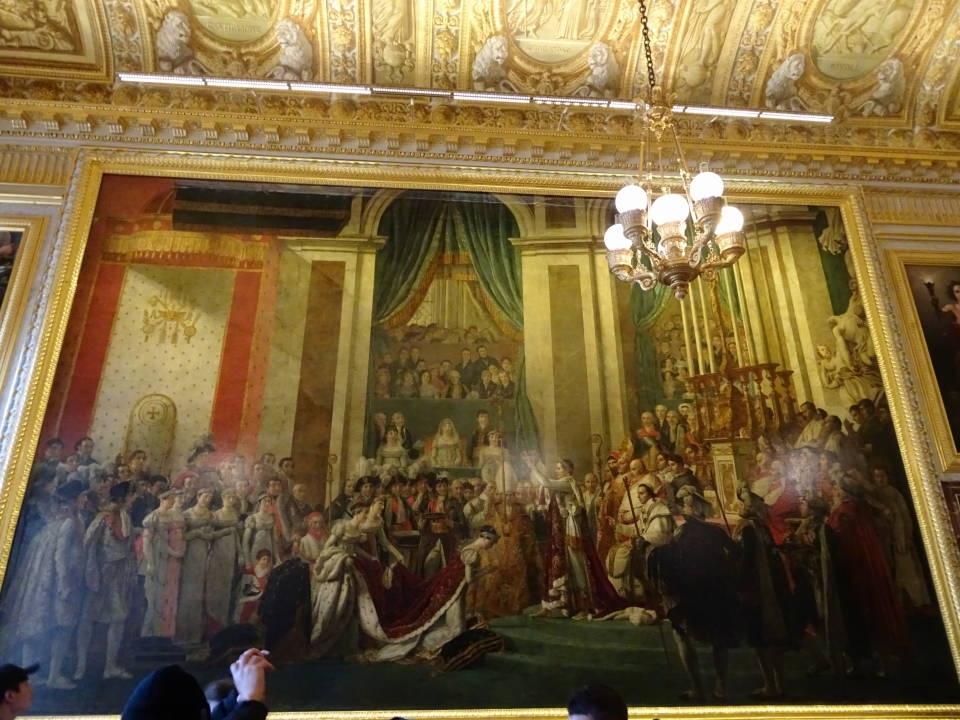
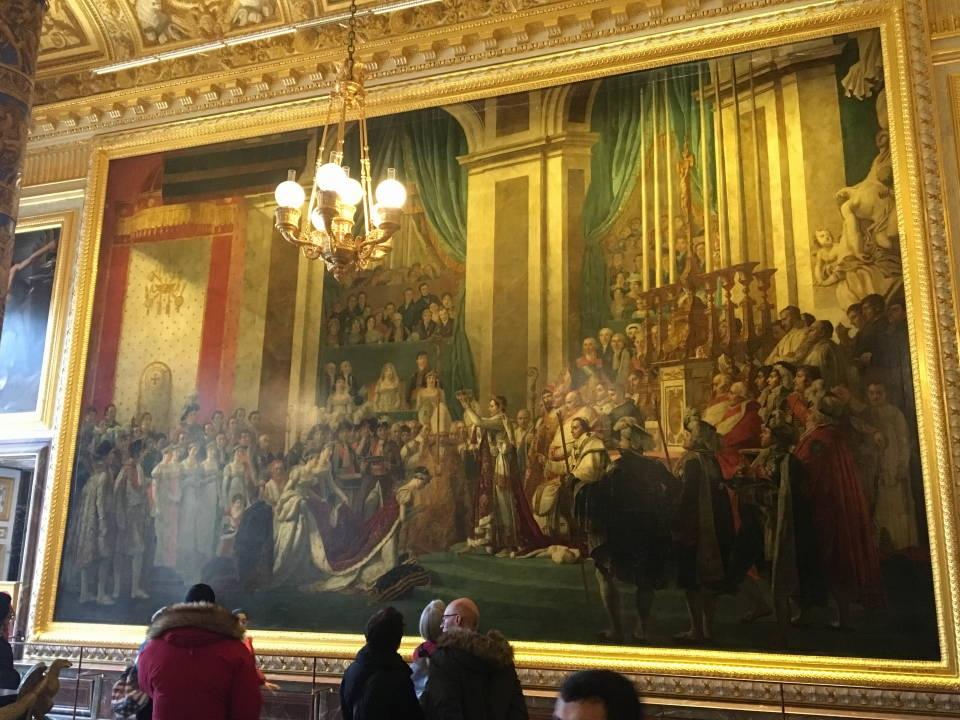
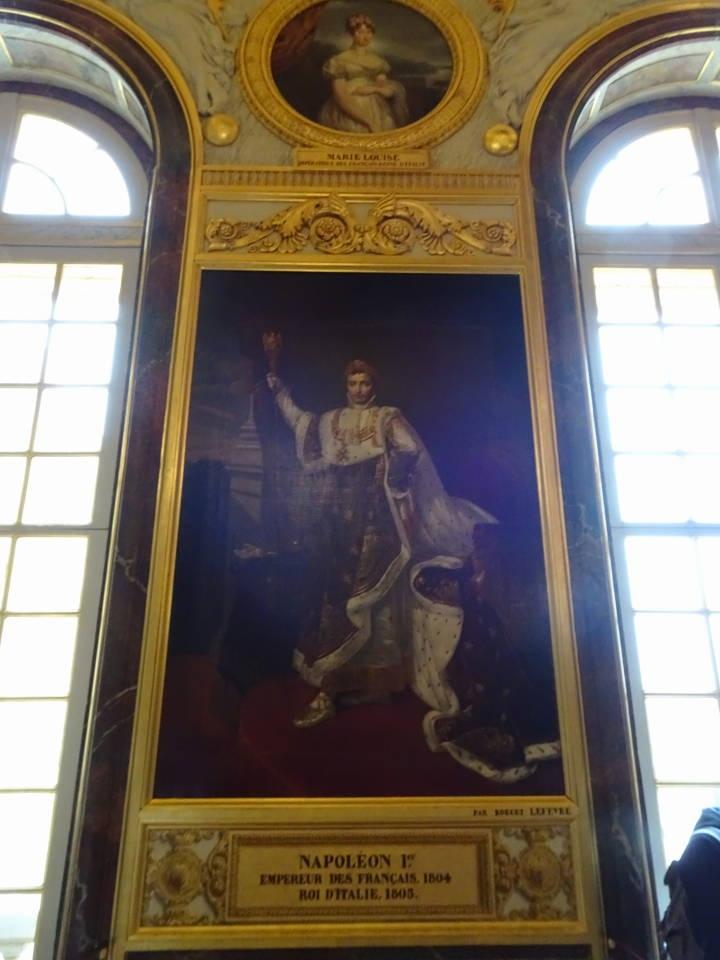
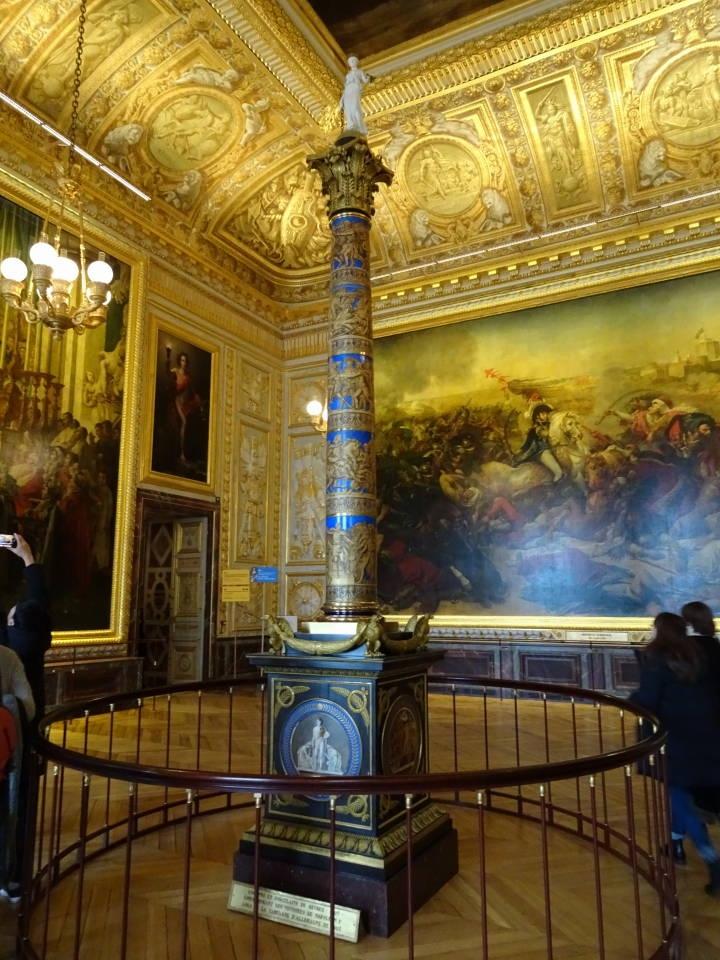
The coronation room
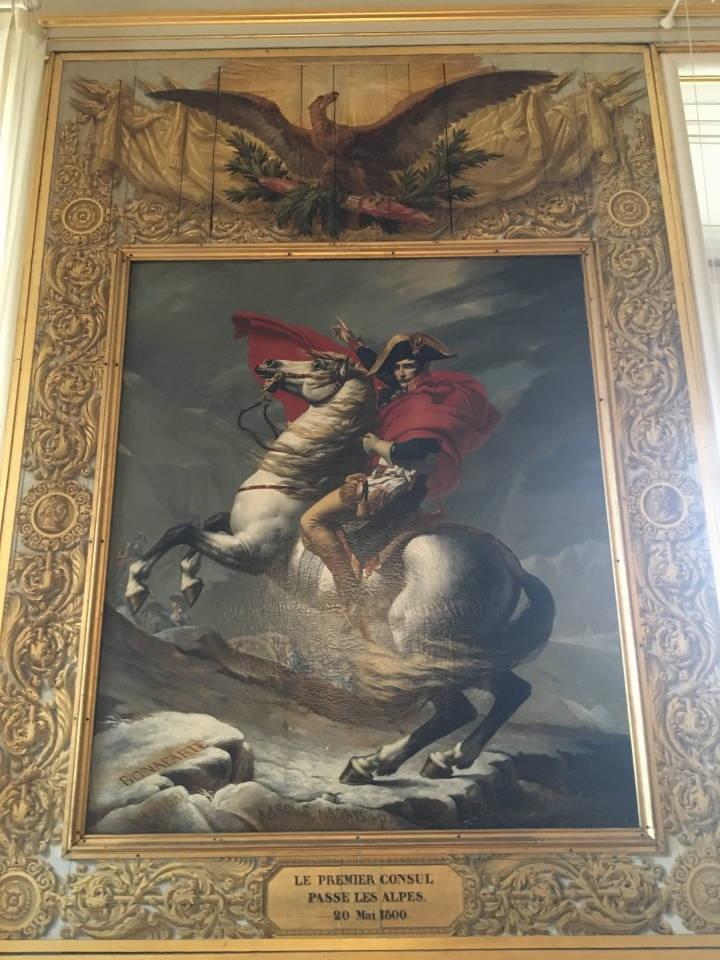
This large space adjoining the royal apartments first served as the palace’s second chapel (1672-1682), and then the Great Guard’s Room “for both the King and the Queen” (1682-1789). In 1833, it became a room devoted to the glory of Napoleon Bonaparte, First Consul and then Emperor of the French.
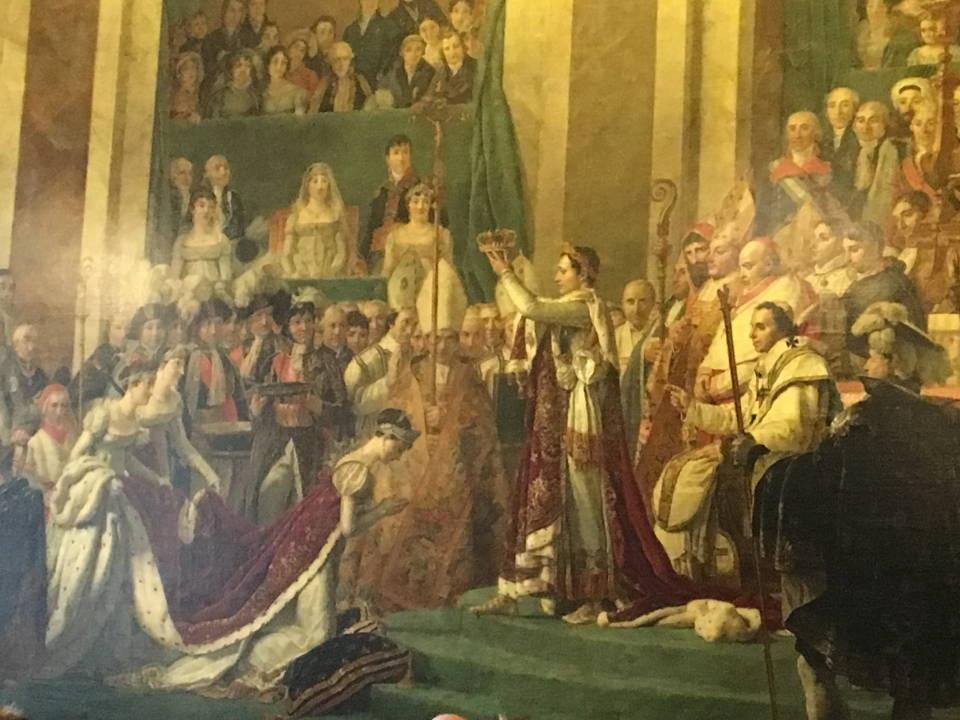
The Coronation of the Emperor and Empress
Full title : The Coronation of the Emperor and Empress, 2 December 1804
Jacques Louis David 1808-1822
Coronation at Notre-Dame de Paris, 2 December 1804. The famous painting by David of Napoleon’s coronation, which ought to be called “The Coronation of the Emperor and Empress at Notre-Dame de Paris on 2 December 1804”: a replica was painted by the master and his pupils on commission for a group of American businessmen in 1808. They hoped to organise a commercial operation by showing it to the American public in different cities, in the same way as was done in panoramas and dioramas, then very much in fashion.
about the coronation painting(デヴィッドによるレプリカ)
The Coronation, which was located in this room and actually shows the coronation of Empress Josephine, was moved from Versailles to the Louvre in Paris in 1889. It has since been replaced by a second copy that David painted in Paris and then in Brussels in 1808-1822, for a group of American businessmen. The painting was shown across the United States and Europe throughout the 19th century, before Versailles acquired it in 1947. It was placed in this room the following year, thus recreating this beautiful space as imagined by Louis-Philippe. -
The coronation room
ナポレオンの栄光の為の部屋
To the glory of the emperor
This large space adjoining the royal apartments first served as the palace’s second chapel (1672-1682), and then the Great Guard’s Room “for both the King and the Queen” (1682-1789). In 1833 it became a room devoted to the glory of Napoleon Bonaparte, First Consul and then Emperor of the French. The plan was to display the greatest paintings of his reign, which could not be placed anywhere else in the palace: the two immense paintings commissioned from Jacques-Louis David to commemorate the ceremonies celebrating Napoleon’s crowning as Emperor of the French: The Coronation of 2 December 1804 (1805-1808), and The Distribution of the Eagle Standards on 5 December 1804 (1808-1810). The decor that serves as a backdrop to these works was created thanks to the combined talents of palace architect, Frédéric Nepveu, sculptor Jean-Baptiste Plantar (trophies on the wood panelling), and the workshop of painter Jean Alaux (the ceiling arch). -
The coronation room
a napoleonic programme
In addition to David’s paintings, there is also the enormous Battle of Abukir on 25 July 1799 by Gros, commissioned by Joachim Murat, the emperor’s brother-in-law, when he was King of Naples. It commemorates one of the most memorable cavalry charges of Napoleon’s youth, during the Egypt campaign.
The room’s Napoleonic programme included other works as well: on the ceiling, the Allegory of 18 Brumaire by Callet, also called France Saved, symbolizing Napoleon Bonaparte’s seizure of power; and above the door, four allegories by François Gérard: The Warrior’s Courage, Genius Rising Despite Desire, Constancy, and Clemency Leaning on Force. -
The coronation room
Lastly, there are four portraits between the windows: General Bonaparte in Italy, by Rouillard; Napoleon I, Emperor of the French, by Alexandre Dufay, known as Casanova (a painting from that time, adapted here); and the two Empresses Joséphine and Marie-Louise, by Dedreux-Dorcy.
(と説明を切り貼りしたけど、ナポレオン以外は写真は撮っていない。) -
The coronation room
In the centre of the room stands the Column from the German Campaign, also called the “Austerlitz Column”, which Napoleon commissioned from the Sèvres Royal Porcelain Manufactory to commemorate his first imperial victories. Completed in 1807, and placed the following year in the State Apartments at the Palais des Tuileries, it is one of the masterpieces of Sèvres porcelain production during the Empire. It was created in collaboration with Brongniart (drawing), Bergeret (painting) and Thomire, Duterme and Co. (bronze mounting). -
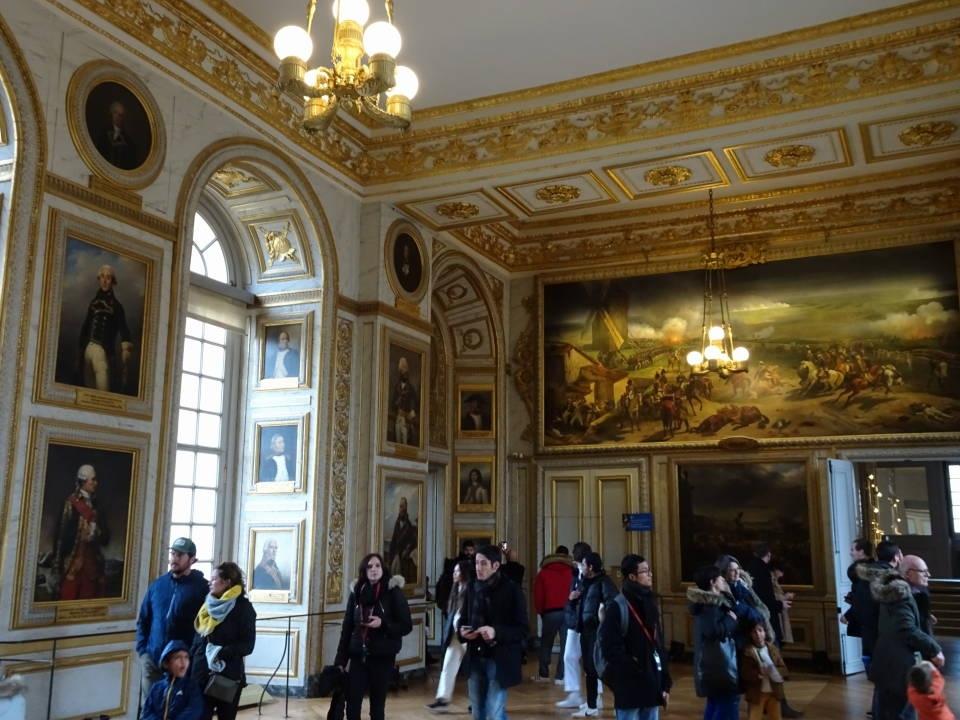
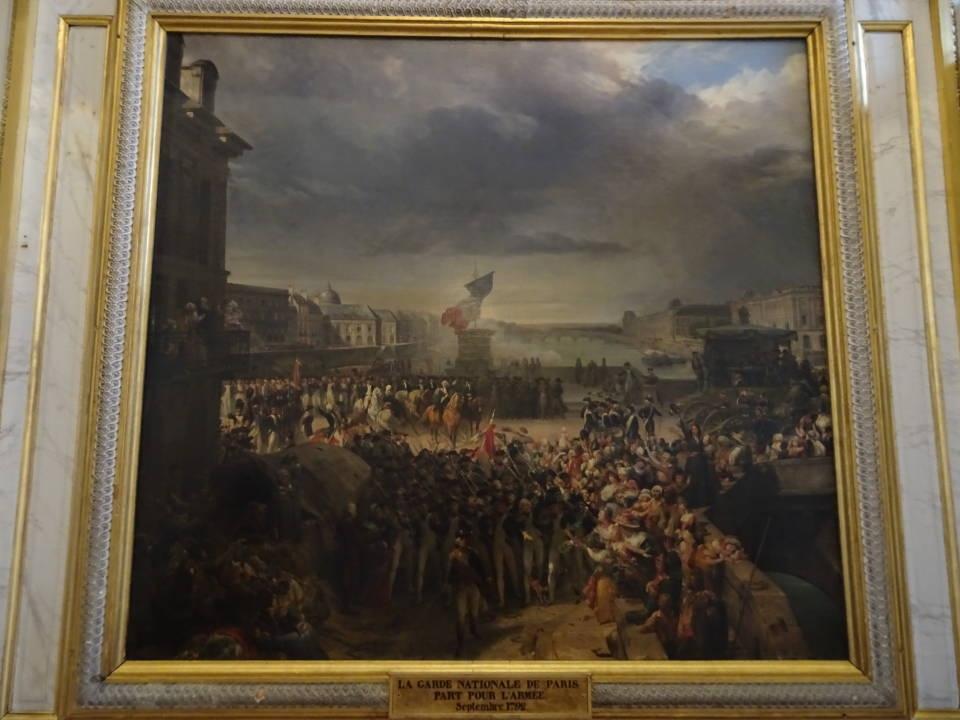
The 1792 room
As the only remnant of the rooms Louis-Philippe devoted to the French Revolution, the 1792 Room offers the keys to understanding the king’s political and historic project.
a transition room
As the only remnant of the rooms that Louis-Philippe devoted to the French Revolution, the 1792 Room offers the keys to understanding the king’s political and historic project. It marks both the end of a world ? the French monarchy fell on 10 August 1792 ? and the beginning of a new era full of hopes as well as worries. The European monarchies were united against France, which found within itself the driving forces that would unite to defend it. -
The 1792 room
Cogniet, The National Guard of Paris Leaves to Join the Army in September 1792 -
The 1792 room
Bataille de Jemmapes, 6 novembre 1792 -
さて、次の展示へ向かいます。
-
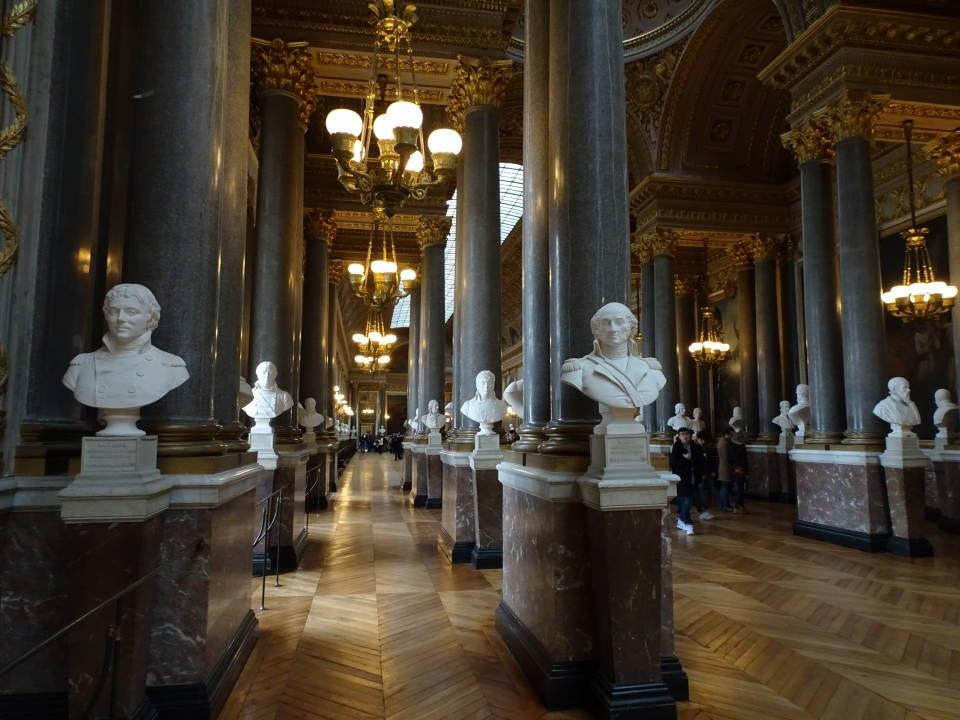
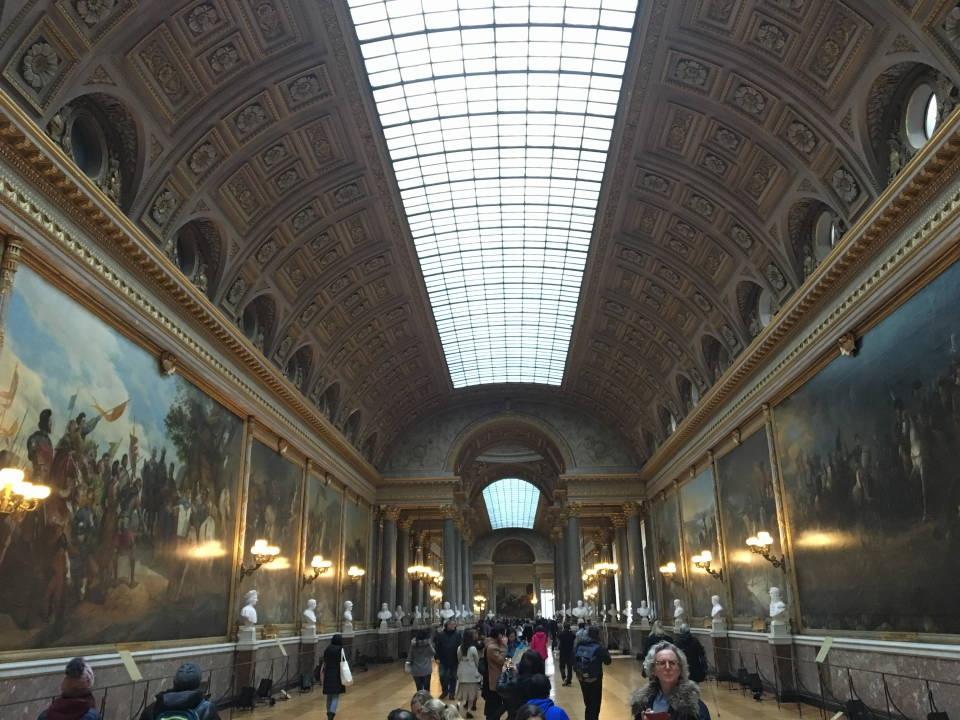
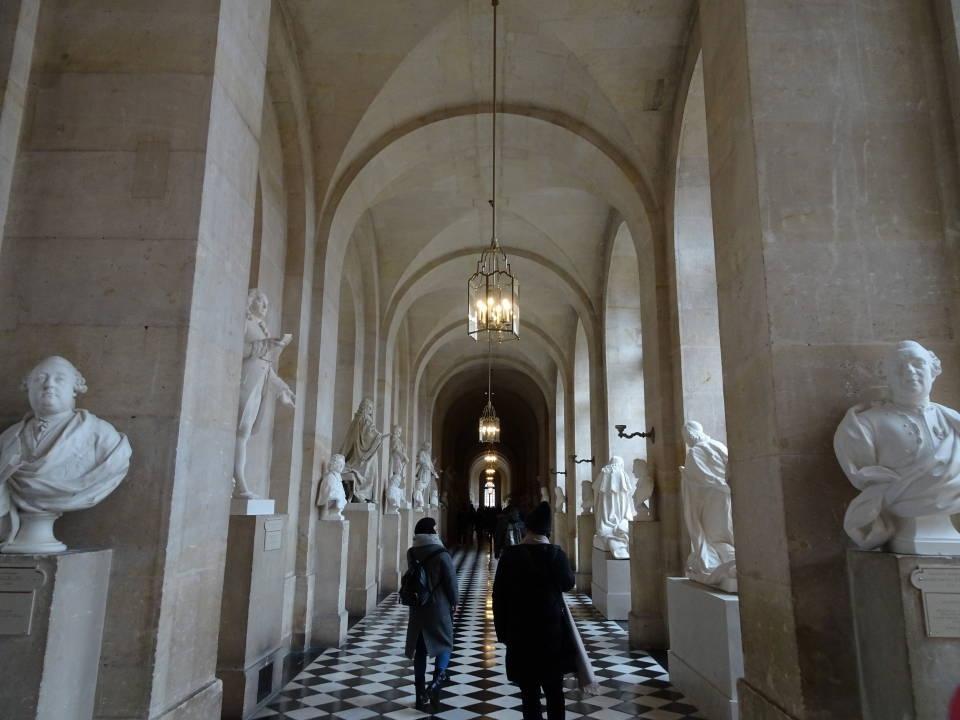
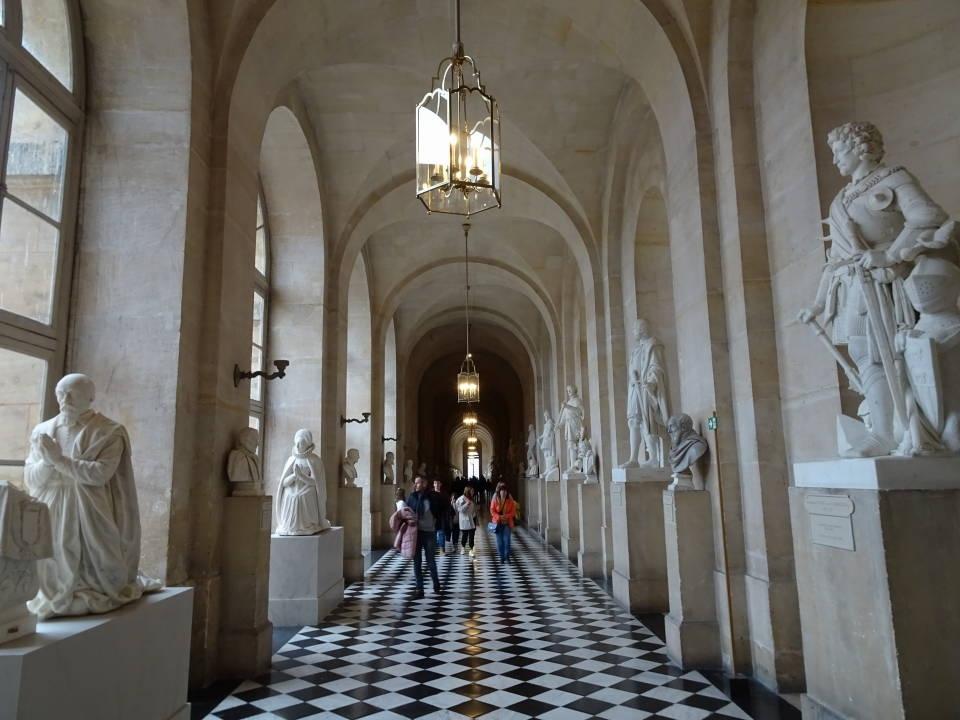
The Gallery of Great Battles
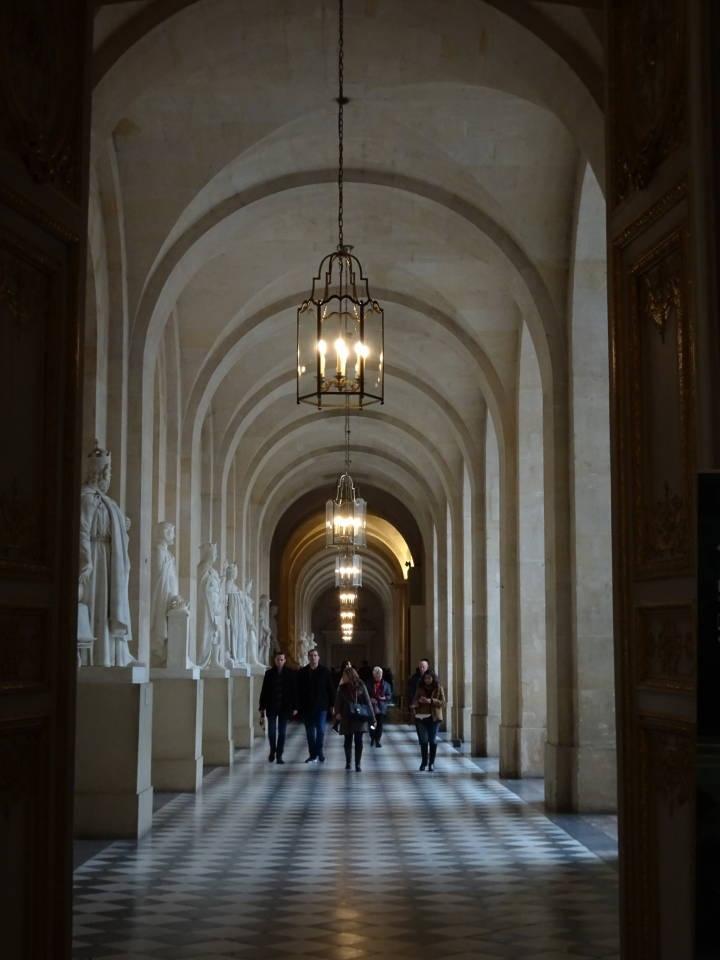
うーん、戦争の歴史。 -
トルビアックの戦い
The Battle of Tolbiac, 496 (1837)
According to tradition, Clovis, the king of the Franks(481-511), defeated the Alamans at Tolbiac(today, Zulpich, near Cologne) in 496. As the enemy gained the upper hand and all seemed lost, he gazed skyward, invoked the name of the god his wife Clotilde worshipped and promised to convert to Christianity if he won the battle. He did, and the victorious king led his troops to Reims to have himself baptised there with them.
Clovis's conversion symbolises the timeless bond between the Church and the French monarchy.
クロヴィスは、メロヴィング朝フランク王国の初代国王(在位481年 - 511年)である。クローヴィス1世の表記が用いられる。クローヴィスは一夫多妻制の生活を送っていたが、妻の1人であった王妃クロティルドの影響で、キリスト教アタナシウス派(カトリック教会)に改宗して、これを保護したのでガリアでの布教活動に大きな貢献があった。
サリー・フランク族の王キルデリク1世を父、その妻バシナを母としてトゥルネー(現ベルギー領)で生まれた。当時は現代のフランス・ベルギー国境付近のトゥルネー、カンブレーを中心とするライン川低地西部を占めていたに過ぎなかった。
クローヴィスは481年頃に父の地位を継承した。486年までの5年間については何も分かっていない。486年にはガリア北部を支配していたソワソン管区のシアグリウスをソワソンの戦いで破り、版図を一挙にロワール川北部に拡大、ローマ属州ベルギカ・セクンダを支配下に治めた。さらにクローヴィスは妹のアウドフレドを東ゴート王国のテオドリックに嫁がせて同盟を固め、493年にはブルグント王国の王女クロティルドとソワソンで結婚した。
496年から497年にかけて、トルビアックの戦いでアラマンニ人に勝利した後、王妃クロティルドの薦めでカトリックに改宗した。ニカイア派キリスト教徒たるクローヴィスは、受洗によりカトリック信仰に依拠する権力保持者の一人となった。この改宗はゲルマン民族諸王の中で初めて行われたカトリックへの改宗であった。一方、西ゴート族やヴァンダル族はすでにキリスト教に改宗していたが、その宗派はアリウス派であった。当時のガリア住民は大部分カトリックであったため、クローヴィスのカトリック改宗はガリア領内のローマ市民との絆を強化するものであった。496年から502年までの間に改宗する洗礼をおこなった。(Wikiより) -
ヴァグラムの戦い
Bataille de Wagram
Battle of Wagram
ヴァグラムの戦い(1809年7月5日-7月6日)は、ナポレオン戦争における戦闘の1つ。ウィーン北東15キロメートルにあるドナウ川北岸の町ヴァグラムの周辺地域で、皇帝ナポレオン1世率いるフランス軍と、カール大公率いるオーストリア軍とが戦った。フランス軍18万、オーストリア軍15万という大軍同士が激突し、合わせて7万以上の死傷者を出した。戦いはフランス軍が勝利し、オーストリアはシェーンブルンの和約を結んで屈服した。(wikiより) -
ブーヴィーヌの戦い
Bataille de Bouvines
The Battle of Bouvines, 27 July 1214 (1827)
On Sunday 27 July 1214, Philippe-Auguste(1180-1223) was preparing to fight a coalition comprising England's king John Lackland and the counts of Flanders and Boulogne. According to one tradition, adter the mass preceding the battle several barons cast doubt on his legitimacy. Then Philippe-Auguste laid his crown on the altar, defying one of them to pick it up if he felt more worthy to wear it. Instead, they acclaimed him. Charles X commissioned this painting, which predates the July Monarchy, for the Council of State rooms in the Louvre.
フランス王フィリップ2世率いるフランク諸侯連合軍が、神聖ローマ皇帝オットー4世率いるドイツ・イングランド連合軍をフランドルとフランスの境近くのブーヴィーヌで破った戦いである。
1214年初頭、勢力を拡大しつつあったフランス・フィリップ尊厳王に対抗するべく、ローマ皇帝オットー4世・イングランド王ジョン・フランドル伯フェラン・ブローニュ伯ルノー1世(英語版)・ブラバント公アンリ1世・オランダ伯ウィレム1世・ロレーヌ公ティボー1世・リンボルフ公ヘンドリク3世といった多くのドイツ・フレマン・イングランドの諸侯が集結した。この連合の目的は、フィリップ2世が在位初期ごろに征服した地域をフランス支配から解放することであった。
フランスの勝利により、イングランド・フレマン人らの失地回復の希望は見事に打ち砕かれた。オットー4世はこの戦いでの敗北で皇帝としての威厳を完全に失ってしまい、教皇インノケンティウス3世から破門宣告を受け、ローマ皇帝の座から引き摺り下ろされた。(その後ローマ皇帝の座にはホーエンシュタウフェン家出身のフリードリヒ2世が就任した。)ジョン王はこの戦いでの敗北でアンジュー地方を放棄せざるを得なくなり、シノンの和約(英語版)によって平和裏にフランス王フィリップ2世に引き渡された。この条約なよってアンジュー帝国は崩壊した。またこのブーヴィーヌでの惨劇により、これまでイングランド王ジョンに不満を抱いていた諸侯らの反発が爆発し、1215年にはマグナ・カルタにより国王の私権を制限するに至った。フランドル伯フェランとソールズベリー伯ウィリアム・ロンゲペーはフランス側に捕虜として捕まり監禁された。そして、西洋におけるパワーバランスが大きく変動し、13世紀ごろ、教皇はフランスの軍事的パワーを頼るようになった。フィリップ2世のこの戦いでの勝利は、自身の直轄地を拡大に繋がり、結果ヨーロッパ中にフランス王家の名声を轟かせる下地を作っただけでなく、フランスにおける絶対君主制の下地を形成し、アンシャン・レジームの形成にも繋がった。(wikiより) -
The Battle of Tailleboug, 21 July 1242
Eugène Delacroix、ウジェーヌ・ドラクロワ(1837)
After 1240 Louis IX -Saint Louis(1226-1270) - pacified his kingdom by defeating his rebellious vassals, in particular the Poitevin barons backed by England's King Henry III and led by Hugues de Lusignan, Comte de La Marche. On 21 July 1242 he confronted them at Taillebourg, on the banks of the Charente(シャラント川). Joinville's account vaunts the bravery of the king, who risked losing his life or his freedom by leading his men into battle.
The battle of Taillebourg, which no artist before Delacroix(Eugène Delacroix、ウジェーヌ・ドラクロワ) had ever depicted, is one of his masterpieces, outstanding for the truthfulness of the action, dramatic emotion and lush colours.
ルイ9世(Louis IX, 1214年4月25日 - 1270年8月25日)は、フランス王国カペー朝第9代の国王(在位:1226年 - 1270年)。ルイ8世とカスティーリャ王アルフォンソ8世の娘ブランシュの子。死後、カトリック教会より列聖され、ここから、Saint-Louis(サン=ルイ)と呼ばれるようになった。これは日本語では聖ルイあるいは聖王ルイと訳される。アメリカの都市、セントルイス(ミズーリ州)の地名の由来ともなった(セントルイスは、Saint-Louisを英語読みしたもの)。ブルボン家の先祖でもあり、同家の王の多くがルイを名乗るのも彼に由来すると思われる。
内政に力を入れ長期の平和を保ったため、彼の治世の間、フランス王国は繁栄した。国内外を問わず、争いを収めるよう努力したためヨーロッパの調停者と呼ばれ、高潔で敬虔な人格から理想のキリスト教王と評価されている。ただ、宗教的情熱から2回の十字軍を行ったが、莫大な費用を費やし、自身も捕虜となるなど散々な負け戦を喫し、失敗に終わった挙句、陣没した。
ポワチエの反乱
ポワチエのラ・マルシェ伯ユーグ10世・ド・リュジニャンは、父ユーグ9世の元婚約者でイングランド王ジョンの未亡人だったイザベル・ダングレームと再婚していた。イザベラはイングランド王ヘンリー3世の母であり、イングランドでは王太后扱いを受けていた。しかし、ルイ9世の弟ポワチエ伯兼トゥールーズ伯アルフォンスへの「臣従の誓い」の際に単なる臣下の妻として扱われた為、これを侮辱だと激怒し、夫と息子ヘンリー3世を扇動して、1241年にポワチエで反乱を起こさせた。
しかし、ルイ9世が鎮圧を始めると配下の城は次々と降伏し、これを見たイングランド諸侯はヘンリー3世を見捨てて勝手に帰国した。ユーグ10世夫妻は降服したが、比較的寛大な条件で許されている。ヘンリー3世は大陸に所有していたガスコーニュを占領されたが、以前失っていたノルマンディーやアンジューを正式に放棄する代わりに、ガスコーニュの領有を認められるという寛大な条件で和解した。
1243年にはアラゴン王ハイメ1世も含めて和平協定が結ばれ、以降、ルイ9世の在位中、フランス国内外の平和は続く。(wikiより) -
Joan of Arc Entering Orleans, 8 May 1429 (1843)
King Charles VII(シャルル7世) received Joan of Arc(ca.1412-1431) at Chinon on 6 March 1429 before she went to Orleans, which ws besieged by the English and seemed lost. Completely devoted to her divine mission of liberating the kingdom, she and a few companions reached Orleans in a rowboat, entering the town on 29 April 1429. Joan sparked a revival of resistance and the English lifted the siege on 8 May.
ぱっと題名を読んでこれがジャンヌダルクのことと分かるかな。フランス語だと、Jeanne d'Arc(ジャンヌ・ダルク)、英語だとJoan of Arcになる。
ジャンヌ・ダルク(1412年ごろ1月6日 - 1431年5月30日)は、15世紀のフランス王国の軍人。フランスの国民的ヒロインで、カトリック教会における聖人でもある。「オルレアンの乙女」(フランス語: la Pucelle d'Orléans/英: The Maid of Orléans)とも呼ばれる。
現在のフランス東部に、農夫の娘として生まれた。神の啓示を受けたとしてフランス軍に従軍し、イングランドとの百年戦争で重要な戦いに参戦して勝利を収め、のちのフランス王シャルル7世の戴冠に貢献した。
ジャンヌは、王太子シャルル(後のシャルル7世)を助けてイングランドに占領されていたフランス領を奪還せよという神の「声」を聞いたとされている。これを信じた王太子は、イングランド軍に包囲されて陥落寸前だったオルレアンへとジャンヌを派遣し、オルレアン解放の任にあたらせた。オルレアンでは古参指揮官たちから冷ややかな態度で迎えられたが、わずか9日間で兵士の士気を高めることに成功したジャンヌは徐々にその名声を高めていった。そしてジャンヌは続く重要ないくつかの戦いの勝利にも貢献し、劣勢を挽回した。結果、王太子はランスでフランス王位に就くことができフランス王シャルル7世となることができた。
その後ジャンヌはブルゴーニュ公国軍の捕虜となり、身代金と引き換えにイングランドへ引き渡された。イングランドと通じていたボーヴェ司教ピエール・コーションによって「不服従と異端」の疑いで異端審問にかけられ、最終的に異端の判決を受けたジャンヌは、19歳で火刑に処せられてその生涯を終えた。ジャンヌが死去して25年後に、ローマ教皇カリストゥス3世の命でジャンヌの復権裁判が行われた結果、ジャンヌの無実と殉教が宣言された。その後ジャンヌは1909年に列福、1920年には列聖され、フランスの守護聖人の一人となっている。フランスを救い、シャルル7世の戴冠に貢献したことから、ジャンヌは西洋史上でも有名な人物の一人となった。ナポレオン1世以降、フランスでは派閥を問わず、多くの政治家たちがジャンヌを崇敬しているといわれる。世界的に著名な作家、映画監督、作曲家たちがジャンヌを主題とした作品を制作している。(wikiより) -
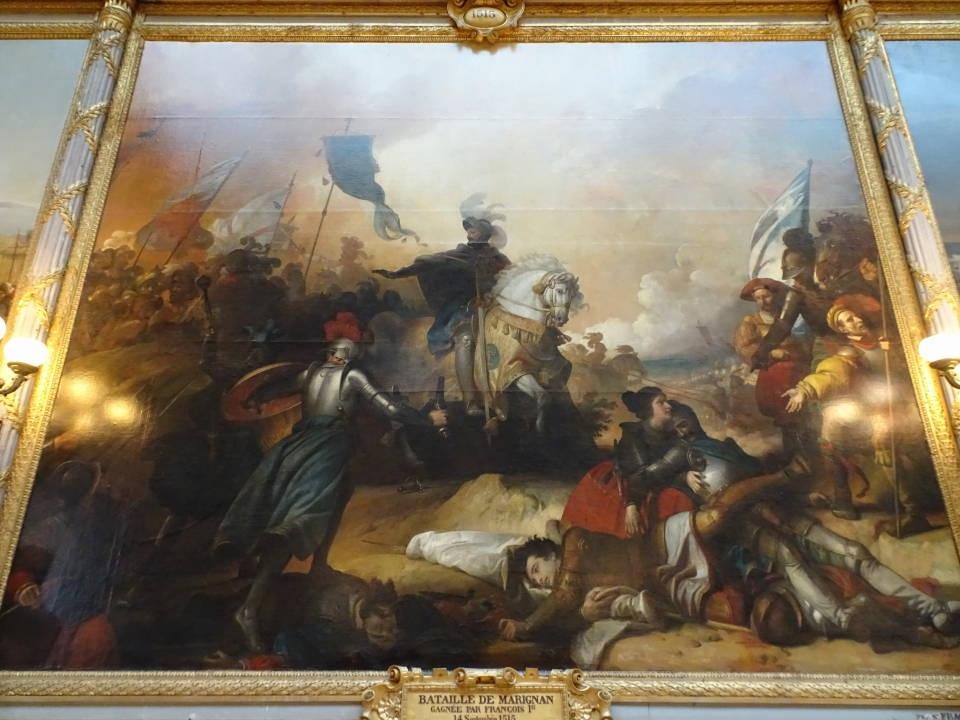
マリグナンの戦い、1515年9月14日(マリニャーノの戦い)
アレクサンドル・エヴァリステ・フラゴナール(Alexandre Evariste Fragonard)
1833年
フランシス1世。 -
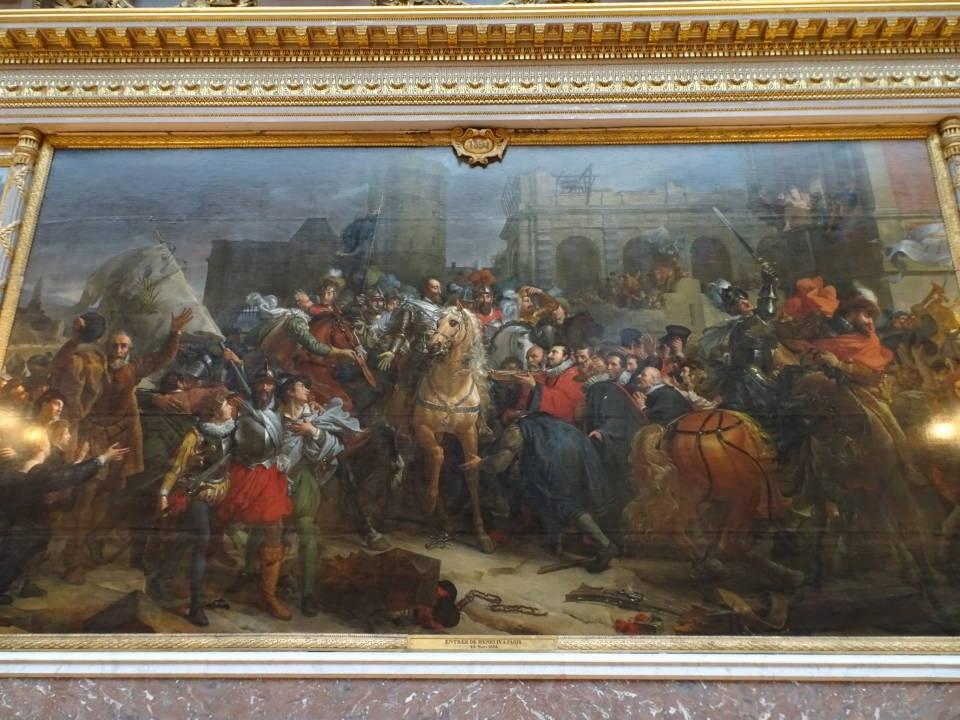
アンリ4世のパリ入城(ユグノー戦争)
Entrée d'Henri IV à Paris, 22 mars 1594
François Gérard(フランソワ・ジェラール) (1817)
アンリ4世(1553年12月13日 - 1610年5月14日)は、ブルボン朝初代のフランス国王(在位:1589年8月2日 - 1610年5月14日)、およびナバラ国王エンリケ3世(在位:1572年6月9日 - 1610年5月14日)。
ユグノー戦争で叔父コンデ公ルイが戦死したため、年少にしてユグノーの盟主となる。1572年、自身の婚礼に際して企てられたサン・バルテルミの虐殺に遭遇したが、カトリックに改宗して難を避け、1576年に脱走して再びプロテスタントに復帰し、1589年のアンリ3世の暗殺により王位を継承する。その後再度カトリックに改宗して国内を平定し、1598年にナントの勅令を発布してカトリックとユグノーとの国内融和に努め、40年近くにわたる戦争を終結させた。戦後は戦争によって疲弊した国家の再建を行ったが、1610年に狂信的なカトリック信者によって暗殺された。在位中から現代に至るまでフランス国民の間で人気の高い王の一人で、大アンリ(Henri le Grand)、良王アンリ(le bon roi Henri)と呼ばれる。1959年から発行された50フラン紙幣において肖像が採用されていた。(Wikiより) -
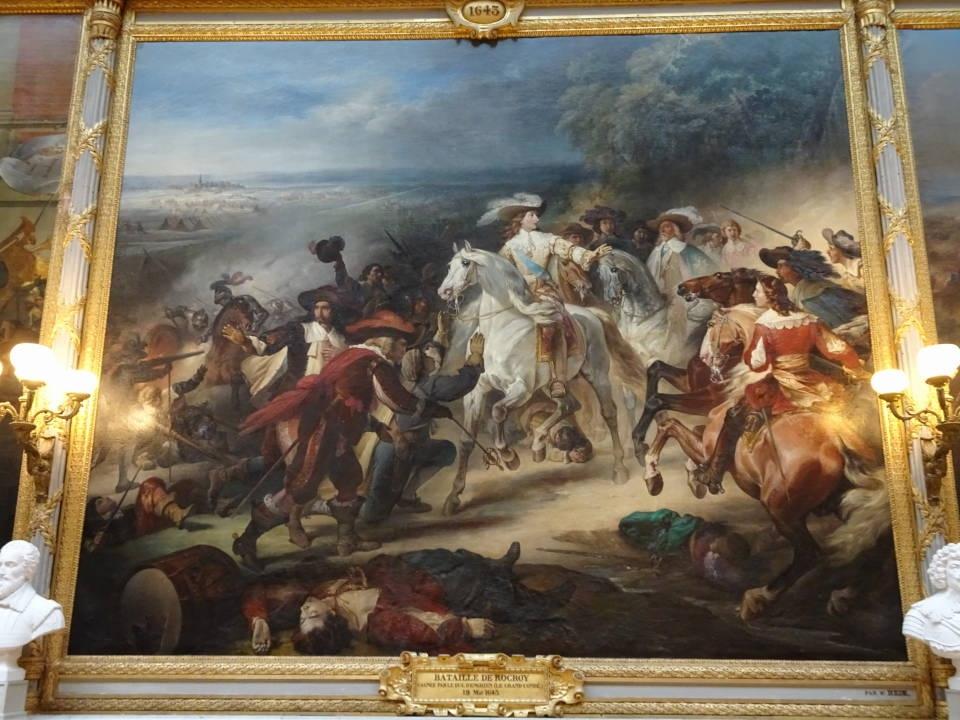
ロクロワの戦い(30年戦争)
Bataille de Rocroy 19 Mar 1643
The Battle of Rocroi
François Joseph Heim(フランソワ=ジョゼフ・エイム) 1834年
ロクロワの戦いは、三十年戦争中の1643年5月19日、フランドル(南ネーデルラント)からパリに向かっていたフランシスコ・ダ・メルロ率いるスペイン軍とアンギャン公ルイ2世率いるフランス軍によって、北フランスの町ロクロワ付近で行われた戦い。(wikiより) -
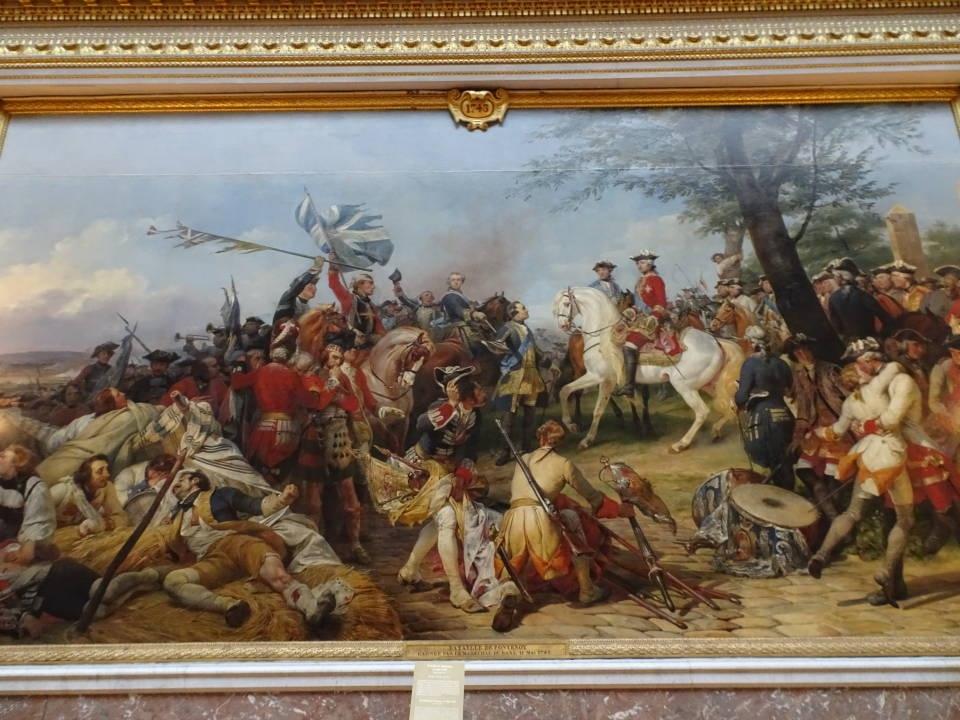
フォントノワの戦い(オーストリア継承戦争)
Bataille de Fontenoy
The Battle of Fontenoy, 11 May 1745
Émile Jean-Horace Vernet(エミール・ジャン=オラース・ヴェルネ) (1827)
Disagreement over who should succeed the Austrian emperor CHarles VI, who died in 1740, plunged Europe into war. Louis XV(1715-1774) tried settling the dispute with diplomacy but entered the conflict in 1744 as the Austrian Dutch and English coalition threatened France's territorial integrity on the Rhine and in Flanders. The French, under the command of Marechal de Saxe(モーリス・ド・サックス) and in the king's presence, won the Battle of Fontenoy, the main event in the 1745 campaign and in the Austrian War of Succession(1740-1748).
フォントノワの戦いは、1745年5月11日に行われたオーストリア継承戦争における会戦である。フランス軍と、イギリス、ネーデルラント連邦共和国(オランダ)、オーストリアの連合軍が戦い、フランス軍が勝利した。フォントノアの戦い、フォントネーの戦いの表記も見られる。この戦いは当時の戦争における雰囲気をよく伝えるエピソードで知られ、歴史の中でしばしば引き合いに出される。(wikiより) -
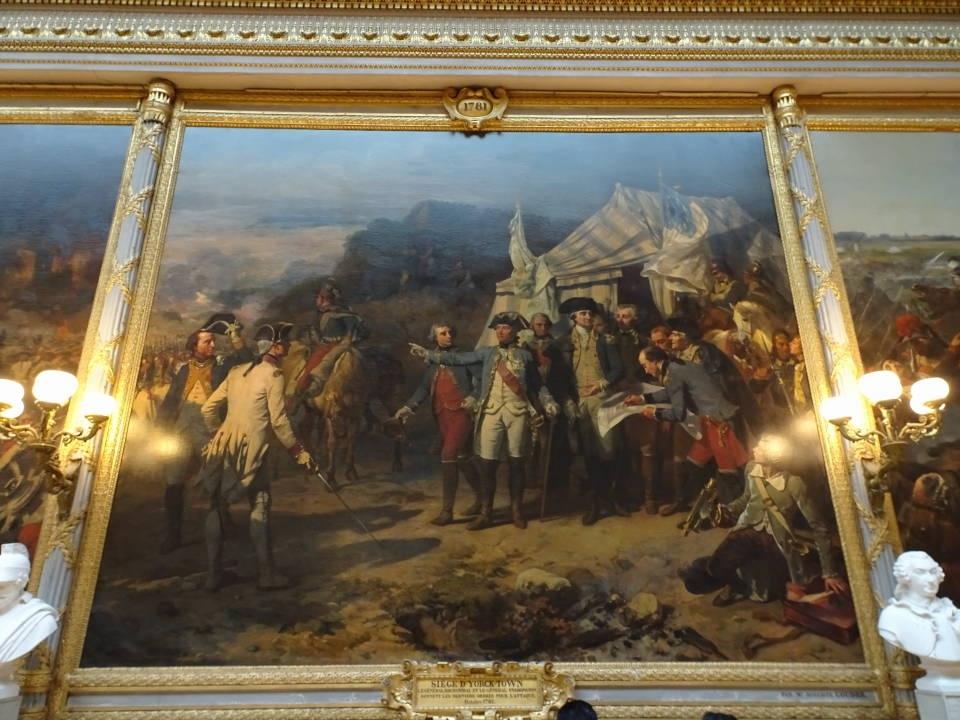
ヨークタウン包囲(アメリカ独立戦争)
The Siege of Yorktown, October 1781
(1836)
IN 1776 Benjamin Franklin went to Paris and convinced France to help the United States in their war of independence with England. In October 1781 the combined forces of Rochambeau, Admiral de Grasse and Washington, the French and American troops' commanders-in-chief, took Yorktown(6-19 October 1781), led the British to surrender. Two years later England signed the Treaty of Versailles recognising the independence of the United States of America.
ヨークタウンの戦いは、1781年に起こった、アメリカ独立戦争を事実上終結させた決定的な戦闘。バージニア植民地東岸のグレートブリテン王国(イギリス)軍最終拠点であったヨークタウンにて、米仏連合軍がチャールズ・コーンウォリス率いるイギリス軍約7,000を包囲、降伏させた。この戦いによって、アメリカ独立戦争における植民地軍の勝利は確定し、独立戦争は事実上の終結を見た。 -
The Gallery of Great Battles
-
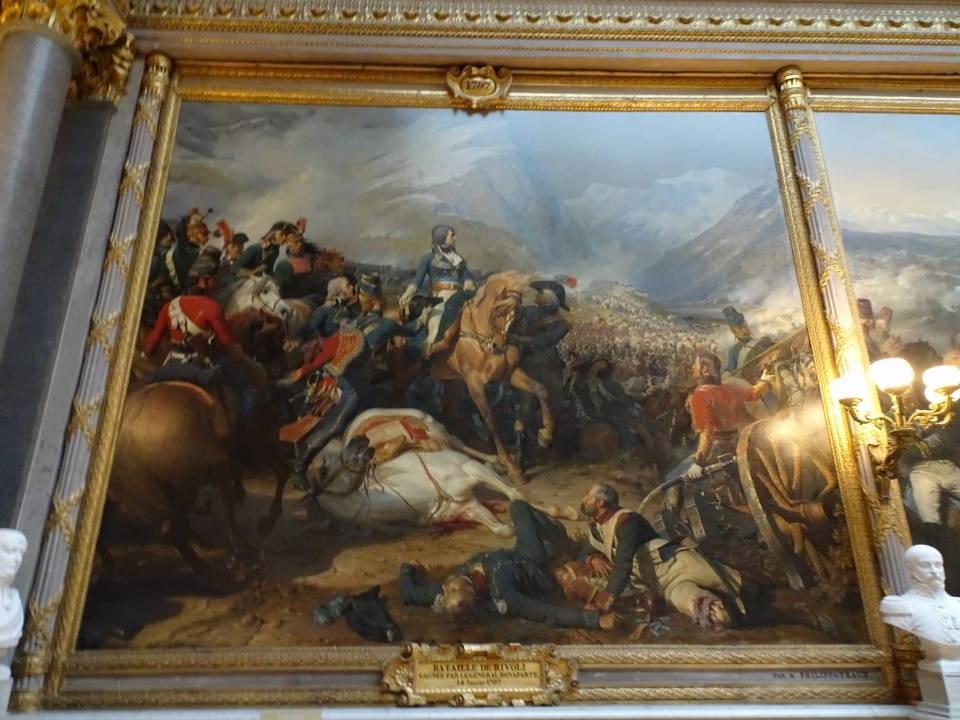
リヴォリの戦い(イタリア戦役(1796-1797年)、フランス革命戦争)
Bataille de Rivoli
The Battle of Rivoli, 14 January 1797
Henri Félix Emmanuel Philippoteaux
アンリ・フェリックス・エマニュエル・フィリッポトー(1844)
The battle of Rivoli in northern Italy was, with the Battle of the Pont d'Arcole, young General Bonaparte's most illustrious victory after being appointed commander-in-chief of the army for the liberation of Lombardy. In defeating General Alvinzi, the Austrian army's commander, he drove Austria out of Lombardy. In this work, Philippoteaux created the archetype of the remote, transfigured hero figures as well as one of the most famous images in the Napoleonic legend.
リヴォリの戦いは、イタリア戦役において、フランスがオーストリアに対して決定的な勝利を得た、1797年1月14日から15日の戦いである。ナポレオン・ボナパルト率いるフランス軍2万3千はヨーゼフ・アルヴィンツィ将軍率いる2万8千のオーストリア軍の攻撃を退け、ここに、包囲されたマントヴァを解放しようというオーストリアの4度目の試みは潰えた。リヴォリはナポレオンの栄光にさらなる輝きを与え、フランスによる北イタリア占領に道を開いた。 -
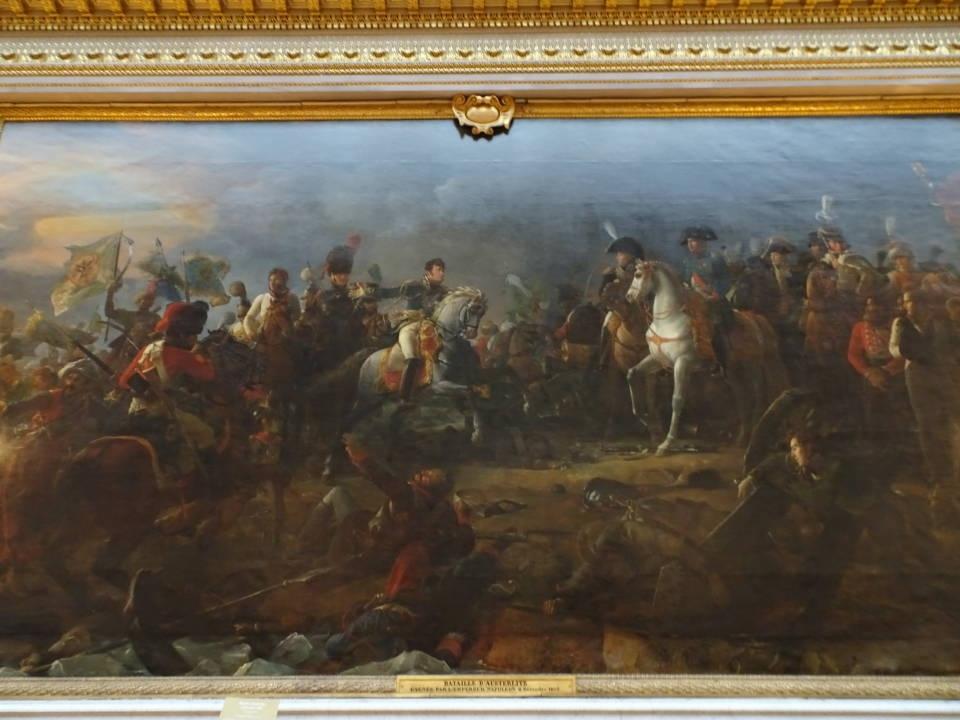
アウステルリッツの戦い
Bataille d'Austerlitz
The battle of Austerlitz, 2 December 1805
François Pascal Simon, Baron Gérard(フランソワ・ジェラール) 1810年
The painting celebrates France's victory at the <<Battle of the Three Emperors>>(French, Austrian and Russian), the climax of the campaign against Russia and Austria, which took place at Austerlitz(today, in the Czech Republic) on 2 December 1805. The victory, ratified by the Treaty of Presbourg on 26 December, spelled the end of Third Coaliation and soon led to the Holy Roman Empire's downfall.
The painting was commissioned in 1806 and installed at the Tuileries Palace. It is among Francois Gerard's greatest masterpieces and one of the most popular images of the Napoleonic epic, reproduced and commented upon countless times.
アウステルリッツの戦いは、1805年12月2日にオーストリア領(現チェコ領)モラヴィアのブルノ近郊の町アウステルリッツ(現在のスラフコフ・ウ・ブルナ)郊外で、ナポレオン・ボナパルト率いるフランス軍(大陸軍)が、ロシア・オーストリア連合軍を破った戦いである。
フランス皇帝ナポレオン1世、オーストリア皇帝フランツ1世(神聖ローマ皇帝フランツ2世)、ロシア皇帝アレクサンドル1世の3人の皇帝が参加したことから三帝会戦とも呼ばれる。なお、実際にはフランツ2世は戦場から離れた場所にいた。
1805年、オーストリアはロシア、イギリスなどと第三次対仏大同盟を結成し、バイエルンへ侵攻した。ナポレオン率いるフランス軍はウルムの戦いでオーストリア軍部隊を降伏させ、11月13日にウィーンへ入城した。フランツ1世はモラヴィアへ後退し、アレクサンドル1世とクトゥーゾフの率いるロシア軍と合流した。
ナポレオンもドナウ川を渡ってモラヴィアへ進出し、アウステルリッツ西方へ布陣した。そのころ、いまだイタリア方面にはカール大公のオーストリア軍部隊がほぼ無傷で残っており、これらの部隊が集結する前にロシア・オーストリア連合軍主力を叩く必要があった。そこでナポレオンは、敵の攻撃を誘うため、罠を仕掛けた。
ナポレオンの戴冠式から1周年の記念日にあたる1805年12月2日午前8時、ロシア・オーストリア連合軍約85,000はアウステルリッツ西方のプラツェン高地へ進出し、優勢な兵力をもってフランス軍への攻撃を開始した。
フランス軍は73,000と劣勢であった。またその布陣は、後方との連絡線確保のうえで重要な右翼(南側)が手薄であった。アレクサンドル1世はこれを好機とみて、主力をプラツェン高地からフランス軍右翼へと向かわせた。フランス軍右翼を守るダヴーの第3軍団は攻撃に耐え切れずに押し下げられたかに見え、さらに多くの連合軍部隊がフランス軍の陣前を横切ってフランス軍右翼へ殺到した。
だが、ナポレオンは、手薄になった連合軍の中央部にニコラ=ジャン・ド・デュ・スールトの第4軍団を突入させた。中央を守っていたクトゥーゾフはロシア近衛軍団を投入し、フランス軍と激戦を繰り広げたが、ベルナドットの第1軍団の援護とナポレオンによる近衛隊の投入によってプラツェン高地の連合軍は突破された。中央突破に成功したスルト軍団は、ダヴー軍団と協力して、フランス軍右翼へ殺到していた連合軍部隊を挟撃した。夕刻までに、連合軍は15,000人の死傷者と多数の捕虜を出し、散り散りになって敗走した。
12月26日、オーストリアはプレスブルクの和約を締結してフランスへ屈服し、第三次対仏大同盟は崩壊した。フランツ2世は神聖ローマ皇帝位から退位。神聖ローマ帝国は解体され、ドイツにはライン同盟が成立した。
アウステルリッツの戦いとそれまでの戦役はヨーロッパ政治の性格を大きく変えた。3ヶ月間でフランス軍はウィーンを占領し、2カ国の軍隊を打ち破り、オーストリア帝国を屈服させた。アウステルリッツの戦いは10年近くに及ぶフランスによるヨーロッパの覇権を容易にしたが、より直接的な影響は翌1806年の対プロイセン戦役である。 -
The Gallery of Great Battles
-
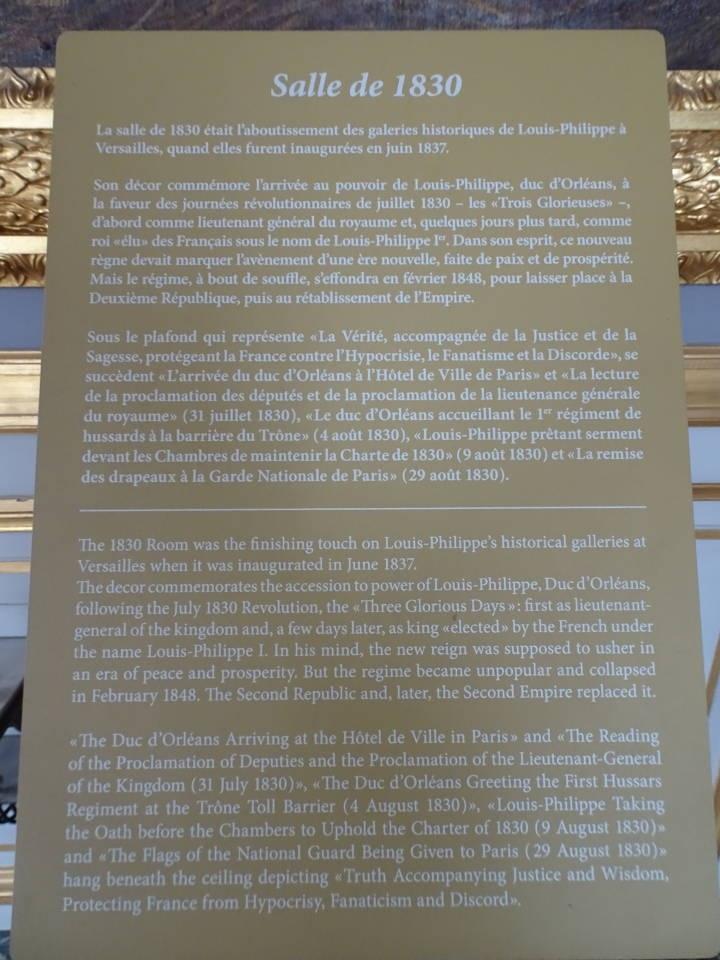
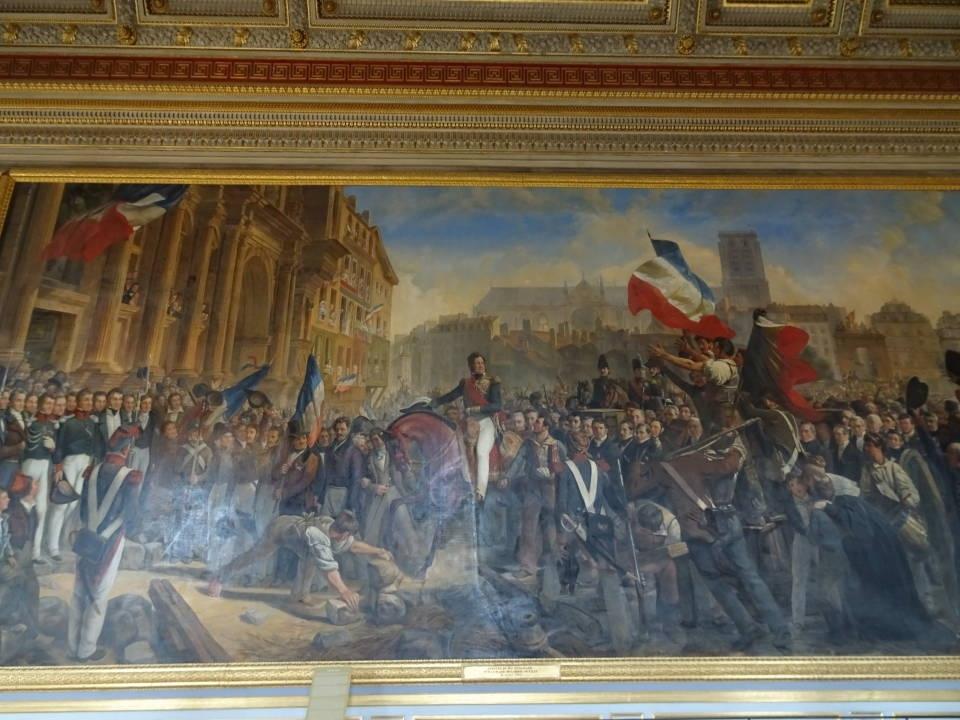
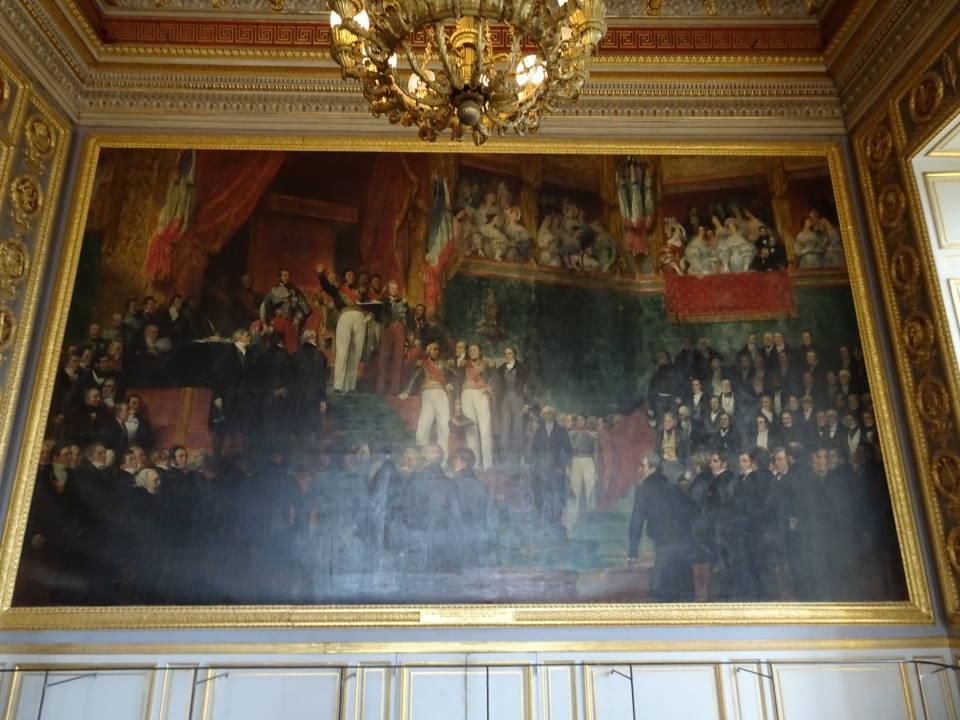
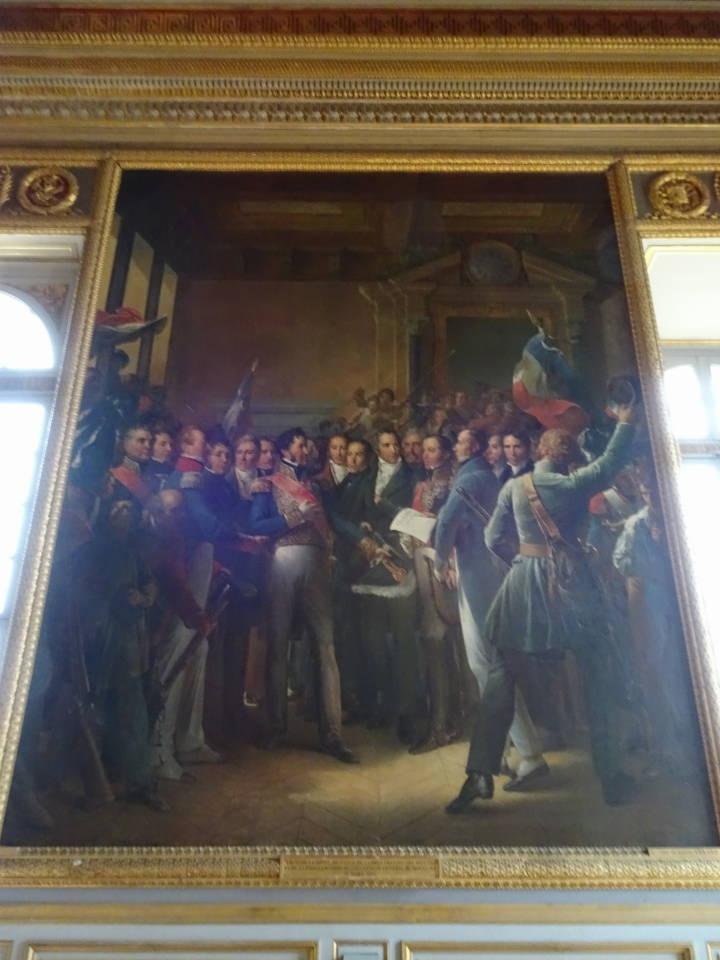
The 1830 Room
Salle de 1830
フランス7月革命は、1830年7月27日から29日にフランスで起こった市民革命である。フランスでは栄光の三日間(仏: Trois Glorieuses)とも言う。
これにより、1815年の王政復古で復活したブルボン朝は再び打倒された。ウィーン体制により構築された正統主義は部分的に崩壊し、ブルジョワジーの推すルイ・フィリップが王位に就いた。その影響はヨーロッパ各地に波及し、ウィーン体制を揺るがせた。 -
The 1830 Room
Salle de 1830 -
The 1830 Room
Salle de 1830 -
The 1830 Room
Salle de 1830 -
The 1830 Room
Salle de 1830 -
-
-
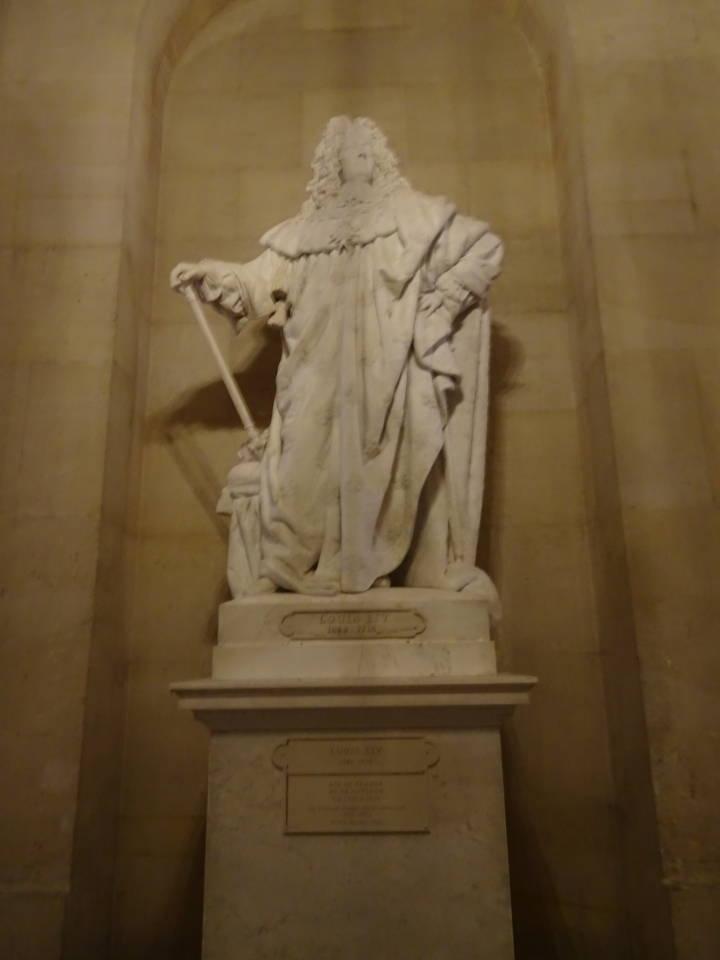
ルイ14世
-
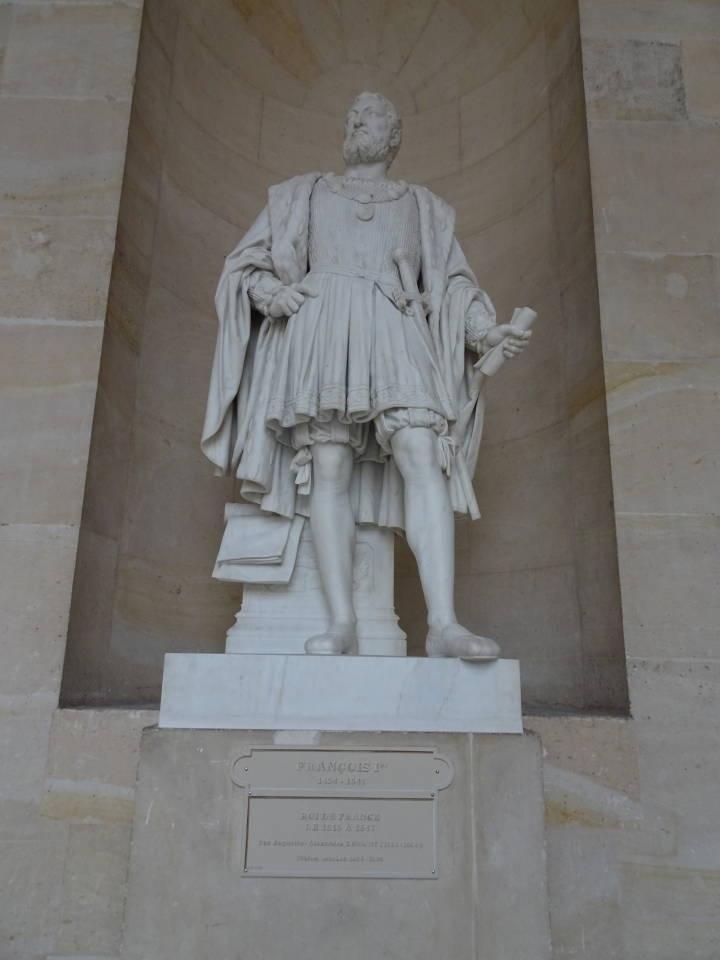
フランシス1世
-
-
ナポレオン
この後は庭園を散策します。


![ヘラクレスの部屋<br />Hercules Room<br /><br />天井画。「ヘラクレスの栄光」。フランソワ・ルモワーヌ作<br />The first salon of the King's Grand Apartment, the Hercules salon was created at the end of Louis XIV's reign. The works on the Hercules salon lasted until 1736, when Francois Lemoine completed the painting of the vault depicting the Apotheosis of Hercules, which was supposed to show that "Virtue raises man above himself". This vast allegorical composition with 142 figures aimed to rival the masterpieces of the Italian fresco painters but it was painted on primed canvases, i.e. glued onto the support. The work was so exhausting that the young painter, despite the success of his work, committed suicide shortly afterwards.<br /><br />Francois Lemoine(フランソワ・ルモワーヌ)<br />パリでフランス王室の御者の息子に生まれた。父親が亡くなった後、母親が画家のロベール・ル・ヴラック・ド・トゥルニエール(Robert Le Vrac de Tournières)と再婚したことから、美術の道に進むことになった。13歳の1701年に、王立絵画彫刻アカデミーに入学し、ルイ・ガローシュ(Louis Galloche: 1670-1761)に学んだ。1713年までガローシュのもとで学び、後年は助手として働いた。1711年にローマ賞を受賞した。1718年にアカデミーの会員になった。1723年になって、イタリアを旅し、ボローニャ、ローマ、ナポリ、ヴェネツィアを旅しフランスに戻った。パリでスタジオを開き、ルモワーヌが教えた画家には、フランソワ・ブーシェやシャルル=ジョゼフ・ナトワール、ドナシャン・ノノットらがいた。1728年、ヴェルサイユ宮殿の一室の天井画の依頼を王室から受け、1733年から1736年まで取り組み、その作品は賞賛を受けた。1733年に王立絵画彫刻アカデミーの教授に任じられ[1] 、1736年に、国王の筆頭画家に任命された。<br />その翌年の1737年、パリで自殺した。理由は、過剰な仕事量や、王室画家たちの中での軋轢、妻の死や不安定な性格、芸術的完成度を達成できないことへの欲求不満など、さまざまに推測されている。剣で、胸と喉を合計9回刺したと伝えられている。(wikiより)](https://cdn.4travel.jp/img/tcs/t/pict/src/74/15/97/src_74159763.jpg?1663586700)















利用規約に違反している投稿は、報告する事ができます。
コメントを投稿する前に
十分に確認の上、ご投稿ください。 コメントの内容は攻撃的ではなく、相手の気持ちに寄り添ったものになっていますか?
サイト共通ガイドライン(利用上のお願い)報道機関・マスメディアの方へ 画像提供などに関するお問い合わせは、専用のお問い合わせフォームからお願いいたします。
something like thatさんの関連旅行記
パリ(フランス) の旅行記



パリ(フランス) の人気ホテル


フォートラベル公式LINE@

おすすめの旅行記や旬な旅行情報、お得なキャンペーン情報をお届けします!
QRコードが読み取れない場合はID「@4travel」で検索してください。
\その他の公式SNSはこちら/
0
136